
Ed Davey Says Nigel Farage as PM Could Lead to a Rise in School Shootings: The Extraordinary Political Clash Over Guns, Trump and Britain’s Future
Sir Ed Davey has launched one of his most dramatic attacks yet on Nigel Farage, warning that a Reform UK government could put Britain on a path towards the kind of gun violence associated with the United States.
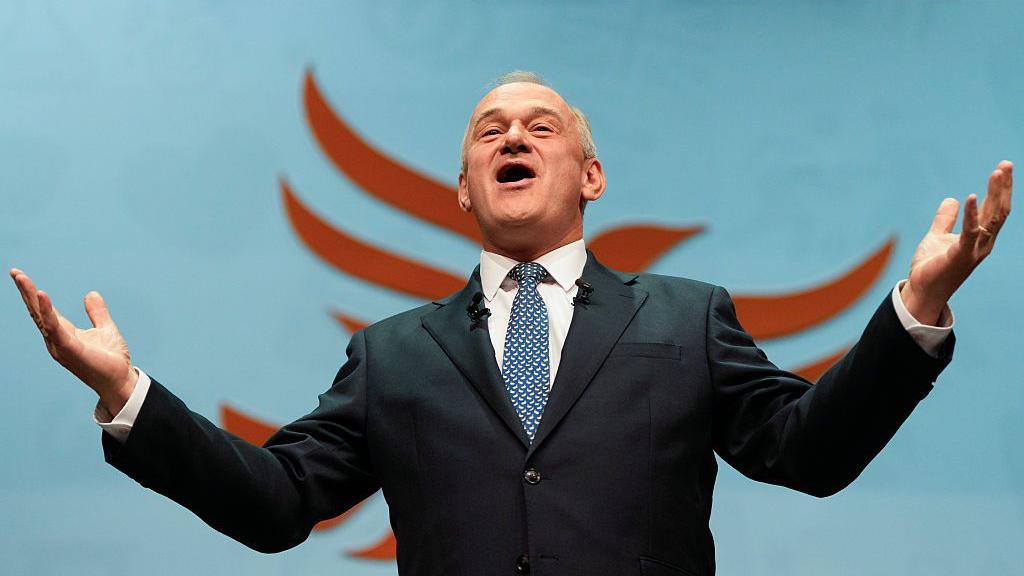
Speaking at the Liberal Democrat conference in Bournemouth in September 2025, Davey painted a deeply alarming picture of what he called a “Trump-inspired” Britain under Farage. Among his claims was that a Reform government could roll back gun laws to such an extent that schools might eventually have to prepare children for mass shootings.
The accusation immediately provoked a furious response from Reform.
And there is an important complication at the heart of the controversy: Reform UK did not have a policy of relaxing Britain’s gun laws.
Davey’s argument instead relied heavily on comments Farage made more than a decade earlier, when he was leader of UKIP and criticised the handgun restrictions introduced following the 1996 Dunblane massacre.
That distinction is central to understanding the political row.
Davey’s Extraordinary Warning
Davey’s speech was not a conventional policy disagreement.
He attempted to present a possible Farage premiership as a fundamental threat to Britain’s existing political and social model.
The Liberal Democrat leader described a hypothetical future in which Britain would become more like the United States under Donald Trump.
Among the scenarios he presented was a country in which gun laws were weakened and schools were forced to prepare children for the possibility of mass shootings.
The imagery was deliberately powerful.
School shootings are among the most emotionally charged issues in American public life. Bringing the subject into British political debate therefore immediately raises the stakes.
Britain has a very different firearms culture from the United States.
The two countries have fundamentally different legal systems, historical traditions and attitudes towards gun ownership.
For Davey to suggest that Britain could move in an American direction was therefore intended as a warning to voters.
His broader message was that Reform’s political philosophy represented a dangerous transformation of the country.
The Farage Comments Behind the Row
Davey’s claim did not emerge from nowhere.
Farage did make controversial comments about Britain’s handgun laws in 2014.
At the time, he criticised the restrictions introduced after the Dunblane school massacre, describing the legislation as “kneejerk” and “ludicrous”.
His position was not that Britain should adopt the American system of widespread gun ownership.
Indeed, Farage explicitly said he did not want Britain to become like the United States, where people can readily purchase powerful firearms.
Instead, he argued for a system in which licensed individuals could possess handguns under strict controls.
That historical position became the foundation of Davey’s attack more than a decade later.
The Liberal Democrat leader argued that politicians should be judged not only by their current manifestos but also by what they have said and supported in the past.
That is a legitimate political argument.
But it does not establish that a future Reform government would actually dismantle Britain’s current firearms restrictions.
Reform’s Response
Reform strongly rejected Davey’s characterisation.
A party source described his remarks as “total madness” and pointed out that Reform did not currently advocate relaxing Britain’s gun laws.
That rebuttal exposes the central weakness in Davey’s argument.
There is a significant difference between saying:
“Nigel Farage once opposed a particular gun restriction.”
and saying:
“A future government led by Nigel Farage would cause school shootings.”
The first statement can be supported by the historical record.
The second is a prediction about a future government for which there is no direct evidence.
That does not mean Davey cannot make the argument politically.
Opposition politicians routinely warn voters about what they believe could happen under another party.
But voters should distinguish between a documented policy and a political prediction.
Britain’s Very Different Gun Culture
The comparison with America also requires context.
Britain has some of the strictest firearms laws among major Western democracies.
The modern framework was heavily shaped by the Dunblane massacre in Scotland in March 1996, when 16 children and their teacher were killed at Dunblane Primary School.
The tragedy produced enormous public pressure for tighter handgun controls.
The subsequent Cullen Inquiry recommended stronger restrictions, and Parliament introduced legislation that effectively prohibited private ownership of most handguns. Tens of thousands of firearms were subsequently surrendered.
The political consequences were enormous.
Dunblane became one of the defining moments in Britain’s modern firearms policy.
Any politician proposing major changes to those laws would therefore face intense public scrutiny.
It is also why Farage’s old comments remain politically useful to his opponents.
Why Davey Invoked Donald Trump
The Trump comparison was another important part of Davey’s argument.
Farage has maintained a longstanding political relationship with Donald Trump and has expressed admiration for some aspects of the American conservative movement.
Davey attempted to use that relationship to construct a broader political narrative.
His argument was essentially that Farage represents an imported form of right-wing populism.
In this interpretation, Britain under Reform would become more like America: less regulation, weaker public services, greater individualism and a more confrontational political culture.
The gun argument was therefore only one element of a much wider attack.
Davey also warned about the future of the NHS, fossil fuels, climate policy, social media and civil liberties.
The speech was designed to create a complete picture of what Davey believes “Farage’s Britain” would look like.
Farage as Britain’s Donald Trump?
The comparison is politically convenient but not necessarily straightforward.
Farage and Trump certainly share similarities.
Both have built political careers by attacking established political elites.
Both have criticised immigration.
Both have used direct, confrontational political language.
Both have benefited from dissatisfaction with traditional parties.
And both have cultivated a strong personal political brand.
But Britain and the United States operate within very different constitutional and political systems.
Britain does not have America’s Second Amendment.
The country’s political culture surrounding firearms is fundamentally different.
And even if Farage became prime minister, he would still have to operate through Parliament, existing legislation and Britain’s established constitutional institutions.
The Trump comparison therefore tells voters something about Davey’s political warning, but it does not prove that Farage would reproduce American policies.
The Liberal Democrats’ Strategy
Davey’s attack also needs to be viewed in the context of Liberal Democrat electoral strategy.
The party has traditionally attempted to occupy political territory between Labour and the Conservatives.
But the emergence of Reform creates a difficult challenge.
The Liberal Democrats want to attract voters who are uncomfortable with the Conservatives’ traditional politics but also wary of Labour.
Farage provides an obvious target.
By portraying Reform as dangerous and extreme, Davey can present the Liberal Democrats as the safer alternative for moderate voters.
During his conference speech, he specifically appealed to voters who were dissatisfied with the established parties but wanted what he described as decency, tolerance and the rule of law.
The message is clear.
The Liberal Democrats want to become the political home for voters who oppose Farage but do not necessarily want to support Labour.
The Politics of Fear
There is, however, a broader question about political rhetoric.
Warnings about school shootings are emotionally powerful.
But such claims can also make political debate less precise.
If a party does not actually propose relaxing gun laws, suggesting that its victory would result in American-style school shootings risks turning a policy debate into a fear campaign.
The strongest political criticism is normally based on what a party actually proposes.
If Reform wants to change firearms legislation, voters should know exactly what changes it intends to make.
If it does not, then the argument should focus on its real policies.
This does not mean historical statements are irrelevant.
They can reveal political instincts and long-term beliefs.
But they should be placed in context.
Farage’s 2014 comments were clear enough to be politically controversial, but they also included an explicit rejection of the American model of widespread gun ownership.
Why Dunblane Makes the Issue So Sensitive
Any discussion of British gun laws inevitably returns to Dunblane.
The massacre remains one of the most painful events in modern Scottish history.
It changed the national debate about firearms almost overnight.
Before Dunblane, Britain already had significant gun regulations.
After Dunblane, the political consensus shifted decisively towards much tighter controls.
The resulting legislation became a symbol of Britain’s fundamentally different approach to firearms compared with the United States.
That history explains why politicians are extremely cautious about suggesting that those restrictions should be weakened.
It also explains why Davey chose this particular issue to attack Farage.
He is linking Farage’s past remarks to one of the strongest examples of Britain’s modern political commitment to gun control.
The Reform Challenge
For Reform, the controversy presents both a problem and an opportunity.
The problem is obvious.
If opponents successfully convince voters that Reform wants to make Britain more like America on guns, the party could face a significant public-relations challenge.
Most British voters are unlikely to support a political programme that would make schools prepare for shootings.
But there is also an opportunity.
Reform can portray Davey’s attack as evidence that its opponents are exaggerating because they cannot defeat its actual policies.
The party can ask a simple question:
Where is the Reform policy proposing to relax Britain’s gun laws?
If there is no such policy, supporters can argue that Davey’s accusation is designed to frighten voters rather than inform them.
The Importance of Policy Evidence
This controversy illustrates an increasingly important feature of British politics.
Political parties are now judged not only on manifestos but also on statements made years earlier.
Social media and online archives make it possible to retrieve comments from decades ago and place them back into the political spotlight.
That can improve accountability.
Politicians should not be able to completely reinvent themselves without voters being able to examine their previous positions.
But it can also produce misleading comparisons.
A politician’s views can evolve.
A party can change.
Circumstances can change.
A statement made in 2014 does not automatically represent the policy of a political party more than a decade later.
That is particularly relevant in this case.
The Bigger Battle Between Davey and Farage
The personal dimension should not be ignored.
Davey and Farage represent radically different political instincts.
Farage’s politics are nationalist, Eurosceptic and strongly critical of the political establishment.
Davey’s Liberal Democrats occupy a more socially liberal and internationalist position.
They are competing for voters who want change but disagree fundamentally about what that change should look like.
That makes Farage an ideal opponent for Davey.
By focusing heavily on Farage, the Liberal Democrat leader can define the political choice as one between what he portrays as responsible liberalism and what he portrays as dangerous populism.
Farage, naturally, benefits from the confrontation too.
Every major attack gives him another opportunity to present himself as the outsider challenging the establishment.
What Would a Reform Government Actually Do?
This is ultimately the question voters should ask.
Would Reform actually change Britain’s gun laws?
If so, which laws?
Would it reintroduce legal handgun ownership?
Would it change licensing requirements?
Would it alter restrictions on particular firearms?
Or would existing controls remain broadly intact?
Those are concrete questions.
They are far more useful than predictions about hypothetical school shootings.
Similarly, voters should examine Reform’s actual positions on the NHS, taxation, immigration, energy and public spending rather than relying solely on either supporters or opponents to describe the party.
That is the democratic responsibility of voters.
A Warning About Political Polarisation
The Davey-Farage clash also illustrates how polarised British politics has become.
Instead of debating incremental changes to policy, politicians increasingly describe the alternative side as an existential threat.
One side warns of authoritarianism.
Another warns of national decline.
One predicts that Reform could turn Britain into America.
Reform supporters respond that established parties are terrified of losing power.
The result is increasingly confrontational politics.
That can energise voters.
But it can also make serious policy discussion more difficult.
Conclusion
Ed Davey’s claim that a Nigel Farage premiership could lead to a rise in school shootings was one of the most dramatic attacks of the Liberal Democrat leader’s conference speech.
His argument was rooted in genuine historical material: Farage did criticise Britain’s handgun restrictions in 2014, describing the post-Dunblane legislation as “kneejerk” and “ludicrous”. However, Farage also explicitly rejected the American model of widespread gun ownership, and Reform UK does not currently have a policy advocating the relaxation of Britain’s gun laws.
That distinction is crucial.
Davey is entitled to argue that Farage’s past views reveal something about his political instincts.
But predicting that a Reform government would produce American-style school shootings goes considerably further than the evidence establishes.
The debate therefore provides a useful test for British politics.
Voters should be able to examine politicians’ past statements.
But they should also demand evidence for claims about what those politicians would actually do in government.
Britain’s gun laws were transformed by the horror of Dunblane, and the country’s approach to firearms remains fundamentally different from America’s. Any serious proposal to change that settlement would deserve intense scrutiny.
The real political question is therefore not whether Britain should fear an imaginary future of school shootings.
It is whether Nigel Farage and Reform UK have a genuine plan to change Britain’s firearms laws—and, if they do, exactly what that plan would mean.
Until that question is answered with concrete evidence, Davey’s warning remains best understood as a powerful piece of political rhetoric rather than an established prediction about Britain’s future.