
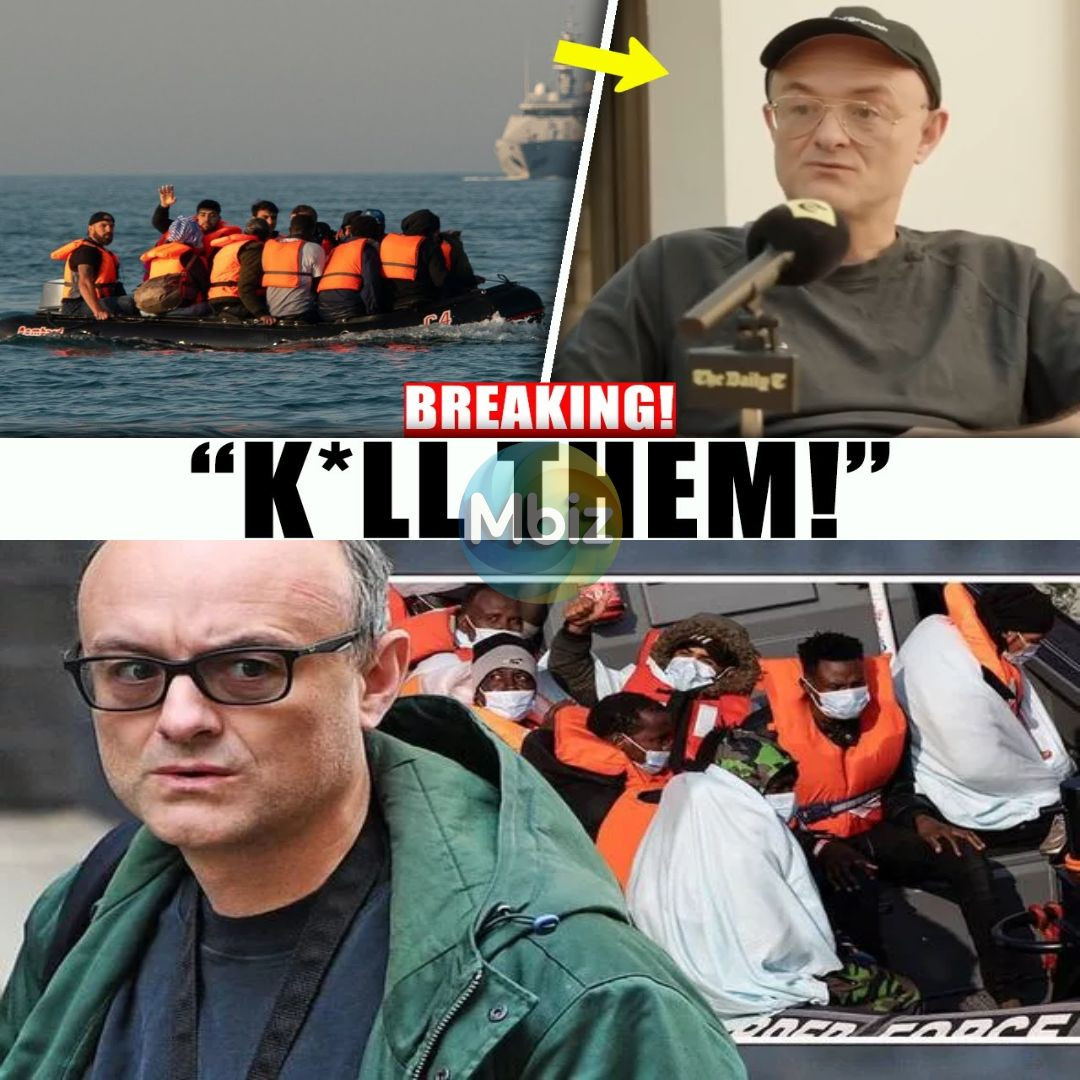
 Cummings argues that the current legal framework, particularly the Human Rights Act, hampers the government’s ability to act decisively. He insists that repealing this legislation would allow the Navy to intercept boats, transporting migrants to offshore facilities instead of British soil. This radical approach has sparked fierce debate across the political spectrum.
The proposal includes targeting human traffickers, with suggestions that British special forces could be authorized to dismantle these networks at their source. Cummings believes that a credible military threat will deter migrants, as they are primarily motivated by financial gain, not ideological beliefs.
A fresh political storm has erupted in Britain following controversial claims that former government adviser Dominic Cummings wants the Royal Navy to take an increasingly aggressive role in stopping migrant boats crossing the English Channel. The explosive debate surrounding border security has once again placed immigration at the centre of British politics, with questions being raised about how far the government should go to prevent dangerous crossings and whether military involvement could ever provide a realistic solution. At a time when public frustration over illegal immigration remains high, the suggestion of using naval power has reignited arguments about national sovereignty, humanitarian responsibilities and the limits of government authority.
Dominic Cummings is no stranger to controversial political interventions. As one of the most influential figures behind the Vote Leave campaign and a former senior adviser to Boris Johnson, he has developed a reputation for challenging established political thinking and making provocative arguments about the machinery of government. His interventions frequently attract attention because they question conventional approaches and demand more radical changes. Any suggestion that Britain should adopt a military-style strategy against migrant crossings is therefore likely to generate an immediate political reaction.
The English Channel has become one of the most sensitive political and humanitarian issues facing successive British governments. Every dangerous crossing creates concerns about border security, organised smuggling networks and the safety of those attempting the journey. Small inflatable boats carrying large numbers of people have become a familiar feature of the immigration debate, while rescue operations regularly place significant demands on emergency services.
For many British voters, the issue represents a test of whether the government can exercise meaningful control over its borders. They want to know why dangerous journeys continue, why criminal smuggling organisations remain active and why previous government promises have failed to produce a lasting solution. These concerns have created an opportunity for politicians advocating much tougher measures to attract attention and build support.
However, the idea of sinking migrant boats raises questions that go far beyond ordinary border enforcement. Such an action would create an obvious danger to everyone aboard, including children and other vulnerable people. A policy involving the deliberate destruction of vessels carrying human beings could result in catastrophic loss of life and would raise serious legal and ethical questions. Preventing dangerous crossings cannot reasonably mean creating an even greater danger for those at sea.
The Royal Navy has an important role in protecting Britain’s maritime security, but its responsibilities are not identical to those of border enforcement agencies. Naval personnel operate in a complex environment involving national defence, maritime surveillance, international cooperation and emergency assistance. Any expanded role in dealing with migrant crossings would require clear legal authority, operational planning and strict safeguards.
The government would also have to consider Britain’s international obligations. Maritime law places significant responsibilities on states and vessels operating at sea, particularly when people are in distress. Rescue and the protection of human life remain fundamental principles. Even when individuals have entered a country irregularly, their safety cannot simply be ignored.
This creates a difficult political contradiction. Ministers are under pressure to demonstrate that Britain can control immigration, but they must do so without abandoning legal responsibilities or putting innocent lives at unnecessary risk. The more extreme the proposed measures become, the more difficult it may be to reconcile political demands with the practical and legal realities of operating in the Channel.
Labour has already faced intense scrutiny over its approach to immigration. The government has promised to tackle the criminal gangs responsible for organising dangerous journeys and improve the effectiveness of the asylum system. However, critics argue that the continuing crossings demonstrate that stronger action is required. Reform UK, in particular, has made border control a central part of its political message, repeatedly questioning whether traditional parties are willing to take sufficiently decisive action.
Nigel Farage and other Reform politicians have used the issue to challenge Labour’s credibility. Their argument is that voters expect the government to establish clear control over Britain’s borders and that repeated announcements are meaningless unless they produce visible results. The Conservatives have also criticised the government’s immigration strategy, arguing that the public deserves more effective enforcement and a clearer explanation of how irregular arrivals will be managed.
A proposal involving the Royal Navy would inevitably intensify this political competition. Supporters of a stronger military presence might argue that naval surveillance could improve the detection of suspicious vessels, strengthen coordination between agencies and disrupt the activities of smugglers. They may also believe that a more visible security operation would demonstrate that Britain is serious about protecting its maritime borders.
But surveillance and rescue operations are very different from deliberately destroying boats. The former can potentially improve maritime security while protecting human life. The latter would introduce enormous risks and could undermine Britain’s legal responsibilities. Any serious discussion about the Navy’s role must recognise that distinction.
The criminal organisations behind Channel crossings are another central part of the problem. Smugglers exploit vulnerable people by charging large sums of money for dangerous journeys. They frequently use poorly constructed vessels, overcrowd passengers and place people in situations where even minor mechanical problems can become life-threatening. Their operations are often connected to wider international networks that move people and money across several countries.
Targeting these organisations requires more than visible patrols. Police investigations, financial intelligence, international cooperation and prosecutions are all essential. Authorities need to identify the people organising departures, trace their financial networks and prevent criminal groups from replacing those who are arrested.
There is also the question of what happens after a boat is intercepted. People rescued from the Channel still require appropriate treatment, identification and legal assessment. Some may have legitimate claims for international protection, while others may not meet the relevant requirements. A functioning immigration system must be capable of examining individual cases fairly and reaching decisions without unnecessary delays.
This is where the government’s broader strategy faces another difficult test. Even if the number of crossings decreases, public confidence may remain weak if asylum applications continue to take too long to process or if accommodation arrangements remain expensive and controversial. Border enforcement and asylum administration must work together if ministers want to demonstrate lasting progress.
Ireland and other European countries also form part of the wider migration debate. Smuggling networks operate internationally, and people travelling towards Britain may pass through several countries before reaching the Channel. This means that cooperation with neighbouring governments is essential. Intelligence sharing, coordinated investigations and effective returns arrangements can all play a role in disrupting criminal activity.
Meanwhile, public discussion is becoming increasingly polarised. Some people believe Britain needs a dramatically tougher approach because existing policies have failed to prevent dangerous crossings. Others warn that increasingly aggressive language risks turning vulnerable people into political targets and distracting attention from the criminal organisations exploiting them.
Both concerns deserve serious examination. The government has a responsibility to protect its borders and maintain public confidence in the immigration system. At the same time, it must ensure that enforcement measures are lawful, proportionate and consistent with the protection of human life.
For Starmer, the political consequences of the debate could be significant. If Labour appears unable to respond effectively to irregular migration, opposition parties will continue using the issue to challenge its authority. If the government adopts excessively aggressive proposals without considering their legal and humanitarian consequences, it could face another set of serious controversies.
The Royal Navy should therefore not become a substitute for a coherent immigration strategy. Its capabilities may support maritime monitoring and appropriate emergency operations, but lasting solutions require effective policing, international cooperation, faster asylum decisions and action against the criminal networks responsible for dangerous crossings.
Ultimately, the controversy surrounding Dominic Cummings illustrates just how intense Britain’s immigration debate has become. Calls for extraordinary measures may attract headlines, but the real test is whether any proposed policy can actually reduce dangerous journeys without creating even greater risks.
British voters want answers, and they want to see measurable results. They expect ministers to explain how borders will be protected, how smugglers will be stopped and how the asylum system will become more efficient. Those expectations are unlikely to disappear regardless of which party occupies Downing Street.
The coming months will reveal whether Labour can regain control of the political narrative or whether more radical proposals will continue gaining attention. One thing is clear: the Channel crisis is no longer simply an immigration issue. It has become a major test of national security, political credibility and Britain’s ability to balance effective border enforcement with its responsibilities under international law.