
British troops have been deployed to Israel to monitor the ceasefire in Gaza as part of a US-led international task force.
The Ministry of Defence has confirmed a small group of military officers have joined the stabilisation force, called the civil-military coordination centre (CMCC).
The exact number of British troops deployed has not yet been disclosed, however the group will be joined by a two-star deputy commander.
The US has pledged up to 200 troops to join the international task force.
The exact number of British troops deployed has not yet been disclosed
Soldiers from Turkey, Egypt, Qatar and the UAE are also believed to be joining the task force as it attempts to assist with getting aid into the Gaza Strip and maintain compliance with the ceasefire.
The US-led international task force is not believed to be the same as the international stabilisation force set out in US President Donald Trump’s 20-point peace plan.
A Ministry of Defence spokesman said that “the UK continues to work with international partners to support the Gaza ceasefire to see where the UK can best contribute to the peace process”.
The deployment of British troops comes just days after Foreign Secretary Yvette Cooper affirmed that there were “no plans” to send UK soldiers to the region as part of Mr Trump’s proposed multi-national force.
Foreign Secretary Yvette Cooper previously affirmed that there were ‘no plans’ to send UK soldiers to the region
The ceasefire agreement between Israel and Hamas appeared to be hanging by a thread on Sunday after two IDF soldiers were killed behind the withdrawal line, but the terror group denied being behind the killings.
In response, Israel carried out a series of strikes against Hamas targets in the Gaza Strip.
However, on Tuesday, US Vice President JD Vance declared that “this peace is going to last”, adding that the deal was “in a good place”.
Mr Vance also said that Hamas would be “obliterated” unless it disarms and warned the terror group to “behave itself”.
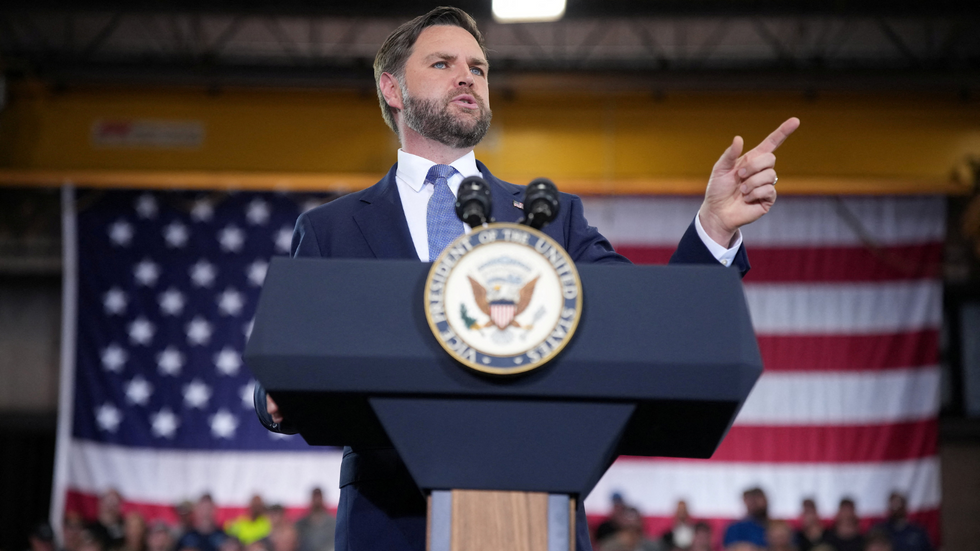
On Tuesday, US Vice President JD Vance declared that ‘this peace is going to last’
REUTERS
On Tuesday, Mr Trump wrote on his Truth Social platform: “Numerous of our now great allies in the Middle East, and areas surrounding the Middle East, have explicitly and strongly, with great enthusiasm, informed me that they would welcome the opportunity, at my request, to go into Gaza with a heavy force and ‘straighten out Hamas’ if Hamas continues to act badly, in violation of their agreement with us.
“There is still hope that Hamas will do what is right. If they do not, an end to Hamas will be fast, furious, & brutal!
“I would like to thank all of those countries that called to help.”
During his first visit to Israel since being elected, Mr Vance urged Benjamin Netanyahu to have “a little bit of patience” surrounding the return of deceased corpses of the hostages.
Despite two more corpses being identified on Tuesday night, the bodies of 15 hostages are yet to be accounted for.
Speaking on the timeframe of Hamas’ disarmament, Mr Vance said: “I don’t think it’s actually advisable for us to say that this has to be done in a week, because a lot of this work is very hard.
“It’s never been done before and, in order for us to give it a chance to succeed, we’ve got to be a little bit flexible.”
He added that some of the Gulf Arab nations, alongside Israel, were starting to get “impatient” with Hamas.
British Troops Deployed to Israel to Monitor ‘Fragile’ Gaza Ceasefire
Britain has deployed a senior military commander and a small number of military personnel to Israel as part of international efforts to support the fragile ceasefire between Israel and Hamas. The deployment, announced by Defence Secretary John Healey in October 2025, followed a request from the United States and marked an important development in Britain’s involvement in the future of Gaza. The decision has attracted considerable attention, raising questions about Britain’s military responsibilities, the future of the Middle East and whether the ceasefire can survive amid continuing tensions between the two sides.
First of all, the deployment comes at a critical moment for the region. After two years of devastating conflict, the ceasefire agreement between Israel and Hamas offered an opportunity to reduce violence, release hostages and improve humanitarian conditions for civilians in Gaza.
The agreement, announced in October 2025 as part of US President Donald Trump’s peace initiative, was widely welcomed by international leaders. However, despite the initial optimism, the situation remained extremely fragile, with both Israel and Hamas accusing each other of violating the agreement.
For thousands of civilians living in Gaza, the ceasefire represented a potential turning point after months of destruction, displacement and humanitarian suffering. Nevertheless, rebuilding confidence between the opposing sides remains an enormous challenge.
British involvement was announced by John Healey, who explained that the United Kingdom would contribute specialist military expertise to an international coordination effort led by the United States.
The British contingent includes a senior two-star military commander who will serve as deputy commander within the US-led Civil-Military Coordination Centre (CMCC). A small team of British planning officers will also support the operation.
Healey described Britain’s contribution as an important role in helping international partners secure a lasting peace. He emphasised that British personnel would provide specialist knowledge and experience rather than take overall control of the mission.
The United States is leading the coordination centre, with other international partners expected to participate, including Egypt, Qatar, Turkey and the United Arab Emirates.
However, an important distinction must be made about the British deployment. Although the initial announcement suggested that British personnel could contribute to monitoring the ceasefire, the Ministry of Defence subsequently clarified to Parliament that the UK planning team was not directly responsible for monitoring ceasefire violations.
Instead, its primary responsibility was to remain integrated into US-led planning efforts for post-conflict stability in Gaza. British personnel were also not expected to enter Gaza or undertake combat operations there. <Cite refs={[“turn810562search0″,”turn810562search1″,”turn810562search6”]}/>
This clarification is important because it demonstrates that Britain’s involvement is primarily focused on coordination, planning and diplomatic support rather than direct military intervention.
Another significant aspect of the deployment concerns the role of Donald Trump. His administration has attempted to establish an international framework capable of supporting the ceasefire, facilitating humanitarian assistance and creating conditions for a longer-term political settlement.
The American-led coordination centre is intended to help organise the delivery of humanitarian aid, logistical assistance and security arrangements. It also forms part of a broader plan to establish an international stabilisation force for Gaza.
However, creating such a force presents considerable difficulties. Countries potentially willing to contribute military personnel are concerned about the risks of becoming involved in another prolonged conflict.
Many governments are reluctant to send soldiers into an environment where Hamas remains armed and where disagreements over Gaza’s future administration have not been resolved.
Israel has also expressed concerns about which countries should participate in any international security arrangement, particularly regarding the potential involvement of Turkey.
These disagreements demonstrate that achieving a ceasefire is only the first step towards establishing lasting peace.
Meanwhile, the humanitarian situation remains a major international concern. Years of conflict have damaged homes, hospitals, schools and essential infrastructure across Gaza.
Thousands of families have been displaced, while access to food, clean water, medical supplies and electricity has remained a serious challenge.
International organisations have repeatedly called for humanitarian assistance to reach civilians safely and consistently.
Britain has an important role to play in supporting these efforts through diplomatic engagement, humanitarian assistance and cooperation with international partners.
The British government has also previously conducted surveillance flights over the Eastern Mediterranean, including operations connected with efforts to locate hostages following the Hamas attacks of October 7, 2023. The Ministry of Defence confirmed that these flights ended after the October 2025 ceasefire agreement and the release of the remaining hostages. <Cite refs={[“turn810562search5”]}/>
For Keir Starmer’s government, the deployment represents an opportunity to demonstrate Britain’s continuing influence in international affairs.
Although Britain is no longer the dominant military power it once was, its armed forces retain considerable experience in planning, intelligence, logistics and international cooperation.
Working alongside the United States and regional partners allows Britain to contribute to diplomatic and security efforts without committing large numbers of troops to a dangerous conflict.
Nevertheless, the decision also creates political challenges.
Some critics may question why British military personnel are being deployed to support a US-led initiative when the government has repeatedly emphasised the importance of avoiding direct involvement in the conflict.
Others may argue that Britain has a responsibility to contribute to international efforts that could prevent further civilian casualties and create opportunities for political stability.
The government must therefore maintain transparency about the responsibilities of British personnel, the risks they face and the objectives of their mission.
Another important issue concerns the future governance of Gaza. A sustainable peace agreement will require more than a temporary reduction in fighting. There must also be credible arrangements for administration, reconstruction, security and the political future of the Palestinian population.
Without progress on these issues, the ceasefire could remain vulnerable to further violence.
Israel and Hamas must also demonstrate a genuine commitment to implementing the agreement. Continued accusations, military incidents and disagreements over security arrangements could undermine international confidence.
For ordinary civilians, the priority is straightforward: an end to violence, the safe return of displaced families and access to the basic necessities of life.
The international community must therefore ensure that political negotiations are accompanied by practical humanitarian action.
Britain’s military contribution may be relatively small, but its involvement demonstrates that the government considers international cooperation essential to securing a lasting settlement.
Ultimately, the success of the mission will depend on whether the United States, Britain and regional partners can work together effectively while encouraging both sides to respect the ceasefire.
In conclusion, Britain’s deployment of a senior military commander and a small team of planning officers to Israel represents an important development in international efforts to support the fragile Gaza ceasefire. Although British personnel are not directly responsible for monitoring ceasefire violations and will not enter Gaza, their participation in the US-led coordination centre gives Britain a role in planning for post-conflict stability. Keir Starmer’s government faces the challenge of supporting peace efforts while avoiding unnecessary military escalation. The future of Gaza will depend on effective international cooperation, humanitarian assistance and a genuine commitment to ending the conflict. Ultimately, the greatest priority must be protecting civilian lives and creating the conditions for a lasting and peaceful future in the Middle East.