

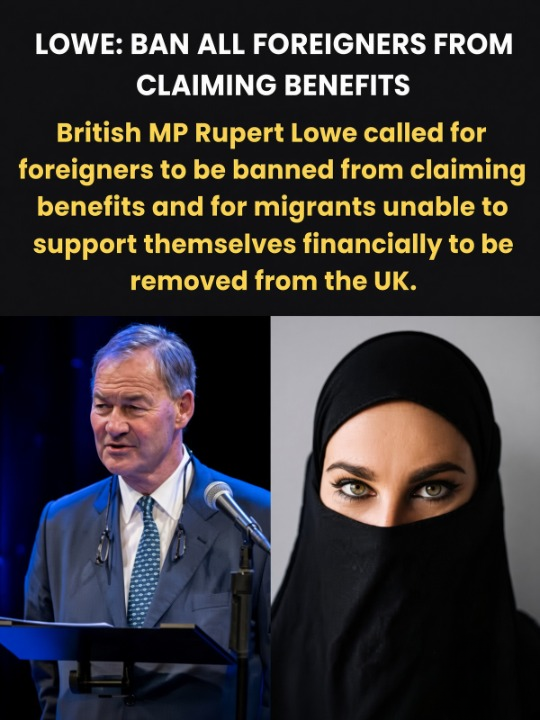
“BRITISH TAXPAYERS FIRST”: Rupert Lowe Calls for Foreigners to Be Barred From Benefits as Parliament Erupts Over Welfare and Immigration
A fierce new battle over immigration, welfare and the rights of foreign nationals has erupted in Britain after MP Rupert Lowe called for foreigners to be prevented from claiming benefits and argued that migrants unable to financially support themselves should be required to leave the country.
Speaking in Parliament, Lowe framed the issue around a simple but politically explosive principle: money collected from British taxpayers, he argued, should primarily support British citizens rather than people who have moved to the United Kingdom from abroad.
His intervention immediately reopened one of the most contentious questions in British politics: who should be entitled to access the welfare state, and how far should nationality determine that entitlement?
Lowe argued that Britain should adopt a dramatically tougher approach. In his view, foreign nationals should generally be expected to support themselves financially while living in the country. Where migrants cannot do so, he suggested that continued residence should be reconsidered rather than allowing them to rely on taxpayer-funded benefits.
The government rejected his argument and challenged figures used to support his case, highlighting how politically disputed the economics of migration and welfare have become.
That disagreement matters because the phrase “foreigners claiming benefits” can conceal a far more complicated legal reality.
Britain already restricts access to public funds for many migrants. Numerous people entering the UK on temporary immigration visas are subject to a “no recourse to public funds” condition, commonly known as NRPF. That generally prevents them from accessing a range of benefits while their immigration status remains subject to that restriction.
Other foreign nationals, however, can acquire eligibility depending on their immigration status, residency history and individual circumstances. Refugees, people with settled status and certain other legally resident groups may have rights that temporary migrants do not.
That means Lowe’s proposal would go considerably further than simply enforcing existing restrictions.
A genuine blanket prohibition covering “all foreigners” could potentially affect people who have lived and worked in Britain legally for years, paid income tax and National Insurance, raised families in the country and subsequently experienced unemployment, disability or another financial crisis.
Supporters of a citizenship-first welfare model nevertheless argue that this is precisely the principle Britain should debate.
Their case is that the welfare state is ultimately financed by taxpayers and cannot provide unlimited support to everyone who enters the country. At a time when public finances are under enormous pressure, they argue, the government has a responsibility to prioritize its own citizens.
For voters struggling with housing costs, taxation, NHS waiting lists and the cost of living, that argument can have considerable political force.
Critics, however, say the proposal risks treating very different categories of people as though they were identical.
A recently arrived temporary migrant, a refugee, an EU citizen with protected status and a long-term legal resident who has spent decades paying taxes may all technically be non-British citizens, but their circumstances and legal rights can be profoundly different.
There is also the economic question.
Migration is frequently discussed in terms of what migrants receive from the state, but any serious calculation must also examine what they contribute through income tax, National Insurance, VAT, employment, business activity and other forms of taxation.
This is one reason arguments about the supposed “cost” of migrants can produce wildly different figures.
The result depends heavily on what population is being measured, which benefits and public services are counted, what taxes are included, the period being examined and whether researchers distinguish between different categories of migrants.
The government’s rejection of Lowe’s figures therefore forms a central part of the dispute rather than a minor technical disagreement.
Lowe’s broader argument is also about immigration enforcement.
If a foreign national cannot financially support himself or herself, he argues, Britain should consider removal rather than continuing to provide welfare assistance. Supporters see that as an extension of the principle that immigration should benefit the country accepting the migrant.
But translating that slogan into policy would be considerably more complicated.
Not every foreign national receiving financial assistance can simply be deported.
A person may have permanent residence rights, refugee protection, family connections, rights established under existing agreements or other legal protections. Decisions involving removal can also be challenged through the courts and may be affected by domestic legislation and international obligations.
Then comes perhaps the most difficult hypothetical case: someone who arrived legally, worked in Britain for 20 years, paid substantial taxes throughout that period but never became a British citizen.
If that person suddenly lost their job, should they receive temporary assistance from the system they helped finance?
Lowe’s call for a sweeping nationality-based restriction forces precisely those uncomfortable questions into the political conversation.
His supporters are likely to respond that citizenship matters for a reason. If access to the full welfare state is indistinguishable between citizens and non-citizens, they ask, what meaningful privileges should citizenship carry?
Opponents would answer that welfare eligibility has traditionally depended on a combination of residence, immigration status, contributions and need rather than nationality alone.
Behind the argument lies a broader transformation in British politics.
Immigration is no longer being debated only in terms of border crossings and asylum hotels. Increasingly, politicians are connecting it to housing, healthcare, wages, taxation, welfare spending and access to public infrastructure.
That shift could prove significant.
For years, governments have attempted to distinguish legal migration from illegal immigration and asylum. Lowe’s intervention challenges that distinction by asking whether even legally resident foreign nationals should enjoy the same access to certain parts of the welfare system as British citizens.
The government now faces pressure from competing directions.
On one side are voters demanding tighter immigration controls and greater priority for British citizens. On the other are businesses dependent on overseas workers, migrant families who have established lives in Britain and critics warning against policies that could undermine legal rights or create a two-tier society.
There is also a practical question that neither side can avoid.
If Britain requires migrants to be financially self-sufficient, how should the government respond when circumstances change unexpectedly?
A worker can lose a job. A business can collapse. A parent can become widowed. An economic recession can destroy employment across an entire sector.
Should a migrant who has contributed to Britain for years immediately face the possibility of removal when something goes wrong?
Or should access to taxpayer-funded support depend upon citizenship above everything else?
Those questions explain why Lowe’s intervention has attracted attention beyond a routine parliamentary exchange.
It taps into a growing argument about the basic relationship between immigration and the welfare state.
For Lowe and those sympathetic to his position, the answer is straightforward: Britain must put its own citizens first, foreign nationals should support themselves, and taxpayers should not be expected to finance migration.
For the government and Lowe’s critics, the picture is much more complicated. Existing benefit restrictions are already extensive for many migrants, different immigration categories carry different rights, and sweeping claims about migrant welfare costs require careful scrutiny.
What happens next may depend less on a single parliamentary speech than on whether the public accepts Lowe’s central premise.
Because beneath all the statistics, legal arguments and political accusations lies one deceptively simple question that could become increasingly important in British politics:
Should access to Britain’s welfare state ultimately be determined by need and legal residence—or by the passport in your pocket?
Rupert Lowe has made clear where he stands.
Now the argument is whether Britain is prepared to follow him.
Rupert Lowe’s Shock Offer to Nigel Farage: “Millions Must Go” as Britain’s Immigration Debate Intensifies
Britain’s immigration debate has returned to the political spotlight amid renewed calls for tougher controls, a more restrictive asylum system and a fundamental reassessment of the country’s approach to migration. A headline suggesting that Rupert Lowe has made Nigel Farage a dramatic offer under the slogan “Millions Must Go” raises questions about the relationship between prominent figures on the British right and the policies they believe should shape the country’s future.
The precise details of the reported offer, including whether Lowe formally proposed a political agreement with Farage and what conditions it might involve, require confirmation. Nevertheless, the broader debate surrounding large-scale immigration reductions has become an important feature of British politics, with Reform UK and other political figures arguing over how the country should manage its borders, asylum applications and migration system.
At the heart of the controversy lies a difficult question: how far should Britain go in reducing immigration, and what practical, legal and economic consequences would follow from such a policy?
Rupert Lowe and Nigel Farage: Different Political Paths
Rupert Lowe and Nigel Farage have both become prominent figures in debates about immigration and national sovereignty, although their political positions and organisational roles should not be treated as identical.
Farage leads Reform UK, a party that has built its political identity around issues including immigration control, opposition to what it regards as excessive government spending and criticism of the established political parties.
Lowe, meanwhile, has pursued his own political agenda and has been associated with calls for significantly tighter immigration policies. His public interventions have contributed to debates about the scale of migration, national identity and the responsibilities of government.
Any suggestion that Lowe has made a formal offer to Farage would need to be assessed against the actual terms of that proposal. A shared concern about immigration does not necessarily mean that two politicians agree on party leadership, strategy, candidate selection or the details of a future government programme.
Political cooperation can take several forms, from agreement on particular policies to electoral coordination or a more formal organisational arrangement. Each would carry different implications.
The distinction matters because headlines can create an impression of a political agreement that has not necessarily been established. Without a verified statement from the individuals involved, the nature and status of the reported offer remain uncertain.
What Does “Millions Must Go” Mean?
The phrase “Millions Must Go” suggests a proposal for a substantial reduction in the number of people living in Britain who do not have an unrestricted right to remain. However, the precise meaning cannot be established from the headline alone.
Immigration policy involves several distinct categories, including people arriving on work and study visas, people seeking asylum, individuals whose asylum claims have been refused and people who have overstayed their permission to remain.
These groups are governed by different legal rules and cannot simply be treated as one category.
A policy aimed at reducing future immigration would operate differently from a policy seeking to remove people who are already living in the country. Similarly, changes to visa requirements would have different consequences from changes to asylum procedures or the enforcement of existing removal decisions.
Any proposal involving millions of people would therefore require detailed explanations of who would be affected, the legal grounds for action, the timetable for implementation and the administrative resources needed.
It would also require clarity about exemptions, appeals and individual circumstances. British citizens cannot be treated as subject to immigration removal merely because of their ancestry, and people with different forms of immigration status have different rights under the law.
Without such detail, a large headline figure does not provide enough information to assess what a policy would actually involve.
Immigration Control and Public Confidence
Support for stricter immigration controls is often linked to concerns about housing, public services, wages and the government’s ability to manage population changes.
Some voters argue that immigration levels should be determined more closely by the country’s infrastructure, housing supply and economic needs. They want ministers to explain how migration policy affects public spending and access to services.
Others emphasise the contribution of migrants to the economy, including their roles in healthcare, social care, construction, hospitality, universities and other industries. They warn that abrupt restrictions could create recruitment difficulties, reduce economic activity or affect institutions that depend on international workers and students.
The overall consequences depend on the type of migration involved, the sectors affected and the policies adopted.
For example, restricting overseas recruitment could have different effects in an industry experiencing labour shortages compared with one where employers have access to a large domestic workforce. Changes to student visas could also affect universities and local economies in ways that differ from changes to work permits.
A serious immigration strategy must therefore explain not only how migration would be reduced but also how employers, public services and local communities would adapt.
Political debate is unlikely to disappear, but meaningful public confidence depends on clear objectives, transparent figures and evidence about the effects of different policy choices.
The Asylum System Is a Separate Challenge
Asylum policy is frequently discussed alongside immigration, but the two are not interchangeable.
People who apply for asylum are asking the government to assess whether they qualify for international protection. Their applications must be considered according to the applicable legal framework and their individual circumstances.
Some applicants are granted protection, while others have their claims refused. A refusal does not automatically mean that removal can take place immediately, because relevant appeals and other legal considerations may need to be resolved.
The government can seek to improve processing times, manage accommodation costs and enforce final removal decisions where lawful. However, it must distinguish between people who have a legal right to remain and those who no longer have a valid basis for doing so.
This distinction is important when evaluating proposals for large-scale removals.
A credible policy would need to explain how decisions would be made, what procedures would apply and how authorities would manage cases involving appeals, documentation or difficulties securing cooperation from receiving countries.
It would also need to account for the practical costs of enforcement and the resources required to implement decisions lawfully.
The question is not simply how many people a politician proposes to remove, but whether the stated objective can be achieved through a clear, workable and lawful process.
The Economic Questions Behind Mass Removal Proposals
Large-scale immigration restrictions or removal programmes could have significant economic implications, depending on their design.
Migrants participate in the British economy as workers, consumers, taxpayers, students and business owners. Their economic contributions vary according to employment, earnings, age, immigration status and the services they use.
Reducing migration may ease certain pressures where population growth is outpacing housing or infrastructure. It could also alter demand for public services and influence the availability of workers in particular industries.
Conversely, sudden reductions in the workforce could make recruitment more difficult for some employers and increase operating costs. If businesses cannot replace departing workers, they may reduce services, raise prices or invest in automation.
The public finances would also be affected by changes in tax contributions and public expenditure. The overall effect would depend on which people were affected and the circumstances of their departure.
These considerations do not determine a single correct immigration policy. They demonstrate why proposals need detailed economic analysis rather than relying solely on headline numbers.
If Lowe or Farage advocates a programme involving substantial removals, the public would need to understand its estimated cost, funding arrangements, expected economic effects and safeguards against unlawful decisions.
Could Political Cooperation Change the Debate?
If Lowe and Farage were to pursue closer cooperation, immigration policy could become an even more prominent point of discussion within Britain’s political right.
However, agreement on immigration does not necessarily translate into agreement across every area of public policy. Politicians may differ over taxation, public services, economic management, defence, party organisation and the practical steps required to implement their proposals.
Formal cooperation would therefore raise questions about priorities, leadership responsibilities and the extent to which each individual would be prepared to compromise.
For Reform UK, any political arrangement would also need to be considered in the context of its existing organisation and public commitments. For Lowe, the terms of any proposal would matter in determining whether cooperation advanced his stated objectives.
At present, the headline alone does not establish that a formal agreement exists or that either politician has accepted specific conditions.
The details would need to be confirmed through direct statements or reliable reporting before conclusions could be drawn about the political significance of the reported offer.
The Legal and Human Rights Questions
Any proposal for large-scale immigration removals would face legal requirements that cannot be set aside simply because a government has a strong electoral mandate.
The law distinguishes between different immigration statuses, and decisions must be made under the relevant rules. Individual cases may involve rights of appeal, family circumstances, protection obligations or other legal considerations.
International obligations can also affect whether a person may lawfully be returned to a particular country.
This does not prevent governments from enforcing immigration rules or removing people who have no legal basis to remain, provided the necessary requirements are satisfied. It does mean that a policy must be designed around enforceable legal powers and appropriate procedures.
The practical consequences of ignoring these requirements could include prolonged litigation, delays, additional expenditure and challenges to the legitimacy of government decisions.
For that reason, the feasibility of a large-scale programme depends on much more than political determination. It requires sufficient administrative capacity, reliable documentation, cooperation with relevant countries and a process capable of distinguishing between individual cases.
A policy that explains these requirements clearly can be scrutinised more meaningfully than one that relies entirely on a numerical promise.
What Voters Will Want to Know
The debate surrounding the reported Lowe-Farage offer raises several questions that voters may reasonably expect politicians to answer.
First, what precisely is being proposed? A reduction in future immigration is different from removing people already in Britain, and each approach needs separate explanation.
Second, which groups would be affected? Work visas, student visas, asylum applications and people with final removal decisions involve different legal and practical circumstances.
Third, what would implementation cost, and how would it be funded? Enforcement, accommodation, legal proceedings and international cooperation all require resources.
Fourth, what would happen to industries and public services that rely on migrant workers? Any substantial change should account for potential recruitment difficulties and the time required to develop alternatives.
Finally, what safeguards would ensure that decisions are made lawfully and that people with valid rights to remain are not wrongly targeted?
These questions are essential to evaluating any proposal, regardless of which politician advances it.
Conclusion: A Headline That Raises Important Questions
The headline “Rupert Lowe’s Shock Offer to Nigel Farage: ‘Millions Must Go’” captures the intensity of Britain’s continuing immigration debate. It points towards a possible confrontation over the scale of migration and the future direction of political policy, but the precise details of the alleged offer remain unverified from the headline alone.
What is clear is that immigration continues to raise important questions about national sovereignty, economic needs, housing, public services and the administration of asylum claims.
Lowe and Farage have both been associated with demands for tighter immigration controls, but their individual proposals, organisational priorities and any potential agreement must be established through verified statements rather than assumed from a headline.
For Britain, the challenge is to debate immigration in terms of clearly defined objectives, reliable evidence and policies that can be implemented lawfully.
Voters deserve to know not only what political leaders promise but also how those promises would work in practice, what they would cost and what consequences they could have for the economy and society.
Ultimately, the significance of any reported offer will depend on its actual terms and whether it develops into a concrete policy or political agreement. Until those details are confirmed, the headline should be understood as a prompt for scrutiny rather than proof that a deal has been reached.