
Things got slightly heated during the most recent instalment of BBC Breakfast between Reform UK leader Nigel Farage and presenter Sally Nugent as she highlighted comments made by Raheem Kassam, a former chief of staff to Farage.
The BBC star mentioned that Raheem had spoken about the Conservative Party leader Kemi Badenoch, calling her a “Nigerian scammer”.
Nugent asked: “Do you think that’s racist?” Farage replied: “A, he’s not a former chief of staff.
B, he’s currently in America, and C, he’s Indian. He’s of Indian heritage, so?”
Cutting in, the BBC star asked if that meant he couldn’t be racist as Farage replied: “I don’t know, you tell me the answer to that.
As far as the scam is concerned, well, it’s a strong word, but it’s pretty clear that Kemi Badenoch often does not tell the truth about things that have happened and tries her very best to reinvent her past.”
Advertisement

Nigel and Sally were in a heated clash over comments made about Kemi Badenoch (Image: BBC)
Not backing down, Nugent asked once again if he supported the comments that Badenoch is a “Nigerian scammer” as he reiterated what he had just said.
Advertisement
He added: “I just said to you, very, very clearly, that the word scammer is about someone who doesn’t always tell the truth.
There are quite a few instances over the last couple of months of her not telling the truth.”
Nugent replied: “Do you think that’s racist? Do you think the phrase ‘Nigerian scammer’ is racist?”
Farage added: “I’ve just explained to you that there are two different words.
One is scammer, and the other is Nigerian. He’s of Indian heritage. Ask him how he describes himself.
Kemi Badenoch calls herself British; she grew up in Nigeria.
By the way, this is not a debate I’m getting involved in.
Somebody in America is making a comment on Twitter.”

Advertisement
Sally was determined to get an answer from Nigel (Image: BBC)
However, Nugent spoke over Farage while he continued, as she highlighted that he was a close associate of his.
Although he didn’t seem phased as he said: “So what?
People say all sorts of things on Twitter, every single day.”
Despite Farage making it clear he didn’t want to delve into the comment again, Nugent continued to ask whether or not he believed the phrase was racist.
Advertisement
In the end, he replied: “No, I don’t.
I don’t think saying someone grew up in Nigeria is racist, no, I don’t.
I don’t think it is, you tell me. What do you think?”
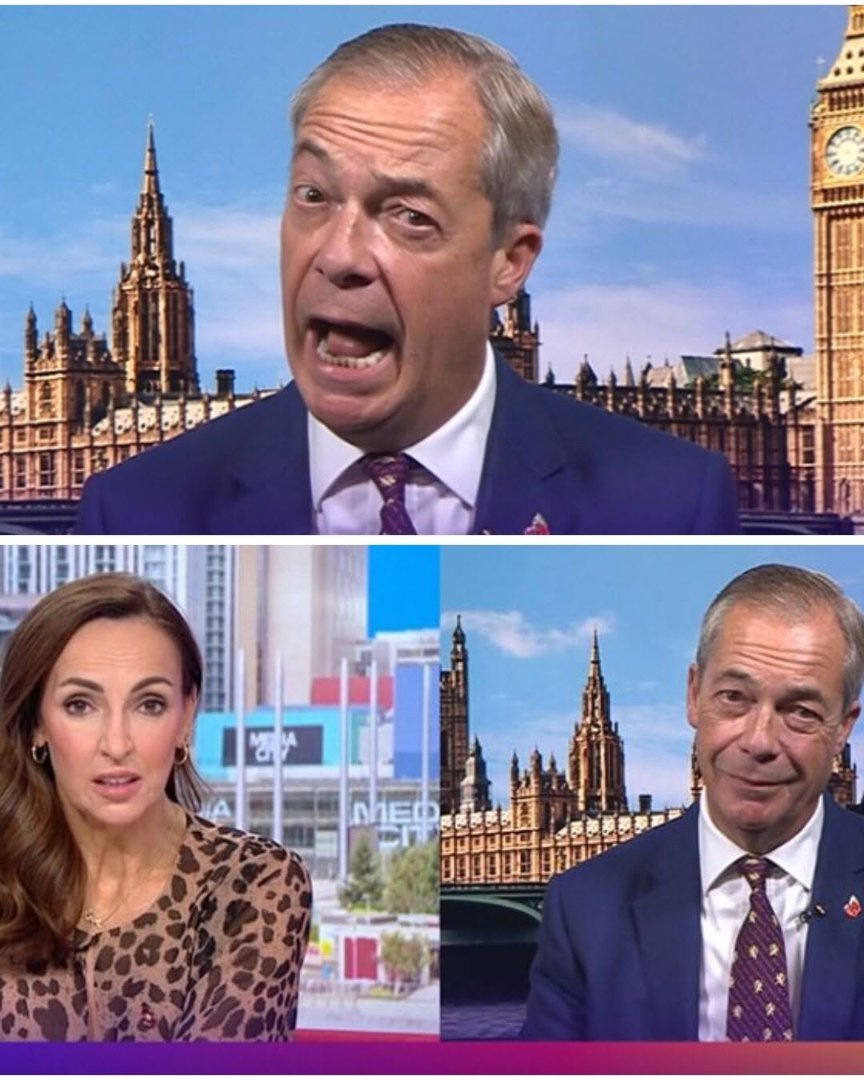
Although he explained he believes the comment was “over the top”, Farage told Nugent that he doesn’t think the remark was intentionally racist.
BBC Breakfast is available to watch on BBC One weekdays at 6am.
BBC BREAKFAST DESCENDS INTO CHAOS AS FARAGE SHUTS DOWN SALLY NUGENT IN EXPLOSIVE RACISM ROW!
A heated confrontation over immigration, racism and political responsibility would be enough to dominate Britain’s television headlines, particularly if it involved Reform UK leader Nigel Farage and BBC Breakfast presenter Sally Nugent. A disagreement of this nature would also raise wider questions about the limits of political debate, the responsibility of broadcasters and the growing divisions within British society.
The headline suggests an explosive exchange in which Farage refuses to accept the direction of questioning and challenges Nugent over allegations of racism. However, without an independently verified recording or transcript, the precise details of such an encounter cannot be established. What can be examined is the wider political controversy surrounding Farage, immigration and the BBC’s approach to interviewing controversial political figures.
Immigration has become one of the most sensitive issues in British politics. Across the country, voters have expressed concerns about border security, asylum accommodation, pressure on public services and the Government’s ability to manage migration effectively. Reform UK has made these concerns central to its political programme, arguing that successive governments have failed to deliver meaningful control over Britain’s borders.
Farage has repeatedly presented himself as a politician willing to challenge what he describes as the political establishment. His supporters believe he raises questions that other politicians are reluctant to discuss, particularly regarding immigration levels, national identity and the consequences of government policy. They argue that these subjects deserve open discussion rather than being dismissed as politically inconvenient.
His critics, however, argue that some of his rhetoric risks encouraging suspicion towards minority communities and migrants. They believe politicians have a responsibility to distinguish between legitimate criticism of immigration policy and language that could contribute to prejudice or hostility towards particular groups.
This distinction would inevitably become central to any serious interview with Farage about racism.
For Sally Nugent, the challenge of interviewing a prominent political figure would be to ask direct questions while maintaining the BBC’s standards of impartiality. BBC Breakfast reaches millions of viewers and plays an important role in explaining political developments to the public. Its presenters are expected to challenge politicians, examine their claims and allow audiences to understand the arguments on different sides.
A difficult interview does not necessarily represent a failure of journalism. Indeed, challenging questions are an essential part of democratic accountability. Politicians seeking public office should expect to explain their policies, defend their statements and respond to criticism.
Equally, broadcasters must ensure that their questions are fair, properly evidenced and clearly distinguish between established facts and political interpretations. An interview should not become an opportunity to make unsupported accusations or force a guest into accepting a particular political characterisation.
The wider issue concerns the meaning of racism in contemporary Britain. Racism can involve explicit discrimination, hostility towards people because of their ethnic background, or broader forms of unequal treatment. However, disagreements over immigration policy are not automatically evidence of racist attitudes. A person can support stricter immigration controls while also believing that everyone living in Britain should receive equal treatment under the law.
At the same time, the freedom to discuss immigration does not remove the responsibility to avoid stereotyping or making sweeping claims about entire communities. Political leaders have considerable influence over public debate, and their language can shape how people understand complex social issues.
This is why interviews involving immigration and racism require careful questioning. If a politician argues that immigration levels should be reduced, the interviewer should examine the evidence supporting that position. If critics claim that particular statements are discriminatory, they should explain precisely which statements they are referring to and why.
The BBC also faces a difficult balancing act. It must provide a platform for political figures representing significant sections of the electorate while ensuring that controversial claims are examined critically. Some viewers may believe that broadcasters challenge Farage too aggressively, while others may argue that his statements deserve even greater scrutiny.
These disagreements reflect a broader crisis of trust in British media. Many people believe mainstream broadcasters are politically biased, although they frequently disagree about the direction of that alleged bias. Social media has intensified these perceptions by allowing short video clips and dramatic headlines to circulate without their full context.
A brief exchange lasting only a few seconds can quickly become a national talking point. Supporters may interpret a politician’s refusal to answer a question as evidence of strength, while critics may view the same behaviour as an attempt to avoid accountability. The complete interview, including the questions and answers before and after the confrontation, is therefore essential for understanding what actually happened.
For Farage, immigration remains a politically significant issue because it connects several concerns: employment, housing, public services, national sovereignty and cultural identity. Reform UK argues that the country needs a substantially different approach to border management and asylum policy.
However, the effectiveness of any proposed changes must be judged through practical evidence. Voters need to know how policies would operate, what they would cost and whether they would comply with British law and international obligations. Strong political language alone cannot solve the administrative challenges associated with immigration.
There are also important economic considerations. Migrants work in a wide range of industries, including healthcare, hospitality, agriculture and social care. Changes to immigration rules can therefore affect employers, public services and the availability of workers. A responsible political debate must consider both the pressures associated with migration and the contributions made by people who come to Britain legally.
Meanwhile, allegations of racism should be treated with seriousness. They can have significant consequences for individuals and political organisations. But such allegations should also be supported by specific evidence rather than relying exclusively on dramatic headlines or political disagreements.
The distinction between criticism and discrimination matters because Britain is a diverse society in which people must be able to discuss public policy without fear of unfair accusations. Equally, members of minority communities should be able to participate in public life without being subjected to hostility or discrimination.
A television interview that explores these competing principles could provide a valuable contribution to national debate. The objective should not simply be to produce a dramatic confrontation but to help viewers understand the evidence, competing arguments and real-world consequences of political decisions.
If Farage is challenged over comments about race or immigration, he should be given an opportunity to explain his position in full. If Nugent raises concerns about the effects of his language, those concerns should be examined with specific examples and reliable evidence. Neither political popularity nor media authority should place anyone beyond scrutiny.
Ultimately, the controversy surrounding immigration and racism is unlikely to disappear from British politics. As the next general election approaches, political parties will continue competing to convince voters that they have credible answers to the country’s most difficult questions.
The BBC has a responsibility to facilitate that debate fairly, while politicians have a responsibility to engage with challenging questions honestly. Viewers, meanwhile, should be encouraged to look beyond sensational headlines and examine complete interviews before reaching conclusions.
A dramatic television confrontation may generate enormous attention, but the real test of political journalism is whether it helps the public understand the issues more clearly. Britain needs a debate about immigration that is honest, evidence-based and respectful of democratic disagreement.
The most important question is therefore not simply who wins a television argument. It is whether politicians and broadcasters can discuss immigration, racism and national identity without abandoning accuracy, fairness and respect for the people affected by these issues.