
Things got slightly heated during the most recent instalment of BBC Breakfast between Reform UK leader Nigel Farage and presenter Sally Nugent as she highlighted comments made by Raheem Kassam, a former chief of staff to Farage.
The BBC star mentioned that Raheem had spoken about the Conservative Party leader Kemi Badenoch, calling her a “Nigerian scammer”.
Nugent asked: “Do you think that’s racist?” Farage replied: “A, he’s not a former chief of staff.
Advertisement
B, he’s currently in America, and C, he’s Indian. He’s of Indian heritage, so?”
Cutting in, the BBC star asked if that meant he couldn’t be racist as Farage replied: “I don’t know, you tell me the answer to that.
As far as the scam is concerned, well, it’s a strong word, but it’s pretty clear that Kemi Badenoch often does not tell the truth about things that have happened and tries her very best to reinvent her past.”
Advertisement

Nigel and Sally were in a heated clash over comments made about Kemi Badenoch (Image: BBC)
Not backing down, Nugent asked once again if he supported the comments that Badenoch is a “Nigerian scammer” as he reiterated what he had just said.
Advertisement
He added: “I just said to you, very, very clearly, that the word scammer is about someone who doesn’t always tell the truth.
There are quite a few instances over the last couple of months of her not telling the truth.”
Nugent replied: “Do you think that’s racist? Do you think the phrase ‘Nigerian scammer’ is racist?”
Farage added: “I’ve just explained to you that there are two different words.
Advertisement
One is scammer, and the other is Nigerian. He’s of Indian heritage. Ask him how he describes himself.
Kemi Badenoch calls herself British; she grew up in Nigeria.
By the way, this is not a debate I’m getting involved in.
Somebody in America is making a comment on Twitter.”

Advertisement
Sally was determined to get an answer from Nigel (Image: BBC)
However, Nugent spoke over Farage while he continued, as she highlighted that he was a close associate of his.
Although he didn’t seem phased as he said: “So what?
People say all sorts of things on Twitter, every single day.”
Despite Farage making it clear he didn’t want to delve into the comment again, Nugent continued to ask whether or not he believed the phrase was racist.
Advertisement
In the end, he replied: “No, I don’t.
I don’t think saying someone grew up in Nigeria is racist, no, I don’t.
I don’t think it is, you tell me. What do you think?”
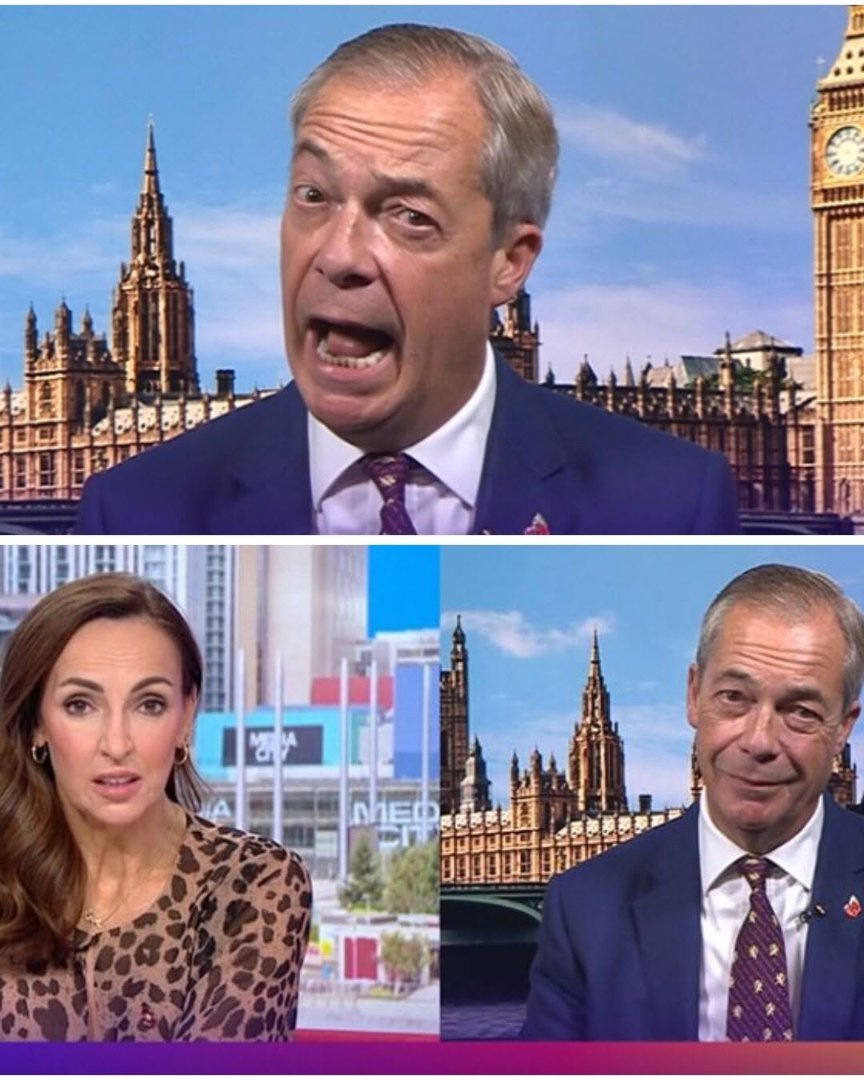
Although he explained he believes the comment was “over the top”, Farage told Nugent that he doesn’t think the remark was intentionally racist.
BBC Breakfast is available to watch on BBC One weekdays at 6am.
BBC BREAKFAST DESCENDS INTO CHAOS AS FARAGE CLASHES WITH SALLY NUGENT IN EXPLOSIVE RACISM ROW!
BBC Breakfast became the centre of a major political controversy after Nigel Farage faced an increasingly tense grilling from presenter Sally Nugent over allegations of racism involving one of his former senior associates. The Reform UK leader repeatedly refused to describe a controversial comment about Conservative Party leader Kemi Badenoch as racist, prompting Nugent to challenge him over his responsibilities as a political leader.
The confrontation, broadcast on 27 October 2026, quickly attracted attention across social media and reignited questions about Reform UK’s approach to race, political accountability and the language used by people associated with the party.
What began as a routine political interview developed into an uncomfortable exchange, with Nugent repeatedly demanding a straightforward answer while Farage attempted to defend his position and distance himself from the controversy.
At the heart of the dispute was a social media post by Raheem Kassam, a former senior adviser to Farage, who had described Badenoch as a “Nigerian scammer”.
The phrase sparked widespread criticism because of its potential racial implications. Farage, however, insisted that the comment was not intentionally racist, although he eventually acknowledged that the wording had gone too far.
Sally Nugent refuses to let Farage avoid the question
The BBC interview became particularly tense when Nugent asked Farage directly whether he believed Kassam’s description of Badenoch was racist.
Rather than immediately answering, Farage attempted to explain that Kassam was currently in the United States and had Indian heritage.
Nugent challenged the relevance of that argument, questioning whether someone’s own ethnic background automatically prevented them from making a racially offensive remark about another person.
Farage continued to resist the line of questioning, arguing that the controversy involved a comment made by someone posting independently on social media.
Nugent reminded him that Kassam was not simply an unknown individual but someone who had previously worked closely with him and had longstanding connections to Reform UK.
When she pressed him again, Farage responded dismissively, suggesting that people made all sorts of comments on social media every day.
However, the presenter refused to abandon the issue.
She repeatedly reminded him that he was the leader of a political party and that voters had a legitimate interest in understanding his position on potentially discriminatory language.
Her central question was straightforward: did Farage believe the phrase was racist?
The controversial Raheem Kassam post
The dispute began after Kassam published comments about Kemi Badenoch on X.
The Conservative leader, who was born in Wimbledon and grew up partly in Nigeria, has previously spoken publicly about her Nigerian background and British identity.
Kassam criticised her statements about Nigeria and her political presentation, using the phrase “Nigerian scammer” and making further remarks about her credibility.
The language quickly attracted criticism from political commentators and social media users.
Critics argued that combining the word “scammer” with a person’s Nigerian identity risked invoking racial and national stereotypes.
Others argued that Kassam was attempting to criticise Badenoch’s political statements rather than make a comment about Nigerian people generally.
However, the controversy was not simply about whether Badenoch could be criticised. Political leaders routinely face criticism, including extremely harsh personal and professional attacks.
The issue was whether the wording crossed a line by connecting allegations of dishonesty to her national and ethnic background.
That distinction became central to the BBC interview.
Farage finally gives his answer
After several rounds of questioning, Farage eventually provided a clearer explanation of his position.
He said he did not believe that referring to somebody growing up in Nigeria was inherently racist.
However, he acknowledged that the comment itself was excessive.
His eventual assessment was that the wording was “over the top”, but that he did not believe it had been intentionally racist.
This distinction did little to end the controversy.
Nugent continued to question why Farage appeared reluctant to condemn the language more directly, particularly given Kassam’s previous association with him.
The presenter also challenged Farage over the responsibilities that would come with becoming Prime Minister.
Farage confirmed that he wanted to become Prime Minister, prompting Nugent to observe that the level of scrutiny facing a national leader would be considerably greater.
She questioned how comfortable he would be with that scrutiny if he reached Downing Street.
The exchange then moved towards another sensitive subject: the personal security of politicians.
Farage became visibly frustrated, insisting that he received an extraordinary number of death threats and that nobody should underestimate the security pressures he faced.
He argued that he could not be held responsible for everything posted online by people who supported his political movement.
The interview ended with the underlying disagreement still unresolved.
Why the racism question matters politically
The controversy has wider implications because Reform UK has built much of its political identity around challenging the established political parties.
Farage frequently presents his movement as an alternative to traditional Westminster politics and argues that political leaders should be willing to speak openly about difficult subjects.
However, critics say that a party seeking national political influence must also demonstrate clear standards when it comes to discrimination and the conduct of people associated with its leadership.
The question is not whether politicians should be protected from criticism. They should not.
Rather, the issue is whether political debate can remain robust without relying on language that risks reinforcing racial stereotypes.
Badenoch herself has become a prominent figure in British politics, and her Nigerian heritage has occasionally featured in public discussions about her identity and political career.
The controversy illustrates how nationality, ethnicity and political identity can become entangled in arguments that might otherwise focus on policy or political performance.
For Farage, the challenge is explaining where he draws the line between legitimate criticism and unacceptable language.
Reform UK faces further questions
The BBC confrontation came amid wider scrutiny of Reform UK’s internal culture and its approach to vetting individuals associated with the movement.
The party has faced criticism over comments made by some supporters, activists and former representatives.
Reform UK has rejected accusations that such incidents demonstrate an institutional problem and has defended its approach to political recruitment.
Farage has repeatedly argued that his party should not be held responsible for every offensive statement made by an individual supporter.
Nevertheless, the Kassam controversy has created another difficult test for the party leader.
Kassam has longstanding personal and political connections with Farage, even though Reform UK has disputed descriptions of him as holding a formal position within the party.
According to subsequent reporting, Farage privately criticised Kassam’s wording, describing it as neither clever nor funny.
Kassam acknowledged that the phrase could have been expressed differently, although he maintained that his intention was to criticise Badenoch rather than attack an entire nationality or ethnic group.
These developments have added another dimension to the dispute, raising questions about the distinction between private criticism, public accountability and the political consequences of controversial statements.
The BBC interview sparks a wider media debate
The confrontation also attracted attention because of the way it unfolded on live television.
Political interviews are designed to test politicians’ statements and challenge explanations that appear incomplete or contradictory.
Nugent’s repeated questioning reflected the BBC’s role in scrutinising people seeking positions of political authority.
However, interviews involving controversial language can also become difficult because the presenter must distinguish between reporting an allegation, examining its meaning and reaching a conclusion about the intentions of the person responsible.
Farage argued that the media was placing excessive emphasis on a social media comment made by someone who was not speaking on his behalf.
Critics responded that his relationship with Kassam made the issue relevant to his leadership.
The disagreement demonstrates why political interviews remain an important part of democratic accountability.
Voters need opportunities to hear politicians explain their positions, particularly when controversies involve questions of equality and public trust.
Farage turns attention towards his political ambitions
One particularly revealing moment came when Nugent asked whether Farage genuinely wanted to become Prime Minister.
His answer was direct: yes.
The presenter then pointed out that holding the highest political office would expose him to even greater scrutiny.
The observation was significant because Farage has frequently criticised the treatment he receives from established media organisations.
If he wishes to lead the country, he would face questions not only about his own statements but also about the behaviour, policies and public comments of people appointed to positions of responsibility.
The same principle applies to every major political party.
Leadership involves more than communicating political ambitions. It also involves establishing standards, explaining decisions and responding when individuals associated with a movement cause controversy.
What happens next?
The row is unlikely to disappear immediately.
The Conservatives have an interest in challenging Reform UK over its response to the controversy, while Labour politicians may also use the incident to question Farage’s ability to present himself as a leader for the entire country.
Badenoch’s position as Conservative leader makes the dispute particularly politically sensitive.
For Farage, the priority will be to prevent the controversy from overshadowing Reform UK’s wider political programme.
For Kassam, the reaction has created renewed scrutiny of his public statements and his relationship with senior figures in British politics.
Meanwhile, the BBC interview has demonstrated the importance of persistent questioning when political leaders are confronted with difficult issues.
A defining moment in the debate over political responsibility
The confrontation between Nigel Farage and Sally Nugent was about more than one controversial social media post.
It raised wider questions about the responsibilities of political leaders, the boundaries of acceptable public language and the relationship between personal associations and political accountability.
Farage ultimately acknowledged that Kassam’s wording was excessive while rejecting the suggestion that it was intentionally racist.
His critics believe that this response did not go far enough. His supporters may argue that he should not be expected to control every statement made by people outside the formal party structure.
Those competing arguments will continue to shape the discussion.
What is clear is that the interview placed an uncomfortable question before Reform UK: how should a political movement respond when language used by someone closely associated with its leadership becomes the subject of a serious discrimination controversy?
For a party seeking to govern Britain, that is a question that cannot simply be dismissed as another social media argument.
And as Farage continues to pursue his ambitions at Westminster, the level of scrutiny surrounding his words, his associates and his political judgement is unlikely to diminish.