
That is the distance it was designed to work from. 1,000 yd. The Australians fired it at 240. That is not a small adjustment. That is not a minor tactical variation. That is taking a weapon designed to lob shells at targets more than half a mile away and pointing it flat like a rifle at something close enough to hit with a cricket ball.
And it worked. It worked so well that it changed how the gun was used for the rest of the war, forced the Japanese army to rewrite their construction orders for defensive positions across the entire New Guinea theater, and eventually helped reshape how artillery was designed and deployed in conflicts that came after.
This video is exactly what the title says it is. You’re going to see how Australian gunners took the 25-pounder beyond every limit its designers intended, why that was a distinctly and specifically Australian thing to do, and how one man with a notebook and a dead friend’s memory figured out something that the British War Office had not put in any manual.
Stay with this. The full story is worth it. But to understand why it matters, you need to understand how desperate things really were. By mid-1942, Japan had taken Singapore. 85,000 Allied soldiers captured in a single surrender, the largest in British military history. Japanese forces were now pushing through the mountains of New Guinea toward Port Moresby along a jungle trail called the Kokoda Track.
If Port Moresby fell, the northern coast of Australia was directly threatened. This was no longer a distant war. It was at the door. Australian infantry in New Guinea had a problem that had nothing to do with courage. The 25-pounder, their standard field gun, a weapon that should have been their greatest asset, was nearly useless in the terrain they were fighting in.
The Owen Stanley mountain range made vehicle movement almost impossible. Ridgelines were too steep for wheeled gun carriages. Tracks turned to knee-deep mud within hours of rain. And even when a gun could be positioned somewhere useful, doctrine required a minimum safe distance of at least 200 yd between the shells and friendly troops, clear communication lines, and flat ground for the crew.
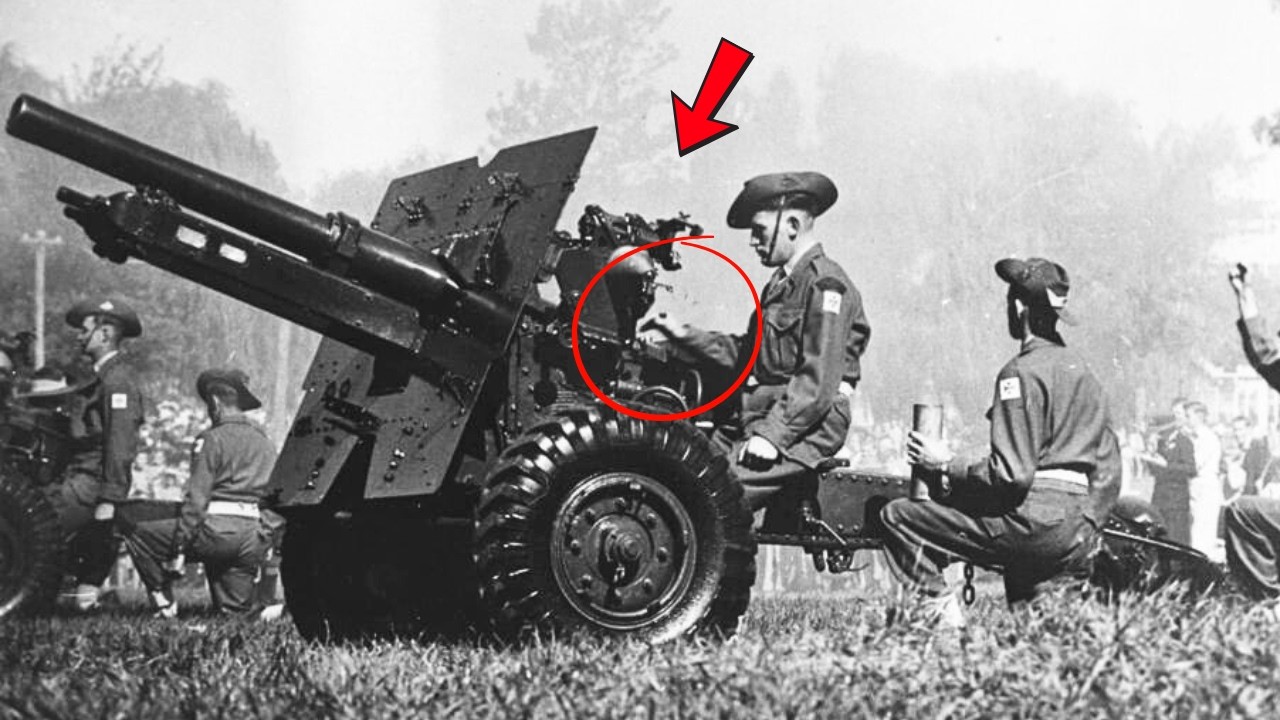
In New Guinea, none of those things existed reliably. When Australian infantry called for artillery support, the average wait was between 23 and 45 minutes. In a close jungle fight, 23 minutes meant the battle was already over. Men died in the first three. So, here was the situation. The Australians had a gun that could hit a target at 1,000 yd with devastating accuracy.
And they were fighting in a jungle where most engagements happened at under 150 yd, where Japanese bunkers were 30 m from Australian infantry. And where the gun’s own minimum safe range made it useless for the one job that needed doing. The doctrine said the gun was an indirect fire weapon. The jungle said the doctrine was wrong.
And the men dying in between those two facts needed someone to notice the gap and do something about it. That someone was Sergeant Tom Callaghan. And the reason he could see the gap when trained officers could not comes directly from where he grew up and what he did before the war. Tom was born in 1914 in Broken Hill, a hard mining town in Outback New South Wales, where the ground gave up silver, lead, and zinc if you were willing to go deep enough to get it.
His father worked the mines. Tom worked alongside him from the age of 14, operating ore-crushing machinery, learning that heavy equipment either obeyed you or it killed you. He developed an instinct for how force moves through metal and stone, not from textbooks, but from years of feeling it through his hands.
When he left Broken Hill at 19 to train as a boilermaker’s apprentice in Sydney, he brought that instinct with him. He spent years building industrial pressure systems, learning to hear when metal was close to its limit. In his spare time, he shot competitively rifles at distances from 100 to 600 yd. And somewhere in those years on the range, he absorbed a truth that most people never think about.
There is a difference between what a weapon is designed to do and what it is actually capable of doing. Those two things are not always the same. He enlisted in September 1939. The army put him in artillery. By 1941, he was a gun sergeant with combat experience in North Africa, fighting through the siege of Tobruk.
And it was there in Libya that the idea first appeared in its earliest form. A German tank advance came within 300 yd of Tom’s position. In desperation, the crew swung the gun for direct fire, flat trajectory, zero elevation, pointing straight at the tank like a rifle. Tom made the adjustments in under 2 minutes.
Two rounds through the side armor of a Panzer three at 280 yd. The tank burned. The advance stopped. A report was filed and forgotten. But Tom did not forget. He kept thinking about it across two years and two continents. What it meant that the gun could do that. What it meant that the doctrine did not allow it. And what it meant for the men who were dying because the manual said the gun had to stay 1,000 yd back.
Then came the night that made thinking about it no longer enough. Late June 1942. A Japanese night infiltration force hit an Australian forward position. The infantry called for artillery. The radio was dead, moisture damage. A runner sprinted 2 km to the gun line. A fire mission was calculated and fired. 23 minutes elapsed.
Tom’s closest friend, Corporal Eddie Walsh, was dead. So were four other men. The shells landed perfectly on target, right where the Japanese had been 8 minutes ago. Tom sat with Eddie’s body until sunrise. He did not write in his diary. He did not need to. The case for waiting was gone. He already knew what he was going to do.
The idea came to him the next morning while watching men carry a stove up a hill. Tom was sitting in the mud, a watching a work party of infantry pioneers struggle up a slope with a field kitchen stove broken into pieces, top, body, legs. Each piece carried separately, reassembled at the top. It was slow and awkward, and it was working.
He thought about the mines at Broken Hill. The massive ore-crushing machines built underground, carried down through shafts too narrow for the whole machine, assembled piece by piece in the dark. Every large industrial system he had ever worked on had been moved the same way. You broke it down because that was the only way to get it where it needed to go.

He thought about Tobruk, about the flat crack of the 25-pounder at zero elevation, about the Panzer three burning at 280 yd. He got up and found his notebook. The 25-pounder could be broken into three main sections. The barrel, approximately 450 kg. The cradle and breech mechanism, approximately 390 kg. The circular platform base plate, approximately 350 kg.
That was the gun alone without its wheeled trailer, which stayed behind. The trailer was what made the gun a vehicle-dependent weapon. Without it, the gun became something you could carry. Total disassembled weight, roughly 1,200 kg, spread across carrying parties working in relay. With 20 men per main load, the gun could move through terrain that no vehicle could touch.
The question was whether it was worth it. Tom did the math. A Japanese log and earth bunker could absorb 20 to 40 mortar rounds and keep fighting. That the same bunker would not survive two direct fire rounds from a 25-pounder at close range. The gun firing flat at 200 yd was not artillery anymore. It was a bunker killer.
Two rounds versus 40, the gun was worth carrying. He went quietly to Lieutenant Alan Forsyth, a young troop commander who had just watched a platoon get destroyed trying to assault a fortified position without artillery support. Tom laid it all out. The portage plan, the direct fire calculations, everything. Forsyth listened.
When Tom finished, Forsyth said, “If Whitmore finds out before we have results, we are both facing a court-martial. So, we had better have results.” They ran unofficial trials in a ravine far enough from headquarters that direct fire shots would not draw attention. Their cover story was ammunition fusing tests. So, it was not entirely a lie.
The first trial failed. Disassembly and carry worked. Reassembly took 47 minutes, far too long. The traverse gear was fouled with grit, exactly as Vic Pearson, a corporal from the Royal Australian Electrical and Mechanical Engineers, had warned. Tom wrote out a standardized disassembly and reassembly procedure that evening.
Three pages of handwritten steps with diagrams. They would practice it until it was automatic. Second trial, 22 minutes, still too slow. The platform was the bottleneck, heaviest, most awkward. Tom and Pearson fabricated a carrying harness from canvas, straps, and timber poles pulled from a destroyed plantation building.
No Quartermaster’s catalog, no official name. It distributed the platform weight across eight men instead of four. Third trial, direct fire against a constructed bunker at 150 yd. First shot missed left by 4 yd. Second shot was a direct hit. Front face of the bunker collapsed. Third shot destroyed the interior. Three rounds. Tom wrote in his notebook that night, “Bunker dead.
Our men would have taken 20 minutes and God knows how many casualties to do the same job. I think we have something.” Fourth trial, the full sequence from disassembly to first round fired took 34 minutes. Tom wanted 28. He did not get there. But before another trial was possible, the war stopped waiting for them to be ready.
August the 26th, 1942. The Japanese had been ashore at Milne Bay for less than 24 hours, and the situation was already close to breaking. Roughly 1,900 to 2,000 Japanese Special Naval Landing Force troops had come ashore in the dark, moving fast along the only real track in the area, a narrow coastal strip between the jungle and the beach.
They had brought Type 94 tankettes with them, small vehicles by European standards, but in single-file jungle on a track wide enough for one vehicle, they were devastating. Australian infantry had the Boys anti-tank rifle. It was not working. Rounds were bouncing or failing to penetrate. The tankettes kept moving toward number three strip, the main airfield.
If the airfield fell, the Japanese had what they came for. Here is what makes this moment the heart of this video. The standard response to tanks was artillery, but conventional artillery at 1,000 yd minimum range fired in an arc, and could not engage targets moving along a narrow jungle track with Australian infantry on both sides.
The 25-pounder used the way the doctrine said to use it was no help at all. The only way the gun could stop those tankettes was the way Tom had been quietly working toward for months, flat, direct, close, 240 yd instead of 1,000. A rifle shot instead of an artillery arc. Lieutenant Forsyth found Tom at 9:30 that evening.
Two tanks on the track, infantry behind them, our boys falling back. “Can you do it?” Tom said yes before Forsyth finished asking. He took his six-man crew and 22 infantry soldiers pulled from a reserve platoon. They began breaking down the gun at 9:45. The conditions were brutal. 28° humidity near 100%. Breathing felt like drinking.
No moonlight, no light at all except one shielded torch that Pearson carried, pointed only at the mechanism. They worked by feel and memory, Tom’s written procedure living in their fingers from weeks of drilling. Twice the sound of the Type 94 engines came through the jungle, a flat, rattling diesel sound, closer the second time. Nobody said anything.
They worked faster. The ground fought them. Mud swallowed footing. Tree roots crossed the track like tripwires. The men carrying the platform fell twice. The second time, Tom heard a sharp ring of metal on root and ran his hands over the entire base plate in the dark, feeling for cracks, no fracture. He breathed once and told them to keep moving.
They reached the firing position at 10:38, a natural hollow at the track’s edge with a clear 240-yd sightline down the main Japanese approach. Tom had chosen it from memory during planning, had already calculated that the coconut palms to the left would block 15° of traverse and adjusted the position 3 m right to compensate.
That detail had lived in his notebook for four days. Reassembly, 26 minutes, their fastest. Tom laid the gun himself. Armor-piercing round loaded, he told his crew, “We are not lobbing this one. We are throwing it straight like a rifle. You see it, you aim for it, you hit it.” At 11:12, the first tankette appeared.
240 yd, visible mainly by the muzzle flash of its machine gun working over Australian positions to the right. Moving at roughly 5 km/h, Tom fired. The sound was nothing like regular artillery. Every man there later struggled to describe it, flat and hard and industrial, like a very large door being slammed inside a metal building.
The concussive wave hit every chest at the same moment. 240 yd in under half a second. The round struck the tankette at the junction of the left track assembly and forward hole. The vehicle stopped. The machine gun went silent. Second round, same point of aim, hole penetration. The tankette burned.
Orange light flooded 200 yd of track in both directions, and suddenly Tom could see everything. The second tankette was at 310 yd, reversing. Third round, engine deck. It stopped. Fourth round, 15 seconds later, it burned. The Japanese infantry advance stopped. Six rounds, 4 minutes, two tankettes destroyed, zero Australian casualties. This is what the title of this video means. 1,000 yd, what the doctrine said.
240 yd, what the Australians did. The gap between those two numbers is where the battle was won. Private George Atkins, watching from the defensive line, said afterward he thought Australian tanks had arrived. A platoon commander walked to Tom’s position at first light, stood looking at the two burning hulks for 30 seconds, and said, “How close were you to them?” “240 on the first one,” Tom said.
The officer said nothing for a moment. Then he said, “Christ.” Tom knew it worked. He had known since the notebook, since the trials, since Tobruk, if he was honest. Well, but there is a difference between knowing something in calculations and watching it happen 60 m in front of you in the dark. He stood behind his gun and felt, just for a moment, something close to calm.
Then he started thinking about what came next because proving it to himself was one thing. Proving it to everyone else was going to be harder. Major Whitmore found out within 6 hours. He arrived at the gun position while the two burned out tankettes were still trailing smoke. 240 yards down the track, still visible, still warm.
He looked at them. He looked at the gun. He looked at Tom. His first question was not well done or good work. It was, he did what? The questions that followed were controlled and precise. Why were the guns that far forward? What if the position had been overrun and the Japanese captured a functioning 25-pounder? Did Callaghan understand he had conducted an unauthorized tactical modification to his assigned role? Whitmore filed an internal report, not a court-martial, but a formal notation recommending both Tom and Forsyth be
officially cautioned. The arguments that came back down from brigade level were organized and legitimate. The 25-pounder was not designed for repeated field disassembly. Doing it regularly would wear precision components. Gun crews operating within small arms range of enemy infantry were outside their training and dangerously exposed.
If every sergeant could decide what the 25-pounder was for, artillery doctrine would collapse. And there was no time to retrain gun crews in unauthorized techniques during an active campaign. Tom acknowledged every one of these arguments privately. He wrote in his notebook, they are not wrong about the risks.
They are wrong about the alternative. The alternative is dead men. What the arguments never said, what not one of them claimed directly, was that the technique did not work because two burned tankettes and a stalled Japanese advance were not theoretical. They were sitting 240 yards down the track. The doctrine said 1,000 yards minimum.
The evidence said 240 yards worked. Nobody could argue with the evidence, so they argued with the process instead. This is worth pausing on because it is one of the most recognizably Australian moments in the entire story. The willingness to ignore a rule book when the rule book is getting people killed is not unique to Tom Callaghan.
Well, it runs through Australian military history like a thread. From the Western Front where Australian commanders pushed back against British tactical doctrine that was wasting lives to Tobruk where the garrison held against conventional military wisdom that said the position was indefensible. Australians have a documented cultural habit of looking at official instructions and asking, yes, but does it actually work? Tom was not a maverick.
He was a product of a military culture that had always trusted results over regulations when the two came into conflict. Brigadier John Field came personally to the gun position about a week after the engagement. He walked the same muddy track Tom’s crew had carried the gun along in the dark. He stood at the firing position and looked down the sightline at the wreckage for several minutes without speaking.
Then he found Tom and said, show me how you did it. Start [snorts] from the beginning. Tom showed him everything. The disassembly sequence, the carrying harness, the load distribution, the direct fire calculations, why a flat trajectory at close range was actually more accurate than an arcing indirect fire shell, why the danger zone for friendly troops shrank rather than grew when the gun was used this way.
He showed Field the notebook. Field was an infantry commander, not an artilleryman. He did not have 20 years of artillery doctrine to push back against. He listened the way a man listens when the answer determines whether his soldiers live or die, quietly, precisely, asking questions only when something was unclear.
When Tom finished, Field said he was going to lose the cautioning report. He said he lost paperwork all the time. He was quite careless that way. Then, how long to train another gun crew to do this? Tom said 2 weeks for a competent crew. Field said, you have 1 week. Pick your best crews. The validation that followed did not arrive cleanly.
It arrived through accumulation, through results that became too heavy to argue against. Over the remaining days of the Battle of Milne Bay, ending on the 7th of September, Tom’s method was used in six further engagements. Three bunkers destroyed in one supported assault on the 3rd of September with two Australians wounded compared to an estimated 20 or more casualties in an equivalent unsupported assault.
Each engagement added to a record that was becoming impossible to dismiss. By October, Major Whitmore, the same officer who had filed the cautioning report, submitted a new document upward through the chain of command. A tactical recommendation. It argued that direct fire and forward portage techniques should be formally incorporated into artillery doctrine for the New Guinea theater.
The report drew directly on Tom’s engagements. It did not mention that Whitmore had initially tried to have Tom cautioned for the same activities. Tom read the report when Forsyth showed it to him. He was quiet for a moment. Then, better late than never, I suppose. The accumulation of evidence had done what argument could not, made the case against it impossible to hold.
Results had finished the argument the way results always finish arguments when the stakes are high enough that nobody can afford to keep pretending. The Japanese were not slow learners. By November 1942, their commanders had noticed something in their after-action reports that did not make sense. Australian infantry was receiving artillery support in terrain where artillery support was supposed to be impossible.
Large-caliber direct fire weapons were appearing without warning at ranges that should have been safe from any gun that size. Japanese officers understood what this meant even if they could not yet explain how. Their response came in construction orders. Bunker overhead cover increased from 1 to 2 feet of earth and timber up to 3 and 4 feet.
Sidewalls were angled to deflect direct fire rounds. Concentrated bunker complexes were replaced with dispersed single-weapon positions connected by covered crawl trenches. Japanese mortar crews received specific orders to blanket any area where close artillery fire was heard. It was a tactically intelligent response.
Tom read the implications in the changing shape of the positions his crews were being asked to destroy, and he adapted. The heavier overhead cover was the most immediate problem. A standard high-explosive round with an instantaneous fuse would detonate on the first layer of earth and waste most of its energy upward.
Tom switched to a two-round sequence. Armor-piercing first to punch through the overhead protection followed immediately by high-explosive with a delay fuse set to detonate after penetration. The armor-piercing round made the hole. The delay high-explosive went through the hole and exploded inside. Two rounds, 8 to 10 seconds apart, and defeated overhead cover that previously required an air strike.
Tom wrote the sequence onto separate sheets and began distributing copies to other crews. He developed what he called in his notebook the ready position concept. Rather than man-packing the gun from the rear each time, teams went forward before any operation began. Cut a flat platform from the vegetation, surveyed the angles, and marked the spot.
The gun went straight to the prepared position when the assault came. It cut set up time by roughly 8 minutes on average. In a close jungle fight, 8 minutes was the difference between supporting the first wave and supporting the men sent to recover the casualties. Against the mortar counter-battery threat, Tom built displacement drills into his crew’s routine.
After a firing sequence, the crew would shift the gun 15 to 20 m laterally. Not a full portage, just enough movement to defeat a mortar crew ranging in on the original sound. He also developed a combined technique with the infantry’s 2-in mortar teams. Smoke rounds fired at bunker apertures while the gun relayed, blinding defenders for the 15 seconds the crew needed to adjust.
Not in any manual, worked every time. Word spread the way useful things spread in a war. Soldiers talking to soldiers. Gunners from other troops visited Tom’s position during rest periods, watched the crew drill, returned to their own units, and began running the same procedures with the same improvised carrying harnesses.
A New Zealand corporal named McFarland spent 2 days with Tom’s crew in December 1942, wrote a detailed letter to his own troop commander, and then had his own crew conducting forward portage operations within 3 weeks. The letter survives in part in the New Zealand Army Museum. It does not mention Tom by name.
It describes the technique as something the Australians had worked out, which was accurate enough. By February 1943, at least four Australian field artillery troops in New Guinea were conducting direct fire and forward portage operations with no formal training in either technique. They had learned from each other, the way soldiers have always learned the things that actually keep them alive.
If this is the kind of story you come here for, men solving impossible problems with the tools already in their hands, subscribe to the channel and hit the bell. There is more coming and you will not want to miss it. And Tom was increasingly being pulled from his own crew for advisory visits to other units.
Not officially an instructor, but functioning as one in every way that mattered. He did not mind the traveling. He minded the leaving. Every day away from his crew was a day they operated without him in jungle that did not forgive mistakes. He came back from each visit and ran the crew through full drills before allowing himself to sleep.
Harold Renny, his loader from the Milne Bay night, said Tom always came back from those visits quieter and more watchful, as if he had been turning something over the whole way. Renny never asked what it was. Tom never said. The technique was no longer his alone. That had always been the point. But there was a cost to its spreading.
Tom could no longer control how carefully it was used. He had written the procedures clearly. He had trained people as well as time allowed. What happened after that was in other hands, in other jungles, in the dark. He accepted that. He had learned in the minds that once a method left one pair of hands for another, it belonged to everyone and to no one.
All you could do was make sure the first pair of hands had done the work right. The numbers tell the clearest version of what Tom’s method actually changed. Before the direct fire and forward portage technique became widespread, attacking a single Japanese bunker complex using infantry weapons and mortars alone cost between one and four Australian casualties per bunker.
Some positions held for days despite repeated assault. The 3-in mortar, the best close support weapon available without artillery, required 20 to 40 rounds to probably destroy a single well-constructed bunker. Artillery support through conventional indirect fire took 23 to 45 minutes from request to impact with accuracy errors of 50 to 150 yd common in jungle conditions.
After the technique spread, those numbers changed decisively. A bunker that previously required 20 to 40 mortar rounds and multiple casualties was being destroyed in two to four direct fire rounds in three to eight minutes. In supported assaults, estimated Australian casualties ran 40 to 60% lower than in comparable unsupported assaults during the same period.
At ranges under 400 yd, the 25-pounder achieved accuracy within 3 to 5 yd of point of aim. The 23-minute wait collapsed to under 5 minutes for a pre-positioned gun. The comparison with alternative methods makes the advantage sharper still. Flamethrowers required operators to approach within 20 to 30 yd of a still fighting position.
Effective, but the casualty rate among operators was severe. Engineers placing explosive charges faced the same problem, crossing open ground covered by the weapon they were trying to destroy. Royal Australian Air Force P-40 fighters could not accurately engage targets under jungle canopy and could not operate within the minimum safe distances required in close contact situations.
Each alternative had its place. None of them could do what a direct fire 25-pounder at 240 yd could do. Put a specific round through a specific aperture in a specific wall from a position that a rifle section could protect. Sergeant William Hartley of the 2/4 Field Regiment demonstrated this at the Battle of Lae in September 1943.
His crew man-packed a 25-pounder across 4.2 km of jungle track over 8 hours. The mud on Hartley’s boots when he reached that firing position was the same mud Tom had walked through a year earlier, 200 km to the southeast. They assembled the gun and destroyed six Japanese bunkers in 22 minutes. An infantry advance stalled for 3 days moved forward within the hour.
Hartley was mentioned in dispatches for exceptional determination. The citation said nothing about 8 hours of roots and mud and the weight of 450 [snorts] kg of barrel carried on a timber frame by men who had been fighting for weeks. Lieutenant Colin Burke of the 2/5 Field Regiment refined the carrying harness during the Finisterre Range operations in late 1943, redesigning the load distribution to reduce the platform carry from eight men to six, freeing two men for ammunition carrying, and increasing the rounds
available at the forward position. Burke’s modification was adopted across multiple units within weeks. By early 1943, the Australian Army had issued an amended tactical instruction formally sanctioning direct fire roles for the 25-pounder in jungle terrain. The language was careful and institutional. It described the technique as emerging from experience gained during operations in the Southwest Pacific Area and noted that the 25-pounder had been successfully employed in direct fire roles at ranges previously considered operationally
inadvisable. It did not name Tom Callaghan. Doctrine rarely names anyone. Shortly after, a formal jungle artillery training program was established at the Land Headquarters Tactical School at Canungra in Queensland. Forward portage and direct fire procedures were now curriculum, printed in training materials, taught to gun crews who would carry the knowledge forward.
Tom spent 3 weeks at Canungra helping develop the curriculum. His name does not appear in the course documentation. Captured Japanese 18th Army documents from 1943 included a formal order requiring all defensive positions in New Guinea to increase construction standards, heavier overhead cover, dispersed layouts, improved aperture protection, citing the threat of enemy direct fire weapons in terrain previously considered safe from artillery.
It was the Japanese Army’s formal acknowledgement that a sergeant from Broken Hill with a notebook full of calculations had forced them to rebuild their defensive doctrine from the ground up. They did not know his name. The result was the same regardless. By 1944, what Tom had built from a notebook and a stove carry and a dead friend’s memory was simply how things were done.
New gunners arrived from Australia already trained in forward portage and direct fire. They learned it at Canungra from instructors who learned it from men who learned it from Tom or from men who learned it from those men. The chain was two and three links long and the new crews did not know where it started. They did not need to.
They arrived knowing how to disassemble a 25-pounder in the field, distribute the weight across a carrying party, lay the gun for direct fire at close range, sequence armor-piercing and delay high explosive against heavy overhead cover. They knew it the way a tradesman knows how to hold his tools. It had become craft. It had become ordinary.
And somewhere in that ordinariness was the clearest possible measure of how completely the idea had succeeded. The 25-pounder, once a 1,000-yd indirect fire weapon, was now routinely positioned at 200 yd and pointed flat at the enemy and nobody thought that was unusual anymore. Tom had been promoted to warrant officer class two.
The promotion acknowledged his expertise and the fact that men followed his judgment in situations where following the wrong judgment meant dying. But it had come slowly. Slower, Forsyth said privately, than it should have for a man who had redesigned how his unit used its primary weapon. Tom said a gun fired the same way whether a warrant officer or a sergeant stood behind it and the shell did not care either way.
Which was true and which was also what a man says when he has decided not to spend energy on something he cannot change. He served through the Aitape-Wewak campaign in 1944 and into 1945. The final major New Guinea proper operation grinding against Japanese 18th Army soldiers who were starving, diseased, and and still fighting with a discipline Tom respected in the way you respect something that is trying to kill you.
The jungle had not changed. The mud was the same mud. Sometimes he watched young gunners run procedures he had written in a plantation outhouse two years earlier, now printed in clean manuals with official stamps, and he felt something he could not name precisely. Not pride, something quieter. In February 1945, a Japanese mortar around landed 35 yd from Tom’s position during a resupply operation.
Shrapnel tore through his left forearm and shoulder. Pearson pulled him clear and got a field dressing on it. Tom was evacuated to a field hospital, told the medical officer his crew was operating without him, and returned after 3 weeks, faster than regulations allowed, slower than he wanted. The wound left reduced strength in his left hand.
He adapted, adjusting which tasks he handled personally and which he passed to crew members whose hands were undamaged. Renny said later, “You would not have noticed anything different watching Tom work except he favored the right side slightly and occasionally paused when lifting the breech mechanism just long enough to reset his grip.” August 1945.
Japan surrendered. Tom was near Wewak when the news came by radio. Men were shouting, some crying, one laughing in a way that could have gone elsewhere. Tom sat on an ammunition crate and was quiet for 5 minutes. Then, “Right, let’s make sure everything is properly secured before we move out.” And that was the end of it.
Captain Forsyth filed a recommendation for the military medal in September 1945. The Milne Bay engagement, the six follow-on engagements, the curriculum development at Canungra, the training network that had spread the technique across four artillery troops before it was formally recognized. It came back with a note.
The actions described occurred in the context of standard artillery operations and did not meet the threshold for individual recognition. Tom received two mentions in dispatches, the 1939-45 Star, the Pacific Star, and the War Medal. He was discharged at Holsworthy Barracks in December 1945 aged 31. He shook hands with Renny on the parade ground.
Renny said he intended to sleep for approximately 1 year. Tom said that sounded about right. He walked out through the barracks gate carrying his kit bag in his right hand, the stronger one, and did not look back. Tom Callaghan went back to boilermaking. He found work quickly at a manufacturing firm in Western Sydney making industrial pressure vessels, the same heavy metal systems he had worked on before the war.
His employer noted that he was unusually calm under pressure, precise in his measurements, and reluctant to explain how he knew what he knew. He simply knew it and the work showed it. He married in 1947, Margaret, a school teacher from Parramatta, the kind of person who asked good questions and waited long enough to actually hear the answer.
Three children, a small solid house close enough to the factory to walk, which he did every morning for 23 years. Neighbors remembered a quiet man who kept his garden well and could fix almost anything mechanical. Anything that involved understanding how force moves through a material and what to do when it moves wrong.
He attended regimental reunions through the 1950s and 1960s. Renny came to most of them. Forsyth came when his health allowed, which became less often. The reunions were loud in the early years and quieter as the gaps filled in. Tom did not make speeches. He sat and listened and occasionally someone told a story involving his gun or his crew or the night at Milne Bay and he would nod or correct a small detail of timing or distance and the conversation would move on.
Margaret said he mentioned the guns occasionally at home, not often. Once, helping their youngest with a school project on levers and mechanical advantage, he said the most important thing he had learned in the war was that if something is not working, you do not wait for permission to try something else. You try it and tell them afterward.
He thought this was probably a universal principle. Their son wrote it down. Tom seemed faintly embarrassed. In 1978, an Australian Army historian came to the house with a tape recorder and spent 3 hours asking about Kokoda, Milne Bay, and the development of forward portage techniques. Tom answered directly, corrected dates when he was sure, said so honestly when he was not.
The recording went to the Australian War Memorial Archive in Canberra. Tom never listened to it. He saw no point in listening to himself talk when he had already said everything. The historian asked whether he felt he received appropriate recognition. Tom’s answer, preserved on the tape, “Recognition for what specifically? I pointed a gun at something and fired it.
Other men thought it was a useful idea and they did the same. That is how things work in a war. You are not doing it to be recognized. You are doing it because the men deserved better than the alternative. Recognition is a peacetime concept. We were busy.” Asked whether he felt frustrated by the early institutional resistance, “Of course. Every day. But frustration is energy.
You either spend it complaining or you spend it working. The work was more satisfying.” He retired in 1974 and died in 1991 aged 77 in the same house he had bought in 1951. His obituary mentioned his military service in two sentences. It said he served in the artillery. It did not say what he did with it. The historical record caught up eventually.
In 1998, military historian Dr. Peter Dennis identified the forward portage and direct fire method as one of the most significant Australian tactical contributions of the Pacific War. Emerging from NCO level improvisation, rather than institutional design. In 2004, the Australian War Memorial’s Kokoda exhibition included photographs of disassembled 25-pounders being man-packed through jungle.
The gun broken into the same three loads Tom had calculated in his notebook. In 2012, a retired Australian Army Colonel writing in the Australian Army Journal argued explicitly that the principle of artillery operating at direct fire range within small arms distance of the enemy, now embedded in Australian land doctrine, had not been developed in a training school.
It had been developed in a Papuan jungle by men who needed it to work and had no time to wait for permission. But the guns that replaced the 25-pounder in Australian service were specifically designed for disassembly and air transport. The ideal that a field gun must be capable of being broken apart and carried wherever it needs to go, which was unusual enough in 1942 that a sergeant could be cautioned for suggesting it, is now built into the specifications before the weapon is manufactured.
The lesson traveled from a notebook in a plantation outhouse to a training manual to a curriculum to a design requirement. Moving forward through time the way knowledge moves when it has been proven the hard way, not as theory, but as fact, stamped in results that nobody could argue with. The 25-pounder was designed to reach targets at 1,000 yd.
The Australians fired it at 240. That gap, 760 yd of doctrine, of institutional assumption of what everyone agreed the weapon was for, was the space where the battle was won. Not by a genius working in isolation, not by an institution that recognized the problem and solved it from the top down, by a boilermaker from Broken Hill who grew up learning that heavy machines could go anywhere if you were willing to break them down and carry them.
Who stood at a firing position in the dark with a dead friend’s name in his head. And who looked at the gap between what the gun was supposed to do and what it was capable of doing, and asked the one question that has always mattered more than any doctrine ever written. Why not?