
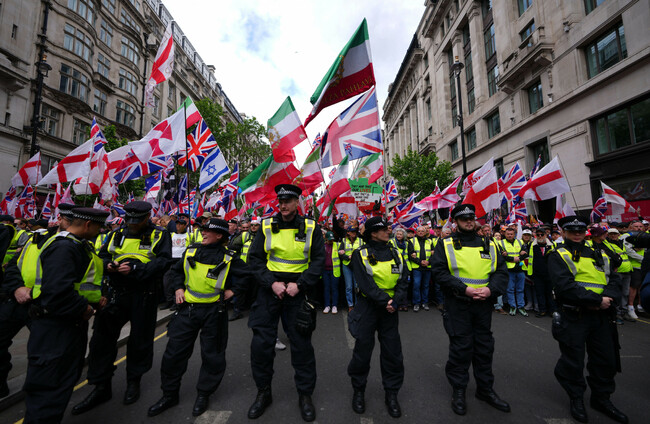
THOUSANDS OF PEOPLE have descended on London for two major demonstrations amid a huge £4.5 million (€5.17 million) police operation.
The Metropolitan Police have estimated about 50,000 people are set to attend far-right activist Tommy Robinson’s Unite the Kingdom march, while 30,000 are expected to go to the pro-Palestine Nakba Day rally.
Armoured vehicles, police horses, dogs, drones and helicopters will be deployed along with around 4,000 officers on duty as the Met aims to avoid clashes between the two rallies.
Eleven people have been arrested “for a variety of offences” at both marches as of 1pm, the Met Police said.
This includes two men who arrived in London to attend the Unite the Kingdom march who were arrested in the vicinity of Euston station over an unrelated incident in Birmingham, police said.
“Two men, wanted on suspicion of GBH following an incident in Birmingham where a man was run over, were spotted arriving into London to attend the UTK protest,” the police said on X.
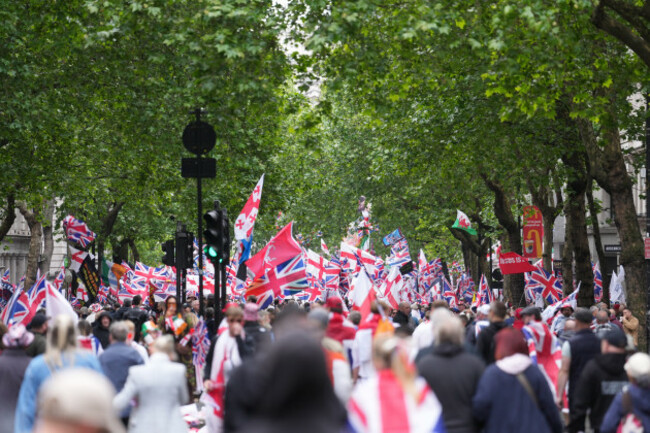
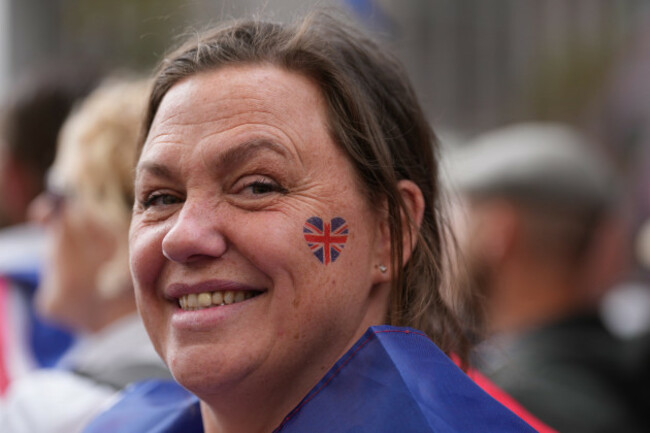
Many attending the Unite the Kingdom march could be seen waving Union flags, while protesters in South Kensington were carrying Palestine flags and signs reading “smash the far right” for the pro-Palestine rally.
Chants of “Keir Starmer’s a wanker” and “we want Starmer out” could be heard at Robinson’s march, with some wearing “Make England Great Again (Mega)” red hats – a play on Trump’s Maga slogan.
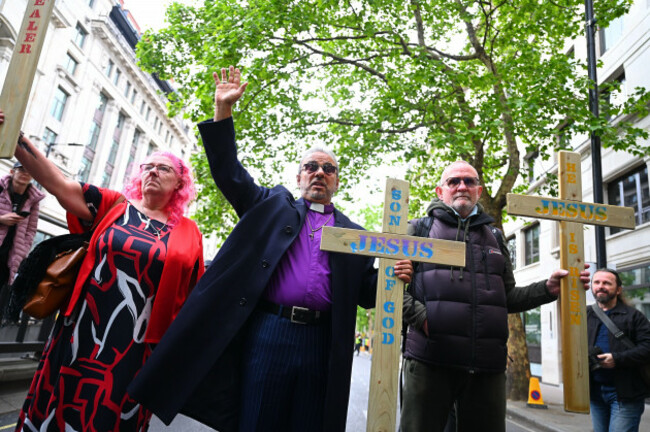
Some at the front of the march were carrying wooden crosses and chanted “Christ is king”, while others threw beach balls and drank cans of alcohol as they waited for it to begin.
At the pro-Palestine protest, a large group of protesters carrying banners and placards reading “Bristol stands with Palestine”, “Stop Trump, Stop Farage”, and “Free Palestinian Hostages” gathered with many wearing keffiyehs.
A woman has been arrested after she appeared to refuse to remove a fabric face mask she was wearing at the pro-Palestine protest.
She was part of a group of protesters who were all asked to remove fabric and surgical face coverings.
A separate group, who were wearing orange jumpsuits with masks over their faces bearing a photo of Reform UK leader Nigel Farage, were also asked to remove their masks.
Robinson, whose real name is Stephen Yaxley-Lennon, has a string of criminal convictions and a big online following years spearheading a fervent anti-Muslim and anti-migrant agenda. He increasingly fuses those themes with claims that Britain is now hostile to free speech.
He posted on X this morning saying “today, we Unite The Kingdom and the West in the greatest patriotic display the world has ever seen”.
Meanwhile, Daniel Kebede, National Education Union general secretary, said “we’re marching today to show that we will not allow Tommy Robinson and the far right to divide our communities”.
Sabby Dhalu, Stand Up To Racism co-convener, said: “Violence broke out the last time Tommy Robinson’s Unite the Kingdom demonstration mobilised what was one of the largest far-right street demonstrations in recent British history.
“This comes amid wider attempts by figures such as Elon Musk to amplify far-right narratives and encourage political instability.
“The far right is attempting to exploit the cost-of-living crisis by stirring up racism and falsely blaming migrants and refugees for people’s hardships in order to build a dangerous street movement.
“History shows where this kind of politics can lead. That is why tens of thousands of people will mobilise today to oppose racism and the far right, and to demonstrate that the overwhelming majority of people in Britain reject hate and division.”
Justice Secretary David Lammy said authorities would act “swiftly” if protests turned violent.
In a post on X, he said: “The Unite the Kingdom march organisers are spreading hatred and division. They do not reflect the Britain I’m proud of.
Peaceful protest is a fundamental right and one I will always protect. But if protest turns violent, we will act swiftly, with extra court capacity in place.
Prosecutors have been told to consider whether protest placards, banners and chants viewed on social media may amount to offences of stirring up hatred during the rallies.
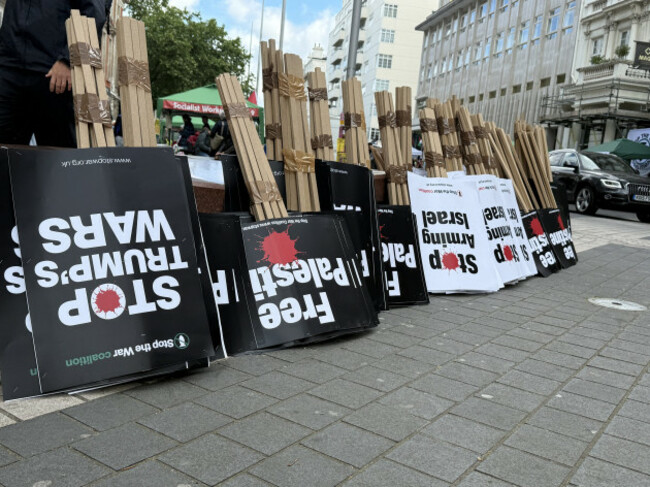
The new guidance, issued before what police have described as an “unprecedented” security operation, urges prosecutors to assess whether slogans, symbols or chants may influence audiences online if they are filmed and shared.
The Crown Prosecution Service (CPS) said the revised advice is designed to reflect “the changing international context” and follows separate guidance concerning the fast-tracking of hate crime prosecutions issued earlier this month.
The guidance tells prosecutors to take account of the wider context surrounding protests, including heightened tensions linked to national or international events.
Recent criminal cases have seen suspects charged after shouting “death to the IDF (Israel Defence Forces)” and “globalise the intifada”.
Director of Public Prosecutions Stephen Parkinson said “this is not about restricting free speech” and “it is about preventing hate crime and protecting the public, particularly at a time of heightened tensions”.
The British government has also blocked 11 foreign nationals described by Keir Starmer as “far-right agitators” from entering the UK ahead of the Unite the Kingdom rally.
Right-wing figures claiming to have been barred include Polish politician Dominik Tarczynski, Belgian politician Filip Dewinter, anti-Islam commentator Valentina Gomez and Dutch activist Eva Vlaardingerbroek.
Speaking during a visit to a Metropolitan Police command centre in Lambeth on Friday, Starmer said the Unite the Kingdom organisers were “peddling hatred and division, plain and simple”.
Met Commissioner Mark Rowley was also at the visit and told Starmer: “We’ve got a time when hate crime has been escalated for the last two or three years.”
Commander Clair Haynes also told Starmer that drones would be used to monitor both protest routes for “potential clashes or flashes” while officers in Wembley would monitor CCTV feeds from the FA Cup final to identify supporters travelling towards demonstrations.
For the first time under official protest restrictions, organisers of the rallies will face prosecution as well as any speakers who break the law by using the events as a platform for extremism or hate speech.
Live facial recognition will be used for the first time in a protest policing operation, with cameras set up in an area of Camden that is not on the route of the Unite the Kingdom march, but is expected to be used by a lot of people attending the event.
The Biometrics and Surveillance Camera Commissioner Professor William Webster told the Press Association police forces could find themselves taken to court over their use of the technology, saying it is not “foolproof”.
Metropolitan Police Deputy Assistant Commissioner James Harman said the policing operation will cost the force £4.5 million (€5.17 million), with £1.7 million (€1.95 million) being used on bringing in officers from other forces to boost numbers.
Meanwhile, the Metropolitan Police Federation said many officers have had leave cancelled and rest days withdrawn to meet policing requirements, adding: “There are not enough of us.”
At Least 11 Arrested as Thousands Descend on London for Two Major Protests
Large-scale protests have long been a defining feature of democratic societies. They provide citizens with a way to express political opinions, challenge government decisions, and bring attention to issues that they believe are being ignored. However, when multiple demonstrations take place in the same city at the same time, especially when opposing views are involved, authorities face the difficult task of protecting freedom of expression while maintaining public order.
The headline “At Least 11 Arrested as Thousands Descend on London for Two Major Protests” highlights a major day of political demonstrations in the British capital, where thousands of people gathered for two separate rallies. The events attracted significant attention because of the different causes involved, the large police operation required, and concerns about possible clashes between opposing groups.
London has a long history of political demonstrations. From campaigns over workers’ rights and economic issues to protests about international conflicts and social movements, public marches have played an important role in British political life. The right to protest is considered a fundamental part of democracy because it allows citizens to express views outside traditional political institutions.
However, managing large demonstrations is a major challenge for law enforcement. Police must ensure that protesters can exercise their rights while also preventing violence, intimidation, or disruption that could endanger the public. This becomes especially difficult when two groups with opposing views gather in nearby locations.
According to reports, the demonstrations required a significant security operation involving thousands of police officers, including specialist resources such as police horses, drones, helicopters, and other equipment. Authorities prepared extensively in an effort to prevent confrontations between rival groups and maintain safety across central London.
The scale of the operation demonstrated the seriousness with which authorities approached the situation. Large protests require careful planning, including controlling crowd movement, protecting key locations, managing traffic disruption, and responding quickly to incidents. The cost of policing major demonstrations can also become a subject of political debate, with questions about how public resources should be used.
One of the major demonstrations was organised by supporters of the Unite the Kingdom march, associated with far-right activist Tommy Robinson. The event focused on issues including immigration and national identity. Supporters argued that they were expressing concerns about government policy and the future direction of the country.
Opponents of the march criticised the event, arguing that some far-right movements promote division and hostility towards minority communities. Counter-protesters gathered to express opposition and challenge what they viewed as extremist messages. This created a highly charged political atmosphere in central London.
The second major demonstration was a pro-Palestinian Nakba Day rally. Participants gathered to express support for Palestinian rights and raise awareness about the situation in the Middle East. Organisers and attendees used the demonstration as a platform to call for political change and highlight humanitarian concerns.
The presence of two major demonstrations with very different political messages created concerns about possible conflict. Although protests are protected under democratic principles, disagreements between groups can sometimes lead to confrontations. Police therefore focused heavily on separating crowds and preventing situations from escalating.
Initial reports stated that at least 11 people had been arrested during the protests for a variety of offences. Later updates from police indicated that the total number of arrests increased as officers reviewed incidents connected to both demonstrations.
Arrests during protests often lead to debate about the balance between maintaining public order and protecting civil liberties. Supporters of stronger policing argue that authorities have a responsibility to prevent violence and protect citizens. They believe that individuals who break the law during demonstrations should face consequences regardless of their political views.
However, civil liberties groups often warn that police responses must remain proportionate. They argue that the right to protest is essential in a democratic society and that authorities must avoid creating situations where people feel discouraged from expressing lawful political opinions.
The events also highlight the increasing political polarisation seen in many countries. In recent years, debates over immigration, foreign policy, national identity, and social issues have become more intense. Political disagreements that once took place mainly in parliament or the media are increasingly visible on the streets.
Social media has contributed to this change by allowing political movements to organise quickly and attract large numbers of supporters. Online platforms can help people mobilise for demonstrations, but they can also increase tensions by spreading extreme opinions, misinformation, or hostile messages.
The role of political leaders is also important during periods of social tension. Governments must respond carefully when controversial demonstrations occur. They must protect democratic freedoms while making clear that violence, intimidation, and hate crimes are unacceptable.
Opposition parties may use large protests as evidence that public dissatisfaction is growing. Governments may argue that demonstrations represent only certain groups rather than the wider population. Understanding public opinion therefore requires looking beyond the size of a protest and examining broader evidence, including elections, surveys, and community discussions.
The media also plays a major role in shaping how protests are understood. Different news organisations may focus on different aspects of an event, such as the number of participants, the political messages, clashes, arrests, or police response. As a result, public perceptions of the same demonstration can vary significantly.
For the police, large protests provide operational challenges but also opportunities to demonstrate professionalism. Effective policing requires communication with organisers, clear rules, and careful decision-making. Officers must often make rapid judgments in complex situations where emotions are high and crowds are large.
The events in London also raise wider questions about social division. A healthy democracy allows disagreement, but societies must find ways to manage differences peacefully. Political debate becomes dangerous when opponents are viewed not as people with different opinions but as enemies who must be defeated.
Many experts argue that the best way to reduce political tensions is through open debate, strong democratic institutions, and addressing the underlying concerns that cause people to become frustrated. Ignoring public concerns can increase anger, while extreme responses can deepen divisions.
In conclusion, “At Least 11 Arrested as Thousands Descend on London for Two Major Protests” reflects a significant moment of political activity in the UK capital. The demonstrations showed the continuing importance of protest in British democracy while also highlighting the difficulties involved in managing large gatherings with opposing viewpoints.
The events demonstrated the complex balance between protecting freedom of expression and maintaining public safety. Protests allow citizens to participate in political debate, but they also require responsibility from organisers, participants, authorities, and political leaders.
Ultimately, the impact of such demonstrations is not measured only by the number of people who attend or the number of arrests made. Their deeper significance lies in what they reveal about public concerns, political divisions, and the challenges facing modern democracies. How societies respond to disagreement will continue to shape the future of democratic life.