

Andy Burnham Has Just Lost His Bounce — And Now He’s About to Bomb
For a politician who arrived in Downing Street promising a new beginning, Andy Burnham’s honeymoon has been remarkably short. His rise was built on a powerful political narrative: Labour had lost touch with ordinary voters, the cost-of-living crisis demanded urgent action, and Britain needed a government that appeared more energetic, more optimistic and more willing to intervene.
For a brief moment, that message seemed to work. Labour began to recover in the polls, Burnham enjoyed a surge in personal popularity and the so-called “Burnham bounce” gave his government an immediate sense of momentum. But the latest signs suggest that the bounce is already beginning to fade. Recent polling has shown Labour losing ground again, while Burnham’s personal ratings have come under pressure. 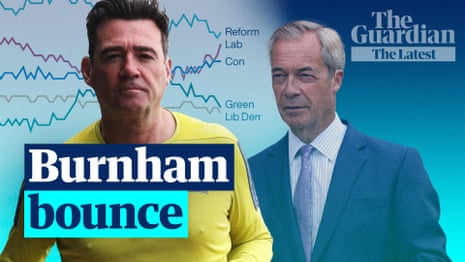
That matters because Burnham’s greatest political asset has never simply been his policies. It has been the belief that he is different. He presented himself as a politician who understood voters frustrated by Westminster, someone who could communicate in straightforward language and offer practical solutions to problems that had been allowed to grow for too long.
The danger is that once the novelty disappears, voters begin asking a much more difficult question: what has actually changed?
Burnham entered office with a series of attractive promises. He wanted to reduce the cost of living, make transport cheaper, tackle homelessness, reform social care and put greater emphasis on regional government. These are issues that affect people’s everyday lives, and they gave his administration a clear political identity.
But attractive announcements are easier than delivering lasting change.
The first few weeks of a new government are often the easiest. Ministers can announce initiatives, make speeches and present themselves as agents of change. The real test begins when the Treasury asks how everything will be paid for, when officials discover that reforms are more complicated than expected and when difficult choices have to be made.
Burnham is now approaching that stage.
One of the biggest problems is that his political programme is considerably more expensive than the early headlines suggest. Reducing household costs sounds simple until the government has to explain where the money comes from. Supporting public services sounds popular until ministers have to choose between competing departments. Building homes sounds straightforward until planning, infrastructure and funding become obstacles.
The government is therefore moving from the politics of promises to the politics of trade-offs.
That transition could be particularly dangerous for Burnham because his political image depends heavily on optimism. If he begins telling voters that his ambitions must be delayed, reduced or funded through higher taxes, some of the enthusiasm that brought him to power could disappear.
There are already signs of this tension. Burnham has been criticised for stepping back from some of the more radical commitments made during his rise to national prominence. His housing ambitions have been scaled back, his position on water nationalisation has softened and some constitutional reforms have been delayed.
None of these changes necessarily represents a disaster on its own. Governments have to adapt when they confront reality. But politically, they create a difficult impression. Burnham built his reputation partly on being the politician who would do things differently. If voters begin to see him as another leader making promises and then retreating from them, the central advantage of his brand could disappear.
The polling is therefore important.
At one point, Burnham appeared capable of giving Labour an immediate electoral boost. A poll in July showed Labour moving ahead of Reform, with the party benefiting from increased support after Burnham’s arrival. But subsequent polling suggested that the momentum was not permanent, with Reform returning to the lead in another survey.
That reversal should worry Labour.
Reform represents a particularly serious threat because Burnham cannot rely only on traditional Labour voters. His political strategy requires him to attract people who previously abandoned the party. Some of those voters are economically frustrated, sceptical about Westminster and willing to support whichever party appears most capable of offering change.
If Burnham fails to deliver, those voters have somewhere else to go.
This is why the next few months could be far more difficult than the first few weeks. The public has already seen the announcements. Now they want results.
Energy is an obvious example. Burnham’s government has promised measures intended to reduce pressure on household bills. Such policies are highly visible and can immediately improve the government’s popularity. But energy prices are influenced by international markets and wider economic conditions that the government cannot completely control.
If household bills remain high despite government intervention, voters may conclude that the promises were exaggerated.
The same problem exists with transport. Lower bus fares are easy to understand and potentially popular. But the government must ensure that the policy is financially sustainable and that cheaper fares translate into a better transport system rather than simply a larger public subsidy.
The more areas in which Burnham promises direct government intervention, the greater the pressure becomes on the public finances.
And Britain’s finances leave very little room for error.
The government is dealing with a huge national debt, high debt-servicing costs and substantial demands from public services. At the same time, defence spending is becoming increasingly difficult to postpone. Burnham is also expected to confront major challenges involving welfare, prisons, social care and housing.
These problems cannot all be solved with announcements.
Eventually, Burnham will have to choose between spending more, raising taxes, borrowing more or scaling back his ambitions. Every option carries political consequences.
Higher taxes could undermine his popularity among working households. More borrowing could alarm financial markets and future voters. Spending cuts would conflict with his promise to rebuild public services. Abandoning major pledges would damage his reputation for delivering change.
This is the trap facing the new Prime Minister.
His greatest political strength may also become his greatest weakness. Burnham has spent years presenting himself as the alternative to conventional Westminster politics. That gives him permission to promise more than a cautious politician might. But once he is responsible for the entire country, voters expect more than rhetoric.
They expect competence.
That is already becoming a critical issue. Recent polling has suggested that Burnham’s ratings for competence and decisiveness have weakened, even while he remains relatively well regarded compared with several other political leaders.
The distinction is important. Being liked is not enough for a Prime Minister.
A politician can be approachable, charismatic and popular while still losing public confidence if voters believe that the government is drifting. Burnham therefore needs to prove that his administration has a coherent economic strategy rather than simply a collection of popular interventions.
His supporters will argue that it is too early to judge him. That is fair. He has only recently entered Downing Street, and major reforms take time. It would be unreasonable to expect Britain’s deepest economic problems to disappear within weeks.
But politics rarely gives leaders the luxury of unlimited time.
Voters form impressions quickly. Opponents exploit mistakes immediately. The media moves on to the next story. A government that begins with momentum can lose it surprisingly fast.
Burnham’s greatest challenge will therefore be maintaining the sense of possibility that brought him to office while confronting the financial reality that limits what he can achieve.
The opposition will undoubtedly argue that the early “Burnham bounce” was never a genuine transformation, merely a temporary reaction to the arrival of a new face. They will say that Labour has not solved the problems that caused voters to abandon it in the first place. If those arguments begin to resonate, Burnham could find himself facing the same political difficulties that destroyed the popularity of previous governments.
There is, however, still an opportunity for him.
The fact that the bounce has weakened does not mean that Burnham is finished. His initial popularity demonstrated that many voters are willing to give Labour another chance under different leadership. His focus on living standards has also attracted attention beyond Labour’s traditional base. The challenge is to convert that goodwill into sustained confidence.
That requires results.
If families genuinely feel better off, if public services improve, if housing construction accelerates and if the government can demonstrate that its spending is financially sustainable, Burnham’s political position could strengthen again.
But if the government continues making ambitious promises while quietly watering them down, the opposite could happen. Voters may begin to see Burnham not as the politician who changed Westminster but as another Prime Minister who discovered that governing is harder than campaigning.
That would be a devastating reversal.
The most dangerous moment for Burnham may therefore not be an obvious scandal or a single disastrous policy. It could be the slow erosion of expectations. People who were initially excited may simply become less interested. Supporters may become disappointed. Floating voters may return to Reform or other alternatives. The government’s political energy could gradually disappear.
That is how a honeymoon ends.
Burnham still has time to prevent that outcome. But the window will not remain open forever. The government must now move beyond announcements and demonstrate that its promises can survive contact with the Treasury, the economy and the realities of government.
The “Burnham bounce” was useful because it created momentum. But momentum is not the same as success.
The real test begins when the easy victories are over and the difficult decisions arrive. If Burnham can make those decisions while preserving the optimism that brought him to Downing Street, he may yet establish himself as a formidable long-term Prime Minister.
If he cannot, the same voters who welcomed his arrival could quickly decide that the change they were promised was little more than another political illusion.
And that is why the next few months may matter more than the first few weeks. The bounce may be fading, but the real battle for Burnham’s political future is only just beginning.