
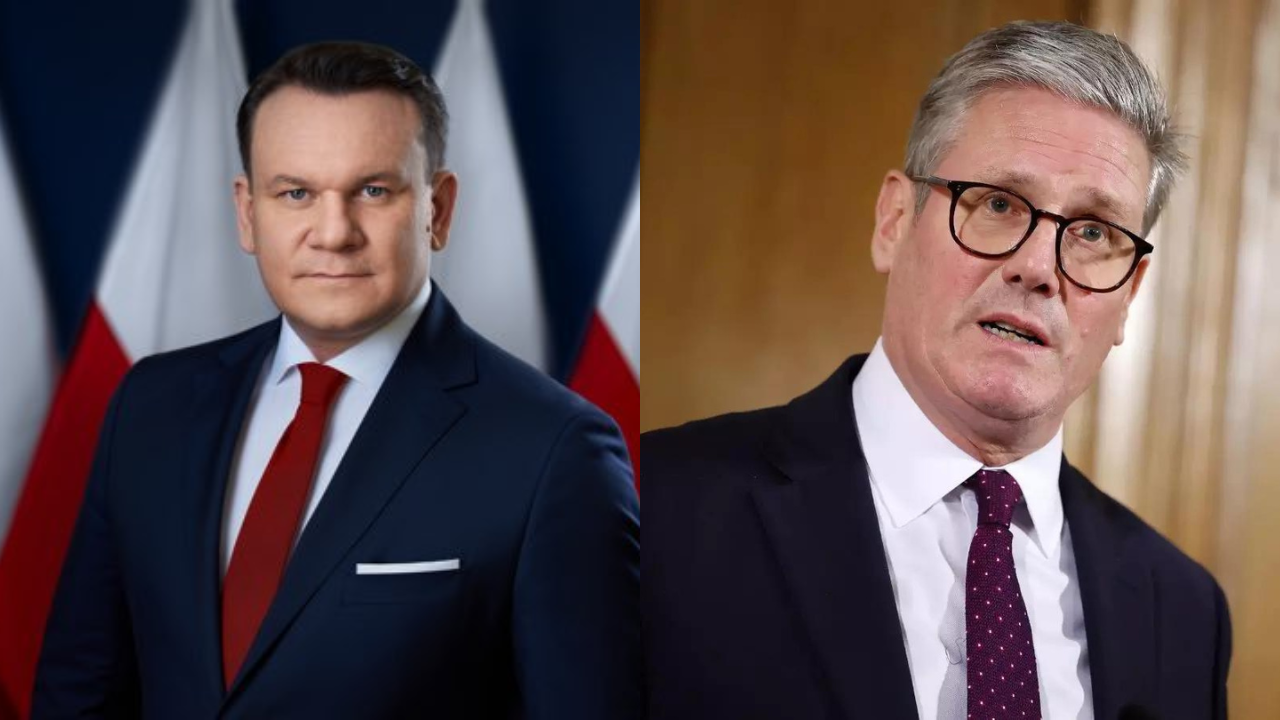
A Diplomatic Nightmare Explodes: Dominik Tarczyński Challenges Keir Starmer Over UK Entry Ban
A political confrontation between Britain and a Polish member of the European Parliament erupted in May 2026 after Dominik Tarczyński was prevented from entering the United Kingdom ahead of a major demonstration in London.
Tarczyński, a Polish MEP from the Law and Justice party, had been scheduled to attend and speak at the Unite the Kingdom rally associated with activist Tommy Robinson. British authorities cancelled his Electronic Travel Authorisation, effectively preventing him from travelling to Britain for the event. The Home Office said the presence of those excluded was considered not conducive to the public good.
Tarczyński responded with fury.
He accused Prime Minister Keir Starmer of attacking democratic freedoms and announced that he intended to take legal action against him personally. In a statement posted online, the Polish politician described the decision as “communism in the 21st century” and said he would sue Starmer after the next British election.
The confrontation immediately raised a much larger question.
How far can a democratic government go in restricting the entry of foreign political figures when it believes their presence could threaten public order or contribute to hatred?
And where does legitimate national security policy end and political censorship begin?
Those questions have made the Tarczyński case much bigger than a dispute over one politician’s travel plans.
The controversy began in the run-up to the Unite the Kingdom rally in London. The event was expected to attract a large crowd and had become a major gathering point for anti-immigration and nationalist activists. The British government had already signalled that it would take a tougher approach toward foreign figures whom it regarded as potential “far-right agitators.”
Starmer publicly defended the government’s position.
He said Britain would not allow individuals to enter the country if they intended to threaten communities or spread hatred on British streets. The government subsequently prevented several foreign political figures and commentators from entering the UK ahead of the demonstration.
Tarczyński was among them.
His political background made him a particularly controversial figure.
He is well known in Poland and in the European Parliament for his strongly anti-illegal-immigration position. He has also made provocative statements about multiculturalism and immigration, positions that have led critics to describe him as part of the European far right.
Tarczyński rejects that characterization.
From his perspective, the British government was not protecting democracy—it was preventing an elected European politician from speaking to a political audience.
That argument immediately attracted supporters outside Poland.
Former British prime minister Liz Truss described the decision as “shocking,” while Tarczyński’s supporters argued that the British government was setting a dangerous precedent by excluding foreign politicians because of their political views.
But the British government’s position is based on a different principle.
The right to enter a country is not the same thing as freedom of speech.
An elected politician may have the right to express political opinions, but that does not automatically give him an unrestricted right to enter another country to participate in a public demonstration.
This distinction is at the centre of the dispute.
Britain has broad powers to control immigration and deny entry to foreign nationals under certain circumstances. The government argued that the individuals excluded from the rally presented a potential public-order or community-cohesion concern.
At the same time, the decision inevitably creates questions about proportionality.
If a foreign politician is denied entry because officials believe his presence could contribute to disorder or hatred, what evidence should be required?
Should there be an opportunity to appeal?
Should elected politicians receive special consideration?
And how transparent should the government be about the reasons behind the decision?
These questions become particularly important because Tarczyński was not simply a private activist.
He was a sitting Member of the European Parliament.
That fact gives the dispute an international dimension.
Although Britain left the European Union, British and European politicians continue to interact on issues ranging from security to migration. When a serving European parliamentarian is denied entry to Britain for political activity, the decision inevitably attracts attention beyond British domestic politics.
The controversy also exposed a growing ideological divide across Europe.
Immigration has become one of the most powerful political issues in many European countries. Parties and politicians demanding tougher border controls have gained influence, while governments have simultaneously faced pressure to protect minority communities and prevent political extremism.
Tarczyński represents one side of that struggle.
His political message is based heavily on opposition to illegal immigration and criticism of multiculturalism.
Starmer’s government represents a different approach, arguing that Britain must protect communities from intimidation, hatred and extremism.
The conflict between the two positions is therefore about more than one rally.
It is about competing definitions of freedom.
For Tarczyński and his supporters, political freedom means allowing even controversial voices to enter the country and make their arguments publicly.
For the British government, freedom must exist alongside public safety and social stability.
Neither principle is inherently trivial.
Democratic societies depend on free political debate.
But democratic governments also have responsibilities to prevent violence and protect communities.
The difficult question is where the boundary should be drawn.
The London rally itself demonstrated why authorities were concerned. Thousands of people gathered for the demonstration on 16 May, while a separate counter-protest also took place. Police arrested dozens of people during the day’s events. Tarczyński, unable to attend physically, appeared at the rally through a video link.
His absence therefore did not silence him.
In fact, it arguably gave him another platform.
Instead of speaking from a London stage, he addressed supporters remotely and used the ban as evidence for his argument that Britain was becoming less tolerant of political dissent.
This is one of the paradoxes of political exclusion.
A government may prevent a controversial figure from appearing at an event, but the decision itself can generate publicity that makes the politician even more prominent.
Tarczyński understood this immediately.
His accusation that Starmer was behaving like a communist was deliberately provocative. It transformed a technical immigration decision into a symbolic confrontation over democracy.
But there is another important question: is Tarczyński actually suing Starmer?
The answer requires careful wording.
What was clearly reported in May 2026 was that Tarczyński threatened legal action and said he would sue Starmer personally. Multiple reports described his intention to take the matter to court.
That is different from establishing that a lawsuit against Starmer had already been filed and was proceeding through the courts.
The distinction matters because dramatic headlines can easily turn a threat of legal action into the impression that a completed lawsuit already exists.
At the time of the reports, the verified development was his threat to sue.
There is also a question about whether Starmer personally made the immigration decision.
Tarczyński repeatedly directed his anger at the prime minister, saying he would sue “Starmer personally.” But the actual administrative action involved the British Home Office and the cancellation of his travel authorisation.
That makes the legal issue more complicated than the political rhetoric suggests.
A prime minister may establish government policy or publicly support a particular approach without personally signing an individual immigration decision.
If Tarczyński eventually brings a legal challenge, the central issue would therefore be more than whether he disagrees with Starmer.
The court would need to consider the legal basis for the exclusion, the evidence behind the decision, the powers used by the authorities and whether those powers were exercised lawfully.
That is where political language ends and legal scrutiny begins.
The controversy also raises an uncomfortable question for Britain.
A country that prides itself on freedom of expression must decide how to handle political figures whose rhetoric is considered deeply inflammatory.
If Britain allows every controversial foreign speaker to enter, critics may argue that the government is failing to protect vulnerable communities.
If Britain begins excluding politicians because officials dislike their rhetoric, opponents may argue that political censorship is replacing open debate.
The challenge is finding a principled line between the two.
And that line cannot simply depend on whether a government agrees with the speaker.
It must depend on clear laws, consistent standards and evidence.
This is why the Tarczyński controversy matters beyond the personality of one Polish politician.
It touches the relationship between immigration control and political freedom.
It touches Britain’s post-Brexit relationship with European politicians.
It touches the growing political battle over immigration.
And it raises a fundamental question about modern democracy:
Can a government defend freedom while restricting who is allowed to enter the country to exercise that freedom?
There is no simple answer.
Tarczyński believes the British government crossed the line.
Starmer’s government believes it was acting to protect the public from people it considered likely to spread hatred or contribute to disorder.
Both sides now have an opportunity to test their arguments against evidence and law rather than slogans.
For Tarczyński, the episode has strengthened his image among supporters as a politician willing to confront what he considers political censorship.
For Starmer, the episode represents his government’s determination to take a harder line against foreign activists associated with extremist or inflammatory movements.
And for Britain, the controversy presents a much broader challenge.
The country must decide how it wants to balance national sovereignty, public safety and freedom of political expression in an increasingly polarized political environment.
The dramatic language surrounding the dispute may make for powerful headlines.
But the real story is more complicated.
Dominik Tarczyński was barred from entering Britain ahead of a controversial rally. He publicly blamed Keir Starmer and threatened to sue him personally. The British government defended its broader policy of excluding foreign figures it believed could harm the public interest. Tarczyński subsequently addressed the London rally through video rather than appearing in person.
Whether his threatened legal challenge ultimately succeeds is a separate question.
What cannot be denied is that the dispute has become a symbol of a much larger European argument.
Immigration.
Free speech.
National sovereignty.
Political extremism.
And the limits of government power.
The courtroom, if the promised legal challenge proceeds, may determine whether Britain’s authorities acted within the law.
But the political argument has already begun.
And it is unlikely to disappear anytime soon.
Leave a Reply
You must be logged in to post a comment.