
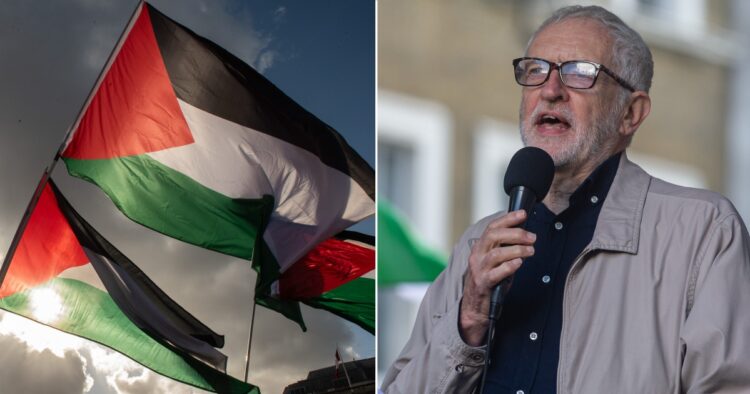
More than 100,000 people have signed a petition calling for an inquiry into the UK’s involvement in the Gaza genocide.
The petition was launched by Your Party chair Jennifer Forbes after former Labour leader Jeremy Corbyn called on Prime Minister Andy Burnham to back his Private Members’ Bill for a full inquiry into the UK’s complicity in Gaza.
Burnham has so far rejected calls for an inquiry.
However, by hitting the 100,000 signatures milestone, a debate on the issue is now likely to be triggered in Parliament.
The petition calls for an investigation “into any British involvement in Israeli operations in Gaza, including the sale, supply or use of weapons, surveillance aircraft and Royal Air Force bases”.
Having been launched on 23 October, the petition has racked up some 103,700 signatures at the time of writing.
Any petitions on the official government website that hit 100,000 signatures must be considered for debate in Parliament by the Petitions Committee.
Commenting on the petition, Corbyn told The National newspaper: “One hundred thousand people have signed this petition because they want the truth about Britain’s complicity in genocide. They deserve answers, and the Palestinian people deserve justice.”
He added: “What weapons were supplied to Israel? What intelligence was gathered over Gaza, and how was it used? What legal advice did ministers receive, and what decisions did they take?
“Parliament must now make time for this debate. But our demand remains a fully independent public inquiry with the power to question those responsible and expose the full extent of Britain’s involvement.”
Corbyn continued: “One day, there will be an inquiry. Does this government want to be remembered for getting in the way? It’s not complicated: if the government had nothing to hide, then it would not block our efforts to expose the truth.”
“Delaying scrutiny will not make questions of complicity disappear. This issue is not going away – and we are not going anywhere until we have exposed the truth.”
After the petition hit the 100,000 mark, Corbyn wrote to the Petitions Committee “to ensure a parliamentary debate is arranged as soon as possible.”
Petition Demanding Inquiry into UK Involvement in Gaza Genocide Passes 100,000 Signatures
The growing demand for accountability over Britain’s role in the conflict in Gaza has reached a significant milestone after a petition calling for an independent public inquiry surpassed 100,000 signatures. The development has brought renewed attention to the British government’s political, military and intelligence relationship with Israel and raised important questions about the country’s responsibilities under international law.
The petition, launched on 23 October 2026 by Jenn Forbes, chair of Your Party, reached the required threshold on 9 November, just over two weeks after its launch. Its success means that the issue must be considered by the UK Parliament’s Petitions Committee for a possible debate in the House of Commons. However, reaching 100,000 signatures does not automatically guarantee a parliamentary debate or force the government to establish an independent inquiry.
The campaign has received public support from Jeremy Corbyn, the former Labour Party leader and current parliamentary leader of Your Party. Corbyn has argued that British citizens deserve transparency about decisions made by successive governments concerning military cooperation with Israel during the war in Gaza.
The petition represents more than a numerical achievement. It highlights growing public interest in the relationship between foreign policy, international humanitarian law and democratic accountability. It also places renewed pressure on the government to explain the decisions taken since the conflict escalated in October 2023.
What Is the Petition Demanding?
At the centre of the campaign is a demand for a comprehensive and independent investigation into any British involvement in Israeli military operations in Gaza.
According to the petition, the proposed inquiry should examine several important areas, including the sale and supply of weapons, intelligence cooperation, surveillance operations and the use of British military facilities.
Campaigners want investigators to establish whether British military equipment or intelligence contributed to Israeli military operations and whether government officials properly considered their legal responsibilities when making decisions about cooperation with Israel.
One particularly important issue concerns British surveillance flights over Gaza. Reports have indicated that the United Kingdom conducted numerous surveillance missions during the conflict and shared intelligence with Israel. The British government has maintained that these operations were intended to assist efforts to locate and rescue hostages.
Nevertheless, questions remain about the precise nature of the intelligence collected, how it was processed and whether information was subsequently used in military operations.
These are precisely the kinds of questions that campaigners believe an independent inquiry should investigate.
Another significant issue concerns British-made components supplied to the international F-35 fighter jet programme. The United Kingdom manufactures approximately 15 per cent of the aircraft’s components worldwide. Critics have questioned whether continuing certain supplies could expose Britain to legal responsibilities if the equipment contributes to violations of international humanitarian law.
The petition therefore seeks to establish a detailed public record of Britain’s involvement rather than relying exclusively on government statements.
Jeremy Corbyn Calls for Transparency and Accountability
Jeremy Corbyn has become one of the most prominent political figures supporting the demand for an independent investigation.
The former Labour leader has repeatedly criticised British foreign policy towards Israel and argued that the government must explain its decisions concerning arms exports, intelligence sharing and military cooperation.
Following the petition’s achievement of 100,000 signatures, Corbyn welcomed the public response and called on Parliament to make time for a debate.
He questioned what weapons had been supplied to Israel, what intelligence had been collected over Gaza, how that information had been used and what legal advice ministers had received before making important decisions.
His central argument is that the British public has a right to understand the actions undertaken in its name.
Corbyn has also warned that delaying an investigation will not remove the questions surrounding Britain’s involvement. He argues that a fully independent inquiry should have sufficient authority to question ministers and officials and examine relevant government decisions.
The campaign follows earlier efforts by Corbyn to secure parliamentary support for a Chilcot-style investigation into Britain’s relationship with Israel during the Gaza conflict. His previous legislative initiative did not receive the necessary government backing, prompting renewed efforts through the public petition system.
Britain’s Military and Intelligence Relationship with Israel Under Scrutiny
The petition has emerged amid growing controversy surrounding Britain’s military and intelligence relationship with Israel.
Since the outbreak of the war in October 2023, successive British governments have faced questions about their responsibilities towards the conflict. Although the United Kingdom has publicly called for the protection of civilians and respect for international humanitarian law, critics argue that its continued cooperation with Israel requires much greater scrutiny.
One of the most controversial issues has been Britain’s arms export policy.
The previous government suspended approximately 30 arms export licences to Israel in September 2024 after concluding that there was a clear risk that certain military equipment might be used in serious violations of international humanitarian law.
However, the suspension did not cover every form of military cooperation. In particular, exemptions concerning components supplied to the multinational F-35 fighter jet programme attracted criticism from campaigners.
Opponents of the exemptions argue that the continued supply of British-made components raises questions about the consistency of the government’s approach. They believe that the government should explain why certain exports were restricted while other forms of military cooperation continued.
Supporters of closer scrutiny also point to intelligence-sharing arrangements and surveillance activities. They argue that transparency is essential because intelligence cooperation can have significant consequences during military operations.
The government, however, has maintained that its decisions are guided by national security considerations and legal obligations. It has also defended the purpose of its surveillance activities, particularly in relation to efforts to secure the release of hostages.
An independent inquiry could examine these competing claims and establish a clearer understanding of the decisions taken by British officials.
The International Legal Dimension
The controversy surrounding Britain’s involvement in Gaza is closely connected to international law.
The Genocide Convention, adopted in 1948, establishes obligations for states to prevent and punish genocide. It also creates important questions about the responsibilities of governments when there is a serious risk of such crimes being committed.
The International Court of Justice (ICJ) has considered proceedings brought by South Africa against Israel under the Genocide Convention. In a series of provisional measures orders, the court addressed the risk of irreparable harm to Palestinians in Gaza and directed Israel to take measures concerning its obligations under the convention.
These provisional measures are not a final judgment establishing that genocide has occurred. Nevertheless, they demonstrate the seriousness of the legal issues raised by the proceedings.
The question of third-party responsibility is also important. Governments providing military equipment, intelligence or other forms of assistance may face legal scrutiny depending on the circumstances, their knowledge and the applicable rules of international law.
For Britain, this creates a need to demonstrate that its decisions were consistent with its international obligations.
Campaigners argue that an independent inquiry would help establish whether the government properly assessed the legal risks associated with its actions.
However, determining legal responsibility requires evidence, careful investigation and consideration of the relevant legal standards. Political accusations alone cannot establish criminal or state responsibility.
Why Has Public Pressure Increased?
The petition’s rapid growth reflects the continued importance of Gaza in British public debate.
For many people, the conflict is not simply an international diplomatic issue. It raises fundamental questions about civilian protection, human rights, humanitarian assistance and the responsibilities of governments.
Public concern has been intensified by reports of extensive destruction, displacement, shortages of essential supplies and the impact of military operations on Palestinian civilians.
Humanitarian organisations and international institutions have repeatedly highlighted the devastating consequences of the conflict.
Against this background, some British citizens believe that their government should provide a detailed explanation of its relationship with Israel.
The petition also demonstrates the role of digital campaigning in modern democracy. Within just over two weeks, more than 100,000 people supported the demand for an investigation.
This achievement suggests that public petition platforms can provide citizens with an opportunity to bring controversial political issues directly to Parliament.
It also shows that questions of foreign policy and international accountability can generate substantial public engagement beyond traditional political party structures.
What Happens After the Petition Reaches 100,000 Signatures?
Under the UK Parliament’s petition system, petitions receiving 100,000 signatures are considered for debate by the Petitions Committee.
This is an important parliamentary milestone, but it should not be confused with a guarantee that the government will establish an inquiry.
The committee must consider whether a debate should take place. Even if Parliament discusses the petition, MPs are not automatically required to support its demands.
Furthermore, the government is not legally compelled to establish an independent investigation simply because the petition has reached the required number of signatures.
Nevertheless, the milestone creates an opportunity for MPs to question ministers and examine the political and legal issues raised by the campaign.
It also increases pressure on the government to provide a meaningful response to public concerns.
For campaigners, the next stage will involve maintaining public attention and persuading Parliament that the proposed investigation deserves serious consideration.
The official parliamentary petition can be accessed here: UK Parliament Petitions website .
The Government Faces Difficult Questions
The government now faces several important questions about its foreign policy decisions.
First, it must explain the extent of Britain’s military cooperation with Israel since October 2023.
Second, it must provide greater clarity about the legal assessments undertaken before approving or continuing military exports.
Third, it must address concerns about intelligence-sharing arrangements and explain what safeguards were implemented to ensure that British assistance complied with international law.
These questions are not limited to one political party or one administration. They concern decisions taken by successive governments and therefore raise broader issues about institutional responsibility.
An independent inquiry could examine documents, interview relevant officials and establish a comprehensive timeline of government decisions.
Such an investigation would also provide an opportunity for different perspectives to be heard, including those of legal experts, military officials, humanitarian organisations and affected communities.
Whether the government ultimately agrees to establish such an inquiry remains uncertain.
However, the growing petition demonstrates that the issue is unlikely to disappear from British political debate.
Conclusion
The petition demanding an independent inquiry into Britain’s involvement in the Gaza conflict represents a significant moment for public accountability in the United Kingdom.
By surpassing 100,000 signatures, campaigners have brought questions about arms exports, intelligence cooperation and military relations with Israel directly into the parliamentary process.
Jeremy Corbyn and Your Party are calling for a comprehensive investigation into decisions that they believe deserve greater public scrutiny. Meanwhile, the government must address concerns about the legal and political implications of Britain’s relationship with Israel.
The central issue is not simply whether Britain supported an ally during an international conflict. It is whether every decision made by British officials was consistent with the country’s legal obligations and commitment to protecting human rights.
An independent investigation would provide an opportunity to examine the available evidence, establish the facts and determine whether further accountability is necessary.
Reaching 100,000 signatures does not guarantee that the inquiry will happen. However, it ensures that the demand has reached an important stage in the democratic process.
Ultimately, the controversy raises a fundamental question for British democracy: how can citizens hold their government accountable for decisions made in international conflicts, particularly when those decisions may have serious humanitarian and legal consequences?
For the thousands of people demanding answers, the campaign is about transparency, justice and the principle that government actions should never be beyond public scrutiny.