
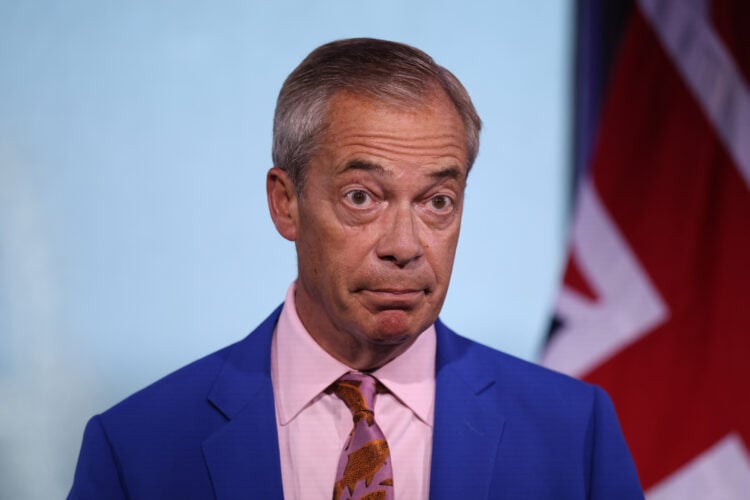
It’s fair to say 2026 has not been a good year for Nigel Farage. His Reform party went from riding high in the polls, to falling into third place behind both Labour and the Conservatives. But it seems the latest figures released by Lord Ashcroft on Sunday have sent him over the edge.
New poll puts Reform below the 20% mark
According to the numbers, Labour lead on 31% – which is highly consistent with the data recently published by the likes of YouGov, Opinium, and Ipsos. Then, following a summer bounce for Kemi Badenoch, the Tories are now up to 26% – easily marking their highest total this calendar year.
Then, some way down in third, there’s Reform. Lord Ashcroft has got the party on a lowly 18% – representing one of their smallest vote shares in an opinion poll since 2024. It shows an astonishing decline in the party’s popularity – but of course, the top brass aren’t taking this one on the chin.
Senior figures within Reform have lashed out at the pollster, branding Lord Ashcroft as an ‘unreliable’ source. He uses a different methodology to others, asking participants who they would vote for ‘at the next election’, rather than ‘if there was an election tomorrow’.
He’s not having it! Nigel Farage fumes at Lord Ashcroft poll
Despite this discrepancy, many people have been keen to point out that Lord Ashcroft was actually one of the first pollsters to predict a Reform slump, forecasting them as the third-place party months before anyone else did. Alas, Nigel Farage has unleashed his fury, calling the data ‘dishonest and bogus’:
“This is totally dishonest polling by a Conservative Party donor, who isn’t even a member of the British Polling Council. He had us sitting at 21% in May, and Reform achieved 28% for the Local Elections – and his polling has been proven as bogus time and time again.” | Nigel Farage
Nadhim Zahawi also chimed in on Sunday, identifying this as a ‘rogue poll’. However, Lord Ashcroft himself has responded to the furore, reminding Nigel Farage and his colleagues that he didn’t hear any similar gripes when one of his surveys gave Reform a nine-point lead. Funny, that…
Nigel Farage Blows a Gasket as New Polling Sees Reform UK Slump to 18%
The political landscape in the United Kingdom is becoming increasingly unpredictable as a new opinion poll suggests that Reform UK has suffered a significant decline in public support, falling to just 18%. The result represents a potentially serious setback for Nigel Farage, the party’s leader, who has repeatedly presented Reform UK as a powerful alternative to Britain’s traditional political establishment. The latest figures have raised questions about the party’s political strategy, Farage’s leadership and its ability to maintain momentum ahead of future elections.
For a party that has built much of its identity around challenging the political establishment, such a decline could prove particularly damaging. Reform UK has attracted considerable attention by promising radical changes to immigration policy, economic management and Britain’s relationship with the wider world. However, the latest polling suggests that the enthusiasm surrounding the party may not be as strong or as stable as previously expected.
A Major Setback for Nigel Farage
Nigel Farage has long been one of the most recognisable and controversial figures in British politics. Known for his outspoken personality, confrontational debating style and ability to attract media attention, he has successfully positioned himself as a politician who speaks for voters dissatisfied with mainstream parties.
His political career has been closely associated with opposition to European integration, demands for stricter immigration controls and criticism of successive British governments. Through his involvement in the Brexit campaign, Farage became a central figure in one of the most significant political developments in modern British history.
More recently, Reform UK has attempted to transform dissatisfaction with the Conservative and Labour parties into a broader political movement. Its message has appealed particularly to voters who feel ignored by traditional politicians.
Nevertheless, a fall in support to 18% could represent a serious challenge to Farage’s ambitions. A political movement that depends heavily on its leader’s personal popularity must be particularly careful when public enthusiasm begins to weaken.
Although one opinion poll cannot determine the outcome of a future election, it can reveal important changes in public attitudes. For Reform UK, the figures may indicate that some voters are reconsidering their support.
Why Is Reform UK Losing Support?
There are several possible explanations for the apparent decline in Reform UK’s popularity.
First, voters may be becoming increasingly concerned about whether the party’s promises can realistically be delivered. Political campaigns often succeed by offering simple and attractive solutions to complicated national problems. However, governing a country requires detailed policies, financial planning and difficult compromises.
Reform UK has frequently focused on immigration, public spending, taxation and national sovereignty. These subjects attract strong public interest, but voters may increasingly expect more detailed explanations of how the party would implement its proposals.
Second, economic concerns could be influencing public opinion. The cost of living, housing affordability, wages and pressure on public services remain important issues for British households. Many voters want to know how political parties will improve their everyday lives rather than simply criticise their opponents.
If Reform UK cannot convince the public that it has credible economic policies, some supporters may become disappointed.
Third, the party’s political style may be becoming less attractive to certain voters. Farage’s direct and combative approach has helped him gain attention, but constant political confrontation can also create fatigue. Some voters may prefer a party that demonstrates stability, professionalism and a willingness to cooperate.
Nigel Farage and the Challenge of Leadership
Farage’s personality is both one of Reform UK’s greatest strengths and one of its potential weaknesses.
Unlike many traditional politicians, he has developed a public image based on challenging conventional political language. His supporters often appreciate his confidence and willingness to confront controversial subjects. They see him as someone prepared to express opinions that other politicians might avoid.
However, political leadership requires more than attracting attention. It also requires the ability to build trust among different groups of voters.
A leader who performs well during election campaigns must also demonstrate that he can manage a political organisation, develop experienced candidates and maintain discipline within the party.
As Reform UK attempts to establish itself as a serious political force, the expectations placed on Farage are becoming greater. Voters may increasingly judge him not only on his speeches but also on the quality of his party’s policies and representatives.
A decline in polling support could therefore place additional pressure on his leadership.
The Problem of Political Expectations
One of the biggest challenges facing Reform UK is the gap between electoral expectations and political reality.
When a party experiences rapid growth, supporters and activists often become optimistic about its future. Strong polling results can create the impression that a major political breakthrough is inevitable.
However, political popularity is rarely permanent.
Voters may support a smaller party because they are frustrated with the government, dissatisfied with the opposition or simply interested in sending a message to the political establishment. This does not necessarily mean that they are fully committed to that party.
Some Reform UK supporters may have previously voted Conservative but become frustrated with the Conservatives’ record in government. Others may have been attracted by Farage’s criticism of immigration policy or his promise to change the direction of British politics.
Yet, if these voters become dissatisfied with Reform UK, they could return to the Conservatives, consider Labour or choose another political alternative.
This makes maintaining public support a difficult task.
Implications for Labour and the Conservatives
The reported decline to 18% could also have important consequences for Britain’s two major political parties.
For the Conservative Party, weaker Reform UK support could offer an opportunity to recover voters who previously abandoned it. The Conservatives have faced considerable challenges in rebuilding their reputation after years of political instability and internal disagreements.
If Reform UK loses momentum, Conservative politicians may attempt to persuade former supporters that the party has learned from its mistakes and can once again represent voters on the political right.
However, winning these voters back will not be easy. Many people who switched to Reform did so because they believed the Conservatives had failed to deliver on important promises.
Labour could also benefit from changes in the political landscape. A weaker Reform UK might reduce pressure on the government in certain constituencies, particularly where opposition votes could otherwise challenge Labour’s position.
Nevertheless, Labour should not assume that Reform UK’s difficulties automatically translate into increased support for the government. Voters who are unhappy with Reform may also remain dissatisfied with Labour.
Ultimately, the political consequences will depend on where former Reform supporters decide to go.
Is This the Beginning of the End for Reform UK?
Despite the negative headlines, it would be premature to conclude that Reform UK is approaching political collapse.
An opinion poll represents a snapshot of public opinion at a particular moment. Polling results can change significantly depending on the questions asked, the sample selected and developments in the political environment.
Furthermore, Reform UK has demonstrated an ability to attract voters who feel disconnected from conventional political parties. The issues that helped the party gain attention, particularly immigration, economic insecurity and dissatisfaction with political leadership, have not disappeared.
Farage also remains a highly experienced campaigner with considerable media visibility. His ability to communicate directly with supporters could help the party recover if it responds effectively to the latest developments.
However, the 18% figure should not be dismissed. It is a warning that political momentum can disappear quickly when voters begin to question a party’s direction.
Reform UK must now demonstrate that it is more than a protest movement. It needs to establish a convincing political identity, present realistic policies and show that it can offer solutions to the country’s most pressing problems.
Conclusion
The reported decline in Reform UK’s support to 18% represents an important moment for Nigel Farage and his political ambitions. After building a movement around public dissatisfaction with Britain’s traditional political parties, he now faces the difficult task of maintaining confidence among voters who may be reconsidering their support.
The challenge is not simply to regain lost polling points. It is to convince the British public that Reform UK has the experience, policies and leadership necessary to become a credible governing alternative.
For Labour and the Conservatives, the party’s apparent difficulties could create new political opportunities. However, neither should underestimate the continued dissatisfaction that has helped Reform UK attract supporters.
Ultimately, British politics remains highly competitive, and no party can take public support for granted. Nigel Farage may have built his reputation by challenging the political establishment, but the latest polling suggests that his own party is now facing an equally important challenge: convincing voters that it deserves their trust.
Whether the reported fall to 18% proves to be a temporary setback or the beginning of a longer decline will depend on how Farage and his colleagues respond. One thing is certain: Reform UK can no longer rely solely on political protest and strong rhetoric. It must now prove that it has a serious vision for Britain’s future.