
“DANNY TOMMO JAILED — BUT THE PATRIOT PLATFORM DECLARES ‘IT’S NOT OVER YET'”
A neutral, evidence-checked analysis
Headline received: “🚨 DANNY TOMMO JAILED — BUT THE PATRIOT PLATFORM DECLARES “IT’S NOT OVER YET”… A new 15-month plan has just been announced. But it’s the final message to the Government that’s really turning heads… 👀👇”
Reading time: approximately 30 minutes
Date of analysis: 14 October 2026
A note before we begin. This story concerns an active criminal case. Daniel Thomas has pleaded not guilty to the charges against him, a provisional trial date has been reported for March 2027, and the presumption of innocence applies in full. This article reports only what has been published by identifiable news outlets and what can be independently checked; it does not assert guilt, and it treats every allegation as an allegation. Nothing in this article should be read as a finding about whether the charges will be proved.
The verdict in brief
Three factual claims sit inside this headline. Each needs to be separated from the excitement wrapped around it.
Claim 1: “DANNY TOMMO JAILED.” Misleading. Daniel Thomas — the 37-year-old anti-migration activist known as “Danny Tommo” — was remanded in custody on 29 September 2026 at Portsmouth Crown Court after pleading not guilty to charges of criminal damage and failing to disclose a mobile phone PIN. Remand is pre-trial detention, not a conviction and not a sentence. No credible reporting found in the course of this analysis records a conviction, a guilty plea, or a sentencing hearing having taken place since. The accurate term remains “remanded,” and the distinction matters: a trial, where the evidence will be tested, is provisionally listed for 1 March 2027.
Claim 2: “A new 15-month plan has just been announced.” Not supported. The documented announcement from Patriot Platform — made at a gathering in early October 2026 and reported across multiple sources — describes an 18-month organising plan, not a 15-month one. A transcript of the group’s statement circulating online states the ambition in its own words: over the next 18 months, the organisation intends to become larger, better informed and more capable. No identifiable source found during this analysis mentions a 15-month plan. The figure of 15 months appears to be either an error or an invention introduced somewhere in the chain of reposting.
Claim 3: “The final message to the Government that’s really turning heads.” Manufactured framing. The actual reported message from Patriot Platform was defiant political rhetoric — vows to continue campaigning, to research and document, and to put pressure on politicians over immigration policy. Crucially, the statement as transcribed explicitly disavowed threats: it said it contained no threats, no warnings of violence toward anyone, and no intended intimidation. That is a political promise to keep organising, not the menacing “final message” the headline’s wording implies. There is no evidence in the available reporting that the message “turned heads” in government or anywhere else beyond the social-media audiences already following the story.
The provenance. The headline follows the classic template of engagement-bait aggregation: capitalised alarm (“🚨”), ellipsis suspense (“…”), a curiosity gap (“really turning heads”), and the pointer emoji (“👀👇”) directing readers toward a comments section. Versions of this story circulate through a network of low-quality mirror sites that republish one another’s copy. That does not automatically make every detail wrong — the underlying remand is real — but it means the packaging should be treated as marketing, not reporting.
In short: the detention is real; the “jailed” label is wrong; the 15-month plan is unverified; and the drama was added later.
1. The single word that changes everything: “jailed” versus “remanded”
Headlines live or die on single words, and “jailed” is doing heavy lifting here. In ordinary conversation, to say someone was “jailed” suggests they were found guilty and sent to prison as punishment. In the legal process of England and Wales, that is not what happened to Daniel Thomas — at least not according to any reporting available as of 14 October 2026.
What happened, as reported by Sky News via outlets including Radio X and Capital FM on 29 September 2026, is that Thomas was remanded in custody. Remand is a pre-trial decision. A judge decides that a defendant will be held in prison while awaiting trial rather than released on bail. It is not a finding of guilt. It does not mean the prosecution has proved its case. The defendant remains innocent in the eyes of the law until — and unless — a court finds otherwise after hearing the evidence.
Why does this matter beyond legal pedantry? Because the difference shapes everything the headline wants the reader to feel. “Jailed” implies the story is over: wrongdoing established, punishment delivered, the system has spoken. “Remanded” means the story has barely begun: charges denied, evidence untested, a trial months away. A reader who absorbs “jailed” will understandably conclude that Thomas’s guilt is settled fact. It is not. He has pleaded not guilty, and the trial at which the allegations will be examined is provisionally scheduled for March 2027 — roughly five months from now.
The confusion is not accidental in the ecosystem this headline comes from. Across the mirror sites and social-media posts that recycle this story, “jailed,” “imprisoned,” “locked up,” and “political prisoner” are used interchangeably, as though they described the same thing. They do not. A political prisoner is a contested political characterisation, not a legal status. Being “locked up” on remand describes a custodial situation without explaining its legal basis. Each phrasing nudges the reader toward a different conclusion — persecution or justice served — while the underlying legal fact stays the same: an unconvicted man is being held before trial.
There is a further reason for precision. Reporting on active criminal proceedings in England and Wales operates under strict contempt-of-court rules. The purpose of those rules is to avoid prejudicing a future trial — to make sure that when a jury eventually hears the case, it decides on the evidence presented in court rather than on months of commentary. Describing a remanded defendant as “jailed” does not merely mislead readers; in a coarser information environment, it contributes to a climate in which the presumption of innocence is treated as a technicality. This article will therefore use “remanded” throughout, and will describe Thomas as “the defendant” where the legal context requires it.
One more distinction worth keeping in mind: bail can be reconsidered. A remand decision is not necessarily final for the whole pre-trial period. Defence teams can renew bail applications if circumstances change, and courts can revisit the question. Reporting in early October suggested further bail arguments were made or anticipated, though the specific claims on this point come from lower-quality aggregators and should be treated cautiously. What is firmly established is the position as of the last reliably reported hearing: bail refused, custody continued, trial provisionally listed.
2. The legal case: what is established and what is not
The charges
Daniel Thomas, 37, faces two charges:
- Criminal damage, relating to an incident in the English Channel on 22 September 2026. The allegation, as reported, is that damage was caused to a small boat while an emergency responder was aboard — described in some reports as the slashing of the vessel. Thomas has pleaded not guilty. Some secondary sources describe the charge in more serious terms, referencing danger to life, but the core allegation consistently reported by mainstream outlets is criminal damage arising from the 22 September incident.
- Failing to disclose the PIN for his mobile phone under Section 53 of the Regulation of Investigatory Powers Act 2000 (RIPA). This is the offence of failing to comply with a lawfully imposed requirement to provide access to protected electronic information. Thomas denies this allegation as well.
At an early hearing at Basingstoke Magistrates’ Court on 25 September 2026, Thomas elected for the matters to be dealt with at the Crown Court. His barrister, Simon Pentol KC, stressed in court that Thomas is not being prosecuted merely for his political activism — a point worth recording because much of the online commentary frames the case exclusively in political terms.
A practical detail reported at the magistrates’ hearing illustrates how much remains unresolved: the cost of the alleged damage to the vessel was not established as being above or below £5,000, partly because the boat had been taken back to France. The threshold matters for sentencing powers — criminal damage valued above £5,000 carries a significantly higher maximum penalty than damage below it — but it has no bearing on the question of guilt, which is for the trial.
The remand hearing
On Tuesday 29 September 2026, Thomas appeared by video link from HMP Winchester at Portsmouth Crown Court. Reporting consistently describes him wearing a grey T-shirt and holding a copy of the Bible during the hearing; the Press Association’s court artist produced sketches that were widely reproduced.
Judge James Newton-Price KC refused the defence’s application for bail and remanded Thomas in custody. The defence had proposed what his barrister described as a package of bail conditions, arguing that Thomas understood any misstep would breach them and that he wished to return to his family. The judge declined.
The judge’s stated reasoning deserves to be quoted in substance, because it cuts against the most heated claims on both sides of the online debate. He told the court, in effect, that he was not concerned with the political issues or motivations in the matter and put them aside in deciding the bail question. In other words, the decision was presented as a judicial assessment of the bail criteria — not a judgment on Thomas’s politics, and not an endorsement of them either. Supporters who describe the remand as punishment for his views, and critics who treat it as vindication of their view of him, are both reading politics into a decision the judge said was not political.
The timeline as reported
- 22 September 2026: the alleged Channel incident involving the small boat.
- 25 September 2026: first hearing at Basingstoke Magistrates’ Court; Thomas pleads not guilty and elects Crown Court trial.
- 29 September 2026: bail refused at Portsmouth Crown Court; Thomas remanded in custody; provisional trial date set for 1 March 2027; next hearing listed for 12 November 2026.
- Early October 2026: Patriot Platform holds a gathering (reported as 4 October, at Hoghton Tower) at which a “Stage Two” plan is announced.
What is not established
- No conviction has been reported. Searches conducted for this analysis on 14 October 2026 found no credible report of a trial having taken place, a guilty plea having been entered, or a sentence having been imposed. The case remains at the pre-trial stage.
- The “political prisoner” description is a characterisation, not a legal status. Some supporters and commentators use the term. It expresses an opinion about the prosecution’s motivation. It is not a finding by any court, and the available court reporting does not establish that Thomas was detained because of his political opinions.
- Claims about a second bail refusal in early October circulate on low-quality aggregator sites. They may be accurate, but the sourcing is thin, and this article does not treat them as verified.
3. Who is Danny Tommo, and what is Patriot Platform?
Understanding the headline requires understanding the people it is about — and being honest about where verified fact ends and contested characterisation begins.
The man
Daniel Thomas, known online as “Danny Tommo,” is a 37-year-old activist who became one of the most recognisable figures in Britain’s anti-migration street-protest scene during 2026. The verified background, as reported by mainstream outlets:
- He has a criminal history that includes a kidnapping conviction. He is privately educated and has described himself as having turned his life around after prison — his own framing of his past, reported by the Daily Mail.
- He was previously associated with Tommy Robinson (Stephen Yaxley-Lennon), the long-standing figure of Britain’s far-right street politics, and has been reported as having worked in a security capacity around him. Robinson has since given public updates on Thomas’s case, framing the remand as politically motivated — a characterisation that is Robinson’s opinion, not an established fact.
- During the anti-immigration disorder of summer 2024, Thomas posted videos calling for confrontations in multiple cities — material that critics, including anti-extremism monitors, have described as incitement. He later led a demonstration in Downing Street that ended in disorder and dozens of arrests.
None of this is on trial in the current case. It is context for why Thomas is a polarising figure: to supporters, he is a reformed man speaking for ordinary people failed by the political system; to critics, he is a convicted criminal turned far-right organiser. Both descriptions are characterisations. The facts underneath them — the conviction, the activism, the current charges and the not-guilty pleas — are what can be verified.
The organisation
Patriot Platform is a real organisation. It has a Wikipedia entry, has been investigated by the anti-extremism organisation Hope Not Hate, and has been covered by the Daily Telegraph, The Guardian, the BBC, and Sky News. The established facts:
- Founded mid-2026. Thomas launched the group in June or July 2026, after falling out with Ryan Bridge, co-founder of the “Raise the Colours” flag-protest movement. Its website was registered in May; Thomas first posted about it on YouTube on 8 June. The launch video referenced his visit to Belfast during the 2026 Northern Ireland riots and spoke of building a large movement of supporters.
- Self-description. The group presents itself as a network of patriotic activists concerned with borders, immigration and national identity. Its stated values, as published on its own website, include freedom, fairness, family, faith and homeland. Thomas has insisted its purpose is border security and lawful protest, not extremism.
- Critics’ description. Hope Not Hate has described it as a self-styled “army of patriots” functioning as a vigilante-style unit, and reported that Thomas’s inner circle included men with criminal histories despite his claims of vetting and discipline. The Guardian described it as an attempt to bring together local far-right groups under a single leader. These are the assessments of its critics, reported here as their views.
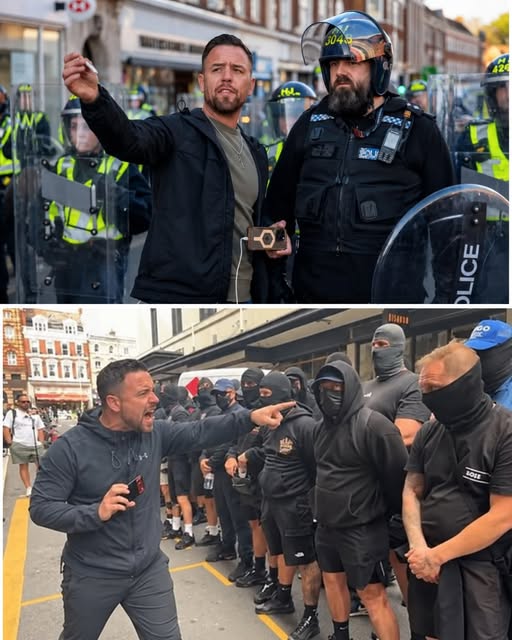
- Tactics. The group’s signature has been highly visible street demonstrations — notably at Dover, where masked men blocked roads and disrupted traffic, and at Portsmouth, where protesters gathered after asylum seekers were brought ashore. Police made arrests connected with the protests. Thomas says masks are worn because activists fear being targeted by political opponents; critics say the masks are intimidatory. The fact of the protests and the masks is verified; the interpretation is contested.
- Money. Thomas has raised funds via an American Christian crowdfunding platform, seeking monthly support for transport, boats and a studio; in September 2026 alone the group reportedly raised around £9,000.
- Political friction. Reform UK leader Nigel Farage publicly criticised the masked Dover and Portsmouth protests; Thomas subsequently confronted a press conference by Reform’s home affairs spokesman to object. The disagreement is a matter of public record and illustrates that Patriot Platform’s relationship with the broader right is itself contested.
The honest summary is that Patriot Platform is a small, new, confrontational activist network whose size and significance are asserted by its supporters and disputed by its critics — and whose activities sit on a contested boundary between protest and intimidation. That contest is precisely what makes it fertile ground for sensational headlines: every development can be framed as either heroic resistance or dangerous extremism, depending on who is doing the framing.
4. The “new 15-month plan”: tracing a number that isn’t there
The headline’s second claim — “a new 15-month plan has just been announced” — sounds specific. Specificity feels like evidence. But when the claim is traced back through the available sources, the number 15 does not appear. The number that appears, consistently, is 18.
What was actually announced
In early October 2026, days after Thomas’s remand, Patriot Platform held a gathering reported as taking place on 4 October at Hoghton Tower. Around 100 masked supporters attended, according to the available reporting. Police dispersed the assembly; no offences were reported in connection with it.
At that gathering, a masked spokesman delivered a statement announcing what the group called “Stage Two”: an 18-month plan to expand, organise, and apply political pressure. The phrases “this is just the beginning” and “stage two begins now” are consistently reported across the available sources.
A transcript of the statement circulating online — including in a LinkedIn post that reproduces it at length — sets out the ambition directly: over the next 18 months, the organisation intends to become the largest, most informed and capable organisation of its kind the country has seen. The statement describes a first phase of recruitment as complete and a second phase of what it calls intelligence and reconnaissance — meaning, in the group’s own terms, researching and documenting who it holds responsible for immigration policy — as now beginning. It ends with an appeal for supporters to join and a prayer for Thomas.
Whether the plan is realistic is a separate question from whether it was announced. No independently verified membership figures have been published that would allow a reader to assess the group’s actual size, and a claim circulating alongside the statement — that the organisation doubled in size after Thomas’s detention — was presented without verifiable data. But the announcement itself, and its 18-month timeframe, are consistently documented.
Where “15 months” might have come from
No identifiable source found in the course of this analysis — mainstream or otherwise — refers to a 15-month Patriot Platform plan. Several possibilities exist, and they should be weighed honestly:
- Simple error. In the chain of reposting and rewriting that characterises aggregator networks, numbers are among the easiest details to corrupt. An 18 becomes a 15 through carelessness, and once one version carries the wrong number, mirrors repeat it.
- Deliberate novelty. A headline that says “a new 15-month plan” implies fresh news — something has changed since the 18-month plan already reported. If no new plan exists, the altered number manufactures the impression of a development where there is none. This cannot be proved from the available evidence, but the incentive structure of engagement-bait publishing rewards exactly this kind of modification: returning audiences need a reason to click again.
- Confusion with another figure. Fifteen months is close to other timeframes in the story — the roughly five-to-six months of pre-trial custody, the 18-month plan itself — and a writer working quickly from half-remembered details could conflate them.
What can be said with confidence is only the negative: as of 14 October 2026, there is no verified reporting of a 15-month plan. Readers encountering the claim should ask for a source — a date, a venue, a named speaker, a recording — and will find, on the evidence available, that none is offered.
Why the number matters
It might seem like a small thing — 15 versus 18. But the specificity is doing rhetorical work. A “new plan” suggests momentum, escalation, and news value. It tells the reader that the story has moved forward since they last checked. If the plan is neither new nor 15 months long, then the headline is not updating the reader — it is re-serving old material in altered packaging. Recognising that is the difference between being informed and being managed.
5. The “final message to the Government”: what was actually said
The headline’s most tantalising promise is its last: “it’s the final message to the Government that’s really turning heads.” The reader is invited to imagine something explosive — a threat, an ultimatum, a revelation. The available evidence points somewhere far more ordinary.
The message, as reported
The statement delivered at the early-October gathering was addressed, by name, to the Prime Minister and the Home Secretary of the day, and to “the rest of the establishment.” Its content, as transcribed in the circulating text, runs along these lines:
- An accusation that the government has misled the public about the scale of illegal migration and misspent public money on facilitating it.
- A declaration that Thomas’s arrest and remand will not halt or slow the organisation.
- A promise to continue “shining a light” on government behaviour and to expose what the group describes as official wrongdoing.
- An announcement that a first phase of recruitment is complete and that a second phase — described as research and documentation of those the group holds responsible — will now take place.
- An ultimatum framed in policy terms: stop illegal migration and restrict legal migration, or face 18 months of organised campaigning intended to build the largest, most informed organisation of its kind.
- A closing appeal for supporters to join, followed by a prayer for Thomas.
That is defiant political rhetoric. It is also, by the standards of protest movements, unremarkable: we will keep campaigning, we will grow, we will hold you accountable. It is a warning in the ordinary political sense — “we will keep organising against you” — not a threat of unlawful action.
The sentence the headline hopes you won’t notice
The most important sentence in the transcribed statement is the one that directly contradicts the headline’s framing. The statement says, in its own words, that it holds no threats, no warnings of violence toward anyone, and no intended intimidation — only, as it puts it, a promise to its country and its people to push back against policies it opposes.
This matters because the headline’s wording — “the final message… that’s really turning heads” — implies something shocking or menacing was said. The group itself went out of its way to say the opposite. A reader who only sees the headline will picture a threat; a reader who reads the statement will find an explicit disavowal of threats. The gap between those two impressions is the headline’s contribution, not the group’s.
“Turning heads” — where?
The phrase “turning heads” implies an audience: people in power, presumably, reacting with surprise or alarm. No reporting found in this analysis documents any such reaction. There is no reported government response to the statement, no ministerial comment, no parliamentary mention. The only heads observably turned are those of the social-media audiences already following Thomas and Patriot Platform — supporters sharing the message approvingly and critics sharing it disapprovingly. That is not nothing as a political phenomenon, but it is not what the headline implies. “Turning heads” here means “generating engagement,” and engagement is the product being sold.
A note on the prayer
The statement closes with a prayer for Thomas, described as carrying a heavy burden and facing injustice. This is consistent with the group’s self-presentation as a Christian movement and with Thomas’s own public religiosity — he held a Bible during his remand hearing, a detail consistently reported. Whether one finds the prayer moving or manipulative will depend on one’s view of the group, but its presence is worth noting because it underscores the statement’s actual register: not a communiqué of menace, but a rallying message to the faithful, blending political grievance with religious solidarity.
6. Why this headline exists: provenance and the engagement economy
Headlines like this one do not emerge from newsrooms. They emerge from an economy, and understanding the economy helps explain the headline’s shape.
The template
Consider the headline’s construction:
- “🚨” — the alarm emoji, signalling urgency and danger before a single word is read.
- Capitalisation — “DANNY TOMMO JAILED,” “IT’S NOT OVER YET” — the typographic equivalent of shouting.
- The curiosity gap — “it’s the final message… that’s really turning heads” tells the reader that something remarkable exists while withholding what it is. The only way to close the gap is to click.
- “👀👇” — the eyes and the pointing finger, directing the reader to the comments section, where the actual content (“see details in the first comment”) is said to live. This is classic engagement-bait formatting: platforms reward posts with high comment counts, so publishers move the payload into the comments to force interaction.
None of these are neutral reporting conventions. They are marketing techniques, optimised for social-media distribution.
The mirror network
Versions of the Danny Tommo story circulate through a network of low-quality aggregator and mirror sites — domains that republish one another’s copy with light rewriting, often under sensational headlines, and frequently without bylines, editorial standards, or verifiable sourcing. In the course of this analysis, near-identical texts about Thomas’s remand and the “Stage Two” announcement were found on multiple such domains, alongside more carefully sourced reporting from established outlets.
The relationship between the two layers is parasitic in a specific way: the aggregators take real events reported by real outlets — the remand hearing, the Hoghton Tower gathering — and repackage them with heightened language and altered details. The underlying facts give the repackaged version its plausibility; the alterations give it its novelty and its emotional charge. A reader who encounters only the aggregator version has no way to know which parts are verified and which were added in the rewrite.
This is not a claim that every detail on aggregator sites is false. It is a claim about provenance: when a headline’s most exciting details — “jailed” instead of “remanded,” “15-month” instead of “18-month,” a “final message” that “turns heads” — appear only in the least accountable layer of the information chain, and the verifiable layer contradicts or fails to support them, the rational response is scepticism.
The timing incentive
There is a structural reason why a “new” plan might be announced in a headline when no new plan exists. The 18-month “Stage Two” announcement was news in early October. By mid-October, it is no longer news — but the audience’s interest has not expired. A publisher serving that audience faces a choice: report genuinely new developments (of which there may be none), or re-present the existing development as new. Changing “18-month” to “15-month” and calling the plan “new” achieves the second option at minimal cost. Whether this happened through error or design cannot be determined from the available evidence — but the incentive is real, and readers should know it exists.
7. What remains unknown and what to watch
A fact-check is a snapshot, not a conclusion. The story is ongoing, and several questions remain open.
The trial. The provisional trial date of 1 March 2027 is the next decisive moment. Until then, the charges remain allegations and Thomas remains entitled to the presumption of innocence. Readers should be wary of any reporting — from supporters or critics — that treats the outcome as foregone.
The November hearing. A further hearing is listed for 12 November 2026 at Portsmouth Crown Court. Bail could in principle be revisited. Any verified reporting from that hearing would be genuinely new information, unlike the repackaged claims examined here.
The group’s trajectory. Patriot Platform’s “Stage Two” is, by its own description, an 18-month project. Whether the group can sustain momentum with its founder on remand is an open question that only time and verifiable evidence — event attendance, published membership data, documented activities — can answer. Claims about the group’s size should be treated as unverified until such evidence appears.
The “two-tier justice” debate. Much of the commentary around this case invokes the idea that the justice system treats different groups of defendants differently — sometimes called “two-tier justice.” This is a political argument, not a legal finding. The judge in the remand hearing explicitly said he put political considerations aside. Whether the system is biased in either direction is a legitimate subject for evidence-based debate, but individual bail decisions — made on case-specific criteria that are not fully visible from outside the courtroom — are a weak foundation for it. Serious analysis of systemic bias requires systemic data, not single cases framed for engagement.
8. A reader’s checklist for the next headline
This story will generate more headlines before March 2027. When the next one arrives, these questions will help separate information from packaging:
- Does it say “jailed” or “remanded”? If it says “jailed” about a pre-trial detainee, the publisher is either careless or writing for effect. Either way, downgrade your trust.
- Are numbers sourced? “15-month plan,” “doubled in size,” “thousands of supporters” — each should come with a when, where, and who-said-it. Numbers without sources are decoration.
- Is the “shocking message” quoted? If a headline promises a startling statement but the article never quotes it at length, the shock is likely in the headline, not the statement.
- Who published it? A bylined report from an outlet with editorial standards and a corrections policy is not the same as an anonymous post on a mirror site. Provenance is evidence.
- Does it respect the presumption of innocence? Any publication treating the charges as proven before trial is telling you about its own agenda, not about the case.
Summary of findings
| Headline claim | Assessment | Basis |
|---|---|---|
| “DANNY TOMMO JAILED” | Misleading | Thomas was remanded in custody on 29 Sept 2026 (Portsmouth Crown Court); he pleaded not guilty; no conviction or sentence has been credibly reported. Remand is pre-trial detention, not punishment. |
| “A new 15-month plan has just been announced” | Not supported | The documented announcement is an 18-month “Stage Two” plan from early October 2026. No source found for a 15-month plan. |
| “The final message to the Government that’s really turning heads” | Manufactured framing | The reported statement was defiant campaign rhetoric that explicitly disavowed threats and violence. No government or public reaction beyond social-media engagement is documented. |
| Implication of fresh news | Unsubstantiated | The verifiable events (remand 29 Sept; Stage Two early Oct) predate this headline; no new verified development is cited. |
Sources and notes on provenance
Higher reliability (established outlets with editorial standards, used for core facts):
- Sky News reporting via Radio X and Capital FM, 29 September 2026: Thomas remanded in custody at Portsmouth Crown Court; charges of criminal damage (22 September Channel incident) and failure to disclose phone PIN under RIPA s.53; not-guilty pleas; provisional trial 1 March 2027; next hearing 12 November 2026; Judge James Newton-Price KC presiding.
- BBC News, The Guardian, Daily Telegraph: background on Patriot Platform’s founding (mid-2026), Dover and Portsmouth demonstrations, masked protests, fundraising.
- Hope Not Hate (anti-extremism research organisation): investigations into Patriot Platform’s structure and personnel. An advocacy source — its findings are its own, but its factual reporting on events is detailed and specific.
Lower reliability (useful for tracing claims, not for establishing facts):
- Aggregator/mirror domains (including newsgb.cfx.bz, newshot24.cfx.bz, hot.celebrity24h.com): near-identical repackaged texts about the remand and “Stage Two.” Used here to document how the story circulates, not as evidence for its claims.
- A LinkedIn post reproducing a transcript of the Patriot Platform statement at length: used only to confirm the statement’s wording on the 18-month timeframe and its disavowal of threats. A transcript on social media is not independently authenticated, but its contents are consistent with other reporting of the statement.
- YouTube commentary videos: used only to confirm the absence of any 15-month-plan reporting in searchable coverage, not as factual sources.
What was not found: as of 14 October 2026, no credible reporting of a conviction, sentencing, or guilty plea in this case; no source describing a 15-month Patriot Platform plan; no documented governmental or institutional reaction to the group’s statement beyond social-media discussion.
Method note: web searches were conducted on 14 October 2026 across news and general indexes. Absence of evidence is not proof that no such plan or event exists — only that no verifiable source currently supports the claim. Should credible reporting emerge, these assessments should be updated.
This article was prepared as a neutral fact-check. It takes no position on immigration policy, on Patriot Platform’s politics, or on the merits of the criminal charges, which are for the courts to decide. Its purpose is to help readers distinguish what has been established from what has been asserted — and to show the workings at each step.