

Viral “Tommy Robinson vs ITV” Clip Fuels Fresh Row Over Migration, Media Trust and Britain’s Protest Movement
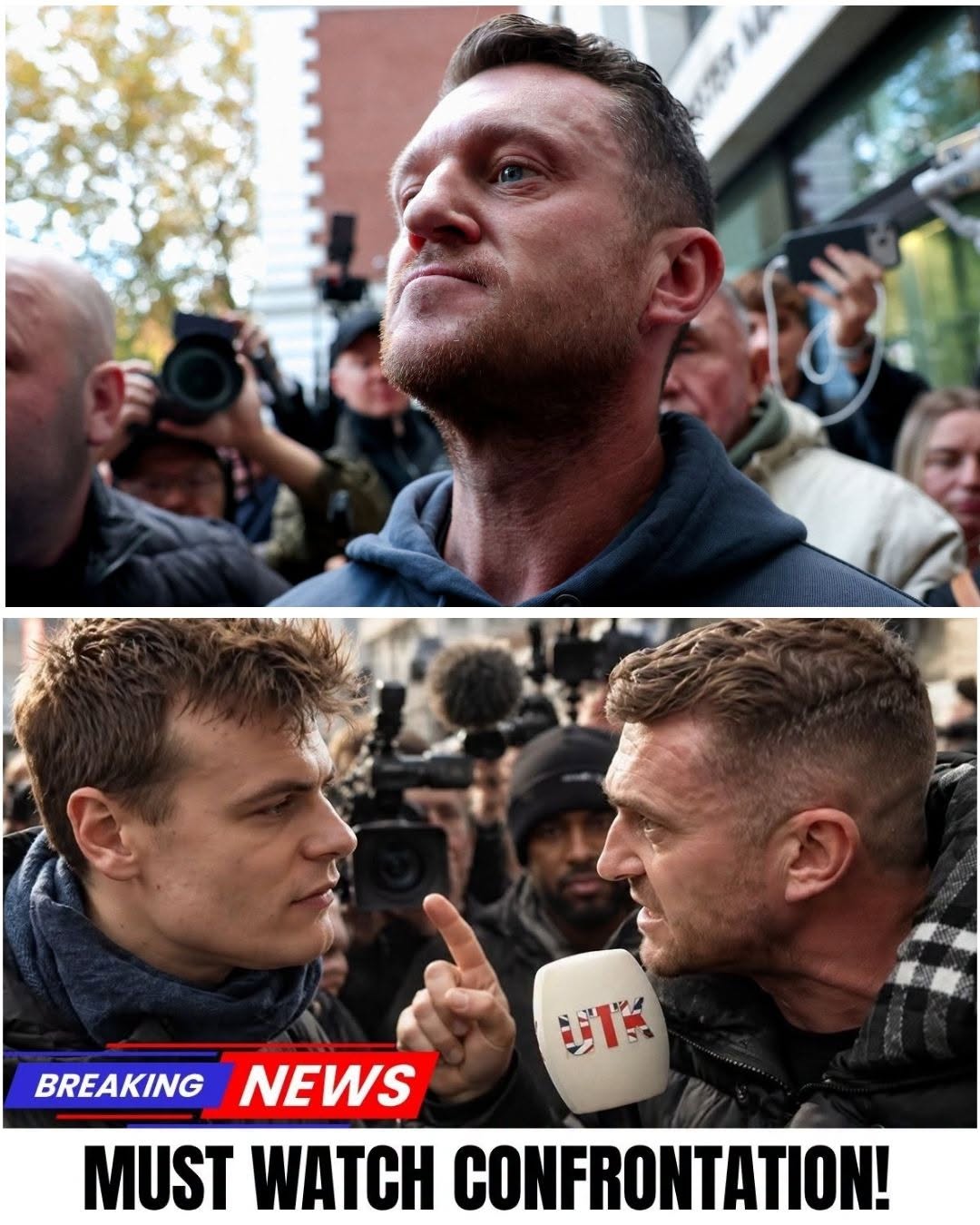
A dramatic video circulating online has been presented as the moment Tommy Robinson supposedly “hijacked” an ITV interview and confronted a reporter over migration, local safety and the treatment of anti-migration protesters. But available reporting does not substantiate several of the most sensational claims attached to the viral post. What can be verified points instead to a wider and increasingly complicated story involving asylum accommodation, women-led protests, activist networks, policing and a deepening argument over whether Britain’s mainstream media fairly represents public concern about immigration.
A photograph or a few seconds of video can acquire an entirely different meaning once it begins travelling through social media. Captions become more dramatic, numbers are detached from their original context, separate incidents are combined and an encounter that may have been complicated in real time is transformed into a simple confrontation between two opposing sides. That appears to be an important consideration in assessing posts claiming that Tommy Robinson recently seized control of a live ITV interview, exposed a supposed secret concerning “800 individuals moving next door” and defended local mothers whom the media had allegedly portrayed as extremists. Searches of recent ITV coverage and other available reporting do confirm that Robinson remains deeply involved in Britain’s anti-immigration protest landscape, but they do not establish the viral narrative in precisely the form described. In particular, a recent ITV confrontation that resembles the image and some elements of the circulating story involved Daniel Thomas, known as Danny Tommo, confronting Reform UK’s Zia Yusuf during an ITV interview in Portsmouth, rather than Robinson taking over an ITV reporter’s interview. ITVX
That distinction matters because Robinson and Thomas are associated with overlapping political and activist networks, and photographs or clips of demonstrations can easily be presented online without enough context to distinguish between them. ITV reported on September 7 that Thomas interrupted an interview with Yusuf while both men were in Portsmouth, where migrants had recently arrived. Thomas is an associate of Robinson and the founder of Patriot Platform, an anti-migration protest group established earlier this year. During the encounter, Thomas challenged Yusuf over comments made by Reform UK leader Nigel Farage and argued that participants in patriotic demonstrations were being unfairly characterised. Yusuf, for his part, emphasised that violence against police officers could not be justified. ITVX
The exchange was undeniably confrontational. But describing it as Robinson “destroying” or “taking down” ITV would turn a political encounter into an editorial conclusion rather than a factual description. More importantly, the available ITV account does not support the claim that a reporter was forced to concede some hidden fact about 800 migrants. That does not mean every concern expressed by protesters is false; it means that individual claims need to be separated and checked rather than treated as proven simply because a video has become popular.
The Number “800” Requires Particular Caution
Numbers have played an unusually powerful role in Britain’s migration debate because they can refer to very different things: people crossing the Channel on one day, residents at an asylum accommodation site, planned capacity at a former military facility, or protesters attending a demonstration. A figure stripped of those distinctions can produce a misleading impression.
For example, ITV reported that RAF Wethersfield in Essex has been used as mass accommodation for asylum seekers and that approximately 800 to 1,000 protesters marched through Braintree in January 2026 during a demonstration attended by Robinson. The 800 figure in that report therefore referred to an estimated number of protesters, not necessarily to 800 asylum seekers being suddenly placed beside a particular neighbourhood. ITVX
Separately, Britain has repeatedly experienced days when roughly 800 people crossed the English Channel. Historical ITV reporting recorded 828 attempted crossings on one day in August 2021 and 872 arrivals on a day in September 2023. ITVX
More recently, the migration issue has again produced large daily figures. On September 23, 2026, 781 people crossed the Channel in ten boats, according to provisional figures reported by the Independent. That was the highest daily figure of 2026 at that point, bringing the year’s total to 18,565. Crucially, however, the same figures indicated that cumulative arrivals were about 42% lower than at the comparable point in 2025. Both statistics can be true simultaneously: Britain can experience a particularly high single day while the overall annual total remains substantially below the previous year’s level. The Independent
That illustrates why claims about “800 people moving next door” should not be repeated as established fact unless the location, accommodation plan and source of the figure can be independently identified.
Why Local Mothers Became Central to the Debate
There is, however, a documented story behind another important element of the viral narrative: the involvement of local mothers in protests against asylum accommodation.
The most prominent example emerged in Epping, Essex, around the Bell Hotel. ITV reported in July 2025 that women from the community organised a march from the hotel to Epping Forest District Council calling for asylum seekers to be removed from the property. One participant, Lindsey Thompson, told ITV that she believed the town had become less safe and wanted people to be vetted before being housed locally. ITVX
The demonstrations followed a criminal case involving a resident of the hotel and a teenage girl. At the time of ITV’s July report, the accused man denied the charge and was awaiting trial. The incident intensified already existing arguments about asylum accommodation and contributed to demonstrations outside the hotel. Some gatherings remained peaceful; others descended into disorder. ITV reported that police had made 16 arrests in connection with the protests at that stage, eight officers had been injured and police vehicles had been damaged. ITVX
This distinction is essential. The existence of violence at some demonstrations does not establish that every person protesting asylum accommodation was violent or extremist. Conversely, the participation of ordinary residents does not mean that extremist organisations or activists were absent from the wider protest environment.
Those two realities can coexist.
Indeed, the father of the teenage girl whose case had become central to the Epping dispute reportedly appealed for violence to stop. In a statement read at a council meeting, he expressed concern about local safety while also saying that violence was not what the family wanted and could ultimately undermine their objective. ITVX
That intervention illustrates a point frequently lost in highly polarised online debate: opposition to a particular asylum accommodation policy is not automatically synonymous with support for violence, while criticism of violence does not automatically amount to dismissal of residents’ concerns.
The Rise of the “Pink Ladies”
Women-led anti-asylum-hotel activism subsequently became more organised. Groups commonly described as the “Pink Ladies” emerged, with participants arguing that their principal concern was the safety of women and children rather than hostility toward people based on ethnicity.
Reporting has described participants as mothers, sisters and grandmothers who reject the label “far right.” The movement became visible at demonstrations outside asylum accommodation in several locations. The Standard
At the same time, the political background of some organisers has attracted scrutiny. Reporting on the Epping movement noted that prominent organiser Orla Minihane had political connections beyond simply being a local mother, including involvement with Reform UK’s local organisation before later supporting other political campaigns. The Guardian Mirror
That does not invalidate the concerns of other residents. Nor does it demonstrate that every participant shares the same political ideology. It does show why broad descriptions such as “ordinary mothers” or, at the opposite extreme, “far-right protesters” can both obscure a more complicated reality.
A protest can simultaneously contain people motivated by personal concerns about neighbourhood safety, established political activists, anti-immigration campaigners, people principally concerned about public spending and individuals holding considerably more radical views.
Understanding who is actually present requires more than assigning a single label to the crowd.
Robinson’s Role in the Wider Movement
Robinson — whose real name is Stephen Yaxley-Lennon — has been one of Britain’s most recognisable anti-Islam and anti-immigration activists for more than a decade. His political history and criminal record are relevant when journalists interview him because they provide context for his public role, but those facts do not by themselves establish whether any particular claim he makes about immigration is true or false. Individual claims still require independent verification.
He co-founded the English Defence League and has accumulated several criminal convictions over the years. Contemporary reporting also describes him as a highly polarising figure whose rallies and online campaigns attract substantial audiences. ABC News
His presence at demonstrations can therefore transform what might otherwise remain a local dispute into a national media event.
That occurred at Braintree earlier this year. ITV reported that several hundred people demonstrated against the use of RAF Wethersfield for asylum accommodation, with Robinson joining the march. Protesters carried banners including “Essex Voices Matter” and “We will not be silenced.” ITVX
For Robinson’s supporters, his involvement can provide national attention to grievances they believe Westminster and national broadcasters have neglected. Critics argue that his intervention can escalate political tensions and connect local campaigns with a broader ideological movement.
Neither interpretation should substitute for examining what happened at a particular demonstration.
The Portsmouth Confrontation Shows How Easily Stories Become Blurred
The recent Portsmouth episode is particularly instructive.
The individual who interrupted the ITV interview was Daniel Thomas, or Danny Tommo. Thomas has worked alongside Robinson and has emerged as an increasingly visible figure in anti-migration activism.
ITV reported that Thomas founded Patriot Platform in July and had promoted the organisation as a vehicle for building what he called a “patriotic army,” partly focused on opposing small-boat migration. The group had also been associated with demonstrations in Dover. ITVX
During the Portsmouth encounter, Thomas challenged Reform UK’s Zia Yusuf rather than an ITV journalist. His grievance centred partly on Nigel Farage’s rhetoric toward certain activists.
Yusuf responded by focusing on policing.
“There is never any excuse for violence against police officers who are doing their job,” Yusuf said during the exchange, according to ITV. ITVX
Thomas maintained that his group had not engaged in violence in Dover. He also addressed criticism surrounding protesters wearing masks, saying that some participants concealed their identities because they feared being branded “far right.” ITVX
That exchange encapsulates several of the issues currently colliding in Britain’s migration debate: distrust of political parties, distrust of mainstream journalism, fears of political labelling, concerns about public disorder and frustration over the government’s handling of irregular migration.
But it is significantly different from the online claim that Robinson took over an ITV interview and forced a reporter to admit uncomfortable truths.
Protest, Intimidation and the Question of Masks
The appearance of black-clad or masked protesters has become another source of controversy.
Organisers may argue that anonymity protects participants from losing employment, being targeted online or receiving threats because of their political views. Critics contend that groups of masked demonstrators can appear deliberately intimidating and make policing more difficult.
Both concerns can exist simultaneously.
The right to peaceful political protest is fundamental in Britain, including protest against government immigration policy. But that right does not extend to violence, threats or unlawful obstruction simply because participants believe strongly in their cause.
This is where political language matters.
Calling every anti-immigration demonstrator an extremist risks collapsing meaningful distinctions between lawful protest, radical political activism and criminal behaviour.
But describing every participant simply as a concerned resident can similarly obscure the involvement of organised political movements.
Responsible reporting has to identify conduct and affiliations rather than infer motives solely from appearance.
Immigration Has Become a Test of Trust
The argument is no longer solely about how many people cross the Channel.
It has increasingly become an argument about whether institutions can be trusted.
Many migration critics believe governments repeatedly announce tougher border policies without delivering the promised results. Some distrust national broadcasters, believing journalists focus disproportionately on extremist elements at demonstrations while giving insufficient attention to residents concerned about accommodation sites.
Others believe activist networks exploit isolated crimes and legitimate policy disagreements to encourage broader hostility toward migrants and Muslims.
Those competing narratives reinforce one another.
When television journalists question activists about criminal histories or extremist associations, supporters may interpret the questions as an attempt to discredit the underlying migration issue.
When activists respond by accusing journalists of covering up crimes or government failures, critics may interpret that as evidence of conspiracy-driven politics.
The result is an environment in which the interview itself becomes the political event.
Who interrupted whom?
Who looked uncomfortable?
Who “won”?
Who was “destroyed”?
Those questions perform extremely well on social media, but they frequently tell audiences less than the substantive questions underneath them.
What Is Actually Happening With Channel Crossings?
The latest available figures provide useful context.
Britain continues to experience irregular migration across the Channel, and hundreds of people can arrive during favourable weather conditions. The September 23 figure of 781 arrivals demonstrated that the route remains active despite government enforcement measures. The Independent
But the annual comparison points in another direction. At 18,565 arrivals by that point in September, the 2026 total was reported as 42% lower than at the equivalent stage of 2025. The Independent
That does not settle the policy argument.
People who favour stricter enforcement may contend that thousands of unauthorised arrivals remain unacceptable regardless of whether numbers have declined.
Those defending the government’s approach can point to falling year-on-year totals as evidence that enforcement is having an effect.
Humanitarian organisations, meanwhile, have long emphasised the dangers faced by people crossing one of the world’s busiest shipping lanes in unsuitable vessels and argue that enforcement alone cannot resolve the forces driving migration.
Those are competing policy positions. The statistics themselves should remain separate from the conclusions politicians and activists draw from them.
Asylum Accommodation Is a Different Question From Border Control
Another common source of confusion is the tendency to treat everyone living in asylum accommodation as if they had identical immigration status.
They do not necessarily.
A person seeking asylum is asking Britain for protection under its asylum system. The legitimacy of that claim is determined through a legal and administrative process. Some claims ultimately succeed and others are rejected.
The question of where applicants should live while claims are processed is therefore distinct from the question of who should ultimately receive permission to remain in Britain.
Hotels became politically controversial partly because of their expense and partly because placing relatively large groups of asylum seekers into individual communities can generate substantial local opposition.
Former military sites have been used partly as alternatives.
RAF Wethersfield is one example. ITV describes it as one of Britain’s mass accommodation facilities used alongside hotels. ITVX
Critics of large sites raise questions about local infrastructure, security and community consultation. Refugee and human-rights organisations have raised different concerns, including whether isolated mass accommodation is suitable for people who may have experienced war, persecution or trauma.
The government consequently faces pressure from opposite directions: reduce hotels, control costs, process cases faster, remove people without permission to remain and provide lawful asylum seekers with adequate accommodation.
There is no single administrative decision that resolves all those objectives simultaneously.
Crime Claims Require Especially Careful Reporting
The most emotionally powerful arguments surrounding asylum accommodation often involve crime.
When a serious offence is committed by someone seeking asylum, it is legitimate to report the suspect’s immigration status where it is relevant. Communities are also entitled to ask questions about screening, accommodation and policing.
But moving from an individual criminal case to conclusions about an entire population requires evidence.
The reverse is equally important.
Journalists should not dismiss residents’ safety concerns merely because extremist groups may attempt to exploit them.
The Epping case demonstrates why both principles matter.
A serious allegation involving a teenage girl contributed to understandable anger. Local women subsequently organised demonstrations. At the same time, some protests experienced violence and police officers were injured. ITVX
Reporting only the alleged crime would give an incomplete picture.
Reporting only the disorder would also give an incomplete picture.
The Media’s Difficult Role
Interviews with Robinson create a particularly difficult editorial problem.
Avoiding him entirely can allow supporters to argue that mainstream broadcasters refuse to engage with politically inconvenient voices.
Interviewing him without sufficiently challenging factual claims can allow misinformation to spread through a major media platform.
Aggressive questioning can then be edited into short social-media clips that supporters present as evidence that journalists are hostile.
The problem predates today’s migration dispute.
More than a decade ago, commentators were already debating whether Robinson’s broadcast interviews challenged him adequately and how journalists should balance scrutiny of his record against discussion of his political arguments. The Guardian
Social media has made the problem considerably harder.
A television interview lasting ten minutes might contain qualifications, statistics and follow-up questions. A 25-second clip uploaded to Facebook, TikTok or X can remove nearly all of that context.
The most confrontational seconds then become the entire story.
“Mainstream Media” Is Too Broad a Category to Verify as a Single Actor
The phrase “MSM” — mainstream media — is frequently used in viral posts as though Britain’s newspapers and broadcasters constitute a coordinated institution.
They do not.
ITV, BBC, Sky News, GB News, Channel 4, commercial radio stations, national newspapers and regional outlets operate under different ownership structures and editorial policies.
They frequently contradict one another.
A claim that “the media” collectively attempted to portray local mothers as extremists therefore needs evidence showing which outlet, journalist or programme supposedly did so.
There is documented reporting connecting some asylum protests with far-right activists. There is also documented reporting giving local mothers substantial opportunities to explain their concerns directly.
ITV’s Epping coverage, for example, quoted a local mother at length explaining why she no longer felt safe and what she wanted authorities to do. ITVX
That fact does not prove every piece of coverage has been fair.
It does demonstrate why sweeping claims of a coordinated media attempt to silence residents should be treated cautiously.
Robinson’s Relationship With the Media Is Itself Part of His Political Strategy
Robinson has built much of his public profile outside conventional political institutions.
Social media allows him to communicate directly with supporters, challenge established broadcasters and distribute his own interpretation of events without relying on traditional editorial gatekeepers.
This can be powerful because audiences receive footage that appears immediate and unfiltered.
But “unfiltered” does not necessarily mean complete.
Activists, political parties, governments and broadcasters all make editorial decisions about what to record, what to publish and what context to provide.
The same principle should therefore be applied to everyone.
A broadcaster’s description should be scrutinised.
So should an activist’s caption.
So should a government press release.
So should a viral Facebook post.
The Battle Over Labels
Perhaps no word generates more disagreement in this debate than “far right.”
Some media organisations use the description for Robinson because of his political history, including his role in founding the English Defence League and his longstanding anti-Islam campaigning. ABC News
Robinson and many supporters reject characterisations they regard as attempts to delegitimise criticism of immigration or Islam.
The useful journalistic approach is therefore to provide concrete information whenever possible rather than relying exclusively on labels.
Readers can be told what organisations someone founded, what policies they advocate, what they have said publicly and what criminal convictions or political affiliations are relevant.
Readers can then evaluate those facts themselves.
The same approach should apply to protesters.
Someone attending a demonstration because an asylum hotel opened near their child’s school should not automatically be assumed to share every belief held by the most radical person at the same demonstration.
Likewise, the presence of ordinary residents does not transform unlawful behaviour by other participants into legitimate protest.
Britain Is Arguing About More Than Immigration
The intensity of these demonstrations suggests that migration has become a proxy for several wider anxieties.
Housing shortages.
Pressure on public services.
Distrust of government.
Community identity.
Policing.
Crime.
National sovereignty.
The cost of asylum accommodation.
The speed of asylum decisions.
Free expression.
And distrust of traditional media.
For some voters, irregular migration represents evidence that the state has lost control of its borders.
For others, the reaction to migration demonstrates the danger of allowing legitimate policy disagreements to become hostility toward foreigners or minorities.
For still others, both concerns are legitimate: Britain should control its borders effectively while maintaining humane treatment and resisting collective blame.
Those disagreements cannot be resolved by determining who appeared stronger during a television confrontation.
The Government Also Faces a Communication Problem
Governments frequently present migration statistics selectively.
An administration may emphasise falling annual arrivals.
Opponents may emphasise a record daily number.
Both can accurately describe the same dataset.
The September figures demonstrate precisely this problem: 781 arrivals represented a 2026 daily high, while cumulative arrivals remained markedly below the comparable 2025 total. The Independent
Good reporting should provide both numbers.
Without context, “RECORD MIGRANT SURGE” might suggest the annual trend is rising dramatically.
Without mentioning the high daily figure, saying only that crossings are “down 42%” might understate the continuing scale and volatility of the Channel route.
Context is not an attempt to weaken one side’s argument.
It is what makes statistics useful.
What the Viral Story Gets Right
Behind the exaggeration, several elements of the broader story are genuine.
Britain is experiencing a politically intense dispute over asylum accommodation.
Local mothers have organised protests.
Some protesters believe national media unfairly portray them.
Robinson remains active within Britain’s anti-immigration movement.
His associates are participating in demonstrations and confrontations.
ITV has filmed tense encounters involving those activists.
Large numbers of people continue to cross the Channel.
And political pressure on the government remains substantial.
Those facts explain why a dramatic caption can appear immediately believable.
What Remains Unverified
The stronger claims require much greater caution.
The available evidence reviewed for this article does not establish that Robinson recently “hijacked” the particular live ITV interview described in the viral caption.
It does not establish that an ITV reporter was forced to admit a hidden fact concerning exactly 800 people being moved beside local residents.
It does not establish that ITV collectively characterised the local mothers involved as extremists.
And phrases such as “ultimate MSM takedown,” “terrifying truth,” “massive bombshell” and “reporter’s reaction is unreal” are promotional judgments rather than independently verifiable descriptions.
A closely related recent confrontation documented by ITV instead involved Danny Tommo interrupting Zia Yusuf while Yusuf was being interviewed in Portsmouth. ITVX
That distinction should remain attached to any retelling of the event unless a full original recording establishing a separate Robinson encounter emerges.
Why Verification Matters Even When the Underlying Issue Is Real
Correcting an exaggerated viral caption does not require dismissing Britain’s migration problems.
The Channel crossings exist.
The asylum accommodation controversy exists.
Community opposition exists.
Public anxiety exists.
Crime committed by individual asylum seekers exists, just as crimes committed by members of the wider population exist.
Violence at some anti-migration demonstrations also exists.
And organised political groups are attempting to shape public understanding of all those issues.
The challenge is separating those realities from claims that cannot yet be demonstrated.
That standard should apply regardless of political perspective.
People who support tougher immigration enforcement benefit from accurate information because exaggerated claims can undermine legitimate arguments when they are subsequently disproved.
People who favour a more liberal asylum policy also benefit from acknowledging documented failures rather than appearing to minimise community concerns.
The Confrontation That Really Matters
Ultimately, the most consequential confrontation is not between Robinson and a television journalist.
It is between public expectations and Britain’s ability to operate an immigration and asylum system that commands sufficient confidence.
Residents want to know who is being housed in their communities.
Asylum seekers need decisions on their cases within a reasonable period.
Police need to protect lawful demonstrations while preventing disorder.
Government needs to reduce irregular crossings and remove people who have no legal right to remain while complying with domestic and international law.
Local authorities want meaningful consultation before accommodation decisions significantly affect their communities.
And journalists need to interrogate all sides without converting political disagreement into entertainment.
Until those underlying issues are addressed, confrontational clips will continue to flourish because they provide emotionally satisfying explanations for extraordinarily complicated problems.
A journalist becomes the villain.
An activist becomes the hero — or the extremist.
A migrant becomes either a threat or a victim.
A local protester becomes either a courageous mother or a radical.
Reality is rarely that simple.
The recent wave of migration demonstrations shows precisely why those distinctions matter. Britain is confronting genuine questions about border control, asylum accommodation, community consent and public safety. It is simultaneously confronting questions about political radicalisation, misinformation and the boundaries of lawful protest.
The public debate is better served when all of those issues can be examined at once.
The viral caption presents a spectacular showdown in which one man supposedly exposed everything the mainstream media wanted hidden. The verifiable record is less cinematic but considerably more informative: Britain’s migration dispute is bringing together local residents, political activists, organised protest movements, national politicians, journalists and police in increasingly tense encounters — while fragments of those encounters are repackaged online into stories that sometimes outrun the evidence.
For viewers encountering the purported “Tommy Robinson vs ITV” confrontation, the most useful question is therefore not who won.
It is which claims can actually be verified.
On the evidence currently available, the broader controversy over asylum accommodation and anti-migration demonstrations is real. The precise viral account of Robinson hijacking an ITV interview, revealing a secret involving 800 incoming residents and exposing a coordinated media campaign against local mothers is not established by the reliable reporting located so far.
That difference may be less dramatic than the headline circulating on social media.
But it is the difference between a viral narrative and a news report.