
UK Migration Debate Intensifies as Shabana Mahmood’s Safe Routes and Family-Life Reforms Face Political Challenge
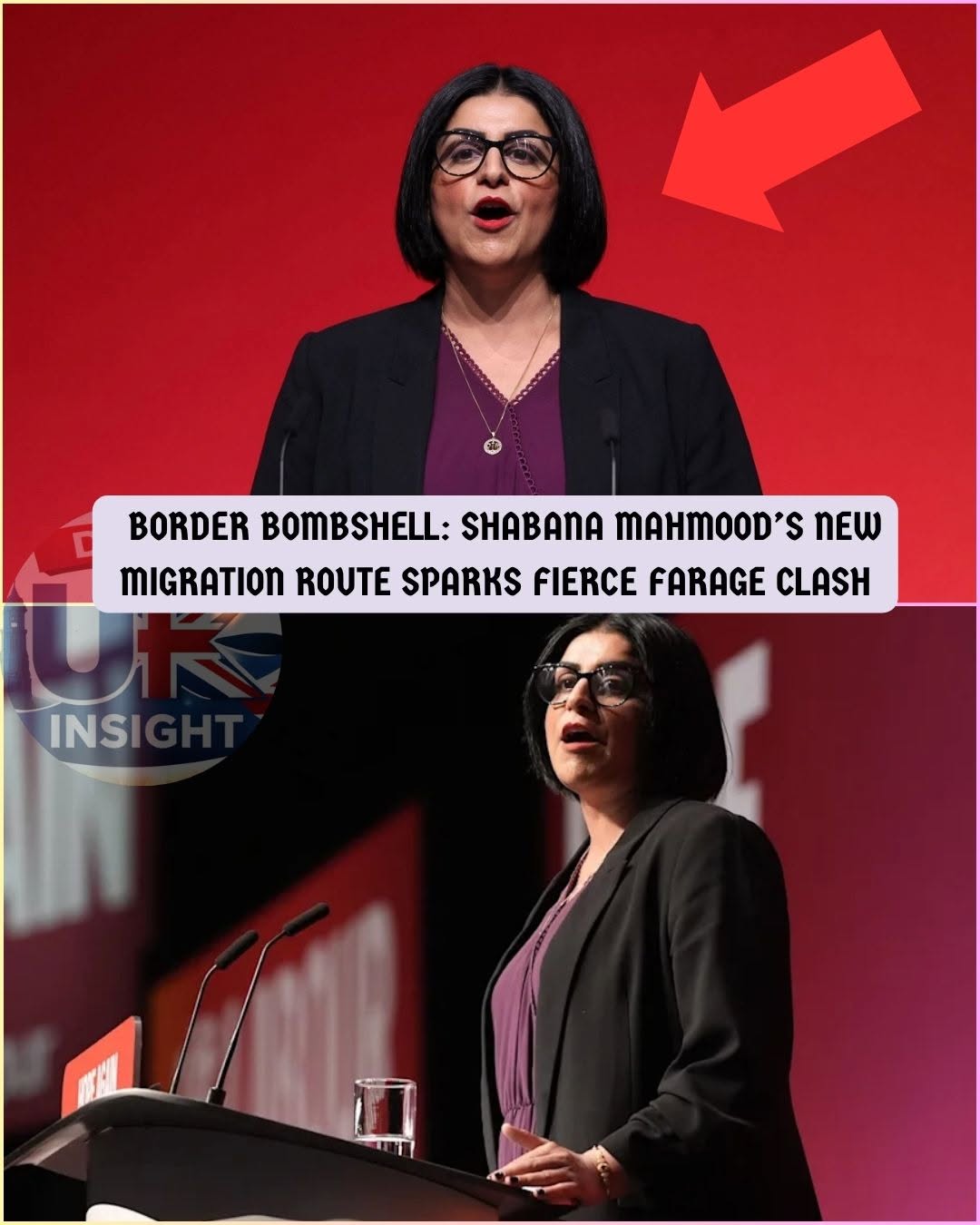
Britain’s immigration debate is entering another complicated phase as Home Secretary Shabana Mahmood pursues two policies that can appear contradictory at first glance: creating controlled routes through which selected refugees can legally enter the United Kingdom, while simultaneously tightening the circumstances in which migrants can rely on family life and human-rights arguments to enter or remain in the country. Nigel Farage and other immigration restrictionists have challenged the broader direction of government policy, while Restore Britain is advocating a substantially more restrictive model. Behind the political confrontation lies a more complicated legal question about Article 8 of the European Convention on Human Rights, refugee family reunion, sponsorship and the distinction between legal migration, asylum and irregular Channel crossings.
The latest controversy is easily distorted by descriptions suggesting that the Government simply intends to “bring migrants directly to Britain”. There is an element of truth behind that phrase—the Government has announced new controlled routes through which qualifying refugees may eventually enter the UK—but it leaves out important qualifications concerning eligibility, sponsorship, numerical controls and the separate reforms being made to immigration and human-rights law.
What is emerging is not a single migration policy but an attempt to restructure several interconnected systems at the same time.
Mahmood has argued that Britain should reduce reliance on irregular journeys and instead decide itself who is admitted through controlled routes. The Government announced in June that new safe and legal refugee routes would begin rolling out from autumn 2026. The planned framework includes sponsorship involving communities and universities, with an employment-based route also envisaged. The Government describes these routes as controlled alternatives to journeys organised by people-smuggling networks. GOV.UK
At the same time, however, the Government is attempting to restrict some uses of the legal principle known as the “right to respect for private and family life”, contained in Article 8 of the European Convention on Human Rights.
That combination explains why the current argument cannot accurately be reduced to either “opening the borders” or “closing the borders”.
It is an effort to change which routes are available, who qualifies for them, who sponsors arrivals, what conditions apply and how much discretion courts have when deciding whether removal would interfere unlawfully with family life.
What Mahmood is actually proposing
The clearest explanation of the Government’s philosophy came during parliamentary consideration of the Immigration and Asylum Bill.
Mahmood told MPs that the Government wanted asylum increasingly to operate through “controlled, safe and legal” routes rather than irregular journeys. Under the proposed model, communities, universities and businesses could sponsor qualifying refugees.
The Home Secretary said these would be capped routes and argued that sponsorship could help ensure that arrivals receive support and have better prospects for integration.
According to the Government’s parliamentary explanation, community sponsorship and a refugee student scheme were intended to begin operating from autumn 2026, with initial arrivals expected subsequently, while a business sponsorship route would provide another pathway through employment. Hansard
This is the source of some claims circulating online that the Government intends to “bring migrants directly into Britain”.
But the terminology matters.
A refugee admitted through an authorised sponsorship programme is legally different from someone who crosses the Channel without prior permission and subsequently claims asylum.
The Government’s objective is precisely to distinguish those two circumstances.
Mahmood argues that Britain can continue accepting people requiring protection while shifting control over admission away from smugglers and towards the state.
Opponents question whether establishing additional legal pathways will genuinely reduce irregular arrivals, whether the eventual numbers will remain limited and whether creating new programmes could generate additional migration rather than substitute for existing irregular routes.
Those are policy disputes rather than facts that can currently be settled conclusively.
The programmes are still developing, and their eventual scale and effects will depend on implementation.
The refugee family-reunion issue is different
Another source of confusion is that the new sponsorship programmes are sometimes discussed alongside refugee family reunion, even though they are not the same thing.
Britain previously operated a dedicated Refugee Family Reunion route allowing certain close relatives of people granted protection in the UK to join them.
New applications through that particular route were suspended from 4 September 2025 while the Government reviewed the wider family migration system.
That suspension remains important.
Official Home Office guidance states that partners and children of people with protection status may instead attempt to qualify through other family provisions, including Appendix FM, but those routes impose requirements that the former refugee-specific system did not necessarily impose in the same way. GOV.UK
Mahmood recently explained the reasoning before Parliament’s Home Affairs Committee.
She said Britain currently has roughly 30 different routes relating to family migration and reunification, creating a system the Government considers excessively complicated.
She also highlighted a politically sensitive disparity.
British citizens attempting to bring a foreign spouse or relative into Britain can face financial and other eligibility requirements. Refugees historically had access to a dedicated family-reunion procedure with different conditions.
Mahmood said the Government wants a more coherent system in which similar principles apply more consistently whether the sponsor is British, settled in Britain, present through a work route or recognised as a refugee. Quốc Hội Vương Quốc Anh
That review is unfinished.
In evidence on 15 September 2026, Mahmood said she was not able to provide a date for ending the suspension and expected to say more about the broader family-migration policy in the early part of next year. Quốc Hội Vương Quốc Anh
That point is particularly important when evaluating claims on social media about a supposedly finalised “new family reunion route”.
Some parts of the wider migration strategy are concrete; others remain under development.
What the numbers show
Official statistics provide useful context.
In the year ending June 2026, the UK granted 57,590 family visas, representing a 19% decline compared with the preceding year.
Refugee Family Reunion grants fell more sharply, from 20,643 to 12,888, a reduction of approximately 38%.
The Home Office explains that some grants continued after the September 2025 suspension because applications lodged before the cutoff remained in the system, alongside appeals and cases where applicants subsequently completed biometric requirements. GOV.UK
Those numbers demonstrate why it is misleading to treat every discussion about family migration as evidence of an immediate expansion.
The dedicated refugee family-reunion route is actually suspended to new applications.
The Government is simultaneously constructing different legal refugee routes and reviewing how family migration should operate in the future.
That distinction is central to understanding the dispute.
Then comes Article 8
The politically explosive component concerns Article 8 of the European Convention on Human Rights.
Article 8 protects the right to respect for private and family life, home and correspondence.
It does not, however, establish an unlimited or automatic right for any person with relatives in Britain to enter the country or remain there permanently.
Unlike some Convention rights, Article 8 is qualified. Governments may interfere with it under specified circumstances where interference is lawful, pursues a legitimate objective and is proportionate.
That proportionality question is where immigration litigation frequently becomes complicated.
Courts can therefore be asked to balance an individual’s family circumstances against the state’s legitimate interest in maintaining immigration control, preventing crime or protecting other public interests.
The political argument concerns where that balance should sit and how much Parliament can specify in legislation.
Mahmood wants to narrow the definition
Interestingly, the Government’s proposed approach is not simply to expand family-life protections.
It is attempting to restrict them.
During the Immigration and Asylum Bill debate, Mahmood explained that the legislation would normally define family for immigration purposes around the immediate family unit: a spouse or partner, a parent, or a child under 18.
Exceptions could exist in unusual circumstances involving particularly strong dependency.
The Bill also addresses the timing of family relationships.
According to Mahmood’s explanation to Parliament, judges would be directed to consider whether the Article 8 relationship was established after someone entered Britain illegally or overstayed a visa.
Another provision addresses overseas applications.
The Government’s proposal is that where someone outside Britain seeks admission on Article 8 family-life grounds, the relevant claim should normally be made by the UK-based sponsor, rather than independently by the overseas relative. Parallel Parliament
This distinction considerably complicates claims that the Government is creating an unrestricted “right to bring family members to Britain”.
The legislation is intended to establish boundaries around exactly who counts as family for these purposes.
Why Farage has focused on Article 8
Nigel Farage has been one of Britain’s most persistent political critics of the way the European Convention interacts with immigration enforcement.
His criticism substantially predates Mahmood’s latest proposals.
During a Commons debate on ECHR withdrawal in October 2025, Farage specifically attacked the application of Article 8 in deportation cases. He argued that decisions about who can legally remain in Britain should ultimately be controlled by Parliament rather than constrained by Strasbourg jurisprudence. Hansard
Farage and Reform UK have therefore approached the issue from a fundamentally different starting point from the Government.
The Government’s position is broadly that Britain can remain within the ECHR while Parliament defines more clearly how Article 8 should operate within immigration cases.
Farage’s longstanding argument is that such reforms do not resolve the underlying problem because the Convention and its judicial interpretation continue to impose external legal constraints.
That is a genuine constitutional disagreement.
It is not simply an argument about the number of migrants entering Britain.
It is also an argument about who ultimately determines the limits of immigration law: Parliament, domestic courts or a legal system operating within Britain’s international treaty commitments.
Is the “right to family life” an automatic immigration loophole?
No.
But neither is Article 8 irrelevant to immigration.
The two oversimplifications frequently appear simultaneously in political debate.
One side sometimes presents Article 8 as though merely having a relative in Britain guarantees that someone cannot be deported.
The other sometimes speaks as though Article 8 never affects immigration decisions.
Neither adequately describes the law.
Individual circumstances matter.
The nature of the relationship matters.
The interests of children can matter.
Immigration history matters.
Criminal offending can matter.
The public interest matters.
And proportionality matters.
This is precisely why governments repeatedly attempt to provide Parliament and courts with more explicit statutory instructions.
Mahmood’s legislation represents another attempt to draw those boundaries.
Children are one of the hardest questions
Cases involving children illustrate why Article 8 disputes become difficult.
Removing a parent from Britain can obviously affect a child who remains here.
But that does not automatically mean removal is prohibited.
Mahmood told Parliament that the Bill would specify circumstances relevant to deciding whether it would be unreasonable to expect a child to leave Britain.
Examples include situations in which the child would be unable to receive an education in the destination country, could not reasonably integrate there, or would experience particularly serious and lasting harm from relocation.
The Government argues that its approach is compatible with existing European case law. Parallel Parliament
Critics can still challenge individual provisions legally or politically, and future court judgments may determine precisely how the new rules interact with Convention obligations.
For that reason, claims that the legislation has already eliminated—or alternatively massively expanded—Article 8 immigration protections should be treated cautiously.
Why create legal refugee routes at all?
The Government’s answer centres on incentives.
Under the present system, people seeking protection can pay smugglers to cross the English Channel and then request asylum after arriving.
Successive governments have tried to deter this.
Mahmood’s alternative argument is that Britain should determine in advance which refugees it accepts.
That produces the concept of capped safe routes.
Rather than an individual paying a criminal organisation to cross the Channel, an approved community organisation, educational institution or eventually an employer could sponsor an eligible refugee through an authorised process.
The Home Secretary has argued that this would allow Britain to maintain its humanitarian role while restoring government control over admissions. GOV.UK
There are, however, competing arguments about whether such schemes will accomplish that objective.
Supporters of safe routes argue that if legitimate alternatives barely exist, people with strong protection claims may still resort to smugglers.
Critics argue that increasing authorised routes does not necessarily stop unauthorised migration and that the Government must demonstrate how the numbers will be controlled.
Those competing propositions will ultimately require evidence from implementation.
Community sponsorship changes the model
The sponsorship component deserves particular attention.
Under the Government’s proposal, refugees would not simply be admitted without institutional support.
Community organisations could participate in sponsorship.
Universities would have a route connected with study.
Businesses are expected eventually to have an employment-related sponsorship mechanism.
The Government argues that sponsorship could improve integration because arrivals would enter with established connections to accommodation, education, employment or community assistance rather than being placed into an already pressured asylum-support system.
In Parliament, Mahmood said the model was intended to mean that refugees would arrive with community consent and financial support from sponsors rather than simply depending upon taxpayers. Hansard
How effectively that principle works will depend heavily on the final rules.
Questions remain over sponsor eligibility, safeguarding, funding, enforcement, annual caps and what happens if sponsorship arrangements collapse.
Those details matter more than political slogans on either side.
Why critics remain suspicious
For migration restrictionists, however, the fundamental concern is numerical.
If Britain creates several new pathways, critics want to know whether people admitted through those programmes will replace some existing migration or constitute additional arrivals.
They also question how initial caps could evolve.
A programme admitting hundreds annually is politically and economically different from one admitting tens of thousands.
When the Government announced its plans in June, it did not initially specify a single definitive long-term number for all the proposed routes. Contemporary reporting indicated that the routes were expected to begin modestly and potentially expand. The Guardian
That uncertainty provides legitimate territory for parliamentary scrutiny.
It does not, by itself, demonstrate that an unlimited programme exists.
Restore Britain goes considerably further
The appearance of Restore Britain in the argument adds another layer because the party’s immigration position is significantly more restrictive than the Government’s.
According to Restore Britain’s own published immigration policy, the party wants what it describes as a reversal of mass immigration rather than merely reducing annual inflows.
Its programme calls for deporting people in Britain illegally and removing some legally resident foreign nationals who fail conditions established by the party.
It also advocates replacing the existing asylum model, imposing much tighter conditions for citizenship and pursuing what the organisation describes as “net negative immigration.” Restore Britain Vote
Restore Britain’s philosophy therefore differs not merely in degree but in architecture from Mahmood’s.
Mahmood wants to replace more irregular migration with state-controlled legal protection routes.
Restore Britain proposes a much more restrictive overall settlement involving substantial removals.
Restore Britain and Reform UK should not be treated as interchangeable
The distinction between Restore Britain and Nigel Farage’s Reform UK is also politically significant.
Although both have advocated much tougher immigration enforcement than Labour, they are separate political organisations and have disagreed publicly about strategy and cooperation.
In August, tensions became visible when Restore leader Rupert Lowe disputed Farage’s account of discussions about political cooperation, even while indicating that Restore remained open to some form of collaboration. The Guardian
Consequently, headlines suggesting a unified Farage–Restore campaign against Mahmood can obscure the actual political landscape.
They may share objections to aspects of current immigration policy without having identical programmes or organisational interests.
Farage’s Channel strategy is another separate issue
Farage has also advocated direct action against small boats.
In August he described a proposal involving naval interception and returning people attempting irregular Channel crossings to France, arguing that such an approach could operate consistently with international law.
That claim itself is politically and legally contested and would depend, among other things, on cooperation with France and applicable maritime, refugee and human-rights obligations. The Guardian
Again, this demonstrates how several distinct issues are being compressed into one national “border debate”:
legal refugee admissions;
small-boat crossings;
family visas;
refugee family reunion;
Article 8 appeals;
foreign-offender deportation;
the ECHR;
and the overall level of migration.
They interact, but they are not legally interchangeable.
The Government faces criticism from the opposite direction as well
Mahmood is not only facing pressure from politicians demanding tougher controls.
She has also been criticised by MPs and campaigners who believe her approach is too restrictive.
That became particularly visible over refugee family reunion.
During an earlier Commons exchange, Labour MP Nadia Whittome argued that restricting refugee family reunion could have the unintended effect of encouraging spouses and children to attempt dangerous irregular journeys because legal routes to reunification were unavailable.
Mahmood responded by pointing towards protection, work, study and safe-route proposals, while arguing that refugee family migration should be brought closer to the requirements imposed on British citizens sponsoring relatives. Hansard
That exchange illustrates the political position Mahmood occupies.
From one direction, critics argue she is creating additional migration routes.
From another, critics argue she is closing humanitarian routes and weakening refugee rights.
Both cannot simply be collapsed into the same accusation.
The fairness argument
One of Mahmood’s strongest recurring arguments concerns equal treatment.
Consider two hypothetical families.
A British citizen marries somebody living overseas and wants that spouse to move to Britain.
A recognised refugee living in Britain wants a spouse living overseas to join them.
Historically, those two sponsors have faced different immigration frameworks.
Mahmood argues that those differences have become difficult to justify and that Britain needs a coherent family migration system.
In September, she told MPs that British citizens can face particularly demanding conditions when sponsoring overseas relatives and said there was a public fairness argument for rationalisation. Quốc Hội Vương Quốc Anh
But equality of rules can point in two directions.
The Government could make refugee requirements tougher.
It could make requirements for British sponsors easier.
Or it could construct a common framework somewhere between the two.
Until the final family policy is published, claims about precisely where that balance will settle remain premature.
The economic dimension
Family migration also intersects with economics.
Governments have historically imposed financial requirements partly because of concerns about dependency on public funds.
Mahmood specifically referred to the ability of families to support themselves when defending the legality of the Government’s approach before MPs.
She said previous court decisions had recognised the principle that financial self-sufficiency can legitimately form part of family migration rules. Quốc Hội Vương Quốc Anh
Critics of income thresholds respond that such requirements can separate genuine families based primarily on earnings and disproportionately affect lower-income British citizens.
Supporters argue that people sponsoring relatives should demonstrate that the household can support itself without imposing unreasonable costs on taxpayers.
That debate will become increasingly important as the Government attempts to harmonise different family routes.
Integration is becoming part of immigration policy
Another significant development is the increasing emphasis on integration.
The Government’s immigration white paper says future family policy should include clearer relationship requirements and appropriate English-language expectations while attempting to simplify the existing framework.
It explicitly says the future policy is intended to cover British citizens, settled residents, workers and refugees seeking to bring family members to Britain. GOV.UK
That suggests the coming family reforms could be considerably broader than the current political controversy implies.
They may eventually affect thousands of ordinary British households with overseas family connections—not merely asylum seekers.
Why language matters so much
The terminology surrounding immigration increasingly determines public perception.
Consider the difference between:
“Government brings migrants into Britain”
and:
“Government creates capped sponsorship programmes for recognised refugees.”
Both descriptions might refer to the same underlying policy, yet they produce dramatically different impressions.
Likewise:
“migrant uses family rights to avoid deportation”
may describe anything from a serious foreign offender pursuing an Article 8 appeal to a parent arguing that removal would cause disproportionate harm to a British child.
Those circumstances are obviously not equivalent.
Responsible reporting therefore requires distinguishing legal categories rather than treating “migrant” as one homogeneous status.
What is established—and what remains uncertain
Several facts can now be stated with reasonable confidence.
The dedicated Refugee Family Reunion route has been suspended to new applications since September 2025.
The Government is developing a replacement or broader restructuring of family migration.
Mahmood has said that the detailed family policy remains under development and recently indicated that further proposals are expected in the early part of 2027.
Separately, the Government has announced controlled refugee sponsorship routes involving communities and universities, with business sponsorship also planned.
And the Immigration and Asylum Bill seeks to narrow and clarify the circumstances in which Article 8 family-life considerations apply within immigration decisions. GOV.UK
What cannot yet be stated with the same certainty is how large the new refugee programmes will ultimately become, how the eventual unified family migration framework will operate, whether the reforms will substantially reduce irregular Channel crossings, and how future courts will interpret disputed provisions once cases arise.
Those are questions for implementation and evidence rather than headlines.
A wider struggle over Britain’s migration model
The significance of this debate extends beyond one Home Secretary, one opposition politician or one immigration route.
Britain is effectively considering three competing models of migration and asylum policy.
The first is a system in which asylum claims continue substantially to arise after spontaneous arrival, including irregular arrival.
The second—the direction advocated by Mahmood—is a more managed model in which irregular migration is discouraged while government-authorised sponsorship and resettlement routes become more important.
The third, represented most clearly by Restore Britain’s published programme, involves dramatically reducing migration and pursuing large-scale removals alongside fundamental changes to the asylum system. Restore Britain Vote
Farage and Reform UK occupy their own position within that landscape, combining demands for stronger border enforcement with longstanding criticism of the ECHR’s influence over immigration and deportation decisions.
The political battle is therefore not simply over whether Britain should have “more” or “less” immigration.
It concerns what kind of immigration system Britain should have.
The unanswered question: can controlled routes reduce illegal routes?
This may eventually become the most important empirical test of Mahmood’s strategy.
The Government’s theory is straightforward.
If Britain selects refugees through controlled programmes and provides legitimate ways for some people to reach the country, the state can combine humanitarian protection with stronger enforcement against irregular migration.
Critics dispute that causal relationship.
They argue that people using Channel routes may represent different populations from those admitted through sponsorship and that additional legal pathways therefore might not materially reduce small-boat arrivals.
Supporters counter that closing legitimate routes while maintaining the possibility of asylum after irregular arrival can create precisely the wrong incentive.
Neither argument should be treated as proven simply because it is politically persuasive.
The evidence will depend on who enters through the new routes, how many places are available, what happens to irregular crossings and how enforcement changes simultaneously.
A debate likely to continue
For now, the dramatic claim that Mahmood has simply created a broad new mechanism for “bringing migrants directly into Britain under the right to family life” goes further than the available evidence supports.
There are new safe and legal refugee routes.
There are major reforms involving Article 8.
There is a wider family migration review.
But they are separate components of a much larger restructuring.
Indeed, one of the striking features of Mahmood’s policy is that while the Government is creating certain controlled routes for refugees, it is simultaneously attempting to narrow the application of family-life protections in immigration cases.
Farage’s challenge comes from a different constitutional position: he has argued that Article 8 and the wider ECHR framework give courts too much influence over decisions that should be controlled domestically. Restore Britain goes further still, advocating a migration system explicitly designed to produce substantial net departures.
Meanwhile, critics on Labour’s left and refugee-rights advocates warn that making family reunion harder could separate families and potentially encourage desperate relatives to seek irregular alternatives.
Those disagreements will not disappear simply through tougher rhetoric.
They involve genuine choices over humanitarian obligations, sovereignty, public finances, integration, border enforcement and the rights of families.
The decisive details will therefore be found not in social-media slogans but in the legislation, the eventual family migration rules, the numerical caps placed on sponsorship schemes and the evidence that emerges once those policies operate.
For the moment, Britain’s migration debate remains caught between two objectives that successive governments have struggled to reconcile: maintaining meaningful control over who enters and remains in the country while preserving legal routes for family life and protection for people whom Britain decides genuinely require refuge.
How Mahmood’s reforms attempt to reconcile those objectives—and how Parliament, the courts, Reform UK, Restore Britain and critics within Labour respond—will help determine the next stage of one of Britain’s most consequential political debates.