
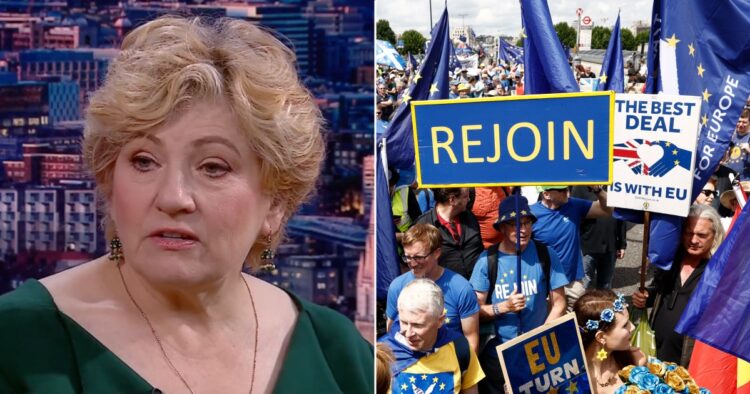
Emily Thornberry has argued there would be no need for a second referendum on the UK rejoining the European Union if Labour included the pledge in their manifesto.
In recent weeks, there has been much discussion about the UK’s long-term relationship with the EU.
Andy Burnham has been highly critical of Brexit and has said he will consider all options as part of his 10-year plan for Britain.
In a statement to the House of Commons on Monday, the prime minister called for “deeper cooperation” with the EU to help drive economic growth in the UK, and said it was an “immediate priority” for him to secure a successful outcome at the EU-UK summit next month.
One suggestion for how Brexit could ultimately be reversed is if Labour included a pledge for a second referendum in their next manifesto.
However, Labour MP Emily Thornberry has said there would be no need for another referendum, and instead her party should include a simple pledge to rejoin the EU in their manifesto.
Speaking to Sky News, Thornberry argued this would be enough of a mandate from the British public, providing a clear choice for voters at the next general election.
Acknowledging she was in a minority on this, Islington South and Finsbury MP said: “We need to have a democratic decision, so we ought to be putting it somehow. I don’t think we need to have another referendum but what we can do is have it in the manifesto and then people can have a choice.
“Do they want to have this current relationship with the European Union or do they want to be back in the EU, if that’s what our policy is.
“I would say, let’s not bother with another referendum, let’s just have it as a general election.”
The suggestion that a referendum wouldn’t be required to reverse Brexit sparked predictably anger from right-wingers and Brexiteers, but it wasn’t just the usual suspects who disagreed with Thornberry.
Despite having voted for Remain in 2016, journalist Lewis Goodall said that rejoining the EU without another referendum would be a “democratic outrage and would not endure.”
He wrote on X: “There is no way that re-accession would have legitimacy as a new settlement without a direct democratic reversal of the last referendum.
“Sure, Parliament is sovereign, it can do what it wants. But our membership of the EU has been assented to or rejected by direct referendum twice. The constitutional principle has been well established. Re-entry without direct endorsement isn’t going to work, especially if deal is worse than before.”
He added that this would also give a Tory government the opportunity to then take the UK back out of the EU without a referendum.
Labour MP Emily Thornberry Says UK Can Rejoin EU Without a Second Referendum
The debate over Britain’s future relationship with the European Union has intensified after senior Labour MP Dame Emily Thornberry argued that the United Kingdom could rejoin the EU without holding another referendum. She believes that Labour should include a commitment to EU membership in its manifesto for the next general election, allowing voters to decide the issue through their choice at the ballot box.
Her intervention has reopened one of Britain’s most divisive political debates since the 2016 Brexit referendum. It has also exposed differences within Labour over how far the country should go in reversing Brexit and whether a separate public vote is necessary to give such a decision democratic legitimacy.
A General Election Instead of a Second Referendum
Speaking to Sky News on 12 October 2026, Thornberry argued that there was no need to organise another nationwide referendum if Labour clearly included rejoining the EU in its next election manifesto. She explained that voters should be able to choose between maintaining Britain’s current relationship with Europe and returning to full membership.
She stated: “I don’t think we need to have another referendum, but what we can do is have it in the manifesto, and then people can have a choice.”
She also made her position clear by saying: “Let’s not bother with another referendum, let’s just have it as a general election.”
Thornberry’s argument is based on the principle of parliamentary democracy. In the United Kingdom, voters elect representatives to Parliament, and governments receive authority to implement policies outlined in their election manifestos. If a political party openly promises to pursue EU membership and subsequently wins a general election, it could argue that it has received a democratic mandate to begin the process.
This approach would avoid the financial and organisational costs of holding a separate referendum. More importantly, it would allow Brexit and Britain’s European future to become part of a broader national political debate covering healthcare, taxation, immigration, economic growth and public services.
Why Thornberry Believes Britain Should Rejoin the EU
One of the main reasons behind Thornberry’s position is her belief that Brexit has damaged Britain’s economic prospects. Since leaving the European Union, British businesses have faced additional administrative requirements when trading with European markets. Customs checks, regulatory differences and increased paperwork have created difficulties for exporters, particularly smaller companies.
Rejoining the EU could potentially restore the benefits associated with membership of the Single Market and Customs Union, although the exact arrangements would depend on negotiations with European institutions.
Supporters of rejoining also argue that Britain has lost some of its influence over European economic and political decisions. Before Brexit, the UK participated directly in discussions about trade regulations, environmental standards, consumer protection and international economic policy. Outside the EU, Britain has had to adapt to many European rules without having the same formal influence over their development.
Thornberry believes that returning to the European Union could strengthen Britain’s international position and create new opportunities for economic cooperation.
There is also a broader political argument. The European Union has developed closer cooperation in areas such as climate change, scientific research, security and international trade. Supporters of membership argue that Britain would have greater influence in addressing these challenges as part of a collective European organisation.
However, rejoining would not automatically solve Britain’s economic difficulties. The country would still need to address domestic problems involving productivity, public investment, housing and the cost of living.
The Democratic Argument: Is Another Referendum Necessary?
The most controversial aspect of Thornberry’s proposal concerns democratic legitimacy.
In the 2016 referendum, approximately 52 per cent of voters supported leaving the European Union, while 48 per cent voted to remain. The result established a clear political mandate for Brexit, although the narrow margin demonstrated that British society was deeply divided over European membership.
Critics of Thornberry argue that reversing such a historic decision should require another referendum. They believe that voters should have the opportunity to approve or reject rejoining directly rather than relying on a general election in which many different political issues influence voting behaviour.
Journalist Lewis Goodall, for example, argued that rejoining without a second referendum would create a serious democratic problem. His concern was that voters might support Labour for reasons unrelated to Europe, meaning that an electoral victory would not necessarily demonstrate public approval for reversing Brexit.
This argument deserves consideration. A general election involves a wide range of issues, and voters do not necessarily agree with every policy contained in a party manifesto. Consequently, winning an election does not always mean receiving explicit approval for every individual political commitment.
On the other hand, supporters of Thornberry’s proposal argue that the 2016 referendum did not establish a permanent constitutional requirement for future governments to consult the public through referendums. The British parliamentary system allows elected representatives to change national policies when circumstances and political mandates change.
The Institute for Government has also explained that there is no legal requirement for a referendum before Britain applies to rejoin the EU. Parliament could theoretically authorise the process through legislation and its normal constitutional procedures. Nevertheless, a referendum could provide stronger political legitimacy and make a future membership settlement more secure.
Therefore, the disagreement is primarily about democratic and political legitimacy rather than whether a second referendum is legally compulsory.
Opposition from Reform UK and the Conservatives
Thornberry’s comments have attracted criticism from politicians who continue to support Brexit.
Reform UK has strongly opposed the idea of reversing Britain’s departure from the EU. Richard Tice, the party’s business, trade and energy spokesman, warned that Labour was seriously underestimating the political consequences of attempting to rejoin without another referendum.
Conservative politicians have also criticised Labour’s growing interest in closer European integration. They argue that Brexit represented a decision about national sovereignty and that reversing it without directly consulting voters could undermine public confidence in the democratic process.
For these political opponents, the central issue is not simply whether EU membership would produce economic benefits. They believe Britain should retain the ability to establish its own immigration, trade and regulatory policies without being subject to the obligations of European membership.
However, the debate also reveals a changing political environment. The economic and political circumstances of 2026 are different from those of 2016, and public attitudes towards Brexit have continued to evolve.
Some voters who supported leaving the EU have become disappointed with the economic results, while others remain convinced that Brexit was necessary to restore national independence. Any future government proposing to reverse the decision would therefore face the challenge of addressing both groups.
Andy Burnham’s Position and Labour’s European Strategy
Thornberry’s intervention came at a time when Prime Minister Andy Burnham was also reopening the debate about Britain’s relationship with the EU.
Burnham has argued that the current post-Brexit arrangements are insufficient for Britain’s long-term economic interests. He has expressed support for closer cooperation in trade, energy, immigration enforcement and security.
However, his position has been more cautious than Thornberry’s. He has emphasised that the British public must ultimately decide the country’s European future and has described the question of an immediate second referendum as premature.
At the same time, Burnham has suggested that Britain could eventually consider returning to full EU membership. He has argued that political leaders should not ignore changes in public opinion or treat Brexit as an irreversible decision.
The difference between the two Labour politicians is therefore largely about the democratic process and political timing. Thornberry believes a general election manifesto could provide sufficient authority to pursue rejoining, whereas Burnham has stressed the importance of public consent and a gradual national discussion.
Their comments demonstrate that Labour has not yet established a completely unified position on the long-term objective of EU membership.
What Would Rejoining Actually Involve?
Even if the British government decided to pursue Thornberry’s proposal, returning to the European Union would not be immediate.
Under Article 49 of the Treaty on European Union, a European country seeking membership must submit an application and demonstrate that it meets the necessary political, economic and legal requirements.
The application would need to be considered by European institutions, and accession would require unanimous agreement from existing member states.
Britain would also have to negotiate the terms of its return. It could not automatically assume that it would recover all the special arrangements it enjoyed before Brexit, including its previous budget rebate and opt-outs from the euro and Schengen arrangements.
The EU would also need to consider the consequences of accepting a former member with a large economy, significant financial influence and an important role in European security.
Therefore, a general election victory for a pro-European Labour government would represent the beginning of a political process rather than an immediate return to membership.
Conclusion
Emily Thornberry’s proposal has reopened a fundamental debate about democracy, national sovereignty and Britain’s future relationship with Europe. Her argument is that the next general election should provide voters with a clear choice about whether the United Kingdom should rejoin the European Union, making a separate referendum unnecessary.
Her position reflects the view that Brexit should not be treated as a permanent decision that future generations are unable to reconsider. However, critics argue that reversing a decision originally made through a referendum requires another direct public vote to establish sufficient democratic legitimacy.
Both arguments raise important constitutional questions. A general election manifesto could provide parliamentary authority for pursuing EU membership, but a dedicated referendum could offer a more explicit expression of public consent.
Ultimately, the future of Britain’s relationship with Europe will depend on political leadership, negotiations with the EU and the willingness of British voters to reconsider the decision made in 2016. Whatever approach is adopted, transparency and democratic accountability must remain central.
Britain’s European future should not be determined by political assumptions or the ambitions of individual politicians. It should emerge from an informed national debate in which citizens understand the economic opportunities, constitutional responsibilities and potential disadvantages of rejoining the European Union.