
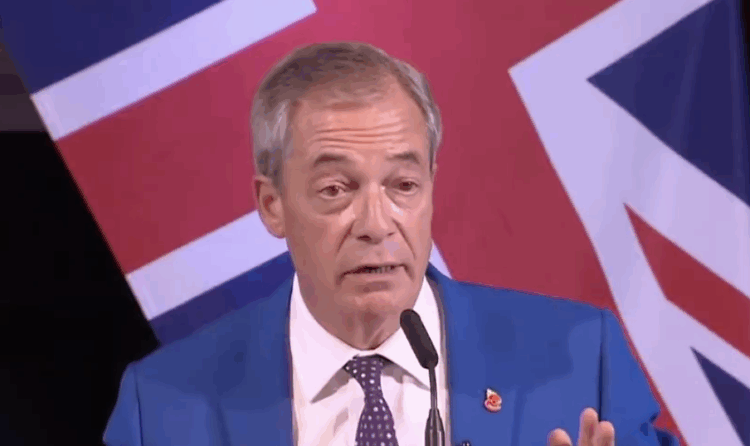
Nigel Farage has said he wasn’t present in Parliament for the Autumn Budget because of the possibility of a “physical altercation.”
On Wednesday, chancellor John Healey delivered his first budget to the House of Commons.
But one person who wasn’t present in the chamber for one of the biggest days in the parliamentary calendar was the man aiming to become the country’s next prime minister, Nigel Farage.
It was reported by the Telegraph that Farage didn’t attend the budget because his prayer card – a green slip of paper that reserves a backbencher’s seat on the Commons benches – had been removed.
Later in the day, Farage was asked about the story and why he wasn’t present for the budget.
The Reform UK leader claimed that he feared he would have been involved in a “physical altercation” if he had tried to take his seat in the Commons.
He told reporters that he had “got involved in a physical altercation with an MP in the chamber” at the State Opening of Parliament earlier this year.
“I didn’t make a fuss about it, I didn’t complain,” he said.
Farage claimed that his prayer card being removed meant that he was “heading towards another physical altercation.”
“Sometimes, it’s better to avoid conflict,” he added.
In response to the claims, a House of Commons spokesperson told the London Economic that Farage’s prayer card had in fact been moved because it did not display the correct date stamp.
The spokesperson said: “There are clear and long-established arrangements for Members to reserve their own seats in the Chamber using Prayer Cards displaying a valid date stamp. Today, a Prayer Card placed on a seat did not display a valid date stamp and was removed in line with the usual Chamber protocol.”
They added that Farage had not attended Prayers and did not approach House staff regarding a seat reservation.
MPs have also dismissed Farage’s claims.
Tory MP Alicia Kearns said the excuse about his prayer card being removed was “total bull,” writing on X that “any of the Reform MPs could have given up their seat” for Farage.
She added: “There were lots of seats without reservation, when exactly did Farage come into the chamber looking for a seat?”
Meanwhile, another Tory MP, Ben Obese-Jecty, said Farage’s reasoning was “Possibly the weakest excuse for not attending the budget I’ve ever heard.”
He pointed out that there appeared to be a space for Farage in his usual spot and asked why Reform deputy leader Richard Tice hadn’t offered up his seat, before taking a swipe at Reform’s sparsely-attended budget event earlier this week.
And there were similar arguments from Lib Dems Josh Babarinde and Tom Gordon.
Nigel Farage Claims He Didn’t Attend Budget Because of Possible ‘Physical Altercation’
Nigel Farage has sparked fresh controversy after claiming that he deliberately avoided attending the Chancellor’s Budget speech because he feared becoming involved in another physical altercation with a fellow MP.
The Reform UK leader was noticeably absent from the House of Commons on Wednesday, 28 October 2026, when Chancellor John Healey delivered his first Budget. Instead of joining other MPs in the chamber, Farage watched the announcement from his office before holding a press conference alongside Reform’s Treasury spokesperson, Robert Jenrick.
Explaining his absence, Farage claimed that a disagreement over parliamentary seating arrangements had created the possibility of another confrontation. He said that his parliamentary prayer card, which MPs use to reserve seats in the Commons, had been removed.
Speaking to journalists afterwards, Farage revealed that he had previously experienced a physical confrontation with another MP during the State Opening of Parliament in May.
“At the State Opening of Parliament, I got involved, I didn’t want to, but I got involved in a physical altercation with an MP in the chamber,” he said.
He continued by explaining that he had not wanted to repeat the experience.
“I didn’t make a fuss about it. I didn’t complain, but I could see, given that my prayer card had been removed, I was heading towards another physical altercation. And just sometimes it’s better to avoid conflict.”
His explanation immediately attracted attention, particularly because the Budget is one of the most important parliamentary occasions of the political year.
Farage Accuses Parliament of Creating an Uncomfortable Situation
Farage suggested that the removal of his prayer card had contributed to his decision to stay away from the chamber.
In the House of Commons, MPs can reserve seats during busy parliamentary occasions by placing appropriately dated prayer cards above their chosen places.
However, the system requires members to follow established procedures, including displaying a valid date stamp.
Farage appeared frustrated that his reservation had been removed and suggested that returning to the chamber could have resulted in another unpleasant confrontation.
He also attempted to explain that his absence had provided an opportunity to study the Budget in greater detail.
According to the Reform leader, he had spent time with economists in his office examining the Chancellor’s proposals line by line.
He argued that this approach had actually been more useful than sitting in the Commons listening to the speech.
Joking about his personality, Farage described himself as a “very quiet, shy, modest kind of person” before saying that he had decided to give Parliament a wide berth.
He also compared the atmosphere surrounding the disagreement to being at school, describing the situation as pathetic.
Nevertheless, his comments raised questions about whether avoiding a major parliamentary event was an appropriate response to a disagreement over seating.
House of Commons Explains Why His Prayer Card Was Removed
The House of Commons subsequently provided an explanation that complicated Farage’s account.
A spokesperson confirmed that the prayer card had been removed because it did not display the required valid date stamp.
The spokesperson said:
“There are clear and long-established arrangements for members to reserve their own seats in the chamber using prayer cards displaying a valid date stamp.”
The statement added that a prayer card placed on a seat without a valid date stamp had been removed in accordance with normal parliamentary procedures.
This explanation suggested that parliamentary staff had followed the established rules rather than deliberately targeting the Reform leader.
The issue therefore became less about whether Farage’s reservation had been removed and more about why the card had not met the necessary requirements.
Critics also questioned why he had not simply followed the normal procedure or accepted another available seat.
Several Reform MPs were reportedly present in the chamber, including deputy leader Richard Tice.
Conservative MP Alicia Kearns argued that one of Farage’s parliamentary colleagues could have given up a seat for him.
Her criticism added to the growing debate about whether Farage’s absence had been avoidable.
Liberal Democrat MP Accuses Farage of Shoving Her
The controversy took a more serious turn when Liberal Democrat MP Caroline Voaden publicly described the earlier incident that Farage had referenced.
Voaden, who represents South Devon, accused the Reform leader of grabbing her by the arm or shoulder and pushing her aside during the State Opening of Parliament on 13 May 2026.
According to her account, Farage had attempted to get past her rather than wait his turn.
She claimed that when she refused to move immediately, he grabbed her and pushed her towards another colleague or the wall.
Voaden said the behaviour had left her shocked and angry.
She described the alleged conduct as unacceptable in any workplace and argued that it had no place inside the House of Commons.
The Liberal Democrat MP also claimed that she had raised the incident with parliamentary authorities and had been expecting an apology.
Her account directly challenged Farage’s suggestion that he had been the person at risk of another confrontation.
Voaden subsequently criticised his decision to bring up an incident from several months earlier while explaining his absence from the Budget.
She suggested that he was using the disagreement as an excuse for failing to attend an important parliamentary event.
It is important to note that these are allegations made by Voaden and have not been established as a criminal finding against Farage.
Reform UK Rejects the Liberal Democrats’ Account
Reform UK representatives strongly disputed the accusations.
A party source described Voaden’s account as untrue and accused Liberal Democrat MPs of behaving aggressively towards Farage.
The dispute quickly developed into a political argument between the two parties, with each side presenting a different version of what had happened during the State Opening.
Liberal Democrat deputy leader Daisy Cooper also commented on the incident.
She said her understanding was that Farage had physically pushed one of the party’s female MPs, prompting another male MP to intervene.
Cooper acknowledged that she had not personally witnessed the incident but said she understood that it had involved members of her parliamentary party.
The disagreement has therefore created competing accounts of the same parliamentary encounter.
For Farage, the controversy is particularly uncomfortable because his original explanation for missing the Budget has drawn further attention to the earlier incident.
Rather than ending questions about his absence, his comments have encouraged other MPs to discuss what happened in May.
Robert Jenrick Defends His Party Leader
Robert Jenrick was also questioned about Farage’s absence and the allegations made by the Liberal Democrats.
The Reform Treasury spokesperson defended his colleague, suggesting that the earlier confrontation had involved Liberal Democrat MPs making it difficult for Farage to move through Parliament.
Jenrick said he had not witnessed the incident personally but believed the behaviour towards Farage had been petty and unpleasant.
He also expressed frustration with what he described as Westminster political arguments.
Jenrick argued that Reform politicians were more interested in addressing the problems facing the country than becoming involved in disputes between MPs.
However, his comments did little to end the controversy.
The incident had already become a major talking point, with questions about parliamentary conduct competing with discussion of the Budget itself.
Farage Faces Criticism for Missing an Important Parliamentary Event
The decision not to attend the Budget has also attracted criticism because of the importance of the occasion.
The Chancellor’s Budget statement provides MPs with an opportunity to scrutinise the government’s economic decisions, question ministers and respond to major financial announcements.
As leader of Reform UK and an elected MP, Farage would normally be expected to participate in important parliamentary debates.
Although he later delivered his party’s response at a press conference, critics argued that this was no substitute for attending the Commons.
The Conservatives also questioned his explanation, suggesting that other Reform MPs could have helped him secure a seat.
The incident has consequently raised questions about his approach to parliamentary responsibilities and his relationship with other members of the House.
Farage Attacks Labour’s Budget Despite Missing the Speech
Despite his absence, Farage did not avoid commenting on the Chancellor’s economic proposals.
At the post-Budget press conference, he described the statement as a politically motivated exercise designed to appeal to voters ahead of a possible general election.
He argued that the government was attempting to please different groups through individual measures while failing to address Britain’s deeper economic problems.
However, he also acknowledged that Healey had delivered the speech competently.
Farage praised the Chancellor’s performance at the despatch box, describing it as assured and suggesting that it was considerably better than some previous Budget presentations.
He was particularly critical of the proposed additional support for Ukraine, saying he was surprised by the scale of the financial commitment and questioning whether the money would be used effectively.
Jenrick was similarly dismissive of the Budget, describing it as an inadequate response to the country’s economic difficulties.
The Reform leadership therefore attempted to redirect attention towards economic policy, although the dispute over Farage’s absence continued to dominate political coverage.
Conclusion: A Parliamentary Dispute Becomes a Major Political Controversy
Nigel Farage’s explanation for missing the Budget has developed into a significant political controversy involving parliamentary seating arrangements, accusations of physical aggression and competing accounts of an earlier confrontation.
The Reform leader insists that he wanted to avoid another physical altercation after his prayer card was removed.
However, the House of Commons has confirmed that the card was removed because it lacked a valid date stamp.
Meanwhile, Liberal Democrat MP Caroline Voaden has accused Farage of shoving her during the State Opening of Parliament in May, an allegation strongly disputed by Reform.
The episode has created an uncomfortable situation for the Reform leader, whose decision to avoid the Budget has raised questions about his parliamentary responsibilities.
For Farage, the challenge is now to move beyond the controversy and return attention to Reform’s economic policies.
For his political opponents, the incident provides another opportunity to question his judgement and conduct.
Ultimately, the dispute demonstrates how a seemingly minor disagreement over a parliamentary seat can develop into a much wider political confrontation when competing accounts, personal accusations and party rivalries become involved.