
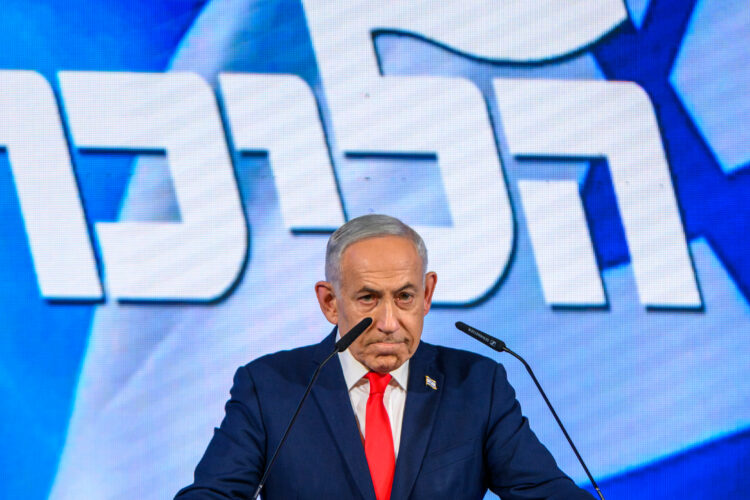
Benjamin Netanyahu’s Likud has accused Arab-led parties of having ‘stolen’ the Israeli election.
As results come in from voting, the Arab-led bloc has made huge gains in the Knesset. With more than 90% of votes counted, the two parties, Ra’am and Joint List, are predicted to win 19 seats in the Israeli parliament, up from 10.
With neither Netanyahu’s far-right ultra-nationalist bloc or main rival Gadi Eisenkot’s ‘Change’ bloc set to win a majority, the Arab parties could find themselves kingmakers.
But this clearly hasn’t gone down well with Netanyahu, who has decided to reach for a fascism classic by refusing to recognise the results.
In a statement on Wednesday afternoon, his Likud party accused the Arab parties of ‘stealing’ the elections.
The party said: “The elections in the state of Israel have been stolen by Arab parties who support terrorism and the annihilation of the Jewish state through serious criminal acts of corruption, threats, violence, falsehoods and the use of prohibited software to encourage voters to vote.”
Likud added that it was submitting testimonies and evidence to the authorities demanding an investigation into the results.
Arab Israelis – who often identify as Palestinian citizens in Israel – turned out in record numbers in what was seen by many as a key opportunity to defeat the most right-wing government in Israeli history.
Both Netanyahu and Eisenkot had ruled out working with the Arab-led parties in the build-up to the election.
Now that neither look set to win a majority though, the Palestinian parties may represent their only route to power.
In particular, it seems difficult to see how Eisenkot could command a government without the support of the Arab bloc.
This is something Yair Golan, the leader of the left-leaning Democrats party in Eisenkot’s bloc, has now called for.
He said in a post on X: “Netanyahu lost. I know how to count to 120. 65 is more than 55. That’s how Israeli democracy works. Period.
“The picture of reality must teach us one resounding lesson: We have no future here if we don’t stop being afraid. And if we don’t stop with the racism. We must no longer accept Netanyahu’s racist division between Jewish votes and Arab votes.
“The voice of an Israeli citizen voting in Taybeh is worth exactly as much as the voice of an Israeli citizen voting in Givat Shmuel. No less. Not approximately. Exactly.
“Anyone who tries to erase the voices of Arab citizens is surrendering to Netanyahu and giving up on Israel.”
He added: “We have responsibility. And we have an opportunity to form a government of change in partnership with Israel’s Arab citizens.
“A government that will serve all Israeli citizens. Now it takes courage. It takes leadership. It takes stopping the fear and starting to act. A government of change now!”
Benjamin Netanyahu’s Party Accuses Arab Parties of ‘Stealing’ Election
Benjamin Netanyahu’s political party has sparked controversy after accusing Arab political parties of attempting to “steal” an election, escalating tensions within Israel’s already deeply divided political landscape. The accusation has raised serious questions about democratic accountability, political rhetoric and the growing divisions between Jewish and Arab communities in the country.
The controversy comes amid an increasingly competitive political environment, with Netanyahu and his allies facing significant pressure to maintain their influence. Arab political parties have become an important factor in Israel’s electoral calculations, particularly when neither major political bloc can secure a clear parliamentary majority.
The accusation has attracted widespread attention because of its potentially divisive implications. Critics argue that describing legitimate political participation by Arab parties as election theft risks undermining democratic principles and reinforcing discrimination against Israel’s Arab citizens.
For Netanyahu, the situation presents another political challenge as he attempts to maintain his position and protect his party’s influence.
Netanyahu’s Party Makes Serious Election Allegations
The controversy began after representatives of Netanyahu’s Likud party accused Arab political parties of attempting to manipulate the electoral process and undermine the democratic will of Israeli voters.
The language used in the accusation was particularly striking, with the word “stealing” suggesting that Arab parties were seeking to obtain political power through illegitimate means.
Such claims are politically sensitive in Israel, where Arab citizens make up approximately one-fifth of the population and have the right to vote, establish political parties and participate in parliamentary elections.
Arab political representatives have repeatedly argued that their participation in Israeli politics is a fundamental democratic right.
They maintain that their voters should receive the same political recognition and respect as supporters of Jewish political parties.
The accusation from Likud has therefore raised questions about whether political disagreements are increasingly being framed along ethnic and national lines.
Arab Parties Play an Important Role in Israeli Politics
Arab political parties have historically faced significant challenges in Israel’s parliamentary system.
Although Arab citizens possess voting rights, their political representation has often been limited by ideological disagreements, coalition negotiations and opposition from sections of the Jewish political establishment.
However, Arab parties have occasionally played a decisive role in determining which political bloc can form a government.
Israel’s parliamentary system is based on proportional representation, meaning that political parties must secure sufficient support to enter the Knesset, Israel’s parliament.
Governments are generally formed through coalitions rather than by a single party winning an outright majority.
This means smaller political parties can become extremely influential during negotiations.
For Netanyahu’s Likud, the prospect of Arab parties influencing government formation can represent a significant political obstacle, particularly when the right-wing bloc is unable to secure enough seats.
However, participating in coalition negotiations and supporting a parliamentary majority are legitimate democratic activities.
Political parties are entitled to use their parliamentary representation to influence government policy, provided they operate within the law.
Netanyahu’s Political Strategy Under Pressure
Netanyahu has dominated Israeli politics for many years and remains one of the country’s most influential political figures.
His leadership has been characterised by a strong security-focused approach, an emphasis on national sovereignty and a close relationship with right-wing political movements.
However, his political career has also been marked by intense controversy, including corruption allegations, criticism of government policy and divisions over the direction of Israeli society.
The political environment has become particularly challenging amid the ongoing security crisis and disagreements over the government’s handling of national affairs.
For Netanyahu, maintaining support among right-wing voters is essential.
His party must convince supporters that it can provide political stability and protect Israel’s security interests.
However, accusations against Arab political parties may also alienate moderate voters who believe that democratic participation should be protected regardless of ethnicity or political identity.
The controversy therefore carries risks for Likud as it attempts to maintain its electoral coalition.
Why the Accusation Has Provoked Strong Reactions
The language surrounding the controversy is particularly important because Arab citizens of Israel have frequently raised concerns about discrimination and unequal treatment.
Political rhetoric suggesting that Arab parties are attempting to steal an election can reinforce perceptions that their participation in democratic institutions is viewed as less legitimate.
Critics argue that such language risks deepening mistrust between communities.
Israel’s political system depends on the participation of citizens from different religious, ethnic and ideological backgrounds.
Although political disagreements are inevitable, democratic legitimacy requires that all eligible voters and political representatives are treated according to the same legal standards.
Arab parties have also argued that accusations of electoral wrongdoing should be supported by clear evidence rather than used as political campaign slogans.
If there are genuine concerns about irregularities, the appropriate response is to provide evidence and allow the relevant electoral authorities and courts to investigate.
Without such evidence, accusations of election theft risk damaging public confidence in the democratic process.
The Wider Divisions Within Israeli Society
The controversy reflects broader divisions within Israeli society.
Political disagreements increasingly involve questions of national identity, religion, security and the relationship between Jewish and Arab citizens.
Arab citizens of Israel have the same formal voting rights as other Israeli citizens, but their political experiences are often shaped by debates about discrimination, public investment, housing and national identity.
Many Arab political leaders argue that their communities do not receive sufficient attention from successive governments.
They have also criticised policies they believe contribute to unequal opportunities in education, employment and local services.
Meanwhile, right-wing politicians frequently argue that national security and the Jewish character of the state must remain central priorities.
These competing political positions have contributed to a highly polarised political environment.
The latest accusation demonstrates how easily electoral competition can become entangled with wider disagreements about identity and citizenship.
The Importance of Protecting Electoral Democracy
The dispute raises an important question about the standards expected of political parties during election campaigns.
Democratic elections depend on public confidence that votes are counted fairly and that political parties can compete without intimidation or discrimination.
Accusations of electoral fraud should therefore be treated seriously.
However, they must be based on credible evidence.
Political leaders have a responsibility to avoid language that could undermine confidence in democratic institutions without providing a clear factual basis.
The right to participate in elections must also apply equally to all citizens.
Arab political parties are entitled to campaign, win parliamentary seats and participate in coalition negotiations.
Their political positions can be criticised, just like those of any other party, but their participation should not be treated as inherently illegitimate.
The controversy surrounding Likud’s remarks therefore highlights the importance of maintaining democratic standards even during highly competitive political campaigns.
International Implications for Israel
The dispute may also attract international attention because Israel frequently presents itself as a democratic state in a region affected by political instability and authoritarian government.
Its electoral system allows multiple parties to compete and provides formal political representation to Arab citizens.
However, accusations that appear to question the legitimacy of Arab political participation may create uncomfortable questions about political equality.
International observers will be interested in whether the controversy remains a temporary campaign dispute or reflects a wider shift in political rhetoric.
Israel’s international reputation is influenced not only by its security policies but also by the strength of its democratic institutions and the treatment of minority communities.
Maintaining confidence in those institutions is therefore important for both domestic stability and international credibility.
Conclusion: A Dangerous Political Dispute
The accusation by Benjamin Netanyahu’s Likud party that Arab political parties are attempting to “steal” an election has intensified an already sensitive political debate in Israel.
The controversy highlights the difficulties facing a political system in which coalition negotiations and smaller parties can play decisive roles in determining who governs.
For Netanyahu, the dispute presents another challenge as he attempts to maintain support among right-wing voters while navigating a deeply divided electorate.
For Arab political parties, the central issue is the protection of their democratic rights and the recognition that their participation in elections is legitimate.
Ultimately, elections are not the property of any single political party or community. Every eligible citizen has the right to vote, and every political party has the right to compete within the law.
If allegations of electoral wrongdoing exist, they must be examined through credible evidence and proper legal procedures.
Democracy depends on more than winning elections. It also requires political leaders to respect the rights of those who disagree with them.
The controversy surrounding Netanyahu’s party therefore serves as an important reminder that democratic legitimacy must be protected for every community, regardless of its political influence or ethnic background.