
It’s been coming. For weeks, Reform’s support has been dropping in the polls whilst Labour’s support has increased under Andy Burnham.
Labour overtook Reform as the poll leaders a while ago, but recently the party has found itself falling into third behind the Tories.
Whilst initially the party could dismiss individual polls as outliers, the trend has become clear – and now the crossover has happened.
Politico’s Poll of Polls now has Reform on a polling average of 20%, one point behind the Conservatives who have seen their support increase in October.
Labour remain clear at the top, a position they have held since August, on an average of 27%.
Lower down, the Greens and Lib Dems are tied on 10% each whilst Restore Britain are on 4%.
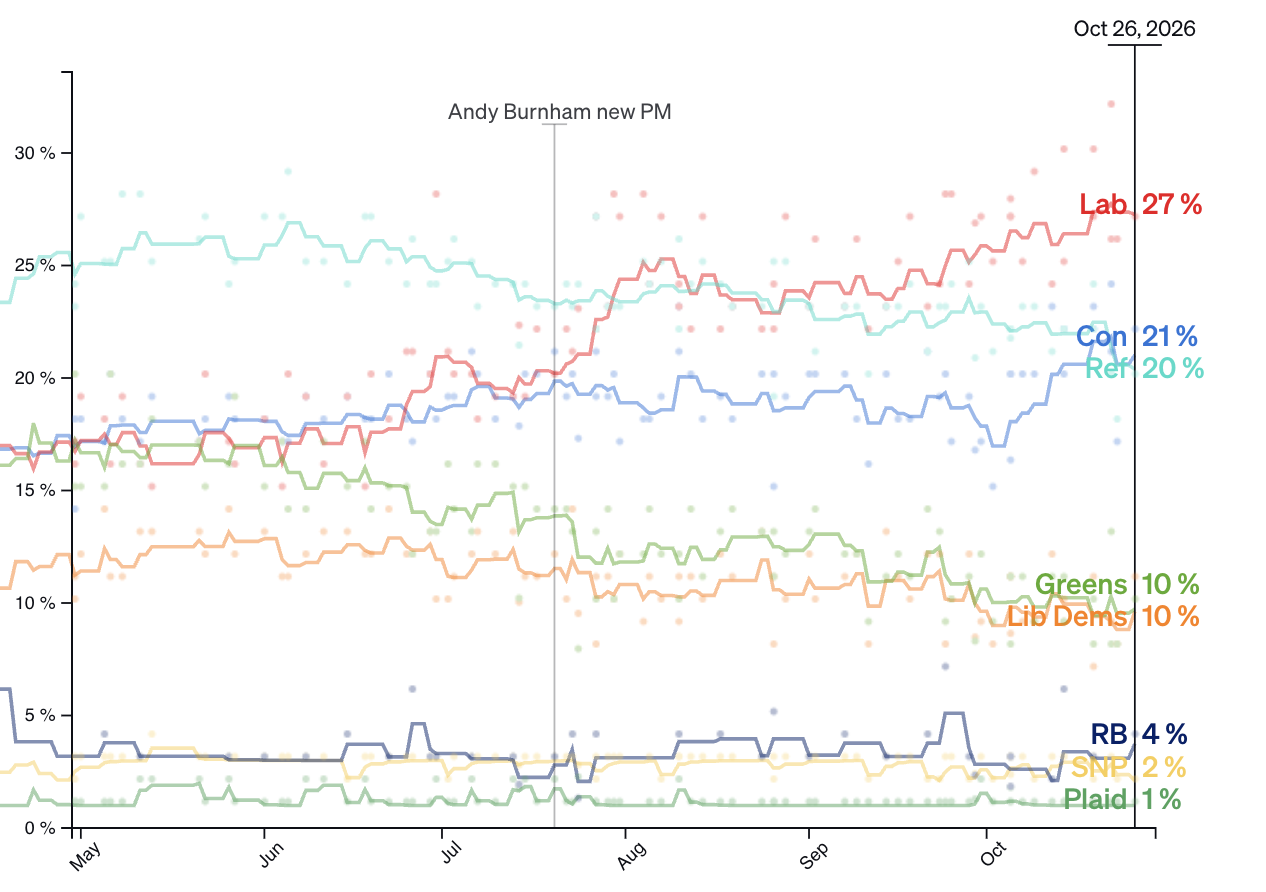
The crossover is a significant moment for both right-wing parties, with Reform having been ahead of the Tories since January 2025.
It highlights the remarkable polling collapse Reform have experienced in recent months.
As recently as June, Farage’s gang were 10 points clear of the Tories and seemed well set to be the biggest right wing party in parliament after the next general election.
But controversy and chaos has embroiled Reform since the summer, whilst the Conservatives have experienced something of a mini-resurgence under Kemi Badenoch, particularly following their party conference in October.
A few months ago, Reform would have had hopes of a winning a majority in the Commons – now it looks like they’ll do well to even be the official opposition.
The next question is – how low can they go?
As for Labour, after 18 months of seeing Reform as their main political threat, the party may have shift its focus back to the Conservatives in a return to more traditional two-party politics.
CROSSOVER CONFIRMED: REFORM UK DROPS TO THIRD IN THE POLLS AS CONSERVATIVES MOVE AHEAD OF FARAGE
Nigel Farage is facing renewed questions about Reform UK’s political position after several British opinion polls placed the party behind Labour and the Conservatives for the first time since the beginning of its remarkable rise in popularity.
The development marks an important change in Britain’s political landscape. Reform UK had previously enjoyed a prolonged period of strong polling support, with Farage presenting his party as the principal challenger to the established political establishment.
However, the latest figures suggest that the Conservatives are recovering under Kemi Badenoch, while Labour has strengthened its position under Prime Minister Andy Burnham.
The shift has also prompted Farage to challenge the credibility of opinion polling, accusing pollsters of manipulating figures and insisting that Reform’s support is stronger than the surveys suggest.
But what do the numbers actually show, and is this a temporary movement or part of a broader change in British voting intentions?
THE NUMBERS THAT CHANGED THE POLITICAL CONVERSATION
The turning point came towards the end of October, when Politico’s Poll of Polls recorded a significant change in the relative positions of Britain’s major political parties.
According to figures reported by The London Economic on 29 October 2026, Labour was leading with an average of 27 per cent, followed by the Conservatives on 21 per cent.
Reform UK had fallen to 20 per cent.
This meant that Farage’s party had slipped behind the Conservatives, marking an important change from the previous months when Reform had regularly occupied second place or led the national polling averages.
The development was particularly notable because the Conservatives had spent much of the preceding political period struggling to rebuild their support following their disastrous 2024 general election result.
Kemi Badenoch’s party now appeared to be attracting some voters who had previously considered supporting Reform.
However, the figures should be interpreted carefully. Different polling organisations use different methodologies, and a narrow difference between parties does not necessarily establish a permanent change in public opinion.
<Cite refs={[“turn886317search0″,”turn886317search1”]}/>
KEMI BADENOCH’S CONSERVATIVES MAKE THEIR MOVE
One of the most important factors behind Reform’s changing position is the recovery of the Conservative Party.
Under Kemi Badenoch, the Conservatives have attempted to rebuild their identity around traditional Conservative themes, including lower taxation, smaller government and stronger national defence.
The party has also sought to persuade former Conservative voters that it remains a credible alternative to Labour.
A YouGov poll conducted on 11 and 12 October placed the Conservatives on 23 per cent, an increase of three points.
Reform fell to 21 per cent, while Labour stood at 24 per cent.
The findings were particularly significant because they placed the Conservatives ahead of Reform for the first time in a YouGov survey since the 2024 general election.
A subsequent YouGov survey conducted on 1 and 2 November found:
- Labour: 26 per cent.
- Conservatives: 24 per cent.
- Reform UK: 21 per cent.
- Liberal Democrats: 11 per cent.
- Green Party: 10 per cent.
The Conservatives had reached their highest YouGov rating since the polling organisation restarted its voting-intention tracker in January 2025.
These figures suggest that Badenoch’s party has recovered some ground, although one poll cannot establish whether the improvement will continue.
<Cite refs={[“turn886317news12″,”turn886317search2”]}/>
FARAGE REFUSES TO ACCEPT THE POLLING RESULTS
Farage has not taken the developments quietly.
On 5 November, the Reform leader challenged several surveys showing his party falling behind the Conservatives.
Speaking during a television interview at an event unveiling Reform’s new armed forces spokesperson, he dismissed the suggestion that the party had fallen into third place.
His response was particularly blunt:
“If you believe we’re third, you’re living on the wrong planet.”
Farage also accused polling organisations of engaging in what he described as “trickery and jiggery-pokery”.
He rejected suggestions that Reform’s support had declined because of controversies surrounding the party’s finances and internal affairs.
His comments demonstrate the growing disagreement between Reform’s leadership and the interpretation of recent polling data.
However, opinion polls are not election results. They measure voting intentions among samples of the population, using statistical methods designed to estimate wider public opinion.
They can be wrong, but dismissing several independent surveys does not automatically invalidate their findings.
The important question is whether subsequent polling continues to show the same pattern.
<Cite refs={[“turn886317search5”]}/>
WHAT IS HAPPENING TO REFORM’S SUPPORT?
There are several possible explanations for Reform’s changing polling position.
First, the Conservatives appear to be recovering some of their previous support.
For voters who supported Reform because they were dissatisfied with the Conservatives, Badenoch’s renewed emphasis on traditional Conservative policies may provide an alternative.
Second, Labour’s improved polling position has changed the wider political conversation.
The arrival of Andy Burnham as Prime Minister has coincided with stronger Labour figures in several surveys.
His communication strategy and emphasis on rebuilding public confidence have attracted considerable attention.
Third, Reform has faced scrutiny over internal controversies, political donations and the conduct of individuals associated with the party.
These issues have generated difficult questions for Farage, who has repeatedly presented Reform as a movement offering a different approach to British politics.
However, it would be premature to attribute the movement in voting intentions to any single issue.
Polling evidence can show changes in support, but establishing precisely why individual voters have changed their minds requires more detailed research.
LABOUR REMAINS AHEAD AS BURNHAM BENEFITS FROM CHANGING POLITICAL CONDITIONS
While much of the attention has focused on the Conservative-Reform contest, Labour’s position is equally important.
The latest YouGov figures placed Labour on 26 per cent, two points ahead of the Conservatives and five points ahead of Reform.
Other polling averages have shown an even stronger Labour position.
For example, UK Decides’ Poll of Polls, using the latest qualifying polls from ten pollsters as of 2 November, placed Labour on 29.6 per cent.
Reform stood at 22 per cent, while the Conservatives were on 21.8 per cent.
This illustrates an important complication: different polling averages can produce different rankings depending on which surveys they include and how they calculate their averages.
Nevertheless, Labour’s position across several recent surveys has been stronger than it was during the earlier months of 2026.
For Burnham, the figures provide an opportunity to consolidate Labour’s support.
But polling improvements are not the same as public approval of every government decision.
The government will still be judged on its handling of public services, taxation, immigration, economic growth and household finances.
<Cite refs={[“turn886317search2″,”turn886317search3″,”turn886317search6”]}/>
WHY THE LIBERAL DEMOCRATS MATTER IN THIS POLITICAL SHIFT
The Liberal Democrats are another important part of Britain’s changing political landscape.
Although the party remains some distance behind the three largest Westminster parties in national voting-intention figures, it has maintained a significant parliamentary presence.
Its approach has traditionally focused on local campaigning and constituency-level organisation.
This matters because Britain’s first-past-the-post electoral system rewards parties that can concentrate their support in particular constituencies.
A party can therefore win a substantial number of MPs without securing the same national vote share as its larger competitors.
The Liberal Democrats may also benefit if voters who are dissatisfied with the Conservatives, Labour or Reform choose to support a different political alternative.
For Farage, this creates another challenge: Reform must demonstrate that its national support can translate into parliamentary victories.
IS THIS A TEMPORARY POLLING MOVEMENT OR A LONGER-TERM CHANGE?
The biggest question is whether Reform’s decline represents a temporary fluctuation or a more sustained change.
There are reasons to be cautious about drawing definitive conclusions.
The YouGov survey conducted on 1 and 2 November included 2,355 adults across Great Britain.
It showed the Conservatives on 24 per cent and Reform on 21 per cent.
However, the polling organisation noted that the changes compared with the previous week were within the margin of error.
Furthermore, other pollsters have continued to place Reform ahead of the Conservatives.
For example, Deltapoll’s survey conducted between 30 October and 2 November placed Labour on 30 per cent, Reform on 25 per cent and the Conservatives on 23 per cent.
That demonstrates why individual polls should not be treated as definitive evidence of a permanent political realignment.
The more useful approach is to examine polling averages, compare surveys over several weeks and consider whether the same movement appears across different research organisations.
If the Conservatives continue to record stronger results while Reform remains lower than its previous levels, the change will become increasingly important.
If subsequent surveys reverse the movement, the apparent crossover may prove temporary.
<Cite refs={[“turn886317search2″,”turn886317search9″,”turn886317search3”]}/>
FINAL ANALYSIS: FARAGE FACES A NEW CHALLENGE AS THE CONSERVATIVES REGAIN GROUND
The latest polling developments have created a new situation for Nigel Farage and Reform UK.
For much of the previous political period, Reform had established itself as a major challenger to Labour and the Conservatives.
Now, several influential surveys have placed the party behind Badenoch’s Conservatives.
Farage’s rejection of these findings demonstrates how seriously the issue is being treated by his leadership.
However, the wider polling picture remains more complicated than the headline suggests.
Some surveys show Reform in third place, while others continue to place the party ahead of the Conservatives.
Labour, meanwhile, has recorded stronger figures across several recent polls.
For Badenoch, the improvement offers an opportunity to rebuild Conservative support and reconnect with voters who previously turned towards Reform.
For Burnham, the challenge is to maintain Labour’s improved position by demonstrating progress on the issues affecting ordinary households.
And for Farage, the immediate task is to show that Reform can maintain its political support despite increased competition from the Conservatives.
The next few months of polling will provide more evidence about whether the changes are temporary or part of a broader shift.
One thing is clear: Britain’s political landscape is changing, and the relationship between Reform, the Conservatives and Labour is becoming increasingly competitive.
The debate is no longer simply about whether Reform can challenge the established parties. It is also about how the established parties are responding to Reform’s rise.