
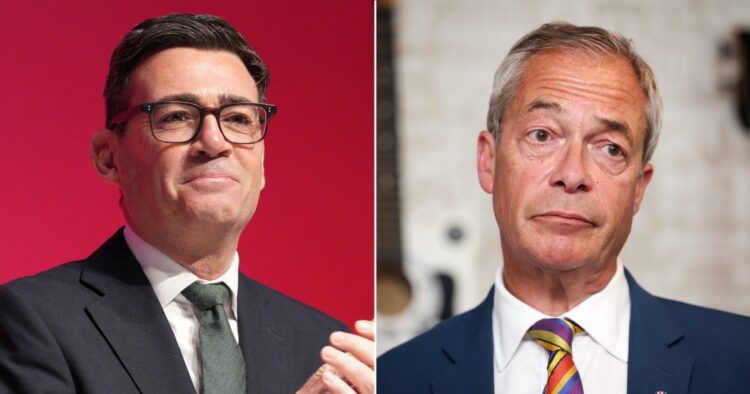
Labour would win a significant majority if a general election was held now, whilst Reform wouldn’t even be one of the three largest parties, according to the latest projections.
Since Andy Burnham became prime minister, Labour have overtaken and pulled clear of Reform in the polls. What at first looked like it could just be a temporary ‘Burnham bounce’ has become much more permanent.
At the same time, Reform’s support has dipped amid controversy and chaos in the party, whilst the Tories have enjoyed a polling bump in October in the wake of their party conference.
This has seen Reform knocked down into third in the polls, as the Conservative Party seem to be re-establishing themselves as the main electoral threat to Labour.
But whilst Labour’s polling lead is still in single figures, it seems like Reform and the Tories will knock enough lumps out of each other to hand Burnham a significant majority if an election was held now.
The latest projection from Electoral Calculus based on its poll of polls predicts that Labour would win 365 seats in a general election, giving them a majority of 80 seats.
Although this would represent a loss of 47 seats compared to their 2024 performance, it would surely be seen as a huge triumph for Labour and give Burnham an undeniable mandate for government.
The Conservatives would be the official opposition with 128 seats, which would be a seven-seat gain compared to 2024.
Most surprisingly, Reform UK wouldn’t even be the third biggest party in the House of Commons, as the Lib Dems are forecast to win 60 seats, three more than Reform.
It’s a truly remarkable fall from grace for Nigel Farage’s party, who just 12 months ago had double-digit leads in the polls and looked set to win the next general election.
If an election result like this did come to pass, we’re pretty sure Robert Jenrick would then be feeling some ‘defector’s remorse.’
LABOUR PROJECTED TO WIN BIG GENERAL ELECTION MAJORITY – WITH REFORM UK TRAILING BEHIND THE LIBERAL DEMOCRATS!
Nigel Farage is facing a potentially devastating political setback after a new general election projection suggested that Labour could secure a substantial parliamentary majority, while Reform UK could fall behind even the Liberal Democrats.
The figures represent a remarkable change in Britain’s political landscape. Only a year ago, Reform UK appeared to be challenging for the position of Britain’s largest political party, with Farage confidently presenting himself as a potential future Prime Minister.
Now, the latest projections suggest that the party could struggle to become the second-largest force in Parliament.
Meanwhile, Prime Minister Andy Burnham appears to be enjoying a significant recovery in Labour’s political fortunes. After months of difficult headlines, internal disagreements and questions about the government’s direction, the projections suggest that Labour could once again be heading towards a commanding electoral position.
But perhaps the most extraordinary part of the forecast is the possibility that Reform could finish behind both the Conservatives and the Liberal Democrats.
For Farage, who has repeatedly promised to transform British politics, such an outcome would represent a serious political embarrassment.
LABOUR’S REMARKABLE POLITICAL RECOVERY
The latest projection, published by The London Economic on 30 October 2026, suggests that Labour could win approximately 365 seats if a general election were held immediately.
That would give the party an estimated overall majority of 80 seats.
Although Labour would lose seats compared with its enormous 2024 election victory, the projection would nevertheless represent a major political recovery.
The figures are particularly striking because Labour’s position had looked considerably weaker during the previous year.
At various points, opinion polls suggested that the party was facing the possibility of a historic electoral collapse, with Reform UK enjoying a substantial lead.
However, the political situation appears to have changed since Andy Burnham became Prime Minister.
Labour has regained ground, while Reform’s support has weakened amid controversies and internal political difficulties.
The latest forecast suggests that the so-called Burnham bounce may have developed into something more substantial.
If the projection became reality, Burnham would enter the next Parliament with a significant majority and considerable political authority.
For Labour supporters, that would be an extraordinary turnaround.
REFORM UK FACES AN UNCOMFORTABLE FOURTH-PLACE WARNING
The most damaging aspect of the projection concerns Nigel Farage’s Reform UK.
According to the Electoral Calculus projection reported by The London Economic, Reform could win just 57 parliamentary seats.
That would place the party behind the Liberal Democrats, who were projected to secure approximately 60 seats.
The Conservatives, meanwhile, would become the official opposition with an estimated 128 MPs.
The numbers represent a dramatic change from the political expectations that surrounded Reform only twelve months earlier.
Farage had presented his party as the natural alternative to Labour and the Conservatives.
Reform’s growing popularity had encouraged supporters to believe that the next general election could produce a historic political breakthrough.
But the latest projection suggests that the party’s momentum may have weakened considerably.
Finishing fourth would be particularly damaging for Farage because it would undermine his claim that Reform has become Britain’s leading challenger to the established political parties.
It would also raise difficult questions about the party’s ability to convert national popularity into parliamentary representation.
Winning votes is one challenge.
Winning individual constituencies under Britain’s first-past-the-post electoral system is another.
WHY HAS REFORM’S SUPPORT STARTED TO FALL?
Several factors could help explain the changing political picture.
One issue has been the controversies surrounding Reform UK and its senior figures.
The party has experienced disagreements over its direction, questions about candidate selection and criticism of the way it handles internal disputes.
Such problems can become particularly damaging for a political movement that presents itself as a disciplined alternative to established parties.
Voters who are attracted to Reform because of its promises to challenge the political establishment may nevertheless expect the party to demonstrate competence and stability.
If its leadership appears distracted by internal arguments, some supporters may reconsider their choices.
Another potential factor is the Conservative Party’s recovery.
For much of the previous political cycle, the Conservatives appeared to be struggling to recover from their disastrous 2024 general election result.
However, the latest projections suggest that the party may be rebuilding its position.
This creates a difficult situation for Farage.
Reform must compete not only against Labour but also against a Conservative Party that is attempting to win back voters who previously abandoned it.
If right-wing voters become divided between the two parties, Labour could benefit significantly.
THE LIBERAL DEMOCRATS COULD BECOME THE SURPRISE WINNERS
Perhaps the most unexpected development is the Liberal Democrats’ projected position.
The party is forecast to win approximately 60 seats, narrowly ahead of Reform UK’s projected 57.
Although this would not make the Liberal Democrats the largest opposition party, it would represent another strong parliamentary performance.
The Liberal Democrats have traditionally focused on local campaigning, constituency organisation and building relationships with voters in areas where they have established political support.
Their strategy can be particularly effective under the first-past-the-post electoral system.
A party does not necessarily need to win a large national vote share to secure a substantial number of MPs.
Instead, it needs to concentrate its support in constituencies where it has a realistic chance of winning.
This could explain why the Liberal Democrats are projected to outperform Reform in parliamentary seats despite having a significantly smaller national vote share.
For Farage, the possibility of finishing behind the Liberal Democrats would be a particularly uncomfortable result.
Reform has spent considerable time presenting itself as the party capable of replacing the traditional political establishment.
Yet a fourth-place finish would suggest that the party’s national popularity has not translated into the constituency victories required to achieve that ambition.
ANDY BURNHAM’S LEADERSHIP IS CHANGING THE POLITICAL CONVERSATION
The projection also raises important questions about the impact of Burnham’s leadership.
Since entering Downing Street, the Prime Minister has attempted to establish a different political identity for Labour.
His communication style has attracted attention, particularly his willingness to use social media and speak directly to voters.
He has also sought to present himself as a leader who understands the frustrations of ordinary households.
However, popularity alone will not guarantee electoral success.
Burnham must still demonstrate that his government can deliver improvements in the areas that matter most to voters.
These include:
-
Reducing the pressure caused by the cost-of-living crisis.
-
Improving the NHS and access to healthcare.
-
Increasing housing availability and affordability.
-
Addressing immigration and border security.
-
Improving economic growth and employment opportunities.
-
Restoring public confidence in government.
If Labour can make convincing progress on these issues, its improved polling position could become more durable.
But if expectations are not met, the current political advantage could disappear just as quickly as it emerged.
The Prime Minister therefore faces an important challenge: turning improved political forecasts into tangible improvements in people’s everyday lives.
ROBERT JENRICK AND THE CONSERVATIVE COMEBACK
The Conservatives also have reasons to be encouraged by the latest projection.
With approximately 128 seats, they would become the second-largest party in Parliament and the official opposition.
This would represent a modest improvement on their 2024 result, when they secured 121 seats.
For the Conservative leadership, such a forecast would provide an opportunity to argue that the party is recovering from its previous electoral collapse.
It could also create a difficult situation for Robert Jenrick and other Conservative defectors who moved towards Reform.
If the Conservatives continue rebuilding their support, some former voters may decide that the traditional right-wing party offers a more credible route to challenging Labour.
This could create further pressure on Farage.
Reform’s biggest challenge may no longer be simply defeating Labour.
It may also have to prove that it deserves to represent voters who previously supported the Conservatives.
The battle for Britain’s political right could therefore become one of the defining contests before the next general election.
HOW RELIABLE ARE THESE GENERAL ELECTION PROJECTIONS?
Despite the dramatic headlines, it is important to remember that these figures are forecasts rather than actual election results.
Electoral Calculus uses polling data to estimate how national voting intentions could translate into individual constituency outcomes.
This is important because Britain’s electoral system can produce substantial differences between national vote shares and parliamentary representation.
The projection published on 30 October estimated Labour at 365 seats, the Conservatives at 128, the Liberal Democrats at 60 and Reform UK at 57.
However, other polling models have produced different results.
For example, YouGov’s September 2026 MRP projection estimated Labour at 241 seats, the Conservatives at 130, Reform at 123 and the Liberal Democrats at 71.
That model suggested a hung Parliament rather than a Labour majority.
A newer projection published on 7 November by UK Elections estimated Labour at 376 seats, the Conservatives at 143, the Liberal Democrats at 60 and Reform at 28.
These differences demonstrate why projections should be treated as snapshots of political opinion rather than guaranteed predictions.
Polling can change, campaign strategies can evolve and unexpected political events can transform an election.
FINAL VERDICT: IS FARAGE’S POLITICAL MOMENTUM FINALLY RUNNING OUT?
The latest general election projection represents a significant warning for Nigel Farage and Reform UK.
A party that once appeared capable of challenging for government is now facing the possibility of finishing behind the Conservatives and even the Liberal Democrats.
Meanwhile, Labour appears to have regained considerable ground under Andy Burnham, with one projection suggesting that the party could secure a majority of approximately 80 seats.
For Labour, this represents an opportunity to rebuild its reputation and demonstrate that its political recovery is sustainable.
For the Conservatives, it offers hope that they can reclaim their position as Britain’s main opposition party.
For Reform, however, the message is considerably more uncomfortable.
Farage must demonstrate that his party is more than a protest movement and can offer voters a credible, disciplined and effective alternative government.
The next general election is not decided, and these projections could change considerably before voters enter polling stations.
But the political warning is unmistakable.
Nigel Farage may have promised to change British politics. The question now is whether Reform UK can survive the changing political landscape long enough to deliver on that promise.