
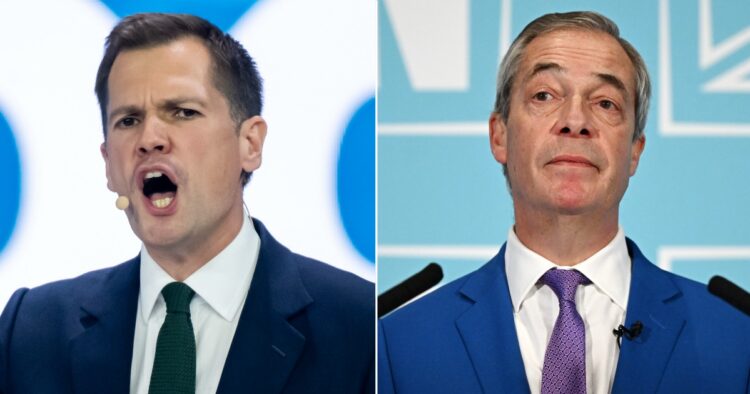
Robert Jenrick has not-so-subtly hit out at Nigel Farage over his support for the US and Israel’s war in Iran, after the Republicans were humiliated in the US midterms.
This week, Americans told Donald Trump loud and clear how unhappy they were with his presidency as the Democrats gained control of both chambers of Congress.
This included stunning wins in traditionally deep-red states such as Texas and Kansas that hadn’t elected Democratic senators in decades.
The main issue for voters was the economy and rising fuel prices, caused entirely by Trump’s decision to go to war with Iran alongside Israel.
Following the results, Trump’s vice president JD Vance launched a stunning criticism of the decision to start the Iran war, saying it was the reason the Republicans lost.
In a clear attack on Trump, Vance wrote: “The reason we lost is the war. The president himself said so last night.
“If you’d like to argue it was worth it, that losing the Senate for the next 6 years was worth it, then do so. Argue it was a worthwhile cost to pay. Agree or disagree, that’s at least honest.
“But everyone knows why we lost. And any honest conversation about where we go from here must start there.”
Jenrick follows Vance’s lead
When the Iran war started, Farage had been vocal in his support for the US’s military action. Alongside the Tories, Reform had encouraged then-prime minister Keir Starmer to join the US in strikes on Iran.
On Wednesday evening, Jenrick decided to remind people of what his stance had been.
Sharing a post he had written ten days into the war back in March, Jenrick said: “The war has been a disaster for America and the UK. Yesterday Trump suffered the electoral consequences of his mistake.
“The lesson? Always put the safety and prosperity of your people first.”
Of course, plenty of people decided to remind Jenrick that Reform had backed Trump to the hilt back in March, and he hadn’t spoken up at then.
ROBERT JENRICK TAKES AIM AT FARAGE OVER IRAN WAR AFTER REPUBLICAN MIDTERMS WIPEOUT
A growing disagreement within Britain’s right-wing political movement has emerged after Conservative defector Robert Jenrick appeared to challenge Nigel Farage over his earlier support for the American and Israeli military campaign against Iran.
The intervention came just days after Donald Trump’s Republicans suffered a major defeat in the November 2026 US midterm elections, with Democrats gaining control of both chambers of Congress.
As political pressure mounted on Trump over the economic and military consequences of the eight-month conflict, Farage began expressing increasingly critical views of the American president’s handling of the war.
But Jenrick was quick to remind political observers that the consequences of military intervention had been visible long before the Republican electoral defeat.
In a pointed social media intervention, he highlighted a statement he had published approximately ten days after the conflict began, warning that the war was damaging both the United States and Britain.
His message was unmistakable: national leaders should prioritise the safety and prosperity of their own citizens rather than become involved in prolonged overseas conflicts.
The intervention has raised questions about whether Farage and his senior colleagues are attempting to distance themselves from an increasingly controversial military campaign.
JENRICK DELIVERS A PUBLIC REMINDER TO FARAGE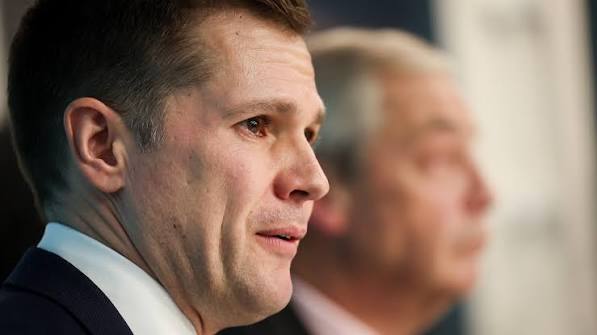
On Wednesday, 4 November 2026, Jenrick shared an earlier statement on social media in which he had criticised the consequences of the Iran conflict.
He wrote:
“The war has been a disaster for America and the UK. Yesterday Trump suffered the electoral consequences of his mistake.
“The lesson? Always put the safety and prosperity of your people first.”
The timing was significant.
Only days earlier, the Republican Party had suffered substantial electoral losses, with Democrats securing control of the House of Representatives and the Senate.
The results placed Trump’s foreign policy under renewed scrutiny, particularly his decision to pursue military action against Iran.
Jenrick’s intervention appeared to draw a contrast between his earlier opposition to Britain’s direct involvement and the more supportive statements previously made by Farage and other Reform UK figures.
Although Jenrick did not explicitly accuse Farage of dishonesty, the timing and wording of his post invited comparisons between their respective positions.
The message also reinforced Jenrick’s argument that Britain’s national interests should take priority over the demands of international military alliances.
<Cite refs={[“turn951279search0″,”turn951279search3”]}/>
WHY THE IRAN WAR HAS BECOME A POLITICAL LIABILITY
The conflict between the United States, Israel and Iran has developed into a major political and economic issue.
What initially attracted support from politicians who viewed Iran’s nuclear programme as a serious security threat has become increasingly controversial because of its duration and economic consequences.
Higher oil prices have contributed to rising fuel costs, placing additional pressure on households and businesses.
For ordinary families, the consequences are not abstract geopolitical arguments.
They are reflected in the cost of filling a car, transporting goods, heating homes and running businesses.
These pressures became particularly important during the American midterm elections.
Democratic candidates repeatedly highlighted the economic consequences of the conflict, arguing that the administration had failed to protect American households from rising living costs.
The Republican defeat subsequently strengthened criticism of Trump’s foreign-policy decisions.
For British politicians, the situation has created a difficult question: should Britain support American military action even when the economic consequences are being felt by British consumers?
Jenrick’s answer has been increasingly clear.
He believes that Britain should not become directly involved in a prolonged conflict unless doing so is demonstrably necessary for British security.
FARAGE’S EARLIER POSITION COMES UNDER SCRUTINY
The disagreement is particularly significant because Farage initially expressed support for the American and Israeli military operation.
In the early stages of the conflict, the Reform UK leader argued that Iran represented a serious strategic threat and supported efforts to prevent the country from developing nuclear weapons.
At one point, he said Britain should do everything possible to support the operation.
Other senior Reform figures also adopted strong positions.
Deputy leader Richard Tice suggested that a Reform government would assist the Americans and Israelis in whatever way they considered appropriate.
Former Conservative chancellor Nadhim Zahawi also argued that Britain should support the military campaign.
These comments subsequently attracted criticism as the conflict continued and energy prices increased.
Jenrick, however, had expressed reservations about direct British military participation much earlier.
During an appearance on the BBC’s Laura Kuenssberg programme in March, he argued that deploying British aircraft in offensive operations against Iran was not necessary at that stage.
His argument was that Britain should distinguish between supporting its allies and automatically participating in their military operations.
He maintained that the government had to consider the interests of British citizens before committing military personnel to an overseas conflict.
This position became the foundation of his later criticism.
<Cite refs={[“turn951279search7″,”turn951279search8″,”turn951279search6”]}/>
FARAGE ADMITS THAT TRUMP GOT IT WRONG
Following the Republican defeat, Farage himself acknowledged that he had misjudged the American political situation.
Before the midterms, he had rejected predictions that Republicans would suffer overwhelming losses.
He believed that Republican financial resources, campaigning technology and support from influential figures such as Elon Musk could limit the Democrats’ gains.
But after the results were announced, Farage admitted that his prediction had been wrong.
He described the Republican performance as a complete wipeout and an absolute disaster.
More importantly, he began openly criticising Trump’s handling of the Iran war.
Farage argued that the American president had broken an important promise to voters by becoming involved in another prolonged foreign conflict.
He pointed out that Trump had previously promised an end to America’s involvement in endless wars.
Yet the Iran conflict had continued for eight months, with no clear indication that it was approaching a permanent conclusion.
Farage also warned that further American attacks could push oil prices higher and create additional inflationary pressure throughout the Western world.
Asked whether the war had been a mistake, he responded that there was no question about it.
Nevertheless, Farage continued to defend the objective of slowing Iran’s nuclear weapons programme.
He argued that supporting limited military action was different from supporting an extended war.
This distinction has become central to his attempt to explain his changing position.
<Cite refs={[“turn951279search1″,”turn951279search2″,”turn951279search5”]}/>
JENRICK’S MESSAGE: PUT BRITAIN FIRST
Jenrick’s criticism reflects a wider argument about the role Britain should play in international conflicts.
For him, the central question is whether military involvement produces tangible benefits for British national security.
He has argued that a prolonged conflict could damage the British economy through higher energy prices, increased inflation and additional pressure on public finances.
This approach places economic security at the centre of foreign policy.
It also reflects a political message that has become increasingly important among voters concerned about the cost of living.
Many households are already dealing with expensive mortgages, food prices and energy bills.
The prospect of another international crisis pushing those costs higher creates obvious political difficulties for any government.
Jenrick has therefore presented his position as a question of national priorities.
His argument is that Britain should not become involved in military operations simply because its closest ally requests support.
Instead, ministers should establish whether intervention is necessary, proportionate and genuinely beneficial to the country.
Supporters of this approach argue that Britain must retain an independent foreign policy.
Critics, however, may question whether refusing to support American military action could weaken the transatlantic relationship or reduce Britain’s influence over international security decisions.
Both considerations are relevant when assessing the government’s options.
THE SOCIAL MEDIA BACKLASH: WHY REFORM IS FACING QUESTIONS
Jenrick’s intervention did not go unnoticed.
Social media users quickly pointed out that Reform UK politicians had previously expressed support for American and Israeli military action.
Some questioned why Jenrick was now highlighting his earlier opposition while other members of the party appeared to be changing their positions.
Others reminded him that his criticism did not automatically remove the responsibility of senior Reform politicians who had supported intervention.
One particularly important criticism concerned Richard Tice’s earlier suggestion that Britain should assist American and Israeli military operations in whatever way necessary.
The exchange exposed differences within Reform over how far Britain should become involved in the conflict.
These disagreements are not unusual in political parties, particularly when foreign-policy questions involve complicated strategic considerations.
However, they can become politically damaging when senior figures appear to offer contradictory explanations of the same crisis.
For Reform, the challenge is to establish a consistent position that can be defended publicly.
It must explain whether the party supports limited military intervention, defensive assistance, offensive operations or complete non-involvement.
Without clarity, political opponents can continue highlighting apparent contradictions.
<Cite refs={[“turn951279search0″,”turn951279search7″,”turn951279search8”]}/>
WHAT THE REPUBLICAN DEFEAT MEANS FOR BRITISH POLITICS
The American midterm results have consequences extending beyond the United States.
For years, Trump’s political movement has provided inspiration for right-wing populist parties across Europe.
Farage has been particularly open about his relationship with the American president and the similarities between their political approaches.
However, the Republican defeat has created a more complicated environment for politicians who have closely associated themselves with Trump’s administration.
Reuters reported on 5 November that several European right-wing politicians had begun distancing themselves from Trump following the Democratic victories.
The Iran conflict and its economic consequences were central to this reassessment.
The developments demonstrate how international political relationships can become sensitive when domestic economic conditions deteriorate.
For Reform UK, the issue is especially important because the party wants to present itself as a credible alternative government in Britain.
Voters may agree with its arguments on immigration or taxation while disagreeing with its position on military intervention.
The party must therefore demonstrate that it can develop an independent foreign policy rather than simply follow the political direction of its international allies.
<Cite refs={[“turn951279search3″,”turn951279news9”]}/>
IS THIS THE BEGINNING OF A BIGGER SPLIT?
The disagreement between Jenrick and Farage raises questions about the future direction of Reform UK.
Jenrick’s position places greater emphasis on avoiding prolonged foreign conflicts and protecting the British economy.
Farage has maintained that the original objective of limiting Iran’s nuclear programme was justified, while arguing that the conflict should not have developed into an extended war.
These positions are not necessarily completely incompatible.
A politician can support a limited military operation while opposing a prolonged campaign.
However, the differences become more significant when considering the statements made by other senior Reform figures.
Richard Tice and Nadhim Zahawi previously expressed stronger support for British assistance to the American and Israeli operation.
The party must now explain how these different positions fit together.
For the moment, Jenrick’s public intervention should be understood as a criticism of the war and its consequences rather than definitive evidence of a personal split with Farage.
Nevertheless, it has placed an important disagreement within the party firmly in the public spotlight.
FINAL VERDICT: A FOREIGN-POLICY DISPUTE THAT COULD RESHAPE REFORM’S MESSAGE
Robert Jenrick’s intervention has reopened difficult questions about Reform UK’s position on the Iran conflict.
By highlighting his earlier opposition to prolonged military involvement, he has drawn attention to the difference between his position and the more supportive comments previously made by Farage and other senior party figures.
The Republican midterm defeat has added another dimension to the disagreement.
With Trump’s administration facing political pressure over rising energy costs and the consequences of the war, Farage has begun acknowledging problems that he previously played down.
However, the disagreement should not automatically be interpreted as a complete breakdown in relations between the two Reform politicians.
The more important issue is whether Reform can establish a coherent foreign-policy position that puts British security and economic interests at the centre of its decisions.
Britain’s relationship with the United States remains strategically important, but that does not remove the need for independent judgment.
Military intervention carries consequences that extend far beyond political statements and television interviews.
For British families, the most immediate concerns are the cost of living, energy prices and economic stability.
For the politicians involved, the challenge is to explain how their decisions and principles translate into practical policies.
The question now facing Reform UK is straightforward: can its senior figures agree on a consistent approach to international conflict, or will disagreements over Iran continue to expose divisions within the party?