
Both France and Italy have requested additional time to win over their agricultural sectors, seeing the bloc postpone the inking of the deal until the new year.
This postponement has once again scuppered the EU’s plans to finalise the long-stalled Mercosur free trade accord.
The agreement, which has been under negotiation for a quarter of a century, would establish the world’s largest free-trade zone encompassing between 700 and 780 million people.
Under its terms, Mercosur nations Argentina, Brazil, Paraguay and Uruguay would reduce tariffs on European exports, whilst the EU would expand food import quotas and lower duties.
However, farmers across the continent have argued that increased imports of beef, chicken and cereals from the South American market would threaten their livelihoods.
To protest the planned sealing of the agreement, 10,000 farmers from across all 27 EU member states descended on Brussels.
More than 1,000 tractors rolled through the streets of the Belgian capital as part of the mostly peaceful demonstrations that occasionally spilt over into chaotic scenes.
The EU has delayed a divisive trade deal after fiery protests from farmers in Brussels
| GETTY
Protesters were seen hurling potatoes and eggs at police while blocking roads and igniting fireworks.
Some also brought down the Christmas tree standing outside the European Parliament, replacing it with a blazing pile of tyres and debris.
Police deployed water cannons and tear gas to manage the crowds, with black smoke engulfing surrounding streets.
Windows at the parliament building were smashed by troublemakers on the fringes of the demonstration, prompting officials to email staff, warning them to keep away from the windows.
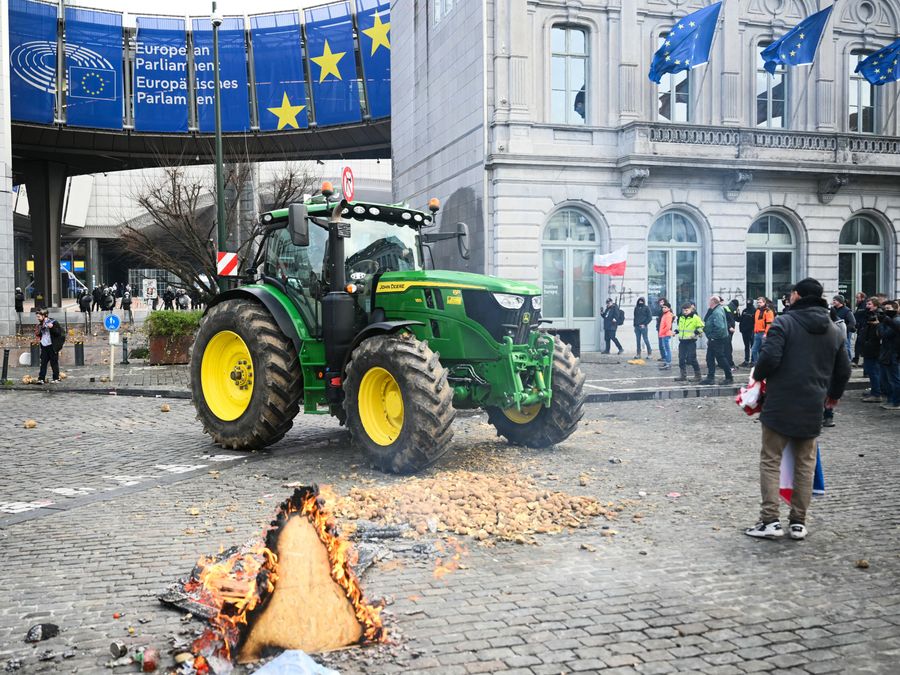
As many as 10,000 farmers from across all 27 EU member states protested the plans outside the European Parliment
| GETTY
In the shadow of what some called the century’s largest mobilisation of European farmers, European Commission president Ursula von der Leyen announced on X: “We have reached out to our Mercosur partners and agreed to postpone slightly the signature.”
A Commission spokesman also confirmed: “The European Commission proposed that it be postponed to early January to further discuss with countries that still need a little bit more time.”
The delay follows a telephone conversation on Thursday between Italian Prime Minister Giorgia Meloni and Brazilian President Luiz Inácio Lula da Silva.
“Meloni explained that she is not against the agreement, she is simply experiencing some political embarrassment because of the Italian farmers, but that she is certain she is capable of convincing them to accept the agreement,” President Lula said.
“She asked me that if we have patience for a week, 10 days, at most a month, Italy will join the agreement,” he added.
Ms Meloni’s office stated on Thursday evening: “The Italian government is ready to sign the agreement as soon as the necessary responses are provided to farmers, which depend on the decisions of the European Commission and can be finalised quickly.”
French President Emmanuel Macron also called for a delay, making clear upon arriving in Brussels that Paris would not back the agreement without enhanced protections for its agricultural sector.
“I want to tell our farmers, who have been making France’s position clear all along: we consider that we are not there yet, and the deal cannot be signed” as it stands, President Macron told reporters.

French President Emmanuel Macron and Italian Prime Minister Giorgia Meloni requested a delay in the agreement
| GETTY
He pledged that France would resist any “attempt to force this through”.
German Chancellor Friedrich Merz took a contrasting view, pressing for rapid progress on the accord.
“If the European Union wants to remain credible in global trade policy, then decisions must be made now,” Chancellor Merz stated in Brussels on Thursday.
Germany, Spain and the Nordic countries remain strong advocates for the pact, keen to boost exports amid Chinese competition and potential American tariffs.
EU Forced to Delay Hated New Plans After Farmers Stage Extraordinary Protest in Brussels
The European Union is facing renewed pressure from the agricultural sector after farmers took their anger directly to the streets of Brussels, challenging controversial policies that they believe threaten their livelihoods and the future of European farming.
The latest demonstrations have once again exposed the growing divide between European policymakers and the people responsible for producing the continent’s food.
For farmers, the issue is not simply about regulations or political disagreements. It is about survival.
Rising production costs, falling agricultural prices, complicated environmental requirements and competition from cheaper imports have created an increasingly difficult situation for farming businesses across Europe.
Many agricultural workers believe that politicians in Brussels are making decisions without properly understanding the financial pressures experienced by those working on the land.
The extraordinary demonstrations have therefore become a powerful symbol of resistance against policies that farmers believe could make their businesses less competitive.
The political consequences could be significant.
The European Commission has already faced pressure to reconsider several agricultural proposals following previous waves of protests. The latest confrontation adds to questions about whether Brussels can continue pursuing ambitious environmental and trade policies without securing greater support from the agricultural community.
For European leaders, the challenge is becoming increasingly complicated.
They must balance climate commitments, international trade ambitions and economic competitiveness while ensuring that farmers can continue producing affordable food.
Farmers Take Their Anger to the Heart of Brussels
Brussels has become a familiar destination for agricultural protests, but the demonstrations have repeatedly shown how much frustration exists across Europe’s farming communities.
Farmers have travelled from different countries to make their concerns heard outside the institutions responsible for shaping European agricultural policy.
Tractors, banners and demonstrations have become powerful images of the growing disagreement between rural communities and political leaders.
The protests are not driven by one single issue.
Some farmers are concerned about environmental regulations that they believe restrict how they can use their land. Others are worried about agricultural subsidies, international trade agreements and the increasing cost of fuel, fertiliser and machinery.
For many, these pressures are connected.
Farmers argue that they are being expected to meet increasingly demanding standards while competing against producers operating under different economic and regulatory conditions.
They believe this creates an unfair situation in which European agricultural businesses carry higher costs but receive insufficient protection against cheaper imports.
The demonstrations are intended to send a clear message: agricultural workers want their concerns to influence decisions made in Brussels.
The Controversial Plans That Have Angered Farmers
One of the biggest sources of tension concerns the European Union’s future agricultural policy and the environmental requirements attached to farming.
The Common Agricultural Policy, commonly known as the CAP, provides financial support to farmers and plays a major role in determining the structure of European agriculture.
However, proposed changes to agricultural funding and environmental obligations have generated considerable opposition.
Farmers fear that changes to the subsidy system could reduce the financial support available to their businesses.
They are also concerned about proposals that could introduce additional administrative responsibilities or make it more difficult to receive payments.
For smaller farms, even relatively modest changes can have serious consequences.
Many agricultural businesses operate with limited profit margins. They must pay for land, machinery, fuel, seeds, fertiliser, insurance and labour before receiving money from the sale of their products.
Additional administrative costs can make an already difficult situation worse.
Farmers argue that environmental policies must take economic realities into account.
They do not necessarily oppose protecting nature or improving agricultural sustainability. Their criticism is directed at regulations they believe are too complicated, expensive or disconnected from everyday farming conditions.
Our farmers nedd to do the same in order to finally shame this uncaring government into stopping the unncessary IHTAX destroying farmers lives and mad Miliband from using Arable Farmland for Chinese solar panels!! Farmers work 365 days a year, from dawn to dusk and often longer and unlike politicians, they cannot charge their bills on expenses!!