

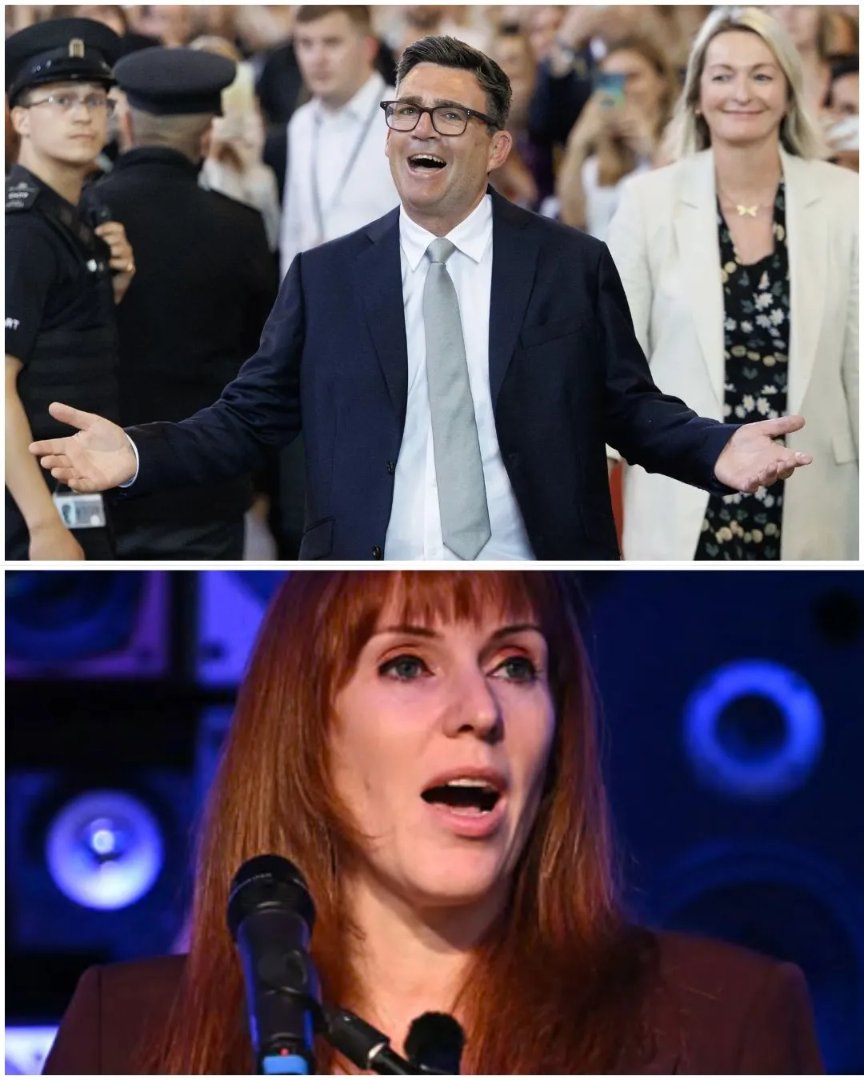
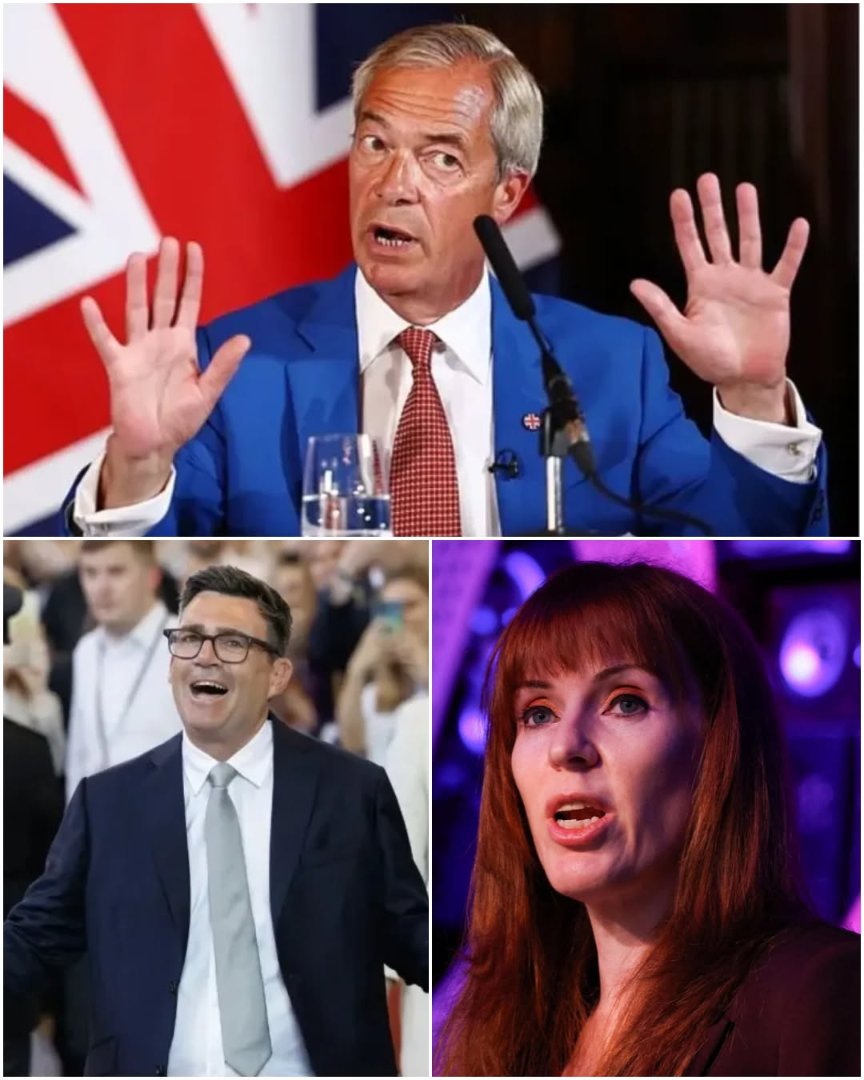
Rayner and Burnham accused of Brexit Betrayal (Image: Daily Express)
Nigel Farage has hit out at a Brexit betrayal after an arch-Remainer and ally of Andy Burnham hinted she would back rejoining freedom of movement.
Reports emerged that Mr Burnham is open to heading back into the scheme, which allows for the free movement of people across and within the EU without migration controls.
Advertisement
That follows years of wrangling between Labour politicians and eurocrats seeking a “reset” of relations between London and Brussels.
The Prime Minister is due to attend the UK-EU summit next month as part of those talks, after the crunch meeting was delayed when Labour ousted their previous boss – Sir Keir Starmer.
Speaking on Sky News, Angela Rayner, an ardent Remainer and close ally of the Prime Minister, appeared to back plans to rejoin the scheme.
When repeatedly asked if she would support surrendering Britain’s immigration controls to Brussels, she initially attempted to sidestep the question.
Pressed on the matter, Ms Rayner said: “In terms of our future relationship with the EU, of course we should be having a conversation and understanding the facts of what could be possible.”
Advertisement
The Labour Party has come under fire for attempting to cosy back up to Brussels after Mr Burnham performed a U-turn on commitments not to reopen the Brexit argument.
Advertisement
Mr Burnham voted to Remain, campaigned to Remain, and demanded a second referendum when his side lost in the largest democratic vote in British history.
Speaking in 2025 at the Labour Party conference, he even said he wanted to see the country back in “in my lifetime”.
Yet he changed position during the Makerfield by-election, a seat which voted 65% to leave the EU, and chose to run away when challenged on his evolving stance by the Daily Express.
When speaking at the Labour Party conference this year, he changed position again, saying he would press ahead with his party’s long-touted desire to “reset” relations with eurocrats.
Over the weekend the Prime Minister appeared to go evern further.
He told the Sunday Times that an “honest discussion” was needed.
Mr Burnham said: “Freedom of movement had very significant challenges associated with it and I spoke about them in my previous time in parliament.
“But, at the same time, it was a type of immigration that perhaps wasn’t as difficult [as now].
“Revolving door migration where people would come and then go back is different.
The balance of migration has changed, hasn’t it, since then?
“I think we’ve just got to have an honest discussion about those things.”
Commenting online Kemi Badenoch, the leader of the Conservative Party, wrote: “This is yet another example of Burnham’s foot in mouth syndrome.
Advertisement
He hasn’t thought this through or the implications.”
She added: “Most people who voted for Brexit did so because they didn’t want free movement.
Too many politicians have failed to understand the significance and impact of immigration on communities.”
Veteran Brexiteer and Reform UK Leader Nigel Farage fumed that the Labour Party was staging a “total betrayal of Brexit Britain”.
Advertisement
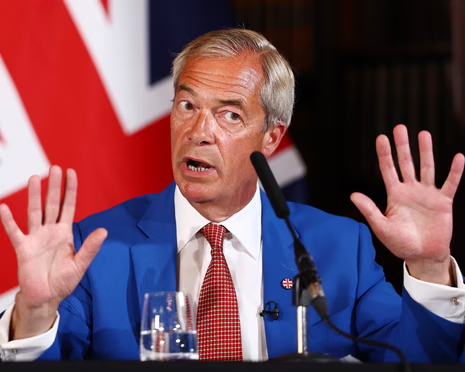
He added that Mr Burnham was also breaking his “Makerfield pitch”, a pledge he had made during the by-election where he said he would only work in the interests of his constituents.
Advertisement
Mr Farage told the Daily Express that Mr Burnham was “deluded to say immigration was different when we were members of the EU”, pledging to “fight this dishonesty”.
The Daily Express has launched its ‘Give Us A Proper Brexit’ crusade, which calls for leaving the ECHR, a 12-mile border to protect British fishing waters and the cutting of EU red tape.
Labour has maintained that it is seeking to improve relationships with the trading bloc, which it says were harmed by bad deals struck by the previous Conservative Government.
Disclaimer: This story was generated with AI and is entirely fictional. It is intended for entertainment purposes only.
Names, characters, businesses, places, events, and incidents are either products of the author’s imagination or used fictitiously.
Any resemblance to actual persons, living or dead, or actual events is purely coincidental.
BREXIT ROW: NIGEL FARAGE CONDEMNS PROSPECT OF RENEWED EU FREEDOM OF MOVEMENT AS A BETRAYAL OF BREXIT
Nigel Farage has launched a fierce political attack on Prime Minister Andy Burnham after the Labour leader opened the door to a possible return of European Union freedom of movement, reigniting one of Britain’s most divisive political debates. The Reform UK leader has described the prospect as a betrayal of millions of voters who supported Brexit, warning that any attempt to restore the previous immigration arrangements would undermine the result of the 2016 referendum.
The controversy has placed Labour under renewed pressure over its European policy, particularly after senior figures including Angela Rayner expressed support for a more open discussion about Britain’s future relationship with Brussels.
Almost ten years after Britain voted to leave the European Union, the issue of immigration is once again dominating political debate. For Farage, the question is straightforward: if voters supported Brexit partly to end freedom of movement, why should politicians now consider bringing it back?
Burnham, however, believes Britain needs to examine the economic and practical consequences of its current relationship with Europe rather than treating every aspect of Brexit as permanently settled.
The disagreement has created a new political dividing line between Reform UK and Labour.
Farage accuses Burnham of betraying Brexit voters
Farage’s response was immediate and uncompromising.
Reacting to Burnham’s comments, the Reform UK leader described the possibility of restoring freedom of movement as a “total betrayal of Brexit Britain and his Makerfield pitch”.
He also challenged Burnham’s argument that immigration was different when Britain was an EU member.
“We will fight this dishonesty,” Farage declared.
His criticism is particularly significant because Burnham’s Makerfield constituency voted strongly in favour of leaving the European Union in 2016. Farage believes that reopening the freedom-of-movement question risks undermining the expectations of those voters.
Speaking on BBC Radio 4’s Today programme on 27 October, Farage argued that the Prime Minister had no mandate to reopen Brexit arguments.
He pointed to Labour’s 2024 election manifesto, which explicitly ruled out restoring freedom of movement, rejoining the single market or returning to the EU customs union.
Farage questioned why the Government was apparently discussing options that had previously been excluded from Labour’s political commitments.
For Reform UK, this is not simply a disagreement about immigration policy. It is a question of democratic accountability and whether politicians should be allowed to reconsider major referendum decisions without seeking a fresh mandate.
Burnham wants an honest discussion about Europe
The Prime Minister’s position is more complicated than an immediate proposal to restore free movement.
In an interview with the Sunday Times published on 24 October, Burnham called for an “honest discussion” about whether Britain should consider returning to some form of freedom of movement.
He acknowledged that the previous system had created significant challenges, particularly concerning immigration levels and pressure on communities.
However, he suggested that migration patterns had changed considerably since Brexit.
Burnham argued that before Britain left the EU, many European workers came to the UK temporarily, worked for a period and subsequently returned to their home countries.
He described this as a form of revolving-door migration, contrasting it with more recent migration patterns involving longer-term visas and permanent settlement.
The Prime Minister believes these differences deserve serious examination.
He has also argued that leaving the EU weakened Britain’s ability to cooperate with European partners on immigration enforcement and asylum-related matters.
Nevertheless, Burnham has stressed that he is not proposing an immediate return to freedom of movement.
He has indicated that any fundamental changes must be considered through the democratic process and that the British public should ultimately decide the country’s long-term relationship with Europe.
Angela Rayner backs closer relations with Brussels
The controversy has intensified because Angela Rayner has also supported Burnham’s call for a more open discussion about Britain’s relationship with the European Union.
Speaking on the BBC’s Sunday with Laura Kuenssberg, Rayner argued that the country should examine the possible trade-offs involved in securing a closer relationship with Brussels.
She believes that Brexit has created economic difficulties for British businesses and that the Government should investigate opportunities to reduce unnecessary barriers.
Rayner also suggested that any major proposals should be presented to voters at a future general election.
Her intervention indicates that the debate extends beyond the Prime Minister himself.
Other Labour figures, including Ed Miliband and Stella Creasy, have expressed support for closer European cooperation.
However, the issue is far from universally accepted within Labour.
Some MPs representing constituencies that strongly supported Brexit remain concerned that reopening freedom of movement could damage public confidence and create political difficulties in northern England and the Midlands.
Home Secretary Shabana Mahmood has also previously expressed caution about the potential consequences of closer integration.
The disagreements demonstrate that Labour must balance economic ambitions with the political realities of the referendum result.
Why freedom of movement remains such a sensitive issue
Before Brexit, freedom of movement was one of the fundamental rights associated with EU membership.
It allowed citizens of European Union member states to live, work and study in other participating countries without requiring nationality-based work permits.
British citizens benefited from these arrangements across Europe, while EU nationals could move to Britain under the same broad framework.
Supporters argued that freedom of movement helped businesses recruit workers, encouraged economic growth and provided opportunities for younger generations.
Critics, however, raised concerns about immigration levels, population growth, housing shortages and pressure on public services.
These arguments became central to the 2016 referendum campaign.
For many Leave voters, ending freedom of movement was an essential part of restoring national control over immigration.
Consequently, any proposal to reintroduce similar arrangements is likely to attract strong opposition from people who believe the referendum result should be respected.
Farage has repeatedly argued that Britain should not return to a system in which EU citizens enjoy automatic rights to live and work in the country.
His position is that immigration policy should remain under the control of the British Government.
The economic consequences of Brexit
Burnham’s argument is not limited to immigration.
He has repeatedly criticised the economic consequences of leaving the European Union, pointing to additional trade barriers and administrative requirements facing British companies.
Since Brexit, businesses exporting goods to the EU have had to navigate additional customs procedures, regulatory requirements and paperwork.
Smaller businesses have sometimes struggled with the costs and complexity of trading across European borders.
Supporters of closer European cooperation argue that reducing these barriers could improve trade, attract investment and strengthen economic growth.
However, returning to the single market would involve accepting important European rules, including freedom of movement.
This is precisely where the political disagreement becomes most difficult.
Labour wants to improve economic relations with Europe, but it must also consider voters who believe that restoring freedom of movement would reverse one of the most important consequences of Brexit.
There is no simple solution that satisfies every political or economic interest.
What would happen if Britain restored freedom of movement?
A return to freedom of movement would require a substantial agreement between Britain and the European Union.
It would involve negotiations over the rights of British and European citizens, immigration arrangements, employment regulations and the wider relationship with the single market.
The EU is unlikely to offer the benefits of single-market participation without requiring Britain to accept corresponding obligations.
There would also be important questions about the UK’s domestic immigration legislation and how any new arrangements would be implemented.
Burnham has ruled out recommending membership of the Schengen border-free area or abandoning the pound in favour of the euro.
He has also said that he will not move away from Labour’s existing manifesto commitments during the current parliamentary term.
Nevertheless, his comments suggest that the possibility of a closer relationship could become an issue at a future general election.
The November EU summit becomes increasingly important
Burnham is expected to meet European leaders in Brussels on 20 November 2026.
The summit will provide an opportunity to discuss improvements to Britain’s relationship with the EU, including trade, agriculture, energy and cooperation on migration.
The Prime Minister wants to demonstrate that Britain can develop a more constructive relationship with its European neighbours without immediately reversing Brexit.
European Commission President Ursula von der Leyen will be among the key figures involved in discussions about the future relationship.
However, any negotiations involving the single market or freedom of movement could prove politically sensitive.
The Government will need to explain precisely what it wants to achieve and what concessions it might be prepared to make.
For Farage, the summit provides another opportunity to challenge Labour over its European ambitions.
Reform UK has already indicated that opposing any return to freedom of movement will be a central part of its political platform.
A new battle over Britain’s future
The latest confrontation demonstrates that Brexit remains an unresolved political issue almost a decade after the referendum.
Farage believes that restoring freedom of movement would undermine the democratic decision made by millions of British voters.
Burnham argues that Britain should be willing to examine the evidence and consider whether a different relationship with Europe could deliver economic and practical benefits.
Rayner and other Labour figures believe the public deserves an honest discussion about the potential advantages and disadvantages of closer cooperation.
Ultimately, the question is not simply whether Britain should become closer to Europe. It is about what kind of relationship the country wants, what obligations that relationship would involve and whether voters would support the changes.
The Government must also explain how it intends to protect the interests of British workers, manage immigration and improve economic opportunities.
For Nigel Farage, however, the message is already clear: Reform UK will oppose any attempt to restore the old freedom-of-movement system.
With the November summit approaching, the Brexit debate is once again moving towards the centre of British politics.
Whether this leads to a limited improvement in relations with Brussels or a much wider discussion about Britain’s European future remains to be seen.
One thing is certain: any government considering a return to freedom of movement will face intense political scrutiny from voters who remember why Britain voted to leave in the first place.