

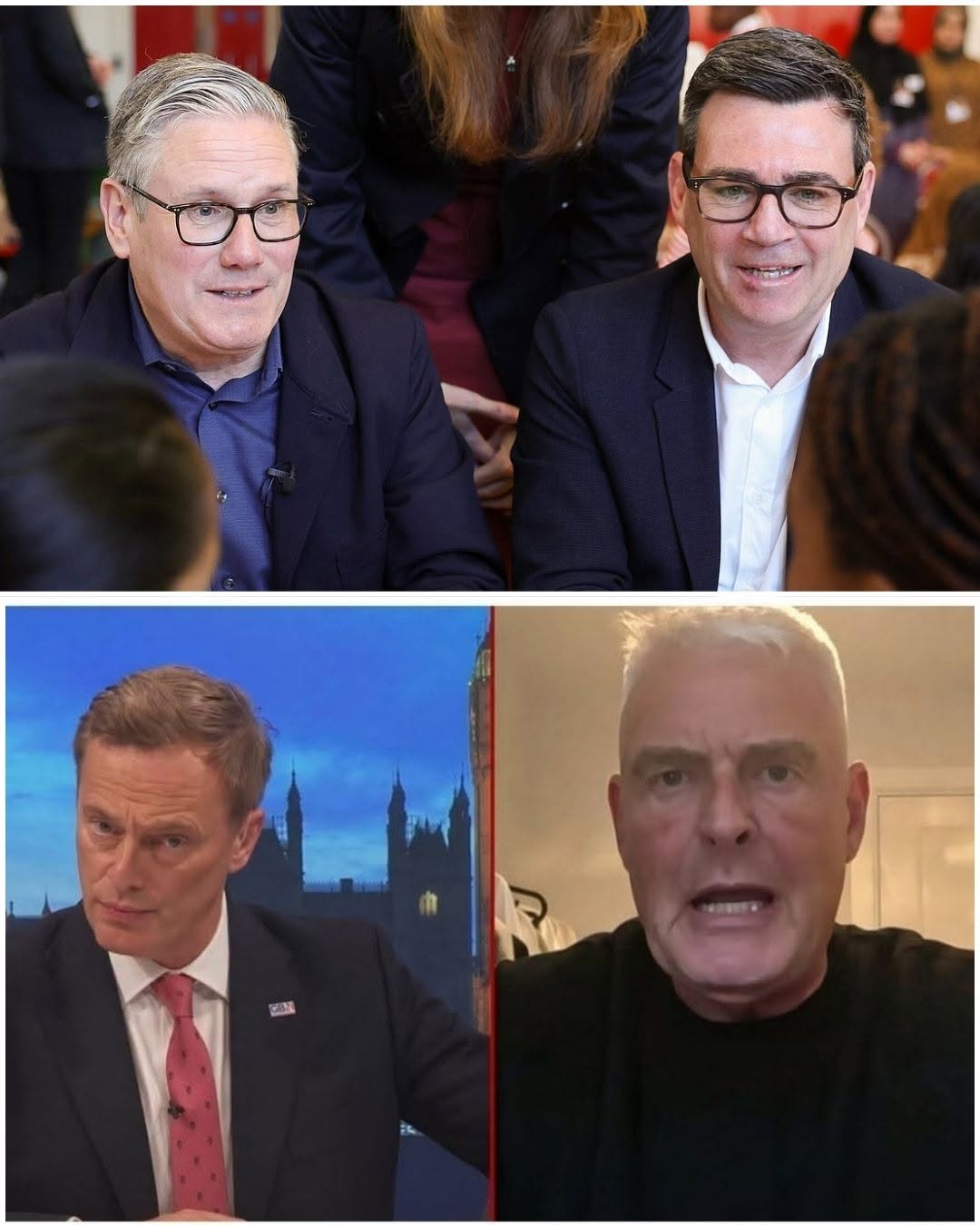
Reform UK Threatens Union Funding Crackdown as Political Donations Row Escalates
A growing dispute over political donations has erupted into one of Westminster’s sharpest clashes over party funding, with Reform UK warning that any attempt to restrict its major donors could eventually be met with legislation targeting trade union funding of the Labour Party.
The confrontation intensified after Reform UK chairman Lee Anderson suggested that a future Reform government could prevent trade unions from financially supporting Labour if the current government moves against Reform’s recent multimillion-pound donations.
Speaking to GB News, Anderson issued a stark warning.
“If they want to play silly games, then we can play them games as well,” he said, before stating that a Reform government could introduce legislation stopping unions from funding Labour.
He then added: “Then game over for the Labour Party. They need to think very carefully.”
The remarks were not merely social-media speculation. Anderson’s comments have been reported by multiple outlets amid a broader political battle over two enormous donations received by Reform UK.
The £72 Million at the Centre of the Dispute
The controversy follows Reform UK’s receipt of two £36 million donations from cryptocurrency billionaires Christopher Harborne and Ben Delo — a combined £72 million that has dramatically strengthened the party’s financial position.
Reform leader Nigel Farage has defended the donations, arguing that they were legally permissible and would help his party compete with Britain’s established political parties. Reform itself has described the money as an investment in what it calls “democratic renewal.”
The scale of the contributions has nevertheless reignited a longstanding debate over whether extremely wealthy individuals should be able to provide political parties with tens of millions of pounds.
The government has already been pursuing reforms intended to reduce the risk of foreign financial influence in British elections.
Under measures contained in the Representation of the People Bill, overseas electors would face an annual £100,000 limit on political donations. The government has also proposed tighter rules for company donations and restrictions designed to ensure political money has a genuine connection to the UK.
Ministers have said the reforms are about protecting democratic integrity rather than disadvantaging a particular political party.
That distinction is crucial.
While some of the rhetoric surrounding the controversy has suggested that Labour is simply attempting to “wipe out” Reform’s funding, the government’s publicly stated policy is broader and focuses particularly on foreign influence, overseas electors and the legitimacy of political funding.
Downing Street has also denied that consideration of stronger donor residency requirements is specifically designed to target Reform’s £72 million.
Reform Says the Rules Must Apply Equally
Reform UK sees the situation very differently.
Its argument is that restrictions on wealthy private donors cannot fairly be discussed without also examining the large sums received by Labour through unions and other established funding sources.
Anderson has therefore raised the possibility of retaliation.
If Labour changes political-finance rules in a way that prevents Reform from benefiting from its major donors, he argues, a future Reform government would be justified in changing the law to restrict union funding of Labour.
That would represent a major change to the British political funding system.
Trade unions have historically played an important role in Labour financing, although describing all Labour donations as “union money” would be inaccurate.
Reform has cited Electoral Commission data to claim Labour received approximately £128 million in reportable donations between 2021 and the period immediately before Reform secured its two record-breaking donations. But that £128 million figure represents Labour’s wider reportable donations, not simply a £128 million trade-union “lifeline.”
That distinction matters because viral descriptions of the row can easily blur two separate issues: Labour’s overall fundraising and the specific role played by affiliated trade unions.
Why Union Donations Are Different — and Why Critics Still Question Them
Trade union political funding operates within its own statutory framework. Unions using political funds must comply with legal requirements, while individual members have rights regarding their participation in those funds.
Union leaders therefore reject comparisons between their funding model and enormous contributions from individual billionaires.
Their argument is essentially that union political funds represent contributions from large numbers of workers rather than the financial influence of a single wealthy individual.
Reform and other critics challenge that distinction.
They argue that if the objective is to prevent excessive financial influence over political parties, lawmakers should be prepared to apply consistent principles to individuals, companies and organised labour.
That disagreement exposes the central problem facing any attempt to reform Britain’s political-finance system.
A cap that appears neutral on paper can affect political parties very differently because they rely on different sources of money.
The House of Commons Library has found that imposing broader donation limits could significantly affect party income. It also notes that the precise consequences are difficult to predict because donors and political organisations could change their behaviour in response to new rules.
Is Labour Actually Planning a General Donation Cap?
Not yet.
The government has acknowledged concerns about very large political donations and established work to examine broader threats involving political funding and political equality.
However, its current legislative focus has primarily been on overseas donors, foreign influence, cryptocurrency and stronger controls on company donations.
In a parliamentary answer published in September, the government said it recognised concerns surrounding very large donations but did not announce a universal cap covering all domestic individuals, businesses and unions.
That means claims that Labour has already decided to abolish or confiscate Reform’s major domestic donations go further than the confirmed policy currently supports.
The political threat from Reform, however, is real.
Anderson has publicly connected possible restrictions on Reform’s funding with future action against union financing of Labour.
A Battle Bigger Than Reform Versus Labour
Behind the increasingly heated language lies a much broader question about British democracy:
How much financial influence should any individual or organisation be allowed to exercise over a political party?
One side argues that dramatic multimillion-pound donations risk allowing extraordinarily wealthy individuals to acquire disproportionate political influence.
The other warns that governments must not redesign funding rules in ways that conveniently weaken their political opponents while protecting their own traditional sources of support.
Both arguments will receive increasing scrutiny if Parliament considers broader donation limits.
For Reform UK, the £72 million provides resources capable of transforming its national organisation and campaigning operation.
For Labour, the controversy creates pressure to demonstrate that political-finance reform is based on consistent democratic principles rather than partisan advantage.
And for trade unions, Anderson’s warning raises another possibility: reforms originally aimed at wealthy donors could eventually trigger a much wider confrontation over how British political parties are financed.
His “game over” declaration is therefore best understood as a political threat about what Reform would seek to do if it enters government, rather than a policy that has already taken effect.
The next phase of the argument will determine whether the confrontation remains political rhetoric — or develops into a fundamental battle over who is allowed to fund British politics.
BRUTAL WAR IN WESTMINSTER! Reform UK Just Issued an Explosive Warning That Could Wipe Out the Labour Party for Good!
Westminster has entered another period of political confrontation as Reform UK leader Nigel Farage intensifies his attacks on the government and promises a fundamental change to British politics. The party is presenting itself as an alternative to the established political order, while Labour faces growing pressure to demonstrate that its policies can deliver tangible improvements in people’s lives.
The language surrounding the dispute is dramatic, with warnings of political battles, accusations of establishment resistance and claims that the traditional party system is under threat. Yet behind the rhetoric lies a serious question: how much could Britain’s political landscape change if Reform UK continues to attract voters who have become dissatisfied with the major parties?
Farage has repeatedly argued that the country needs a radical break from what he describes as years of political failure. In a speech in Plymouth on 20 October 2026, he criticised attempts to restore traditional two-party politics and declared that Reform would continue fighting for its political objectives. He also portrayed opposition to his party as part of a wider establishment effort to preserve the existing system. <Cite refs={[“turn862303search1”]} />
For Labour, the challenge is to respond to that message without allowing every political dispute to overshadow the government’s own priorities. For Reform, the challenge is to turn forceful speeches and public dissatisfaction into sustained electoral support.
Neither task will be simple.
Farage Turns Up the Pressure
Farage has built much of his political appeal around the argument that established parties have failed to respond adequately to public concerns about immigration, public services, taxation and national identity.
His latest attacks continue that strategy. Reform’s message is that Britain needs a different approach to government, with more restrictive immigration policies, changes to the tax system and a stronger emphasis on national sovereignty.
The party has also tried to distinguish itself from the Conservatives, arguing that previous governments failed to deliver the changes they promised. This creates a direct challenge to both Labour and the Conservatives, particularly among voters who feel that successive administrations have not addressed their concerns.
In his Plymouth speech, Farage said Reform had faced sustained criticism since the local election results in May. He argued that political, media and institutional opposition was intended to restore the familiar pattern of competition between Labour and the Conservatives.
Those remarks reflect Farage’s political interpretation of events rather than proof of a coordinated effort by every institution he criticised. Nevertheless, they illustrate how Reform is framing its campaign: not simply as a contest between parties, but as a struggle over the direction of the country.
That framing can be powerful because it offers supporters a clear explanation for why political change has been difficult to achieve. It also invites scrutiny over whether the party’s own proposals would deliver the outcomes it promises.
Labour Faces a Difficult Political Test
Labour’s position has become more complicated as the political landscape has shifted. The party must defend its record while addressing public concerns about the economy, household finances, immigration and the quality of public services.
Voters who are frustrated with government performance may not necessarily support Reform on every issue. Some may be attracted by its immigration policies, others by its criticism of the political establishment, and others by dissatisfaction with Labour or the Conservatives.
That variety makes the political challenge difficult to measure through a single headline or speech.
Labour also faces pressure to explain the practical consequences of its decisions. Announcements about spending, taxation and public-service reform must ultimately be judged against what people experience in their daily lives. If voters believe that promises are not being fulfilled, opposition parties can use that dissatisfaction to challenge the government’s credibility.
At the same time, Reform’s criticism does not automatically establish that its own proposals would work. The party would need to explain how it intends to finance its commitments, implement policy changes and manage the consequences of decisions affecting businesses, workers and public services.
Political competition is therefore about more than delivering the sharpest attack. It is also about demonstrating that a party can turn its programme into workable government policy.