

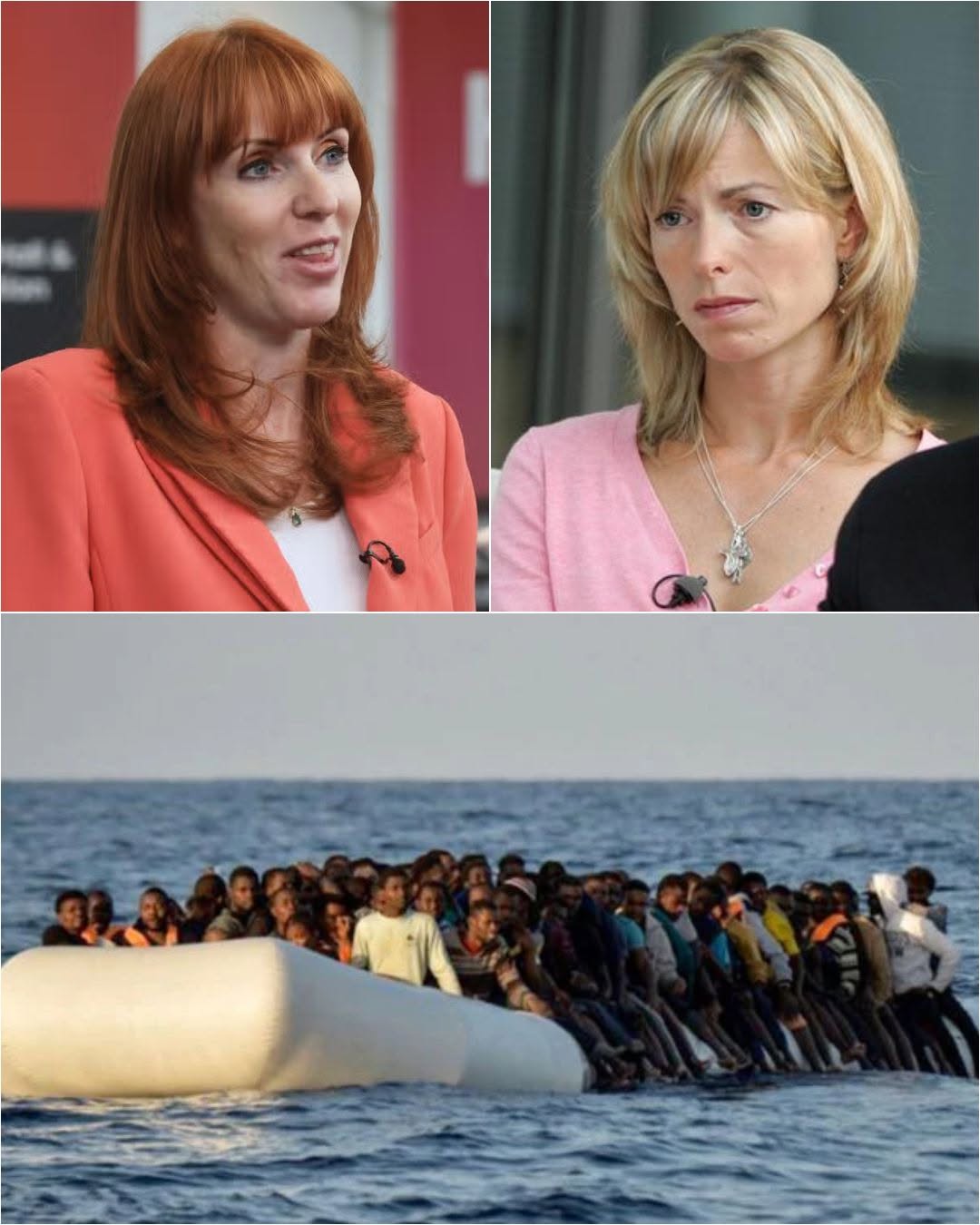
Angela Rayner Faces Migrant Housing Challenge as Viral ‘90,000 vs 9,000’ Comparison Fuels Debate
LONDON — Angela Rayner has faced a wave of criticism after being challenged over why Britain provides accommodation to tens of thousands of asylum seekers while thousands of people continue to sleep rough, with a television exchange rapidly becoming part of a wider political argument over housing, immigration and government priorities.
The confrontation has been framed online in stark terms: approximately 90,000 migrants housed by the state versus around 9,000 homeless people, many of them British citizens.
For critics of the government, the comparison appears to illustrate a fundamental injustice. If accommodation can be found for people seeking asylum, they ask, why can the same urgency not be applied to people already living in Britain who have nowhere to sleep?
But while both figures have foundations in official statistics, placing them directly alongside each other creates a misleading impression about what they measure.
The controversy therefore raises two separate questions: whether the government is doing enough about homelessness, and whether asylum seekers are actually being “prioritised” over British citizens.
Where does the 90,000 figure come from?
Official asylum statistics provide a figure close to the one circulating online.
As of June 2026, approximately 89,089 people were receiving asylum accommodation in the UK, according to figures summarised by the BBC from Home Office data. About 16,021 of them — roughly 18% — were being housed in hotels.
That is a substantial number.
However, describing all 89,089 as people who “arrived illegally” is not supported by that statistic.
The asylum accommodation population covers people receiving government support while their asylum circumstances are being dealt with. The legal status of individual asylum seekers can differ, as can their routes into Britain.
The government has a statutory system for supporting asylum applicants who would otherwise be destitute while their claims are considered.
That is not the same system through which councils address general homelessness.
What about the 9,000 homeless people?
The second number is also broadly recognisable — but again requires context.
Official Ministry of Housing, Communities and Local Government data estimated that 8,748 people slept rough at some point during June 2026 in England.
That was a record high for that time of year.
But the figure does not represent every homeless person in Britain.
It measures people estimated to have been sleeping rough during a particular month in England. It excludes many people legally classified as homeless who are living in temporary accommodation, hostels, refuges, hotels or other insecure housing arrangements.
The same government release estimated that 3,980 people were sleeping rough on a single night in June.
So even within rough-sleeping statistics, the number changes depending on the measurement used.
There is another important qualification.
The viral description often calls all 9,000 people “British.”
Official statistics show that, where nationality was known, 79% of people sleeping rough during June were UK nationals, while 10% were from the European Economic Area and 11% were from outside the EEA. Nationality was unknown for another 1,066 people.
British citizens clearly constitute the largest group, but the entire 8,748 cannot accurately be described as British.
Did Rayner simply have no answer?
Reports of the television exchange describe Rayner as being challenged about why accommodation was available for approximately 90,000 asylum seekers while thousands remained homeless.
Her response focused on Britain’s shortage of housing and the government’s intention to increase social housing supply.
Critics interpreted that as avoiding the central question. A report describing the exchange said Rayner responded by discussing housing supply rather than directly accepting the premise of the numerical comparison.
Characterisations such as “froze,” “squirmed” or suffered a “total failure,” however, are subjective descriptions of her performance rather than independently measurable facts.
More importantly, Rayner’s wider record on the issue shows that homelessness is an area for which she has publicly acknowledged serious problems.
Speaking to Parliament’s Housing, Communities and Local Government Committee, she pointed to the enormous number of children living in temporary accommodation and said the situation was unacceptable.
That does not answer whether current government policy is adequate.
It does mean the claim that the government simply ignores homelessness requires more evidence.
Britain’s homelessness problem is considerably larger than 9,000
This is perhaps the biggest problem with the viral comparison.
Rough sleeping is only the most visible form of homelessness.
A family placed by a council in temporary accommodation is homeless but is unlikely to appear in a count of people sleeping on pavements.
Earlier figures showed more than 123,000 households in temporary accommodation in England, including nearly 160,000 children.
Consequently, Britain’s housing emergency cannot realistically be described as a competition between 90,000 asylum seekers and 9,000 British rough sleepers.
Both populations exist within a much larger shortage of affordable accommodation.
Are asylum seekers receiving preferential treatment?
The statistics alone cannot establish that conclusion.
Asylum support and homelessness assistance operate under different legislation, eligibility rules and government departments.
Providing an asylum seeker with accommodation does not necessarily mean that a council property that could have housed a homeless British family was instead given to that asylum seeker.
Much asylum accommodation consists of Home Office-contracted properties, hotels and other facilities specifically commissioned for the asylum system.
As of June, only around 18% of those in asylum accommodation were in hotels, meaning most were housed elsewhere in the asylum estate.
There are nevertheless legitimate questions about resources.
Hotels and other asylum accommodation cost public money. Local communities can experience pressure on housing and services. Critics are therefore entitled to ask whether the asylum system is efficient and whether government spending priorities should change.
But that policy debate is different from demonstrating that an individual homeless British person was denied accommodation because it had been allocated to an asylum seeker.
The asylum backlog has fallen sharply
Another relevant development is the changing size of Britain’s asylum caseload.
According to the House of Commons Library, approximately 32,400 asylum cases were awaiting an initial decision in June 2026.
The equivalent backlog had reached around 134,000 in June 2023.
That represents a decline of approximately 76%.
Processing cases more quickly matters for housing because people generally leave asylum accommodation after their cases are concluded, although what happens afterward depends on whether they receive protection or are refused.
The relationship with homelessness can also work in the opposite direction from the one suggested by viral posts.
Government statistics show that some people become rough sleepers after leaving asylum support.
In June 2026, 99 people recorded as sleeping rough had recently left asylum support. That was nevertheless sharply lower than the 474 recorded at the peak in May 2025.
Labour is under pressure on homelessness
None of these qualifications removes the political difficulty facing Rayner.
The government’s own statistics say rough sleeping remains at historically high levels for this time of year.
Housing charities argue that the fundamental problem is Britain’s severe shortage of social homes.
Shelter has estimated that England needs approximately 90,000 new social-rent homes every year for a decade to clear most waiting lists and provide homes for homeless households.
Rayner has responded by placing social housing at the centre of her housing agenda.
At Labour’s September 2026 conference, she announced proposals giving councils additional powers to help homeless households access housing-association properties and measures designed to protect social homes from being lost from the affordable sector.
Whether those policies will materially reduce homelessness remains a question of implementation and housing supply rather than announcement alone.
Two crises, not necessarily one queue
The anger behind the television question is understandable as a political phenomenon.
Thousands of people sleeping on Britain’s streets while government-funded accommodation is provided to asylum seekers inevitably creates a powerful visual comparison.
But the evidence does not support reducing the issue to a single queue in which 90,000 foreign migrants have been placed ahead of 9,000 British citizens.
The 89,089 figure covers asylum accommodation across the UK. The 8,748 figure measures people who slept rough over a month in England. Not every person in the first group entered Britain illegally, and not everyone in the second group is British.
Nor does the rough-sleeping figure capture the much larger population living in temporary accommodation.
That does not absolve the government of responsibility.
Britain simultaneously faces a strained asylum accommodation system, persistent irregular migration and a serious shortage of affordable housing. Rough sleeping remains exceptionally high, and large numbers of families continue to live without permanent homes.
The political question for Rayner and the government is therefore broader than the viral “90,000 versus 9,000” comparison.
It is whether Britain can reduce dependence on asylum accommodation while also building enough affordable and social housing to prevent its own homelessness crisis from becoming permanent.
That is a harder question than the viral numbers suggest — and one for which the government’s eventual results will provide a clearer answer than any single television exchange.
A NATIONAL DISGRACE: Angela Rayner’s Live TV Row Sparks Debate Over Migrants and Struggling British Families
Angela Rayner has found herself at the centre of another heated debate over immigration, fairness and the priorities of the Labour government. Her public defence of migrant workers has reignited a difficult question facing politicians across Britain: how can the country treat people who have built lawful lives in the UK fairly while also addressing the financial pressures facing British families?
The controversy comes amid growing disagreement within Labour over proposed changes to the rules governing permanent residence. Rayner has criticised plans that could force some migrant workers, including people employed in health and social care, to wait substantially longer before qualifying to settle permanently. She argues that changing the rules for people who arrived under an existing system risks undermining trust.
For critics of Labour, the dispute raises questions about whether ministers are listening closely enough to people struggling with housing costs, household bills and pressure on public services. For Rayner and those who share her position, fairness also means recognising the contributions of workers who have come to Britain legally and helped support essential services.
The argument has become politically sensitive because it brings two legitimate public concerns into direct tension: confidence in immigration rules and the treatment of people who have followed them.
What did Angela Rayner actually say?
Rayner’s recent comments have focused on the government’s proposed immigration reforms rather than a confirmed policy of prioritising migrants over British citizens.
In September 2026, she renewed her criticism of proposals associated with Home Secretary Shabana Mahmood. Under the plans being discussed, the standard qualifying period for permanent residence would increase from five years to ten for many migrants, while some health and social care workers could face a wait of up to fifteen years. The government has been considering how the changes should apply to people who arrived under earlier rules.
Rayner’s objection is that people who moved to Britain, took jobs and built their lives around the rules in place at the time should not necessarily face a longer wait because the government subsequently changes its approach.
She has described retrospective changes as unfair and disruptive, particularly for care workers who contribute to services looking after vulnerable people.
Her position has not been that Britain should abandon border controls. Rather, she has argued that controlling new arrivals and changing the settlement expectations of people already living and working legally in the country are separate questions.
That distinction is central to understanding the disagreement. Critics may reject her approach, but the available reporting does not establish that she has advocated giving migrants priority over British citizens in access to public services.
Why struggling British families are part of the debate
Across Britain, many households face difficult choices over rent, mortgages, energy bills, food and other essentials. People who have worked for years may feel that their efforts have not translated into greater financial security.
Housing is an especially sensitive issue. In areas where affordable homes are scarce, competition for accommodation can become a source of frustration. Waiting lists, high private rents and limited availability can leave families feeling that the system is failing them.
When politicians discuss immigration, these pressures frequently become part of the argument. Some voters believe that population growth increases demand for housing, healthcare and local services. They want the government to demonstrate that public resources are sufficient and that decisions about eligibility are fair.
However, the relationship between immigration and pressure on services is complex. Housing shortages also reflect long-term building levels, planning decisions, affordability, regional employment patterns and the availability of social housing. The effect of migration varies by location, population group and the particular service being considered.
It is therefore important to examine specific policies and evidence rather than assume that every difficulty faced by a British household is caused by migrant support.
The government has a responsibility to explain how public resources are allocated, how eligibility rules operate and what it is doing to improve services for people who need help.
The disagreement exposes divisions within Labour
Rayner’s intervention has also highlighted differences within Labour over how the government should balance stricter immigration controls with fairness to people already living in Britain.
Mahmood has argued for a tougher settlement system, saying that permanent residence should be earned and that immigration rules must command public confidence. Rayner, by contrast, has warned that changing the rules retrospectively could punish people who accepted jobs and made long-term commitments under the previous arrangements.
Other Labour figures have called for a balance between recognising migrants’ contributions and ensuring that the public believes the system is properly controlled.
These differences are politically significant because they concern more than administrative details. They reflect competing ideas about fairness, responsibility and what the government owes to people who have settled in Britain.
One approach places greater emphasis on reducing migration and extending the period before permanent residence can be obtained. Another argues that the government should distinguish between future arrivals and workers who have already established lawful lives in the country.
Both approaches raise practical questions. How should transitional arrangements work? Should people who arrived under earlier rules be treated differently? What evidence should determine eligibility? And how can the government maintain public confidence without creating uncertainty for workers and employers?
Those are questions that require clear policy decisions rather than personal attacks.