

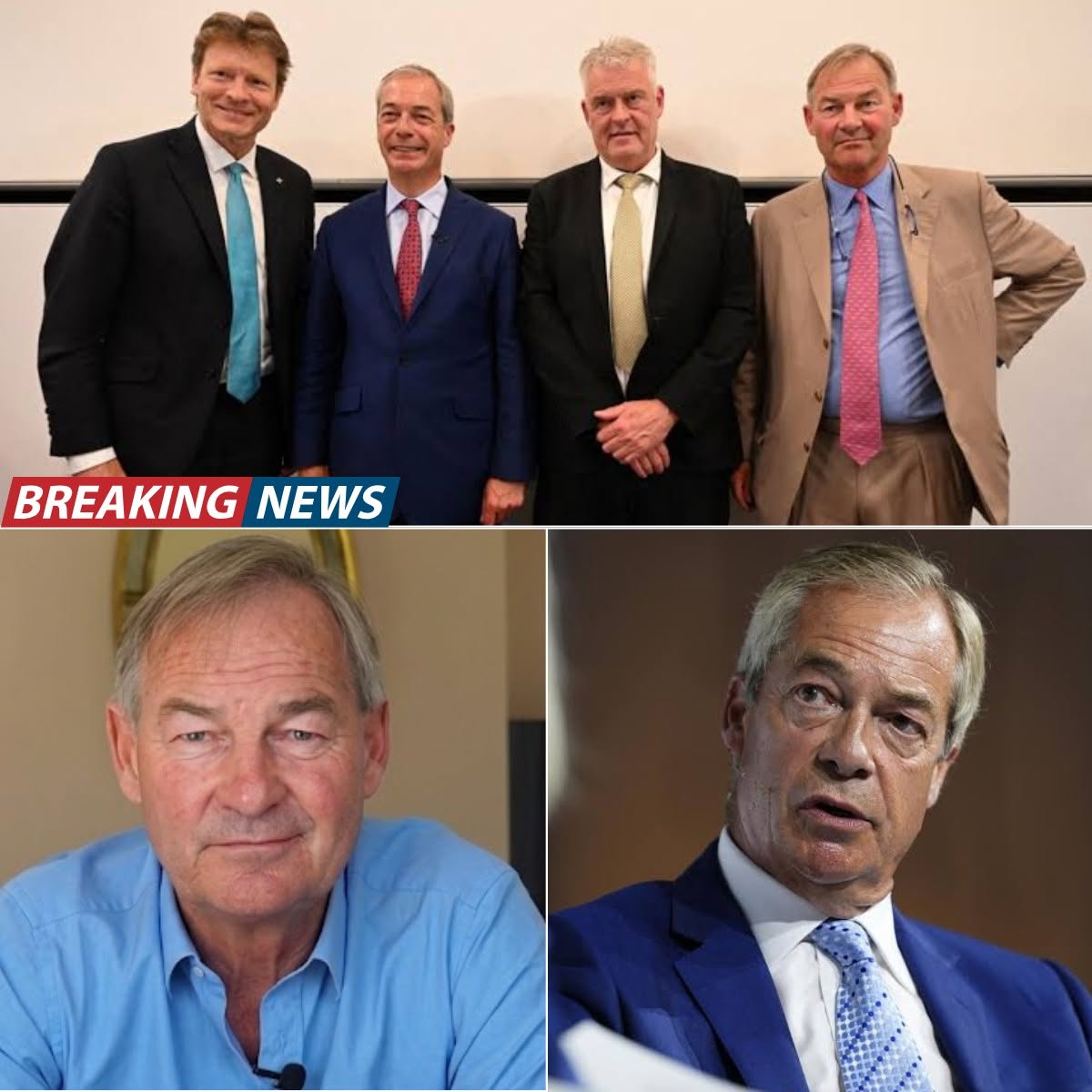
Nigel Farage and Rupert Lowe: Is a Shock Political Alliance Really Taking Shape?
A possible rapprochement between Nigel Farage and Rupert Lowe is generating fresh speculation on the British right, raising an intriguing question: could two politicians whose relationship deteriorated so dramatically now find themselves working together again?
Lowe, the former Reform UK MP who now leads Restore Britain, publicly extended what was widely described as an “olive branch” to Farage in August, suggesting that his new political movement could potentially work with Reform despite their highly public falling-out.
The proposal immediately attracted attention because Lowe and Farage were once part of the same political project before their relationship broke down in one of Reform UK’s most serious internal disputes.
But while talk of cooperation is real, claims that the pair have already formed a dramatic new alliance go considerably further than the available evidence.
At present, the story is better described as a tentative opening between two competing forces on the British right — one that could have significant electoral consequences if it develops further.
From Political Allies to Bitter Rivals
Rupert Lowe was elected to Parliament for Great Yarmouth as a Reform UK candidate in the 2024 general election.
Initially, he was one of the party’s most visible MPs and frequently spoke about immigration, government spending, crime and what he regarded as institutional failures in Britain.
But relations between Lowe and Reform’s leadership deteriorated during 2025.
Lowe was suspended from Reform amid a bitter internal dispute, leading to public accusations and counter-accusations between his supporters and senior figures around Farage.
The split eventually became much more than a personality clash.
Lowe positioned himself as an alternative voice on the right, arguing for a more uncompromising approach to immigration and political reform. He later became associated with Restore Britain, which has increasingly competed for support among voters who might otherwise consider Reform.
That makes the suggestion of cooperation particularly striking.
Lowe’s “Olive Branch” to Farage
In August 2026, Lowe released a video directly addressing Farage and suggesting that Restore Britain could put aside its differences with Reform.
According to reporting at the time, Lowe rejected the argument that Restore was simply splitting the right-wing vote and indicated that he was willing to discuss cooperation.
The gesture was notable because it came after months of hostility.
However, the détente did not immediately produce harmony. The initial outreach was quickly followed by renewed disagreements between the two sides, demonstrating that the personal and political divisions had not disappeared.
That history matters when assessing headlines suggesting that a formal “shock alliance” has suddenly emerged.
An invitation to cooperate is not the same thing as an electoral pact, merger or formal coalition.
So far, there is no reliable evidence that Reform UK and Restore Britain have reached such an agreement.
Why Cooperation Would Matter
The electoral logic behind cooperation is relatively easy to understand.
Reform and Restore potentially compete for many of the same voters: people who favour lower immigration, stronger border enforcement, greater national sovereignty and a more confrontational approach toward Britain’s established political institutions.
Recent reporting has suggested that Restore Britain has become a genuine obstacle for Reform in some parts of the electorate. At the same time, Reform has been trying to rebuild momentum following internal disputes and fluctuating polling numbers.
When two parties target substantially overlapping groups of voters, they risk dividing support in individual constituencies.
Under Britain’s first-past-the-post electoral system, that can have a major effect.
A constituency does not require a candidate to win more than 50% of the vote. A candidate simply needs more votes than anyone else.
If Reform and Restore were each to attract significant support from broadly similar voters, Labour or the Conservatives could potentially win seats even when the combined Reform-Restore vote would have exceeded theirs.
That is one reason political cooperation is being discussed.
But Ideological Similarity Does Not Eliminate Rivalry
Although Reform and Restore share some themes, they are not identical organisations.
Farage has spent decades building a political brand around Brexit, immigration restriction and opposition to established parties.
Lowe has increasingly developed his own political identity, often presenting himself as willing to go further than Reform on institutional change and immigration.
That creates an obvious strategic problem.
Any agreement would require decisions about candidate selection, leadership, policy priorities and which organisation would step aside in particular constituencies.
Those questions are rarely simple.
Smaller political parties frequently discover that agreeing they have a common opponent is easier than deciding who should control the resulting movement.
The personal history between Farage and Lowe makes that challenge even greater.
Farage Is Currently Focused on Reform’s Own Campaign
There is also little evidence that Farage is preparing to abandon Reform’s independent electoral strategy.
On October 1, Farage launched what he described as Reform UK’s general-election campaign at a rally in Doncaster.
He used the event to attack Prime Minister Andy Burnham over Labour’s willingness to reconsider aspects of Britain’s relationship with the European Union, arguing that reopening the Brexit debate could provide Reform with a major political opportunity.
Farage described Burnham’s approach to Europe as an extraordinary political opening for his party and challenged the Prime Minister over the issue.
That rhetoric suggests that Reform is currently positioning itself as a major independent electoral force rather than preparing publicly for a merger with Lowe’s movement.
Reform has also benefited from substantial political donations, strengthening its capacity to hire staff, campaign nationally and invest in digital outreach.
Those resources may reduce the incentive for Farage to compromise with smaller competitors.
Why the Timing Is Interesting
Even without a formal alliance, however, Lowe’s overture has arrived at an important moment.
British politics is becoming increasingly fragmented.
Labour is attempting to consolidate itself under Burnham, the Conservatives are seeking to rebuild after major electoral losses, and Reform is competing aggressively for voters dissatisfied with both traditional parties.
Meanwhile, immigration, Brexit and national identity continue to dominate parts of the political debate.
Farage has seized on Burnham’s decision to reopen discussion about Britain’s long-term relationship with Europe, describing it as one of the biggest political opportunities of his career.
For Lowe, cooperation with Farage could offer access to a much larger political organisation.
For Farage, cooperation with Lowe might remove a competitor capable of drawing support away from Reform.
That does not mean either side will ultimately decide that cooperation is worth the political cost.
Could There Be an Electoral Pact?
An electoral pact would be one possible form of cooperation.
Such an arrangement might involve the two parties agreeing not to stand candidates against one another in selected constituencies.
That would allow them to concentrate votes rather than split them.
But there is currently no confirmed agreement of that kind.
Another possibility would be informal cooperation on particular campaigns or policy issues without any formal electoral arrangement.
A full merger would be the most dramatic scenario — and currently the least supported by public evidence.
Any of these outcomes would require substantial negotiation.
They would also raise difficult questions for both leaders about political authority and party identity.
The Bigger Battle Is Over Who Leads the British Right
The tension between Farage and Lowe is ultimately about more than whether two politicians can repair a damaged relationship.
It reflects a broader contest over the future direction of Britain’s populist right.
Farage remains the dominant national figure in that political space, particularly because of his role in the Brexit campaign and his ability to attract media attention.
Lowe represents a potentially more insurgent alternative, appealing to voters who believe Reform itself has become too cautious or too centrally controlled.
If they remain competitors, they could divide parts of the same electorate.
If they cooperate, they could potentially consolidate that vote — but only if they can overcome the disputes that originally separated them.
A Political Opening, Not Yet a Shock Alliance
For now, describing Farage and Lowe as having formed a surprise alliance would be premature.
Lowe has publicly indicated that he is willing to work with Farage. That is significant, particularly given the bitter history between them.
But Reform and Restore remain separate political organisations, and no formal coalition, merger or nationwide electoral pact has been publicly confirmed.
The more accurate story is therefore one of possibility.
Two figures who once shared a political home, then became bitter rivals, are once again discussing whether cooperation could serve their wider goals.
Whether that develops into an alliance could matter considerably in a closely contested British election.
But until an agreement is announced, the “shock alliance” remains a political scenario rather than an established fact.
And perhaps that uncertainty is precisely why the story has attracted so much attention: the biggest question is no longer whether Rupert Lowe and Nigel Farage disagree.
It is whether electoral pressure could eventually give both men a reason to put those disagreements aside.
NIGEL FARAGE & ROBERT LOWE: THE SHOCK ALLIANCE NOBODY SAW COMING?
Britain’s political right is facing a crucial question: could Nigel Farage and Rupert Lowe put their differences aside and cooperate in an attempt to reshape the country’s political future?
The possibility of an alliance between Reform UK and Restore Britain has attracted attention because the two figures share several political priorities but have also experienced a bitter personal and political breakdown. What began as a split within Reform has developed into a wider debate about leadership, immigration, economic policy and whether competing movements on the right can work together.
Lowe, the leader of Restore Britain, publicly invited Farage to consider cooperation in August 2026. Farage responded that he was open-minded about discussions, but he also made clear that he would not abandon established allies simply to satisfy Lowe’s demands. The exchange revealed both the potential for cooperation and the obstacles standing in its way.
The central question is whether shared political objectives will prove strong enough to overcome the mistrust that has developed between the two men.
An unexpected offer to unite the right
Lowe’s proposal was significant because he had previously been a Reform UK MP before leaving the party in 2025 and subsequently establishing Restore Britain as a separate political organisation.
The split created a new source of competition on the right. Instead of concentrating support behind one party, voters who wanted stricter immigration policies and a more confrontational approach to Westminster could choose between different political movements.
Lowe argued that continued division would weaken their ability to challenge Labour. In his August appeal, he urged Farage to put personal disagreements aside and explore a common political programme.
His message was straightforward: if the two movements agreed on enough important issues, cooperation could be more effective than competing against each other.
Farage did not completely reject the idea. He said he had reached out to Lowe and was willing to consider a discussion. However, the Reform leader questioned why Lowe had announced his proposal publicly rather than beginning with private negotiations.
The exchange quickly exposed a problem that any potential alliance would need to overcome. Even when politicians agree on broad objectives, they may disagree sharply about who should lead, which policies should take priority and how much influence each organisation should retain.
Five conditions that could make or break a deal
Lowe did not offer unconditional cooperation. He set out five demands that he said would need to form the basis of an agreement.
The first concerned immigration. Lowe called for a policy that went beyond reducing new arrivals and included reversing existing migration, with the deportation of people who entered the country illegally.
His second condition focused on what he described as demographic security. The proposals included restrictions on certain religious and cultural practices, such as the burqa and religious slaughter, alongside demands concerning Sharia courts and cousin marriage. These proposals are controversial and would raise substantial questions about civil liberties, religious freedom, equality and the practical operation of British law.
The third condition was a referendum on restoring the death penalty. That would reopen one of Britain’s most contentious debates about criminal justice, punishment and the state’s authority to take a life.
The fourth centred on economic policy. Lowe called for a more self-sufficient Britain, tighter control of public spending, welfare reductions and action on inflation. Such proposals would require detailed explanations of which budgets would be reduced, how savings would be achieved and what consequences the measures could have for households and public services.
His fifth demand concerned political leadership. Lowe said former Conservative ministers who had already held senior positions should not automatically be included in a future government.
That condition directly challenged Farage’s approach to recruiting experienced political figures, including former Conservative politicians who have joined Reform.
Together, the demands reveal that the potential alliance would involve more than an agreement to cooperate during elections. It would require decisions about policy, leadership and the future composition of a possible government.
Why the relationship remains complicated
Farage and Lowe once sat in the same parliamentary party, but their relationship deteriorated before Lowe established his own movement.
Their subsequent disagreement has involved competing accounts of trust, leadership and political strategy. In August, Lowe said Farage had sent him a message promising to call but had not followed through. Farage, meanwhile, questioned the manner in which Lowe had presented his offer and insisted that he would not discard allies because another politician demanded it.
These exchanges matter because political alliances depend on more than matching policy positions. Negotiators need confidence that agreements will be respected, that disagreements can be handled privately and that neither side will use every dispute as an opportunity to undermine the other.
A partnership could give both organisations access to a wider network of supporters and campaigners. It could also create fresh conflict if the parties disagreed about candidate selection, campaign funding, parliamentary strategy or the distribution of influence.
The leadership question is especially important. Farage has built Reform UK around a highly recognisable national profile, while Lowe has sought to establish Restore Britain as a distinct alternative. A formal merger or electoral pact would require both sides to decide how much independence they were prepared to sacrifice.
Neither politician can simply assume that supporters would accept every compromise.
The electoral calculation
The argument for cooperation is partly rooted in the possibility that parties with similar political priorities could weaken one another by competing for the same voters.
Restore Britain’s performance in the Greater Manchester mayoral by-election in July gave Lowe a platform from which to argue that his movement had a role to play. Restore’s candidate received 8.7 per cent of the vote, while Reform finished second with 21 per cent. Labour candidate Andy Burnham won the contest.
Those figures demonstrate that Restore attracted a measurable share of votes in that particular contest. They do not, on their own, establish how the party would perform in other constituencies or a future general election.
Nevertheless, the result provided a concrete example of why cooperation is being discussed. Where parties appeal to overlapping groups of voters, separate campaigns can divide support. A coordinated approach might reduce duplication, but it would not automatically guarantee more votes or parliamentary seats.
Voters could also react negatively to an alliance if they believed their preferred party had abandoned important principles. Others might welcome cooperation if it produced a clearer political alternative.
The consequences would depend on the candidates, local circumstances, campaign messages and the policies ultimately agreed.
Can the two movements agree on economic policy?
Immigration is central to Lowe’s proposal, but economic policy could prove just as important to any lasting partnership.
Both movements have criticised aspects of the existing political establishment, yet broad calls for lower spending and national self-sufficiency leave many practical questions unanswered.
A serious agreement would need to identify how the parties intend to address taxation, public services, debt, inflation, pensions and investment. It would also need to explain how proposed welfare reductions might affect working families, people with disabilities and pensioners who rely on state support.
The same scrutiny would apply to promises about reducing immigration. Changes to migration rules can affect employers, labour supply and the recruitment of workers in sectors such as health and social care. Any government would need to consider those consequences alongside its objectives for border enforcement.
Political slogans may help define a movement, but governing requires decisions about competing priorities and limited resources.
If Reform and Restore were to cooperate, their ability to produce a detailed and internally consistent programme would be an important test of the partnership.
What happens next?
The possibility of a Farage-Lowe alliance remains a question of negotiation rather than a confirmed political merger. Farage has indicated openness to discussions, while Lowe has made clear that he wants any agreement to include substantial policy commitments.
The differences between them remain significant. Lowe’s conditions would require Farage to consider demands that go beyond simply coordinating campaigns, while Farage has shown reluctance to accept conditions that would force him to abandon existing allies.
For now, the situation illustrates a wider challenge for Britain’s political right: whether movements that share some objectives can overcome disagreements about leadership, ideology and strategy.
A formal agreement could alter how these organisations approach elections and public campaigning. Failure to reach one could leave them competing for support and arguing over which movement offers the more credible alternative.
The outcome will depend on decisions that have not yet been fully settled. Until the parties announce a concrete agreement, it would be premature to describe their relationship as a completed alliance.
The prospect is nevertheless politically significant. Farage and Lowe have opened a debate about cooperation, but whether that debate leads to a durable partnership will depend on their willingness to compromise—and on whether their supporters believe the resulting arrangement represents their interests.