
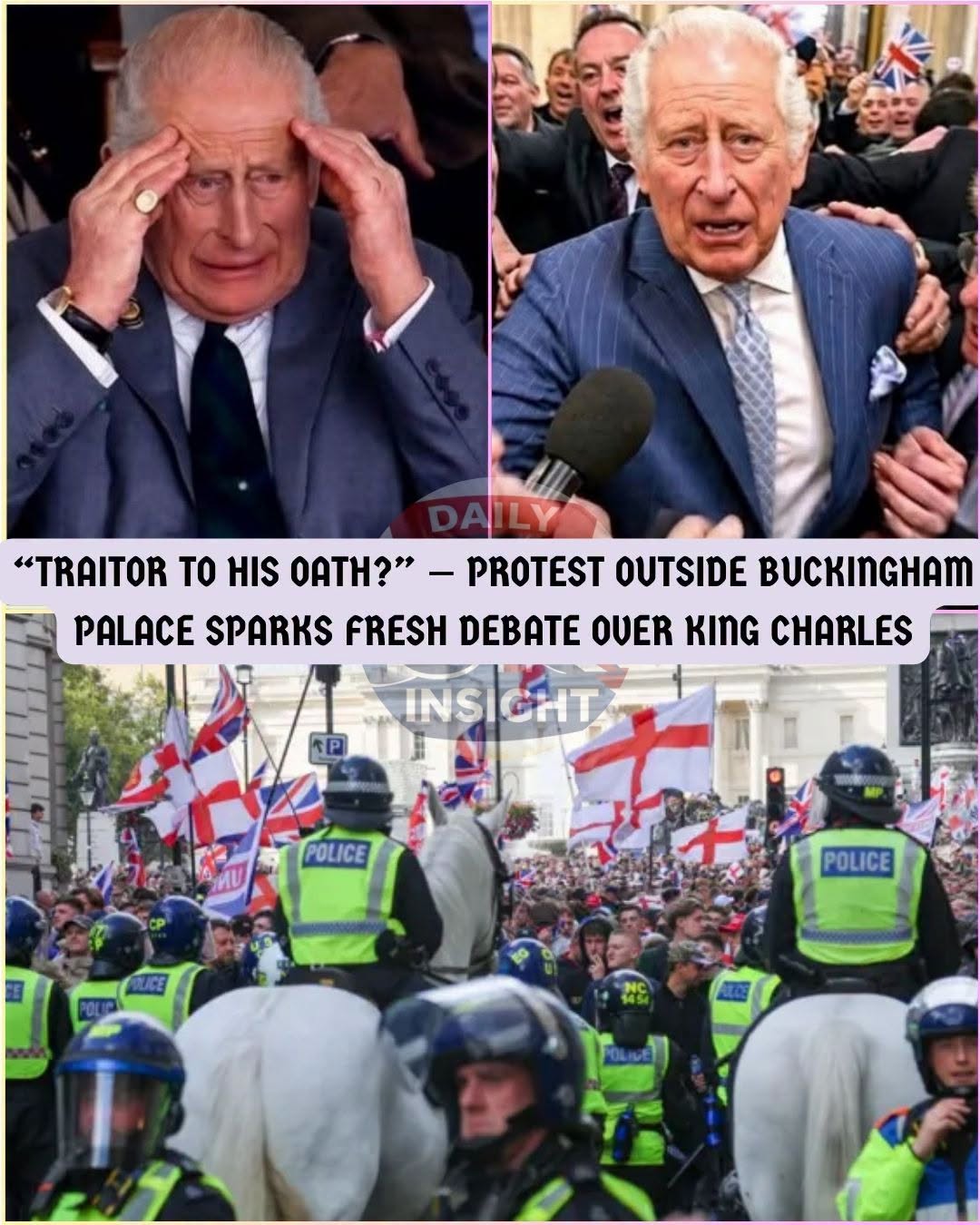
‘Traitor to His Oath?’ Buckingham Palace Protest Reopens Debate Over King Charles and the Meaning of ‘Defender of the Faith’
A protest reportedly staged outside Buckingham Palace has drawn attention online after a woman accused King Charles III of failing to uphold the religious commitments associated with the Crown. Her criticism touches on a much older and more complicated debate: can a monarch remain “Defender of the Faith” and Supreme Governor of the Church of England while also presenting himself as a protector of religious freedom in an increasingly multi-faith Britain?
The accusation could hardly be more serious in constitutional terms.
According to footage and descriptions circulating online, a protester outside Buckingham Palace accused King Charles III of betraying the oath associated with his position as monarch and questioned whether he was fulfilling his responsibilities as “Defender of the Faith”.
But while the language of “betrayal” and “treason” has attracted attention, it is important to separate a protester’s interpretation from the King’s actual constitutional obligations.
The available official evidence does not establish that Charles has renounced his Coronation Oath or ceased to hold his established religious role.
In fact, his constitutional relationship with the Church of England remains intact.
What Did Charles Actually Swear?
Charles made several formal religious commitments surrounding his accession and coronation.
At his Accession Council in September 2022, he swore to maintain and preserve the Protestant religious settlement and Presbyterian Church government in Scotland, as required by law. The oath formally described him as King and “Defender of the Faith”.
Then, at his coronation at Westminster Abbey on May 6, 2023, Charles took the statutory Coronation Oath.
Among its commitments is maintaining the Protestant Reformed religion established by law and preserving the rights and privileges associated with the established Church.
The Coronation Oath Act 1688 provides the legal basis for those commitments, although its precise wording has been adjusted over successive reigns to reflect constitutional changes.
Charles also remains Supreme Governor of the Church of England.
These are not simply ceremonial inventions created for his coronation. They form part of Britain’s unusual constitutional settlement, in which an established Christian church continues to have a formal relationship with the state.
So Why the Controversy?
The disagreement concerns how Charles interprets his wider religious role.
Long before becoming King, Charles expressed an interest in different religious traditions and argued that the monarchy should recognise Britain’s increasing religious diversity.
That led to decades of discussion over whether he wanted to be understood as “Defender of Faith” rather than exclusively “Defender of the Faith”.
But when he became King, the constitutional arrangements did not disappear.
Charles explicitly described himself shortly after his accession as a “committed Anglican Christian”. He simultaneously said that the Sovereign had an additional responsibility to protect religious diversity and the space in which different faiths could be practised.
For Charles, those positions are presented as complementary rather than contradictory.
His argument is essentially that his Christian faith and formal relationship with the established Church can coexist with protecting the freedom of Muslims, Jews, Hindus, Sikhs and people belonging to other faiths — as well as those with no religion.
His Coronation Addressed This Directly
The 2023 coronation ceremony itself anticipated this tension.
Immediately before Charles took the oath, the Archbishop of Canterbury explained that the Church of England, while committed to Christianity, also sought to foster an environment in which people of “all faiths and beliefs may live freely”.
That wording was deliberate.
It placed religious pluralism inside the coronation rather than treating it as a replacement for the Christian character of the ceremony.
The coronation itself remained explicitly Christian.
Charles was crowned in Westminster Abbey, took Christian oaths, was anointed during a Christian liturgy and participated in Communion.
At the same time, representatives of other faith communities were given roles in parts of the wider ceremony.
For supporters, that represented an attempt to reconcile ancient tradition with modern Britain.
For some critics, it symbolised something different: a monarchy gradually weakening the particular Christian identity it is constitutionally supposed to represent.
Has Charles Abandoned the Title?
Claims surrounding this question intensified again in 2026.
Commentators noticed that the Sovereign Grant Report 2025–26 described the King’s role by saying that he is Supreme Governor of the Church of England and “protects the space for Faith within the multi-faith nation”.
Some critics interpreted the wording as evidence that “Defender of the Faith” was being quietly replaced by a broader multi-faith role.
But a change in wording in a Royal Household report is not the same thing as a constitutional abolition of the King’s title or his Church responsibilities.
The King’s formal relationship with the Church of England continues.
As recently as February 2026, the new Archbishop of Canterbury, Sarah Mullally, formally paid homage to Charles as Supreme Governor of the Church of England.
There is therefore a distinction between how the Palace describes the King’s broader social role and his formal constitutional position.
Can the King Simply Choose Another Religious Role?
Not entirely.
Britain is a constitutional monarchy, and the monarch’s formal responsibilities are constrained by law and convention.
The Coronation Oath is rooted in statute. So are important aspects of the Protestant succession.
The House of Commons Library notes that the oath requires the sovereign to maintain the Protestant Reformed religion established by law. It also records that earlier speculation about changing the monarch’s religious role did not result in Charles’s 2023 oath being rewritten to eliminate those commitments.
Charles can express his understanding of monarchy in inclusive terms.
But he cannot personally abolish the constitutional settlement between Crown and Church merely by changing a phrase in a speech.
Major alterations to that settlement would involve constitutional and potentially legislative questions extending well beyond the King’s personal preferences.
Is Supporting Other Faiths a Breach of the Oath?
This is where the protester’s accusation becomes an interpretation rather than an established constitutional fact.
Nothing in the oath says that the King must oppose the existence or free practice of other religions.
Nor does supporting religious freedom automatically mean abandoning Christianity.
Indeed, the Church of England itself explicitly presented freedom for other faiths as compatible with its role during the King’s coronation.
Critics are nevertheless entitled to argue that the monarchy’s increasingly multi-faith language risks weakening the distinctive Christian character of the Crown.
That is a debate about what “Defender of the Faith” should mean in modern Britain.
It is different from demonstrating that Charles has legally violated his oath.
Why the Debate Matters Beyond Buckingham Palace
The controversy ultimately reaches far beyond one protester.
Britain has become considerably more religiously diverse while retaining constitutional institutions created in a very different historical period.
The monarch remains connected to an established Protestant church.
Bishops continue to sit in the House of Lords.
The coronation remains a Christian ceremony.
Yet the King is sovereign of citizens belonging to many religions and of millions who profess no religion at all.
That creates an unavoidable tension.
One interpretation says the Crown should maintain its specifically Christian identity precisely because that continuity is part of Britain’s constitutional heritage.
Another says the monarch can preserve that heritage while ensuring people of other faiths receive equal respect and religious freedom.
Charles has clearly adopted the second interpretation.
What the Protest Does — and Does Not — Establish
The specific protest footage requires more verification before claims about precisely what happened outside Buckingham Palace can be presented as settled fact.
But the constitutional questions it raises can be answered more clearly.
King Charles remains Supreme Governor of the Church of England. He took the statutory Coronation Oath. His accession oath committed him to preserving the Protestant settlement in Scotland. And his coronation remained explicitly Christian.
At the same time, Charles has openly said he believes the sovereign should protect the ability of different religious communities to practise their faith freely.
Whether those two responsibilities sit comfortably together is a legitimate subject for public debate.
But calling Charles a “traitor to his oath” goes considerably further.
At present, that is a protester’s political and religious accusation — not an established constitutional finding that the King has broken his oath.
The deeper question is therefore not whether one dramatic slogan outside Buckingham Palace is true.
It is whether an ancient Christian monarchy can retain its historical identity while serving a modern country whose citizens increasingly belong to many faiths — or none at all.
King Charles appears determined to argue that it can.
Whether the public ultimately accepts that interpretation is part of a debate that is likely to continue long after the protest signs outside the Palace have disappeared.
“TRAITOR TO HIS OATH?” — Buckingham Palace Protest Sparks Debate Over the British Monarchy
A controversial slogan questioning the monarchy’s commitment to its constitutional responsibilities has brought renewed attention to Britain’s growing debate over royal accountability, democratic representation and the role of the Crown in modern public life.
The phrase “Traitor to His Oath?” suggests a serious accusation, but the specific protest described in the headline could not be independently confirmed. Nevertheless, demonstrations outside Buckingham Palace in 2026 have highlighted genuine disagreements about the monarchy, transparency and the relationship between the Royal Family and the public.
The debate is not simply about whether Britain should retain its king. It also concerns what people expect from an institution that occupies a prominent place in national life while remaining largely outside the direct electoral process.
Why Buckingham Palace Remains a Focus of Protest
Buckingham Palace is more than a royal residence. It is a powerful symbol of Britain’s constitutional monarchy, national identity and historical traditions.
For that reason, campaigners who oppose the monarchy frequently choose the palace as a place to demonstrate. A protest at its gates attracts public attention and places political demands directly beside one of the country’s most recognisable institutions.
On May 9, 2026, the republican campaign group Republic organised a march from Trafalgar Square to Buckingham Palace. Participants carried signs calling for the abolition of the monarchy and an elected head of state. Reuters footage documented demonstrators marching along The Mall, while campaigners explained their opposition to a system in which the head of state inherits the position. <Link url=”https://www.reutersconnect.com/item/no-kings-british-anti-royals-take-their-protest-to-buckingham-palace/dGFnOnJldXRlcnMuY29tLDIwMjY6bmV3c21sX1ZBOTIwNDA5MDUyMDI2UlAx” title=”Reuters coverage of the May protest”/>.
The demonstration illustrated the continuing existence of an organised republican movement in Britain. Its participants argued that political authority should ultimately derive from the people rather than birth.
Other Britons strongly support the monarchy, seeing it as a source of continuity, tradition and national representation above party politics.
These competing views are part of a longstanding constitutional debate. A protest can make that debate more visible, but the presence of demonstrators outside the palace does not establish that the country as a whole shares their position.
What Does the King’s Oath Mean?
The word “oath” carries particular significance in discussions of the British monarchy because the sovereign’s constitutional responsibilities are not simply ceremonial in every respect.
During the coronation of King Charles III in May 2023, the King took the Coronation Oath. He promised to govern the peoples of the United Kingdom and other realms for which he is sovereign according to their respective laws and customs, to uphold law and justice, and to maintain the established Protestant religion in the United Kingdom.
The oath is rooted in constitutional tradition and reflects the monarch’s formal responsibilities. It does not, however, give the sovereign unrestricted personal political power.
Under Britain’s constitutional system, the monarch generally acts on the advice of elected ministers. The government is responsible for its political decisions, while Parliament makes laws and scrutinises the executive.
This division of responsibilities matters whenever protesters accuse a monarch of betraying an oath. Such language may express political dissatisfaction, but it does not itself demonstrate a legal or constitutional breach.
A meaningful assessment would require a specific action, a clear understanding of the monarch’s constitutional duties and evidence showing how the relevant obligation had allegedly been violated.
Without that evidence, a slogan remains a political accusation rather than an established finding.
The Question of Royal Accountability
One of the central arguments made by republican campaigners is that an unelected head of state should not occupy a position of national importance simply because of family inheritance.
They argue that a modern democracy should allow citizens to choose their head of state, whether through a direct election or another democratic process. In their view, replacing hereditary succession with an elected presidency would make the constitutional system more accountable to the public.
Supporters of the monarchy offer a different argument. They maintain that the sovereign’s political neutrality can provide stability, particularly when elected governments change. Because the monarch does not campaign for office, supporters argue, the institution can represent the state without being identified with a particular political party.
They also point to the monarchy’s ceremonial duties, charitable work and role in national occasions.
The disagreement therefore involves competing ideas about accountability and continuity. Republican campaigners prioritise democratic selection, while royal supporters emphasise constitutional stability and the separation of the head of state from day-to-day party politics.
Neither argument should be confused with evidence that a particular constitutional duty has been breached.
The Wider Debate Over Transparency
Royal accountability has received additional attention following controversies involving members of the Royal Family.
In July 2026, activists from Republic staged a demonstration inside Buckingham Palace’s Throne Room during its public opening. They displayed an image of Andrew Mountbatten-Windsor alongside Jeffrey Epstein and a banner asking what senior members of the Royal Family knew about Andrew’s association with Epstein. <Link url=”https://www.independent.co.uk/bulletin/news/buckingham-palace-epstein-andrew-king-b3013963.html” title=”The Independent’s report on the July demonstration”/>.
The protest reflected campaigners’ demands for greater transparency. However, questions raised by activists must be distinguished from proven facts, and allegations concerning an individual should not be treated as established wrongdoing merely because they appear on a protest banner.
The episode nevertheless demonstrated how controversies involving the Royal Family can become wider debates about institutional accountability.
For critics, the monarchy’s constitutional position and certain exemptions from ordinary transparency arrangements raise questions about whether the institution is sufficiently open to public scrutiny.
Supporters may respond that constitutional safeguards, privacy and the monarch’s non-partisan role are important to the institution’s operation.
The challenge is to distinguish legitimate confidentiality from matters where transparency may be necessary to maintain public confidence.
Can Protests Change the Monarchy?
Demonstrations can influence public discussion by drawing attention to issues that might otherwise receive less coverage. They can also encourage politicians, journalists and members of the public to examine constitutional questions more closely.
However, a protest does not automatically translate into constitutional change.
Abolishing the monarchy would require substantial political and legal action. It would involve decisions about the future head of state, the constitutional role currently performed by the Crown, and the arrangements governing royal functions and institutions.
An elected presidency would also raise practical questions. Would the president be elected directly by the public? Would the position be largely ceremonial, or would it carry executive authority? How long would a president serve, and what safeguards would prevent the office from becoming entangled in party politics?
These questions show that replacing the monarchy would involve more than removing a royal figure from public life. It would require a carefully designed alternative constitutional structure.
For monarchists, the prospect of such a transformation may appear unnecessary or risky. For republicans, it represents an opportunity to align the head of state with democratic principles.
The political debate is therefore likely to continue even when individual demonstrations have ended.
The Importance of Peaceful Protest
The right to peaceful protest is an important feature of democratic life. Citizens must be able to criticise public institutions, question constitutional arrangements and express dissatisfaction without automatically being treated as hostile to the country.
Equally, protests must comply with applicable laws and legitimate public-safety requirements. Police may impose lawful conditions in certain circumstances, but restrictions must be assessed against the rights of demonstrators and the wider public.
The location of a demonstration outside Buckingham Palace makes the issue particularly visible because the site attracts tourists, residents and official visitors. Managing public access and security while respecting peaceful political expression can be a difficult balance.
A responsible discussion should focus on the actual conduct of demonstrators and the applicable law, rather than assuming that strong criticism of the monarchy is itself improper.
What the Controversy Really Reveals
The slogan “Traitor to His Oath?” uses confrontational language, but its broader significance depends on the specific allegations behind it. Without verified information about the particular demonstration, it would be misleading to identify a target or claim that the monarch has been proven to have violated a constitutional obligation.
What can be established is that anti-monarchy protests have taken place outside Buckingham Palace during 2026 and that campaigners have called for constitutional reform and greater transparency.
These demonstrations reflect a wider discussion about what the British public expects from its institutions. Some people value the monarchy as a source of national continuity, while others believe the head of state should be selected through a democratic process.
Ultimately, the future of the institution will depend on political decisions, public attitudes and the constitutional processes available to the country.
A protest can challenge established traditions and demand answers. But accusations of betrayal require evidence, just as claims that an institution deserves public confidence must withstand scrutiny.
The most useful outcome of this debate would be a clearer understanding of the monarch’s constitutional responsibilities, the limits of royal authority and the ways in which public institutions can maintain trust.
Whether Britain retains its monarchy or eventually chooses a different system of government, the essential questions remain the same: how power is exercised, how responsibilities are defined and how public confidence is sustained in a democratic society.