
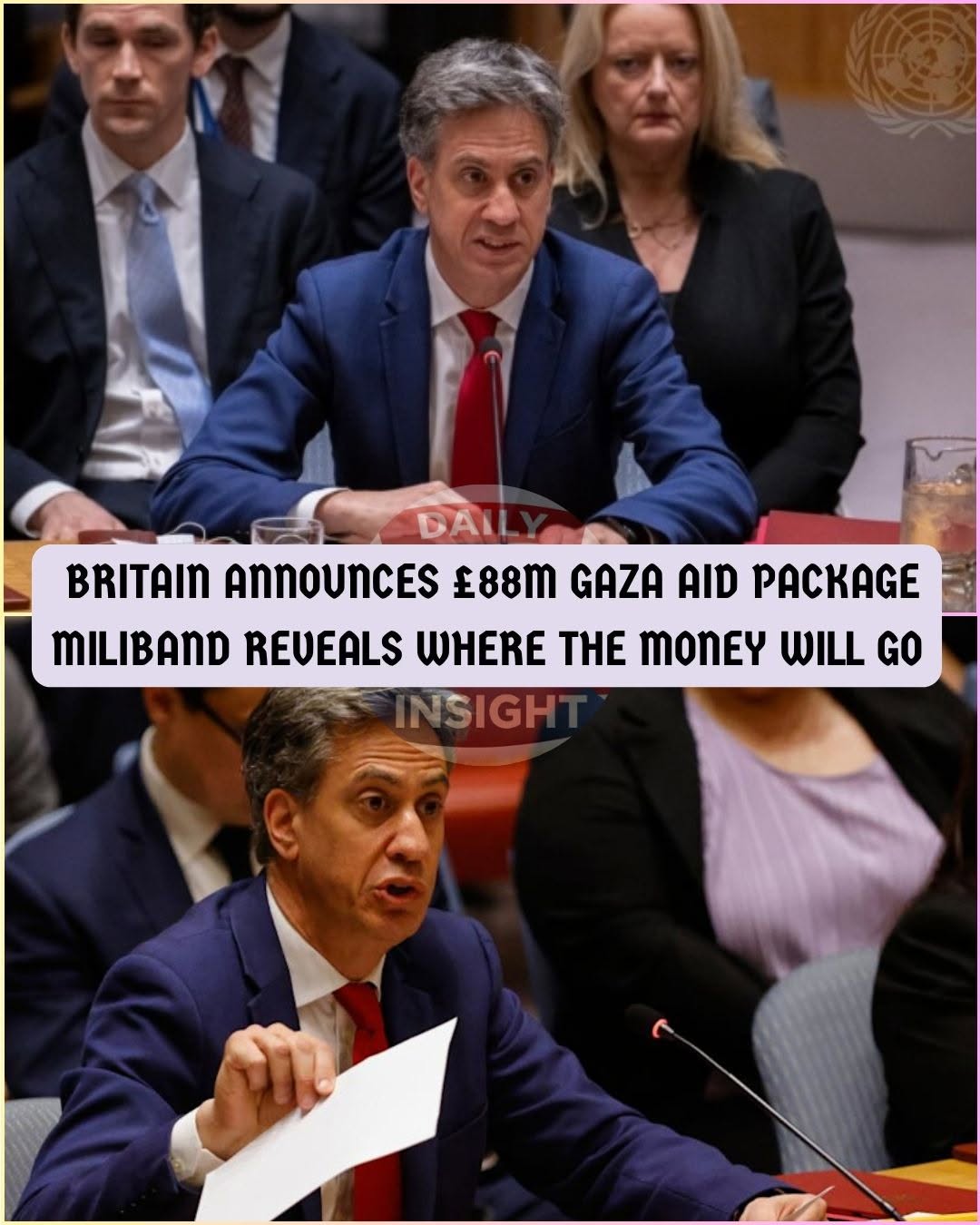
UK Announces £88 Million Humanitarian and Recovery Support for Gaza and the West Bank
Britain has set out more than £88 million in humanitarian and early-recovery support for Palestinians during the current financial year, with funding directed towards healthcare, clean water, sanitation, waste management and protection services across Gaza and the West Bank. Foreign Secretary Ed Miliband highlighted the package at the United Nations General Assembly in New York as the UK sought greater international cooperation on humanitarian access and Gaza’s longer-term recovery.
The British Government has announced a major package of humanitarian and early-recovery support for Palestinians as international attention remains focused on conditions in Gaza and instability across the West Bank.
The package, announced on September 24, amounts to more than £88 million during the current financial year and is intended to provide assistance ranging from medical care and safe water to rehabilitation for children injured by explosions.
Foreign Secretary Ed Miliband announced the support while attending the UN General Assembly in New York, where Britain was also working with Jordan and Qatar to bring governments, international organisations, Palestinian representatives and donors together to discuss humanitarian access and recovery.
But there is an important detail behind the headline figure.
The Government’s official announcement says the £88 million package includes support that had previously been announced through UNRWA and the UN Horizon Fund, alongside new humanitarian funding.
It should therefore not automatically be interpreted as £88 million of entirely new spending announced on a single day.
Where Will the Money Go?
The Government says the programme is designed to address some of the most immediate humanitarian needs facing Palestinians.
According to the Foreign, Commonwealth and Development Office, UK-supported healthcare facilities are expected to provide medical consultations for as many as 900,000 people.
Funding is also intended to provide rehabilitation and prosthetic treatment for approximately 1,000 children suffering from blast injuries.
Another significant component involves sanitation and waste management.
UK-funded programmes are expected to support solid-waste management services for up to 900,000 people, while emergency water trucking could provide safe water for approximately 150,000.
Mental-health and psychosocial assistance is expected to reach another 21,000 people.
These programmes reflect the Government’s argument that humanitarian assistance needs to extend beyond emergency food deliveries.
Damage to healthcare facilities, water infrastructure, sanitation systems and housing can continue affecting civilians long after immediate fighting declines.
Early recovery therefore sits between emergency humanitarian relief and full-scale reconstruction.
Children Among the Priorities
One of the most striking elements of the announcement is the emphasis on children injured during the conflict.
The Government says British funding will help provide rehabilitation and prosthetic treatment for around 1,000 children with blast injuries.
That assistance can involve considerably more than providing an artificial limb.
Children with serious injuries may require surgery, physiotherapy, rehabilitation, replacement prosthetics as they grow and psychological support following traumatic experiences.
Mental-health services therefore form another part of the package.
The Government says UK-supported programmes are intended to provide mental-health and psychosocial assistance to 21,000 people affected by the conflict.
Why Is Britain Acting Now?
The announcement forms part of a broader shift in Britain’s diplomatic approach towards Israel and the Palestinian territories.
Earlier in September, Miliband told the House of Commons that the Government intended to increase pressure over humanitarian conditions in Gaza while continuing to call for Hamas to be disarmed and for a political settlement based on two states.
Britain’s position combines several objectives that can sometimes pull policy in different directions.
The Government says Israel must be able to live in security and that Hamas must no longer pose a terrorist threat.
At the same time, it argues that Palestinian civilians require substantially greater humanitarian access and that a viable Palestinian state remains necessary for a lasting political settlement.
The £88 million commitment therefore sits within a much larger diplomatic strategy rather than operating as an isolated aid programme.
Gaza and the West Bank
Although Gaza dominates much of the international discussion, the British announcement covers Palestinians affected by the conflict in both Gaza and the West Bank.
The distinction matters.
The two territories face different immediate challenges, even though Britain considers both essential components of a future Palestinian state.
The UK has repeatedly raised concerns about violence and settlement expansion in the West Bank. In May, Britain joined several international partners in warning about deteriorating conditions there and reiterating opposition to settlement expansion.
At the same time, Gaza’s humanitarian infrastructure has suffered extensive damage, leaving international donors confronting immediate requirements for healthcare, water, sanitation and shelter as well as longer-term reconstruction.
The Horizon Fund
Part of Britain’s wider approach involves the United Nations Horizon Fund for the Occupied Palestinian Territories.
The UK joined France, Germany, Italy, the Netherlands, Norway, Sweden and Switzerland in welcoming the fund in July.
Those countries said they intended collectively to contribute $57.8 million as part of wider support for UN-led early recovery.
The fund is designed to support areas including water and sanitation, healthcare, housing, debris removal, explosive-ordnance risk reduction and the restoration of economic activity.
That helps explain why the new £88 million headline should not be treated entirely as a separate pot of newly announced money.
Some previously announced British commitments now form part of the broader package being highlighted by the Government.
How Large Is Britain’s Overall Commitment?
The £88 million figure also sits within a larger aid allocation.
According to the FCDO, Britain’s bilateral Official Development Assistance budget for Palestine for the 2026–27 financial year is £127 million.
The Government also says British humanitarian assistance since October 2023 has contributed to sustained food support reaching more than 1.4 million people across the Palestinian territories and improvements to water, sanitation and hygiene services benefiting more than 830,000.
Those figures describe the reach of programmes supported by UK funding rather than suggesting Britain alone provided every service involved.
That distinction is important because international humanitarian operations commonly involve multiple governments, UN bodies, charities and local organisations.
The Debate Over Foreign Aid
The announcement is also likely to revive a familiar domestic political argument.
Critics of overseas aid may question whether tens of millions of pounds should be committed abroad while Britain faces pressures involving housing, healthcare, local government finances and other public services.
Supporters of humanitarian spending argue that assisting civilians caught in conflict is both a humanitarian responsibility and part of Britain’s wider foreign-policy interests.
Those are legitimate competing questions about public spending.
But the £88 million should be understood in context.
It is part of Britain’s international-development budget rather than a standalone domestic spending programme suddenly transferred to Gaza.
The broader bilateral ODA allocation for Palestine had also already been published before the September announcement.
Aid Still Has to Reach People
Money alone does not guarantee humanitarian assistance reaches its intended recipients.
Access remains one of the central difficulties.
Miliband said at the announcement that civilians in Gaza needed unhindered access to humanitarian assistance, while the Government has criticised Israeli restrictions that it says impede aid delivery.
Israel has maintained that security controls are necessary to prevent Hamas from exploiting aid and has disputed aspects of international criticism surrounding humanitarian access.
Britain, meanwhile, continues to say Hamas must disarm and cease posing a security threat while simultaneously pressing for improved humanitarian conditions and progress towards a two-state settlement.
That illustrates the central challenge facing international donors.
Funding hospitals, water systems and humanitarian organisations is one task.
Ensuring those programmes can operate safely and consistently on the ground is another.
More Than an £88 Million Headline
The Government’s announcement is substantial, but the details are more nuanced than the headline alone suggests.
Britain has committed more than £88 million in humanitarian and early-recovery support for Palestinians during the current financial year. The package includes healthcare, water, sanitation, waste management, child rehabilitation and mental-health assistance.
But the figure includes some funding announced previously, alongside new humanitarian support.
The announcement therefore represents both a consolidation of existing commitments and an expansion of Britain’s humanitarian response.
For civilians affected by the conflict, however, the more consequential question will not simply be how large the headline figure becomes.
It will be whether the funding translates into functioning clinics, clean water, rehabilitation for injured children and practical assistance reaching communities that need it.
That will ultimately be the measure by which Britain’s £88 million commitment is judged.
UK Announces £88 Million Gaza and West Bank Aid Package Amid Growing Humanitarian Concerns
The United Kingdom has announced more than £88 million in humanitarian and early-recovery support for Palestinians in Gaza and the occupied West Bank, as the humanitarian crisis continues to place enormous pressure on families, healthcare services and essential infrastructure.
The package was announced by Foreign Secretary Ed Miliband on September 24, 2026, during the United Nations General Assembly. The British government says the funding will help deliver medical care, clean water, sanitation, waste management and protection services to hundreds of thousands of Palestinians affected by the conflict. The announcement also renewed calls for humanitarian aid to reach civilians without unnecessary restrictions. <Link url=”https://www.gov.uk/government/news/uk-announces-major-package-of-support-for-humanitarian-relief-and-early-recovery-in-gaza” title=”UK government announcement”/>.
The decision places humanitarian assistance at the centre of Britain’s approach to the Palestinian territories. It also raises important questions about how aid will reach people in need, whether essential supplies can enter affected areas consistently, and how international partners can support recovery after years of destruction and displacement.
What Does the £88 Million Package Include?
According to the British government, the funding is designed to address several urgent needs affecting Palestinian communities.
Healthcare is one of the main priorities. Medical facilities have faced enormous pressure during the conflict, while injured civilians and people with chronic illnesses require treatment that may be difficult to obtain. UK-supported healthcare facilities are expected to provide medical consultations for up to 900,000 people.
The package also includes rehabilitation and prosthetic treatment for approximately 1,000 children who have suffered blast injuries. Such treatment can be essential for children who have lost limbs or experienced serious physical injuries. Recovery may require surgery, rehabilitation, specialised equipment and continued medical support over an extended period.
Clean water is another central element of the programme. The government expects emergency water trucking to provide safe water to around 150,000 people. Access to clean water is essential not only for drinking but also for cooking, washing and maintaining basic hygiene.
Sanitation and waste management services are expected to benefit up to 900,000 people. When waste collection and sanitation systems break down, communities face increased risks to public health, particularly in crowded displacement areas where families may have limited access to functioning facilities.
The funding will also support mental health and psychosocial services for approximately 21,000 people. The psychological effects of conflict can continue long after immediate physical danger has passed. Children who have witnessed violence, lost relatives or been forced to leave their homes may need sustained emotional support.
These figures describe the expected reach of UK-supported programmes, rather than a guarantee that every intended beneficiary will receive assistance. Delivery will depend on access, security conditions and the ability of humanitarian organisations to operate effectively.
Why Humanitarian Access Matters
Financial commitments alone cannot resolve a humanitarian emergency. Aid must also be able to enter affected areas and reach civilians safely.
The British government has repeatedly called for greater humanitarian access to Gaza and urged Israel to remove restrictions that impede the delivery of essential assistance. Miliband has argued that civilians must be able to obtain aid without obstruction.
The practical challenges are considerable. Humanitarian organisations need reliable access routes, safe conditions for their staff, functioning distribution networks and sufficient supplies. Even when funding has been secured, insecurity, damaged infrastructure and restrictions on essential goods can delay deliveries.
Healthcare assistance illustrates the problem. Medical teams may have funding and equipment available but still struggle to provide treatment if hospitals lack electricity, medicines, clean water or sufficient staff. Similarly, water programmes depend on functioning vehicles, fuel and safe distribution points.
The UK package is therefore part of a wider diplomatic effort. Britain has worked with Jordan and Qatar to convene international partners on humanitarian access, healthcare and Gaza’s recovery. The objective is to turn financial pledges into practical assistance for people facing urgent needs.
The effectiveness of the initiative will depend partly on whether international pressure produces sustained improvements in access and delivery.
The Wider Financial Commitment
The £88 million announcement forms part of Britain’s broader development assistance for the Palestinian territories.
The government has set out a bilateral official development assistance budget of £127 million for Palestine in the 2026/27 financial year. The September package includes previously announced funding through channels such as UNRWA and the UN Horizon Fund, alongside new humanitarian support.
This means the headline figure should not be interpreted as an entirely new allocation separate from every earlier commitment. Rather, it represents a package combining different elements of Britain’s planned humanitarian and early-recovery assistance.
That distinction matters when assessing how much additional funding is being provided and how the money is distributed across programmes.
It also highlights the importance of transparency. Governments and delivery organisations need to explain how funds are allocated, which organisations implement projects, how beneficiaries are identified and what safeguards are in place to ensure assistance reaches civilians.
Clear reporting can help the public understand what the funding achieves and whether programmes are meeting their stated objectives.
Support for Children and Vulnerable Families
Children are among those most exposed to the long-term consequences of the conflict. Physical injuries, interrupted education, displacement and the loss of family members can affect their development for years.
Rehabilitation programmes can help injured children regain mobility and independence. However, prosthetic treatment and physical therapy are only part of the support many young patients require. Some may also need repeated medical procedures, psychological assistance and access to education adapted to their circumstances.
Mental health services are similarly important for parents and caregivers. Families coping with bereavement, uncertainty and displacement may struggle to provide children with a stable environment when their own basic needs remain unmet.
The UK has also supported efforts to transfer sick and injured children from Gaza to the United Kingdom for specialist treatment. In a written parliamentary answer published on October 26, the government said 50 children had received specialist treatment in NHS hospitals through a cross-government taskforce working with the World Health Organization during 2025. It also stated that Britain intended to continue this effort for another group of sick and injured children. <Link url=”https://questions-statements.parliament.uk/written-questions/detail/2026-10-20/36280” title=”UK Parliament written answer, October 26, 2026″/>.
Such measures can provide life-saving treatment to individual patients, although they cannot replace a functioning healthcare system for the wider population.
The Political Debate Over Britain’s Role
The aid announcement comes amid wider disagreements about Britain’s relationship with Israel, the future of Gaza and the international community’s responsibilities toward Palestinian civilians.
Supporters of humanitarian assistance argue that helping civilians is a moral and practical responsibility, regardless of political disagreements. They point to the immediate need for medical care, clean water and basic sanitation.
Critics may question the scale of overseas spending, the effectiveness of aid programmes or whether sufficient safeguards exist to ensure that money is used for its intended purposes. These concerns are legitimate subjects for parliamentary scrutiny, provided they are assessed using evidence rather than assumptions about recipients.
Humanitarian funding should be evaluated according to its objectives, delivery mechanisms and measurable outcomes. It should also be distinguished from military assistance or direct political support: the stated purpose of this package is to provide humanitarian relief and support early recovery.
The government faces the challenge of maintaining public confidence while responding to an international emergency. Explaining what the funding will deliver, publishing results and addressing concerns about access and accountability will be important parts of that responsibility.
Can the Package Help Gaza Recover?
The £88 million commitment could make a meaningful contribution to healthcare, clean water, sanitation and protection services. However, the scale of the needs means that no single funding announcement can rebuild Gaza or resolve the wider conflict.
Early recovery requires more than emergency assistance. Communities need functioning hospitals, reliable water and electricity, restored schools, safe housing and opportunities for people to earn a living. Debris removal and the restoration of basic infrastructure will also require substantial resources and coordination.
A sustainable recovery will depend on security, access for humanitarian organisations, cooperation among international partners and a credible political framework for the future of the Palestinian territories.
The West Bank also faces humanitarian and economic pressures, making it important that assistance is distributed according to assessed needs rather than treating the Palestinian territories as one uniform situation.
International donors will need to coordinate their efforts to avoid duplication and ensure that funding reaches programmes capable of delivering practical results.
What Happens Next?
The next test for Britain’s commitment will be implementation. The government and its partners must translate the funding announcement into services that people can access, while monitoring whether conditions on the ground allow aid workers to operate safely.
Regular reporting should establish how much funding has been disbursed, how many people have received treatment or clean water, and whether programmes are reaching particularly vulnerable groups. Independent monitoring and transparent financial controls can help protect the integrity of humanitarian assistance.
The British government will also need to continue diplomatic engagement with regional partners and international organisations to press for improved humanitarian access and support for recovery.
Ultimately, the announcement of more than £88 million represents a significant financial commitment, but its importance will be measured by what it achieves for civilians.
For families facing injury, displacement and the loss of essential services, the immediate priorities are straightforward: medical treatment, safe water, sanitation, protection and the chance to rebuild their lives.
Britain’s aid package offers support toward those goals. Whether it can deliver its full intended impact will depend on sustained access, effective implementation and continued international cooperation.