
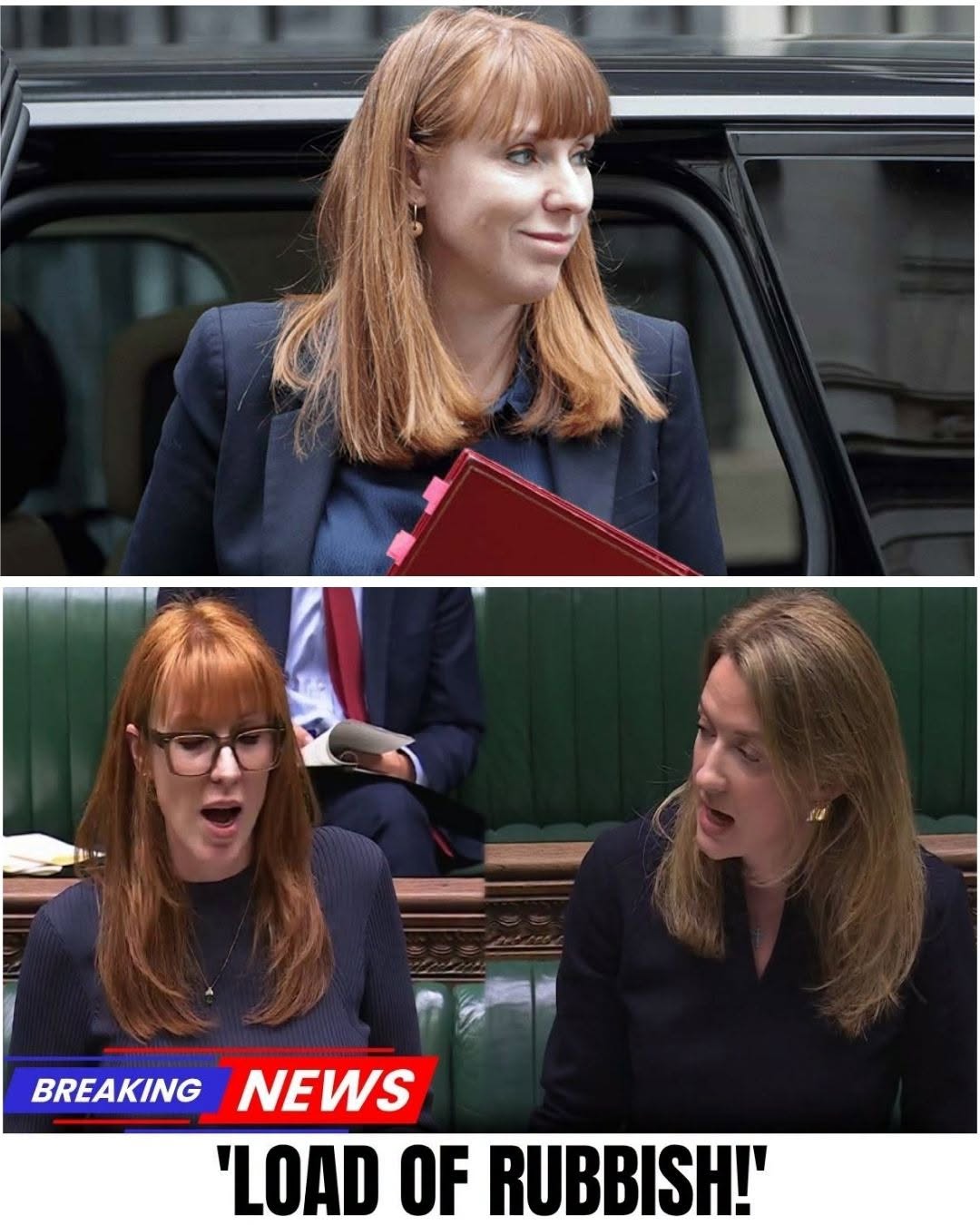
Angela Rayner Faces Commons Challenge Over Rough Sleeping as Housing Battle Intensifies
A heated House of Commons confrontation over homelessness has placed Angela Rayner under renewed pressure, after the Opposition challenged the Housing Secretary over Labour’s ambitious promise to tackle rough sleeping and questioned the record of Prime Minister Andy Burnham in Greater Manchester.
The exchange came as Rayner presented the government’s latest plans for housing, high streets and homelessness, including hundreds of millions of pounds aimed at helping people leave the streets.
But what began as a major policy announcement quickly developed into a wider political argument over responsibility for Britain’s housing crisis — and whether voters should trust another pledge to end rough sleeping.
At the centre of the Opposition’s attack was Burnham’s previous record as Mayor of Greater Manchester.
The Opposition pointed back to his 2017 mayoral manifesto, when Burnham pledged to end rough sleeping in Greater Manchester within three years. Challenging Rayner in the Commons, the Opposition argued that rough sleeping had subsequently risen again, including during a period when Labour controlled both national government and much of the political machinery in Greater Manchester.
The question was designed to expose an uncomfortable contradiction.
If Burnham had previously promised to eliminate rough sleeping locally but had failed to achieve that objective permanently, critics asked, why should the public believe that his government can now deliver the same ambition across the entire country?
Rayner did not accept the premise without challenge.
She argued that rough sleeping initially fell in Greater Manchester and said the later increase demonstrated the limits of trying to solve homelessness through isolated local programmes without sufficient national coordination.
“The numbers actually fell originally,” Rayner told MPs, before arguing that the absence of a comprehensive national programme contributed to subsequent pressures as more people arrived in Greater Manchester seeking support.
Her response effectively turned the Opposition’s criticism around.
Rather than presenting Greater Manchester as evidence that the policy itself had failed, Rayner portrayed it as evidence that local action alone could not permanently solve a problem driven by housing shortages, poverty, health problems and wider economic pressures.
She then attacked the Conservatives’ own record.
Rayner reminded MPs that previous Conservative governments had themselves established targets to eliminate rough sleeping, before failing to achieve them. The Conservatives had pledged in their 2019 manifesto to end rough sleeping by the end of that Parliament, building on earlier commitments to halve it and ultimately eliminate it.
That history means neither major party approaches the current debate without political baggage.
Successive governments have promised substantial reductions in homelessness. Some initiatives produced significant improvements, particularly during the Covid pandemic, when the “Everyone In” programme rapidly moved thousands of vulnerable people into accommodation. But those improvements proved difficult to sustain as rents increased, affordable housing remained scarce and broader cost-of-living pressures intensified.
The current government is now attempting another major intervention.
Rayner told Parliament that everyone sleeping rough would be offered a route away from the streets by Christmas 2026. She announced £442 million for a new rough-sleeping programme and said total government investment in homelessness and rough-sleeping services would exceed £4 billion over the following three years.
The programme is intended to go beyond simply providing temporary accommodation.
Rayner argued that homelessness frequently overlaps with mental-health problems, addiction, unemployment and other vulnerabilities. She told MPs that eight in 10 rough sleepers have a mental-health vulnerability and said the government’s approach would therefore include access to health, substance-misuse and employment support.
The broader housing shortage is equally central to the government’s argument.
Rayner said Britain had failed for years to build enough homes, particularly council housing, and blamed the long-term failure to replace council properties sold under previous policies as one of the underlying causes of today’s crisis.
The government says its answer is a major expansion of social and affordable housing.
Rayner told MPs that an initial allocation under the social and affordable homes programme would support more than 70,000 properties, with nearly two-thirds intended for social rent. The government has also announced additional funding designed to rebuild councils’ planning capacity.
Those measures form part of a much larger political battle over housing.
For Labour, the argument is that rough sleeping cannot be treated separately from housing supply. Ministers contend that emergency accommodation may help somebody tonight, but permanently reducing homelessness requires more affordable homes, stronger local services and intervention before people reach the streets.
The Opposition’s challenge is different.
It is asking voters to judge Labour not only by the scale of its latest announcements but by its previous promises and its record in areas where the party has already exercised significant political control.
That is why Burnham’s Greater Manchester record has become politically important.
The criticism does not establish that a national programme will fail. Nor does Rayner’s counter-argument establish that additional national funding will necessarily succeed. Homelessness is influenced by numerous factors, including housing availability, rents, welfare policy, employment, health services and local authority resources.
The available evidence also shows why sweeping claims from either side deserve scrutiny.
The House of Commons Library notes that governments of different political colours have repeatedly introduced programmes aimed at reducing rough sleeping. Britain has experienced periods of substantial progress followed by renewed increases, illustrating the difficulty of converting temporary reductions into lasting change.
That makes the political language surrounding the Commons clash considerably simpler than the underlying policy challenge.
The Opposition’s attack was effective in highlighting an earlier promise that was not permanently fulfilled.
Rayner’s response, however, raised a legitimate question of its own: can a city or regional mayor realistically eliminate rough sleeping for good when national housing supply, welfare policy and broader economic conditions remain outside local control?
The government’s latest commitment will eventually have to be measured against results rather than parliamentary exchanges.
Burnham launched the new national drive shortly after becoming Prime Minister in July, backed initially by an additional £340 million. The government described its objective as ending rough sleeping “at the earliest opportunity”, rather than presenting homelessness as a problem that Britain must simply accept.
Rayner has now put more detail behind that ambition.
But ambitious funding announcements and political promises are only the beginning.
The real test will be whether fewer people are sleeping in doorways, whether people placed into accommodation remain there, and whether Britain’s chronic shortage of affordable homes begins to ease.
That is ultimately why the Commons confrontation mattered.
Behind the accusations and counter-attacks lies a question successive British governments have struggled to answer: how can the country turn temporary success in reducing rough sleeping into a permanent solution?
Rayner insists that a nationally coordinated housing and homelessness programme can make the difference.
Her opponents have now made equally clear that they intend to hold Labour’s latest promises against its previous ones.
For thousands of people without a secure home, the outcome will matter considerably more than who landed the strongest blow across the Dispatch Box.
BRUTAL COMMONS CLASH! ANGELA RAYNER FACES PRESSURE OVER BRITAIN’S HOUSING CRISIS
Britain’s housing crisis continues to place intense pressure on politicians, with rising housing costs, a shortage of affordable homes and growing demand for social housing creating difficult questions for the government.
Angela Rayner, the Housing Secretary, has been at the centre of the debate as ministers attempt to increase housebuilding while addressing concerns about affordability, homelessness and the infrastructure needed to support new developments.
The headline of a dramatic Commons confrontation captures the political tension surrounding the issue. However, without a verified record of the specific exchange described, it would be misleading to claim that a particular MP delivered a decisive takedown of Rayner in Parliament.
What is clear is that the government’s housing programme faces significant scrutiny, and the arguments over its targets have become increasingly difficult to avoid.
THE 1.5 MILLION HOMES PROMISE
One of the biggest challenges confronting the government is its commitment to build 1.5 million homes in England during the current parliamentary term.
The target was intended to increase supply, improve affordability and create more opportunities for families struggling to find suitable accommodation.
Yet the scale of the ambition has raised questions about whether the construction industry can deliver the necessary number of properties within the available timeframe.
In September 2026, Rayner acknowledged in a BBC interview that there was only a “slim chance” of meeting the target, citing obstacles including rising construction costs and international economic pressures. She nevertheless insisted that the government would continue pursuing the goal. <Cite refs={[“turn863440search1″,”turn863440news7”]}/>
The admission placed a spotlight on the difference between announcing an ambitious housing target and delivering the homes required to meet it.
To achieve 1.5 million homes over five years, England would need an average of approximately 300,000 new homes annually. That requires sustained construction, sufficient land, skilled workers, investment and infrastructure.
The challenge is not simply a matter of granting planning permission. Developers must also be able to finance projects, obtain materials, recruit workers and complete properties that people can actually afford.
For critics, the government’s progress will ultimately be judged by the number of homes delivered rather than the scale of its announcements.
For ministers, the argument is that planning reforms and investment in social and affordable housing need time to produce their full effects.
Both positions highlight the central question facing housing policy: how can Britain translate political commitments into a substantial increase in the supply of homes?
ANGELA RAYNER’S PLAN TO GET BRITAIN BUILDING
The government has responded by proposing major changes to the planning system, including measures designed to make it easier to approve developments and increase the number of homes built each year.
On 29 October 2026, Rayner set out further plans in the House of Commons to accelerate housebuilding. The proposals included raising annual local housing targets to more than 370,000 homes, making local targets mandatory and placing greater emphasis on using suitable brownfield and lower-quality green-belt land. <Cite refs={[“turn637839search2″,”turn637839search3”]}/>
The government’s argument is that Britain cannot solve its housing shortage if local opposition, planning delays and a lack of development land continually prevent new homes from being built.
Rayner has also argued that new developments must be supported by essential infrastructure. That means schools, GP surgeries, roads, public transport and other services need to be considered alongside the number of houses being constructed.
However, the proposals are controversial because they could reduce the ability of some local communities to influence whether developments proceed.
Critics fear that mandatory targets could place additional pressure on towns and villages already struggling with overcrowded roads, stretched healthcare services and insufficient school places.
The disagreement exposes a difficult balancing act: Britain needs more housing, but residents also want reassurance that development will not leave their communities without the infrastructure required to support a growing population.
THE OPPOSITION’S CHALLENGE
Opposition politicians have several potential lines of attack.
The first concerns delivery. If the government promised 1.5 million homes but is now acknowledging the difficulty of reaching that figure, critics can reasonably ask whether its original plans were sufficiently realistic.
The second concerns affordability. Building more properties does not automatically mean that those on low incomes will be able to buy or rent them. The type of housing constructed, its location and its price all influence whether it meets local needs.
The third concerns democratic accountability. If planning decisions are increasingly made through national targets or delegated powers, residents may question how much influence their elected councillors retain.
These concerns have become particularly relevant as councils face pressure to accommodate development while managing limited budgets.
A recent report from the House of Commons Library outlines the government’s £39 billion Social and Affordable Homes Programme for 2026–36, which aims to increase supply, with at least 60% of funded homes intended for social rent. The programme also includes measures to strengthen council housebuilding and protect the existing social housing stock. <Cite refs={[“turn637839search3”]}/>
The scale of that investment demonstrates the government’s stated commitment to affordable housing. The crucial question is how quickly it will result in completed homes for people who need them.
THE PEOPLE BEHIND THE STATISTICS
For families across England, the housing crisis is not an abstract political argument.
Young adults may remain in their childhood bedrooms because they cannot afford deposits or market rents. Families may face overcrowding because moving to a larger property would mean an unaffordable increase in monthly costs.
Some households spend a substantial proportion of their income on rent, leaving less money for food, energy, transport and other essentials. Others remain on social housing waiting lists for years, uncertain when a suitable property might become available.
Homelessness creates further pressure on local authorities, which may have to arrange temporary accommodation while trying to find longer-term solutions.
These problems cannot be resolved by one housing target alone. They require a combination of new construction, affordable rents, social housing, appropriate planning decisions and support for households facing homelessness.
The government has announced policies aimed at addressing several of these areas, but the results will ultimately be measured by whether people can find secure and affordable homes.
WHY THE COMMONS DEBATE MATTERS
The House of Commons is where ministers must explain how their promises will be delivered and where opposition MPs can scrutinise the costs, consequences and practical details of proposed policies.
A heated exchange over housing can attract attention, but the substance of the argument matters more than the description of a politician being “destroyed” or “humiliated”.
In this case, the documented debate reveals substantial pressure surrounding the government’s housing targets and planning reforms. The available reporting does not, however, independently confirm the specific dramatic confrontation suggested by the headline.
The policy questions remain significant regardless of whether a particular exchange becomes a viral political moment.
Can the government increase construction quickly enough? Will new properties be affordable to the people who need them? Can local services keep pace with expanding communities? And will changes to planning rules improve delivery without weakening public accountability?
These are the questions that Rayner and her critics must address.
A POLITICAL TEST THAT WILL BE MEASURED IN HOMES
The housing crisis is likely to remain a major test of the government’s ability to turn its promises into tangible results.
Rayner’s approach centres on planning reform, increased construction and investment in social and affordable housing. Critics question whether the targets are realistic and whether the proposed changes adequately protect local communities and affordability.
The evidence available in October 2026 shows that the 1.5 million-home ambition faces serious challenges. Rayner has acknowledged the difficulty while maintaining that the government will continue pursuing it. <Cite refs={[“turn637839search0″,”turn637839news9”]}/>
For people struggling to find a home, the most important outcome will not be who delivers the sharpest parliamentary speech. It will be whether more suitable homes are completed, whether rents and purchase prices become more manageable, and whether local authorities can provide the services that residents need.
The political clash over housing therefore represents a broader argument about Britain’s future: how to expand housing supply, protect local communities and ensure that economic growth translates into better living conditions.
Until those outcomes become visible, ministers will continue facing difficult questions in Parliament—and the public will continue demanding evidence that promises are being turned into homes.