
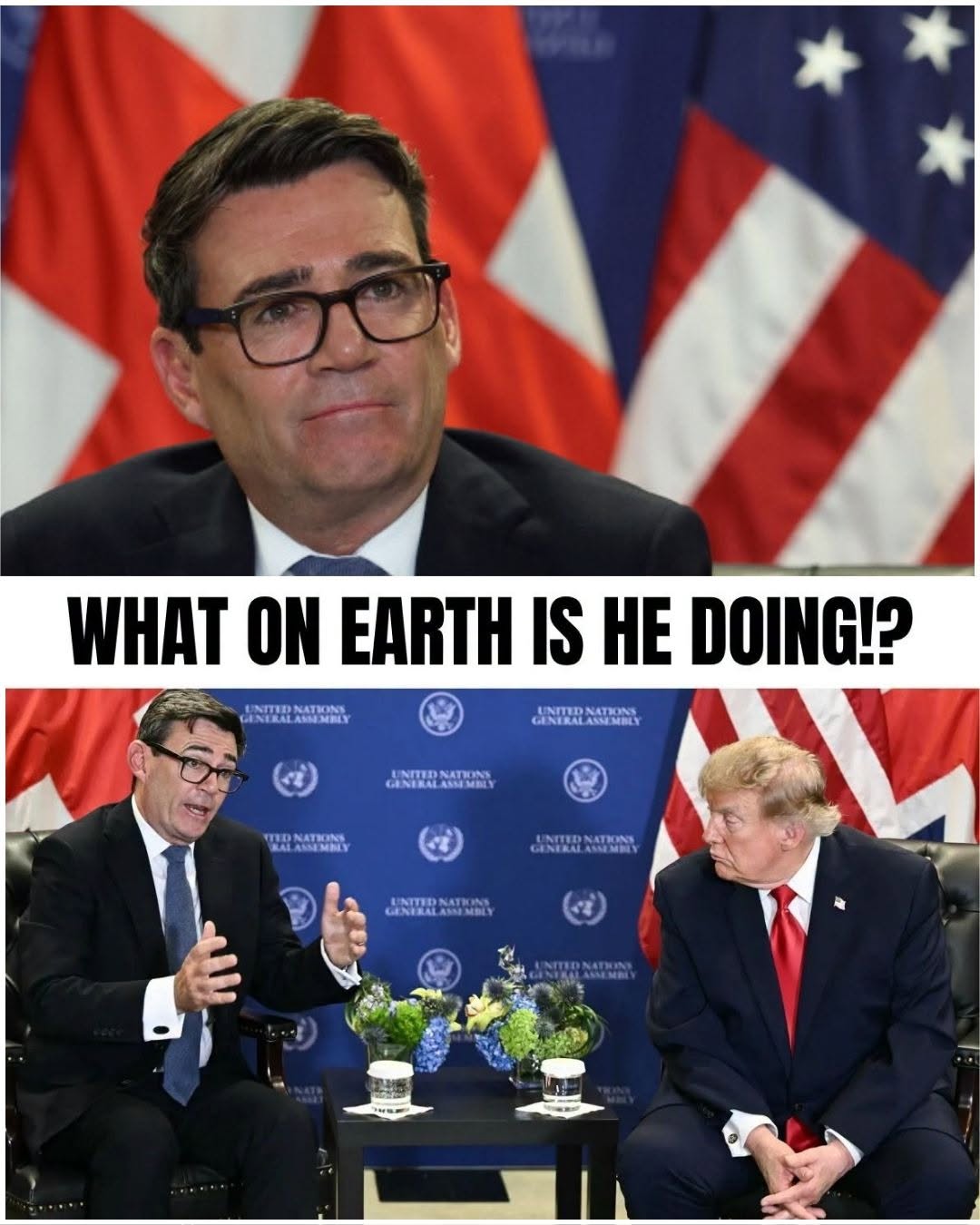
Trump Confronts Burnham Over Chagos Deal as UK Government Confirms Agreement Must Be Reworked
A long-running dispute over the Chagos Islands has erupted into a major diplomatic challenge for Prime Minister Andy Burnham after US President Donald Trump publicly condemned Britain’s sovereignty agreement with Mauritius during their first face-to-face meeting.
Speaking alongside Burnham on the margins of the United Nations General Assembly in New York, Trump made clear that his opposition to the agreement had not softened.
“I don’t support it. I think it’s terrible,” Trump told reporters. He went further, questioning Mauritius’s claim to the territory and describing the proposed transfer as “ridiculous.”
Less than a day later, Defence Secretary Wes Streeting confirmed that the existing arrangement would have to be reconsidered because it lacked American support.
The sequence immediately generated accusations from political opponents that the Labour government had been forced into a humiliating retreat by Washington.
Yet the circumstances surrounding the dispute are more complicated than that description suggests. The Chagos agreement was already facing difficulties before Burnham arrived in New York, while Trump’s opposition had been known to ministers for months.
What has changed is that the disagreement has now been exposed publicly at the highest level — and the British government has acknowledged that the deal cannot proceed in its existing form without US backing.
Trump Makes His Objections Public
Trump’s comments came during his September 22 meeting with Burnham at the UN General Assembly.
The encounter itself was considerably warmer than the disagreement over Chagos might suggest.
Trump praised the new British prime minister as a “natural business person,” while Burnham said the two leaders had established a good connection. Their discussions covered trade, energy, immigration and several international security issues.
But Chagos produced a clear disagreement.
The islands are strategically important because Diego Garcia, the largest of them, hosts a joint British-American military facility that has supported Western operations across the Middle East and Indo-Pacific.
Trump described the territory as “a very important piece of real estate, militarily and strategically” and argued that transferring sovereignty to Mauritius was a mistake.
Burnham did not announce that Britain was abandoning the agreement.
Instead, he said he had inherited the situation from the previous government and would work with the United States and Mauritius to find a resolution.
Downing Street’s official account was similarly cautious, stating that on Diego Garcia, Burnham “was committed to working with all parties to find a solution.”
What Does the Existing Agreement Actually Do?
Britain separated the Chagos Archipelago from Mauritius before Mauritian independence in the 1960s.
Thousands of Chagossians were subsequently displaced as Diego Garcia was developed into a major military base.
Mauritius has challenged British sovereignty for decades.
In 2019, the International Court of Justice issued an advisory opinion concluding that the process of decolonisation had not been lawfully completed and that Britain should end its administration of the archipelago as rapidly as possible.
Against that background, Britain and Mauritius negotiated an agreement under which Mauritius would obtain sovereignty while the UK would retain control of Diego Garcia through a 99-year arrangement.
The agreement was intended to provide legal certainty for the military base while resolving the sovereignty dispute.
Financial arrangements would involve substantial British payments to Mauritius. ITV reported that Britain agreed to pay £165 million annually during the first three years, falling to £120 million a year from year four.
Supporters argue that the arrangement secures the base while addressing the international legal dispute.
Opponents say Britain should not surrender sovereignty over territory containing such a strategically important installation.
Trump now firmly belongs to the second camp.
Streeting: Current Deal Is ‘Not Good Enough’
The political temperature rose further the morning after the Trump-Burnham meeting.
Defence Secretary Wes Streeting acknowledged that without American support, the existing agreement could not proceed.
Streeting said he had been a member of the Cabinet that approved the original agreement and continued to stand by the decision taken at the time.
But he added that American support had always been essential.
“Objectively, in the absence of support from the Americans, is this deal good enough?” he asked while discussing the issue.
His answer was effectively no.
Streeting confirmed that ministers would undertake further work with Washington and Mauritius to reach an arrangement that Trump could support.
ITV subsequently reported that annual payments to Mauritius had been put on hold while the agreement was reconsidered. Streeting said the deal “can’t go ahead without American support.”
That represents a significant obstacle for the original agreement.
Did Trump Force a U-Turn?
The timing makes that interpretation politically attractive, but the chronology requires qualification.
Trump did not suddenly reveal his opposition during the UN meeting.
His concerns were already known.
Indeed, Streeting explicitly said Trump’s position was not news to the government. What the New York encounter provided was “absolute clarity” that the US president was not changing his position on the agreement as currently drafted.
The British government had also begun engaging with Mauritius before Burnham sat down with Trump.
On September 21 — the day before the US-UK meeting — Burnham spoke with Mauritian Prime Minister Navin Ramgoolam.
Downing Street said Burnham had already committed to working with both Mauritius and the United States on a solution that would protect the operation of Diego Garcia and British national security.
The existing deal had also encountered difficulties earlier in the year.
It is therefore more accurate to say Trump’s public intervention intensified an existing problem rather than single-handedly creating a new government reversal.
Why American Support Matters
The US position carries unusual weight because Diego Garcia is not an ordinary overseas territory.
The military installation is jointly operated by Britain and the United States and provides significant strategic capabilities.
It has supported long-range military operations and provides Washington and London with an important position in the Indian Ocean.
That makes the disagreement different from a purely bilateral sovereignty negotiation between Britain and Mauritius.
Burnham himself acknowledged this after meeting Trump.
The prime minister said any workable agreement would need American support as well as the agreement of Britain and Mauritius.
This explains why Streeting’s conclusion was so stark: without Washington, the current arrangement cannot realistically proceed.
Is the Deal Dead?
Not formally.
The government has said it wants to revise the arrangement rather than immediately abandon negotiations with Mauritius.
Burnham has expressed confidence that a resolution can still be found.
But British officials reportedly believe there may be limited scope to modify the existing agreement sufficiently while Trump remains opposed to its central structure.
That creates several possibilities.
Britain and Mauritius could renegotiate aspects of the agreement to provide stronger guarantees for the US. The financial arrangements could change. Security provisions surrounding Diego Garcia could be strengthened. Alternatively, the existing framework could remain stalled if no compromise satisfies Washington.
For now, the outcome remains uncertain.
An Awkward Test for Burnham
Politically, the confrontation provides Burnham with an early test of how his government intends to manage relations with Trump.
Critics can point to the rapid confirmation of a review following Trump’s public attack and argue that Britain’s room for manoeuvre has been constrained by Washington.
The government can counter that American agreement was always necessary for a durable settlement involving Diego Garcia and that reopening negotiations reflects strategic reality rather than diplomatic capitulation.
Both interpretations will continue to shape the political debate.
What the available evidence establishes is narrower.
Trump publicly rejected the agreement and described it as “terrible” and “ridiculous.” Burnham acknowledged that a solution must satisfy the United States as well as Britain and Mauritius. Streeting then confirmed that the current agreement cannot proceed without American backing and that payments connected with it are on hold.
What the evidence does not establish is that Trump unexpectedly forced Burnham into an immediate surrender during their UN meeting.
The disagreement existed beforehand, and the British government was already discussing a new way forward.
The real political test will come from what replaces the stalled agreement.
If Burnham can negotiate an arrangement acceptable to Mauritius, Washington and London while guaranteeing the future of Diego Garcia, the New York confrontation may eventually appear as one difficult stage in a broader negotiation.
If no agreement can be reached, however, Trump’s public intervention could prove to have marked the moment when Britain’s existing Chagos settlement became politically impossible to implement.
For now, the deal is not formally dead — but after the confrontation in New York, its future is considerably less certain.
UN SHOWDOWN: TRUMP PUBLICLY SLAMS UK PM OVER CHAGOS ISLANDS!
A major diplomatic disagreement over the Chagos Islands has put Britain’s relationship with the United States under renewed scrutiny, after Donald Trump publicly criticised the UK’s proposed agreement to transfer sovereignty of the Indian Ocean archipelago to Mauritius.
The dispute became particularly visible during Trump’s first face-to-face meeting with British Prime Minister Andy Burnham on the sidelines of the United Nations General Assembly in New York in September 2026. Although Trump offered warm words about Burnham personally, he sharply criticised the Chagos agreement, describing it as a “terrible deal” and questioning the decision to transfer sovereignty over territory he considers strategically important. <Cite refs={[“turn299016search0″,”turn299016search5”]}/>
The exchange exposed a difficult problem for the British government. It wants to resolve a longstanding sovereignty dispute with Mauritius while protecting the future of Diego Garcia, a military base that plays an important role in British and American defence operations.
Trump’s intervention has added pressure to negotiations that were already politically sensitive. It has also raised questions about whether London can secure an agreement that satisfies Mauritius, preserves the military base and retains Washington’s support.
WHY TRUMP OBJECTS TO THE CHAGOS AGREEMENT
Trump’s principal concern centres on the strategic importance of Diego Garcia, the largest island in the Chagos Archipelago.
The base provides a valuable location for military operations across the Indian Ocean and beyond. Its geographical position supports the movement of military aircraft and personnel and provides logistical advantages for operations involving the Middle East, Africa and the Indo-Pacific.
For Washington, the future of the base is therefore not simply a territorial question. It is closely connected to defence planning, military access and the ability of the United States and Britain to operate together in a strategically important region.
During his meeting with Burnham, Trump argued that transferring sovereignty to Mauritius while relying on a long-term lease for the base was an unsatisfactory arrangement. His public criticism raised doubts about whether the agreement could proceed in its existing form without American backing. <Cite refs={[“turn299016search1″,”turn299016search4”]}/>
The concern is not necessarily that the base would immediately close. Under the proposed agreement, Britain would retain the ability to operate Diego Garcia through a long-term lease arrangement.
Instead, the argument concerns whether the legal and diplomatic arrangements would provide sufficient long-term certainty for such an important military installation.
For Trump, that uncertainty is unacceptable. For the British government, the challenge is to demonstrate that the base can remain secure while the wider sovereignty dispute is resolved.
THE DEAL THAT HAS DIVIDED WESTMINSTER
The agreement emerged from decades of disagreement between Britain and Mauritius over the status of the islands.
Britain retained control of the Chagos Archipelago when Mauritius became independent in 1968. The separation of the islands from Mauritius has remained a major source of diplomatic and legal controversy.
The history is particularly painful because Chagossians were forcibly removed from their homeland during the 1960s and 1970s to make way for the establishment of the military base on Diego Garcia. Many displaced islanders and their descendants have continued to campaign for recognition, justice and a meaningful role in decisions about their homeland.
In 2019, the International Court of Justice issued an advisory opinion stating that Britain’s administration of the Chagos Islands should end as rapidly as possible. The United Nations General Assembly subsequently called on Britain to end its administration of the archipelago. These developments increased pressure on London to reach an agreement with Mauritius.
The proposed settlement would transfer sovereignty to Mauritius while allowing Britain and the United States to continue operating the strategically important base under a long-term lease.
Supporters of the agreement argue that it offers a way to resolve the sovereignty dispute while preserving the military installation. Critics question the cost, the long-term security implications and whether the agreement adequately protects British interests.
Trump’s intervention has added another dimension to that debate by making American support a central issue in the future of the arrangement. <Cite refs={[“turn299016search1″,”turn299016search4”]}/>
A DIPLOMATIC TEST FOR ANDY BURNHAM
For Burnham, the disagreement presents a delicate diplomatic challenge.
The British prime minister must maintain a working relationship with the US president while defending the government’s approach to a longstanding international dispute. The United States remains a central British security partner, and cooperation between the two countries is particularly important for intelligence sharing, military operations and defence planning.
Trump’s criticism therefore carries consequences beyond the immediate question of sovereignty.
Following the September meeting, the British government indicated that the agreement would be reviewed in light of Washington’s concerns. Defence Secretary Wes Streeting acknowledged that the existing arrangement needed American support and said the government would work through the outstanding issues. <Cite refs={[“turn299016search4″,”turn299016news8”]}/>
This leaves Burnham facing competing demands.
Mauritius has maintained that its claim to sovereignty over the archipelago is not negotiable. Meanwhile, Trump wants assurances that the United States will not lose strategic security or operational freedom at Diego Garcia.
Britain must find a way to address both positions without allowing the disagreement to undermine wider cooperation with either country.
THE FINANCIAL COST IS ALSO UNDER SCRUTINY
Another major issue is the financial commitment associated with the proposed agreement.
Under the arrangement, Britain would make payments to Mauritius in exchange for the long-term lease of Diego Garcia. Critics have questioned whether the cost represents value for money, particularly when the government is under pressure to fund defence, public services and other domestic priorities.
Supporters counter that the cost must be assessed against the strategic value of securing the base’s future. They argue that resolving the sovereignty dispute could provide greater legal certainty and reduce the risk of future challenges to Britain’s continued presence.
However, the agreement’s future has become more uncertain following Trump’s renewed opposition.
The Financial Times reported in September 2026 that the government would review the proposal after the US president’s criticism, with planned payments exceeding £3.4 billion over 99 years suspended for the time being. The agreement had not been ratified in UK law. <Cite refs={[“turn299016news8”]}/>
The financial question is therefore tied directly to the diplomatic one: should Britain proceed with an expensive long-term arrangement if its most important security partner does not support the current terms?
That question is likely to remain central to parliamentary scrutiny.
WHAT DOES MAURITIUS WANT?
Mauritius has consistently maintained that the Chagos Archipelago belongs to its sovereign territory.
Its government views the dispute as a matter of decolonisation and argues that the islands should not remain under British administration.
In October 2026, Mauritian Prime Minister Navinchandra Ramgoolam reiterated that Mauritius’s sovereignty over the archipelago, including Diego Garcia, was not negotiable. He also warned that legal action could follow if the dispute was not resolved promptly. <Cite refs={[“turn299016search6”]}/>
These statements underline why the issue cannot be treated as a bilateral disagreement between Washington and London alone.
Mauritius is a party to the negotiations, and any lasting settlement must take its position into account. Simply abandoning the agreement without an alternative could leave Britain facing renewed diplomatic and legal uncertainty.
There is also the question of the Chagossian people themselves. Their displacement and continuing demands for recognition remain an important part of the dispute. Any future settlement will face scrutiny over whether the interests and rights of displaced islanders have been adequately addressed.
The challenge is therefore broader than deciding which government should control the islands. It involves sovereignty, historical responsibility, military security and the future of a community that was forcibly removed from its homeland.
COULD THE DISAGREEMENT DAMAGE THE SPECIAL RELATIONSHIP?
The public exchange has raised questions about the resilience of the UK-US relationship.
Trump’s remarks demonstrate that close allies can disagree sharply over foreign policy, even when their leaders maintain a positive personal relationship.
The British government will want to avoid allowing the Chagos dispute to spill over into other areas of cooperation, including intelligence, defence technology, trade and support for Ukraine.
At the same time, London cannot simply ignore the concerns of the United States if American cooperation is essential to the security arrangements underpinning the agreement.
The two countries have strong incentives to continue discussions. But reaching a compromise may require changes to the proposed arrangement, additional guarantees or a revised approach to securing the base’s long-term future.
No single solution is guaranteed to satisfy every party.
For Burnham, the task is to protect Britain’s strategic interests while avoiding a diplomatic breakdown with Mauritius or Washington.
WHAT HAPPENS NEXT?
The future of the Chagos agreement remains uncertain.
The British government has indicated that it needs to address American concerns, while Mauritius continues to insist on its sovereignty claim. Meanwhile, the military importance of Diego Garcia means that any proposed settlement will be examined closely by defence and intelligence officials.
The immediate questions are whether a revised arrangement can secure Washington’s backing, whether Britain and Mauritius can reach an acceptable compromise, and how the rights and interests of displaced Chagossians will be addressed.
Trump’s public criticism has made those questions more urgent, but it does not by itself determine the final outcome.
The Chagos dispute illustrates the difficult choices facing Britain as it tries to reconcile international law, historical responsibility and national security. The agreement was intended to provide a long-term solution to a dispute that has lasted for decades. Its uncertain future now demonstrates just how difficult that task remains.
For Burnham, success will depend on whether his government can develop an arrangement that is legally defensible, financially sustainable and acceptable to the countries whose cooperation is essential.
Until that happens, the Chagos Islands will remain a sensitive diplomatic issue—and Diego Garcia will continue to sit at the centre of a debate with consequences far beyond the Indian Ocean.