

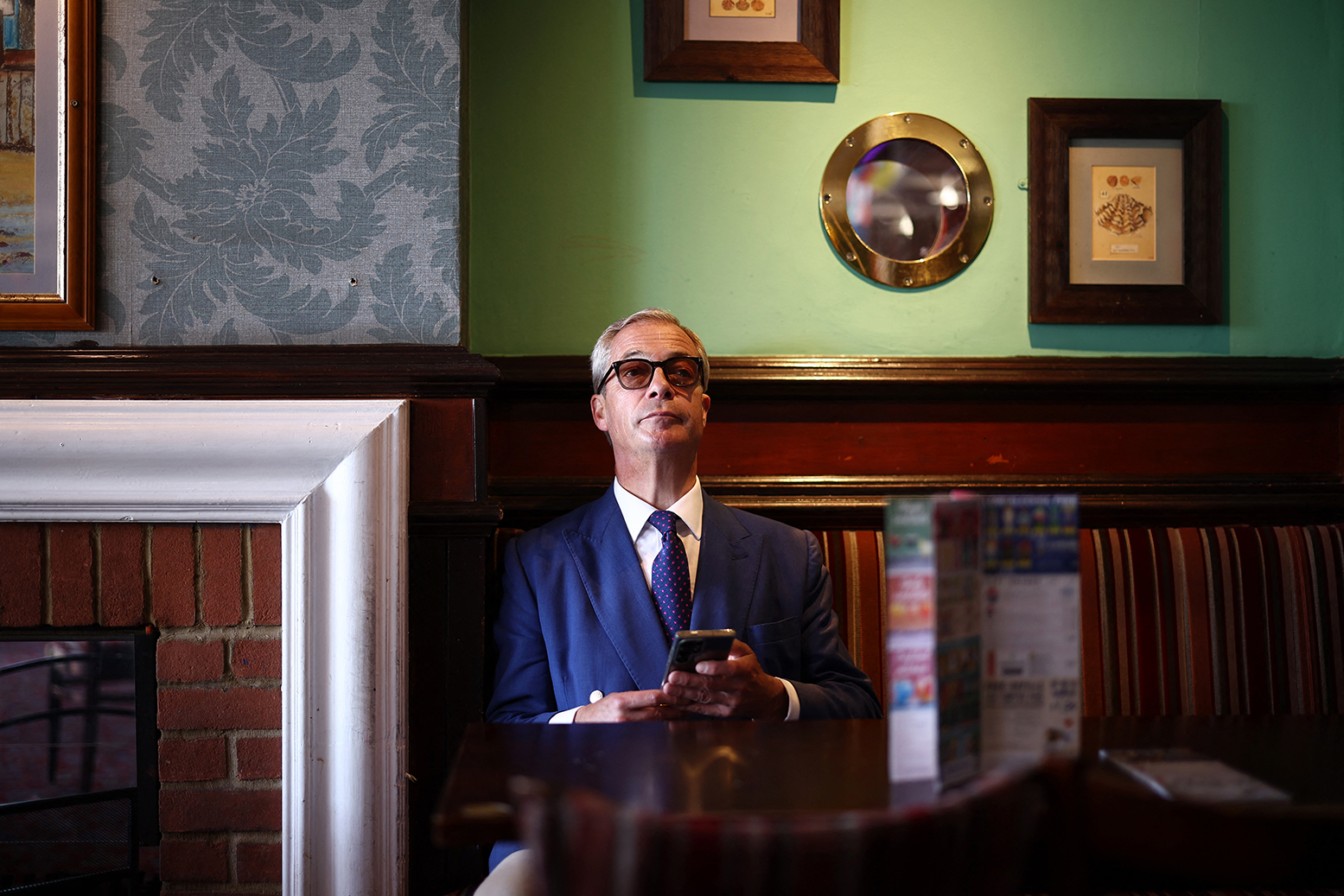
Nigel Farage railed against economic decline (Image: PA)
The music was serene, the lights were low. Out went the thumping Trump-style anthems and in came the violins of Chopin. More than half the audience at Reform’s press conference this morning came from business and “public affairs”. City traders mingled with consultants like me. The message was clear: Reform is serious about running the economy. Just a year ago, most in business and lobbying circles barely considered Reform worth a meeting. Their 2024 conference was largely ignored by corporate Britain. Today was different. A show of force from Reform’s business engagement team, Matthew MacKinnon and John Gill, after a relentless 12-month charm offensive.
Nigel Farage’s answer to his party’s comparatively low fiscal credibility (very slightly lower than the Tories but higher than Labour’s, according to recent polls) was characteristically clear: Reform will cut taxes only after cutting public spending, shrinking what he calls our “bloated state.” It’s smart politics. Voters want both higher spending and lower taxes, an impossible mix. And while Tories and Labour talk of “hard choices,” they’ve failed to explain the contradiction.
Get the latest politics news – straight from our team in Westminster and more
Invalid email
You agree you are 18 or over. We use your sign-up to provide content in ways you’ve consented to and to improve our understanding of you. This may include adverts from us and third parties based on our knowledge of you. You can unsubscribe at any time. More Info.
By linking spending cuts to future tax cuts, Farage may just persuade voters to accept the first for the promise of the second.
Liz Truss’s fatal mistake was splurging without cuts. Labour’s, pledging no tax rises while eyeing vast spending increases, especially in on public sector wages.
When I worked with Nigel in 2019, we had two problems. First, we never got as much airtime, so our economic announcements had to grab headlines, not project credibility.
Second, even when we had credible ideas, the media and civil service clung to the belief that only mainstream parties could manage the economy. That only they had the brains and business backing.
Those days are gone. Reform now dominates headlines. And after the chaos of Liz Truss and Rachel Reeves’ budgets, the myth of establishment economic competence has all but collapsed.
Farage’s announcements today weren’t wildly different from Tory or Labour Right positions. But he delivers them with the type of conviction of force he is famous for. Alongside the usual lines on Tory “Net Zero waste” and immigration “pushing down wages,” two moments stood out.
He praised the rich, calling for “as many high earners living in the country as possible”. Unthinkable from Labour. And, noting the setting in London’s financial district, he hailed the City as “one of the UK’s leading sectors,” pointing to his family’s history in finance.
Bold words, given Reform still lacks a clear NHS policy. And a clear direction of travel.
Then, a pledge for “the biggest benefit cut you’ve ever heard any government ever do”, slashing PIP for “mild anxiety” and insisting disability claims be signed off by independent practitioners, not GPs.
Predictably, most mainstream journalists asking questions at the event accused him of changing direction. The BBC and Guardian even claimed he was “breaking promises”, pointing to past talk of nationalisation.
But what they misunderstand is this is, in fact, Farage returning to his Thatcherite roots. He has more pedigree in that tradition than almost anyone in politics today.
Yes, he admitted Reform had shifted on the two-child benefit cap, but only for “working parents”, a detail “missed by the media,” he quipped.
If he can pull off significant cuts to spending on sickness welfare, on foreign nationals, on the civil service, and Net Zero, we can stay true to his roots whilst also pursuing an industrial strategy and better services.
Today’s performance indicates he has the mettle needed to wield the axe.
I Was in the Room When Nigel Farage Railed Against Decline – One Huge Change Stood Out
There are political speeches that are remembered because of a single dramatic sentence, and then there are moments when the atmosphere of the room tells you more than the words themselves. Listening to Nigel Farage speak about Britain’s decline was one of those moments. His argument was familiar in many respects: the country had lost confidence, ordinary people felt increasingly disconnected from political decision-making, and institutions that once appeared permanent could no longer be taken for granted.
But one change stood out above everything else.
The audience was no longer simply listening to a politician complain about what had gone wrong. There was a much stronger sense that many people wanted a fundamental change in the way politics itself was conducted.
Farage has spent much of his political career presenting himself as an outsider challenging the established political order. From his years campaigning on Brexit to his later leadership of Reform UK, his political message has repeatedly focused on sovereignty, immigration, taxation, government accountability and the frustrations of voters who believe that Westminster has failed to respond to their concerns.
His critics strongly disagree with many of his arguments, particularly over immigration and the consequences of his political programme. Supporters, however, have viewed his approach as an attempt to challenge what they regard as a political establishment that has become detached from everyday life.
Inside the room, the most striking feature was therefore not simply the anger directed at decline. It was the change in expectations.
People appeared less interested in carefully managed political language and more interested in whether politicians were prepared to acknowledge the problems they believed were directly affecting their lives.
That distinction matters.
For decades, British political debate has often revolved around relatively predictable arguments between the major parties. Governments changed, ministers changed and policies changed, but the basic political structure remained remarkably stable. Labour and Conservative governments dominated national politics, while smaller parties struggled to convert public dissatisfaction into sustained electoral influence.
That environment has become considerably more complicated.
The rise of Reform UK has added another significant force to the political landscape. Its growing visibility has placed pressure on other parties to address issues that might previously have been treated as secondary or difficult. Immigration, the cost of government, taxation, national identity and the relationship between Westminster and voters have all become increasingly prominent areas of political disagreement.
Farage’s rhetoric about decline fits into this wider transformation.
When he speaks about Britain, he frequently contrasts what he sees as the country’s potential with what he describes as its present condition. The argument is not simply that one government made a mistake or that one particular policy failed. It is a broader claim that Britain has been moving in the wrong direction for too long.
That is why his speeches can generate such strong reactions.
For supporters, the language of decline provides an explanation for frustrations that can otherwise feel disconnected: high living costs, pressure on public services, concerns about immigration, weak economic growth and distrust of politicians can become parts of a single narrative.
For opponents, the same narrative can oversimplify complicated problems and place too much responsibility on particular groups or institutions. They argue that Britain’s difficulties have multiple causes and cannot be reduced to a single political explanation.
Both interpretations are part of the current debate.
Yet the most interesting change in the room was the apparent decline of political patience.
The old assumption was that voters would listen to politicians, compare competing promises and then make a decision at election time. Increasingly, political audiences appear to demand immediate answers. They want to know what will change, when it will change and who will be held responsible if it does not.
That represents a significant challenge for every political party.
A politician can promise reform, but voters increasingly ask what reform actually means. A party can talk about controlling immigration, but people want to know how such a policy would work in practice. A politician can promise economic growth, but households want to know whether their wages, bills and living standards will actually be affected.
This is where Farage’s political style becomes particularly relevant.
His approach has generally relied on straightforward language rather than the cautious vocabulary traditionally associated with Westminster politics. Supporters see this as directness. Critics sometimes regard it as simplification. Either way, it has helped him maintain a distinctive presence in British politics.
The important point is that the audience has changed too.
Modern political communication no longer takes place primarily through Parliament, party conferences and traditional newspapers. Social media, online video, podcasts and direct digital communication allow politicians to speak to voters without relying entirely on established broadcasters or newspapers.
That has changed the relationship between politician and audience.
A speech can now be recorded, edited, shared and debated within minutes. A single phrase can reach millions of people without passing through the traditional political media system.
This makes political movements more dependent on public reaction, but it also makes them more vulnerable to rapid controversy.
The change I noticed in the room therefore goes beyond Farage himself. It reflects a wider transformation in British political culture.
Voters appear increasingly willing to question assumptions that once seemed secure.
That does not mean everyone agrees with Farage. Far from it. Britain remains politically divided, and many voters reject Reform UK’s positions. But the presence of a large audience willing to engage seriously with arguments outside the traditional political consensus is itself significant.
The question is what happens next.
If political dissatisfaction continues to grow, established parties may face increasing pressure to demonstrate that they understand the concerns being expressed outside Westminster. But responding to those concerns is not the same thing as automatically adopting Reform UK’s policies.
There is a distinction between listening to voters and agreeing with them.
That distinction is essential in a functioning democracy.
The debate over Britain’s future will involve difficult questions. How should immigration be managed? What level of taxation is sustainable? How should public services be funded? What responsibilities should government have? How can economic growth be restored? What role should Britain play internationally after Brexit?
None of these questions has a simple answer.
What has changed is the intensity with which people are demanding that politicians answer them.
That may ultimately be the biggest development of all.
Farage’s message about decline resonates with people who believe Britain has lost direction. Others hear the same message and see an overly negative interpretation of a country facing difficult but manageable challenges. The disagreement is substantial, and it is unlikely to disappear soon.
But watching the political reaction in the room revealed something broader than support for one politician.
It revealed impatience.
People increasingly want politics to produce visible results rather than endless arguments. They want politicians to explain decisions clearly and accept responsibility for their consequences. They want promises to be measurable and governments to be accountable.
That change affects everyone in British politics.
For Reform UK, it creates an opportunity but also a responsibility. Challenging the established parties is one thing; demonstrating that alternative policies can work in practice is another.
For Labour and the Conservatives, the lesson is equally important. Voters who feel ignored do not necessarily remain loyal simply because the alternative is controversial. Political loyalty can weaken when people believe that established parties are no longer addressing their priorities.
And for voters themselves, the changing political environment creates a different responsibility: to examine competing claims carefully, distinguish evidence from rhetoric and judge policies according to their likely consequences.
The room may have been filled with arguments about decline, but the more revealing story was the change in the relationship between politicians and the public.
The era when voters simply accepted the traditional political conversation is becoming harder to sustain.
Whether that transformation produces better government, deeper division or simply a new political equilibrium remains an open question.
What is clear is that Britain’s political conversation has changed.
And as Nigel Farage stood before the audience talking about a country he believes has been allowed to decline, the strongest message was not necessarily contained in any individual sentence.
It was visible in the reaction around him.
People are demanding change.
The political question now is not whether that demand exists, but what kind of change voters ultimately decide they want.