
HAPPENING NOW: 460 Masked Mob Storms Migrant Hotels – Britain Descends Into Riot Hell!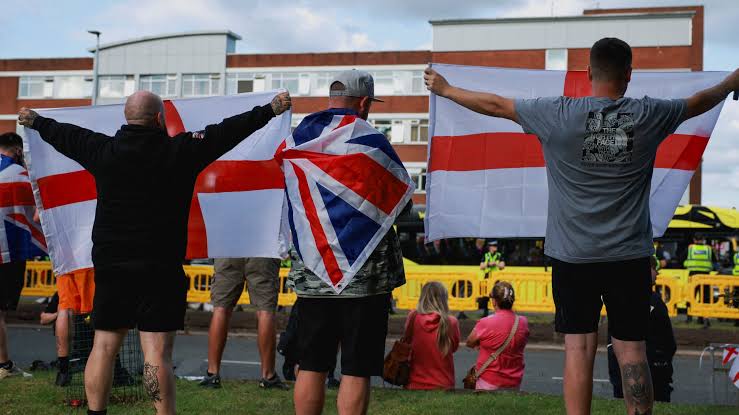
Britain has once again been confronted with scenes of intense protest and disorder surrounding asylum accommodation, but a dramatic claim circulating online that “460 masked rioters” recently stormed migrant hotels in Rotherham and Tamworth has been confirmed as false.
The claim spread rapidly across social media, accompanied by descriptions of masked crowds allegedly breaking through police lines, attacking hotels and forcing officers to retreat. However, South Yorkshire Police and Staffordshire Police both confirmed that the supposed recent incident involving 460 masked people did not happen. Full Fact found that the posts recycled old photographs and footage from earlier demonstrations and riots.
That clarification is important because there have nevertheless been genuine and serious confrontations involving asylum accommodation in Britain.
The combination of real incidents, old footage and unverified claims has created an increasingly difficult information environment, particularly at a time when public debate over immigration remains highly charged.
The Claim That Spread Online
The viral story described an enormous masked mob allegedly descending on migrant hotels in Rotherham and Tamworth.
According to the posts, hundreds of people supposedly attacked police officers, smashed barriers and attempted to storm buildings housing asylum seekers. The language used in the posts portrayed Britain as being in the middle of a new nationwide riot.
But police forces responsible for the two areas rejected the claim.
South Yorkshire Police, which covers Rotherham, said it could “100% confirm” that the alleged incident had not happened. Staffordshire Police similarly described the claims as completely false.
The distinction matters because images accompanying the posts were genuine images of unrest—but they were not evidence of the alleged 2026 incident.
Full Fact identified photographs and videos from the 2024 riots, a 2025 Tommy Robinson rally, England football gatherings and even protests in the United States being presented as if they showed a new event.
The result was a powerful but misleading narrative created by combining authentic images with false descriptions.
Real Violence Did Happen
The fact that the “460 masked mob” story was false does not mean Britain has not experienced serious disorder connected to asylum accommodation.
In August 2024, hundreds of people gathered outside the Holiday Inn Express in Rotherham, where asylum seekers were being accommodated.
The protest developed into a violent confrontation. Police officers faced bricks, bottles, chairs and other objects, while parts of the building were damaged and fires were started. South Yorkshire Police said at least 10 officers were injured.
The same period also saw disorder outside a hotel in Tamworth.
Staffordshire Police said protesters threw projectiles, smashed windows and used petrol bombs to start fires. One police officer suffered a suspected broken arm.
Fortunately, no one inside the Tamworth hotel was reported injured.
These events remain an important part of the background to the current debate.
They demonstrate why claims about attacks on asylum accommodation can appear credible to people who remember the scenes of 2024.
But historical evidence cannot be presented as proof that the same thing happened again.
A New Wave of Protests
There have also been genuine demonstrations around asylum hotels more recently.
In August 2025, groups of protesters gathered outside hotels in west London. Sky News reported that masked men were among those who attempted to enter a hotel housing asylum seekers in West Drayton.
The Metropolitan Police said a group attempted to enter the Crowne Plaza through a rear entrance and damaged security hoarding. Five people were arrested following demonstrations involving several hotels, while two officers suffered minor injuries.
That incident illustrates how quickly a demonstration can become a police matter when people attempt to force their way into private property.
At the same time, Sky News reported that the vast majority of people involved in the demonstrations were peaceful.
This distinction is important.
A protest involving hundreds of people is not automatically a riot, and criticism of government immigration policy is not itself criminal.
The legal boundary is crossed when individuals engage in violence, criminal damage, unlawful entry or attacks on emergency workers.
Portsmouth Shows the Danger of Rumours
Events in Portsmouth in September 2026 provide another striking example of how quickly inaccurate information can produce real-world consequences.
Around 40 to 50 people gathered outside the Marriott Hotel after reports circulated that asylum seekers were staying there.
But the people inside were not asylum seekers.
They were members of Pakistan’s Under-19 cricket team, who were staying at the hotel while touring in England. A Reform UK councillor who attended the scene spoke with hotel management and the cricket team’s coach and confirmed their identity to the crowd.
The protesters then left.
The incident was significant because it demonstrated the potential consequences of identifying people as migrants based simply on assumptions about their appearance or movements.
The crowd had acted on information that turned out to be wrong.
No hotel attack occurred in that particular incident, but the episode showed how quickly online rumours can bring a group of people to a private location.
Why the “460” Figure Matters
Numbers can give a story an appearance of authority.
A claim that “460 masked people” attacked hotels sounds precise. It suggests that somebody counted the participants and that authorities documented the event.
But a precise number does not make a claim true.
In this case, the figure was part of a false social-media narrative. Full Fact found no evidence that 460 masked rioters had carried out the alleged attack. Police forces in both areas rejected the story.
This is particularly important when stories concern immigration.
A dramatic claim can travel extremely quickly because it reinforces existing fears or political arguments. People who already believe Britain is experiencing an immigration crisis may be more likely to share material portraying disorder as widespread.
The same mechanism can operate in reverse, with misleading claims about protesters being used to dismiss genuine concerns.
Reliable reporting therefore requires checking the location, date, police statements and original photographs before accepting a dramatic narrative.
The Political Background
Britain’s asylum system remains a major political issue.
The use of hotels to accommodate asylum seekers has attracted criticism from some local residents, campaign groups and politicians, particularly in areas where people believe public resources should be used differently.
Supporters of the government’s approach argue that accommodation is necessary while asylum claims are processed.
Critics have raised questions about cost, local services, housing availability and the length of time people can remain in temporary accommodation.
These are legitimate subjects for political debate.
However, protests around asylum accommodation have increasingly demonstrated the danger of allowing political disagreement to become confrontation.
When crowds gather outside hotels, police must protect both demonstrators and people inside the buildings.
When individuals attempt to force entry or attack officers, the situation becomes a criminal investigation.
A Real Incident in Liverpool
The issue has also produced criminal cases in 2026.
In June, Robert Scott, 47, attempted to gain entry to the Richmond Hotel in Liverpool during an anti-immigration protest involving between 100 and 150 people.
ITV reported that protesters were shouting and behaving abusively towards people inside the hotel. Scott later pleaded guilty to attempting to enter the hotel and to stealing a Deliveroo bag from riders.
He received a 12-month sentence suspended for two years.
The case provides a useful contrast with the false “460” story.
Here, there was a documented protest, a named defendant, a specific hotel and a court sentence.
That is the type of evidence required before claims of criminal disorder can responsibly be presented as fact.
The Role of Social Media
The continuing problem is that social media does not always distinguish between these categories.
A genuine photograph from 2024 can be reposted with a 2026 caption.
A real protest in one town can be presented as evidence of an event in another.
A small gathering can be described as a huge mob.
An allegation can become a “breaking news” story before journalists or police have confirmed it.
The false 460-person claim illustrates this process particularly clearly. Full Fact found that several different old images had been combined with an invented account of a recent attack.
For readers, the safest approach is to ask three basic questions: When was the image taken? Where was it taken? And has the relevant police force confirmed the event?
Without those answers, dramatic claims should be treated cautiously.
Britain’s Immigration Debate Remains Intense
The false claim also needs to be understood against a genuine political backdrop.
Britain has experienced large demonstrations over asylum accommodation, particularly in communities where hotels are being used to house people while their claims are processed.
At the same time, there have been serious incidents involving violence, criminal damage and attacks on police.
The existence of those real events makes fabricated stories more difficult to detect because the public has seen similar scenes before.
That is precisely why verification is important.
An old image can evoke memories of genuine violence while falsely suggesting that the same violence is happening again.
What the Evidence Shows
The evidence does not support the claim that 460 masked rioters recently stormed migrant hotels in Rotherham and Tamworth.
South Yorkshire Police and Staffordshire Police both rejected the claim, and fact-checkers found that images used in the posts came from different events.
But the broader story is not imaginary.
Britain has witnessed genuine disorder around asylum hotels, including serious violence during the 2024 riots, clashes outside accommodation in 2025 and further demonstrations in 2026.
The challenge is separating those verified incidents from sensational or fabricated material.
That distinction matters not only for journalism but also for public safety.
False reports can encourage people to travel to locations where no incident is taking place. They can place innocent residents at risk and force police resources to respond to rumours rather than verified threats.
The Portsmouth incident showed how quickly a misunderstanding could draw dozens of people to a hotel containing people who had nothing to do with asylum accommodation.
A Country Under Pressure—but Facts Still Matter
Britain’s immigration debate is unlikely to disappear.
Questions about asylum applications, accommodation, borders, public spending and integration will continue to divide political opinion.
People have the right to protest peacefully and to demand changes to government policy.
But the credibility of that debate depends on accurate information.
The story of the alleged “460 masked mob” is a warning about what happens when old photographs, genuine memories of previous riots and unverified claims are combined into a dramatic narrative.
There have been real confrontations outside migrant hotels. There have been real attacks on police officers. There have been genuine attempts to enter asylum accommodation unlawfully.
But those facts do not make every viral claim about migrant hotels true.
The most responsible way to understand Britain’s current tensions is therefore to separate documented events from rumours, historical footage from current incidents and peaceful protest from criminal disorder.
The reality may be less sensational than the headline—but it is also more complicated.
And in a highly charged debate over immigration, getting that reality right is more important than making the story appear bigger than the evidence supports.