

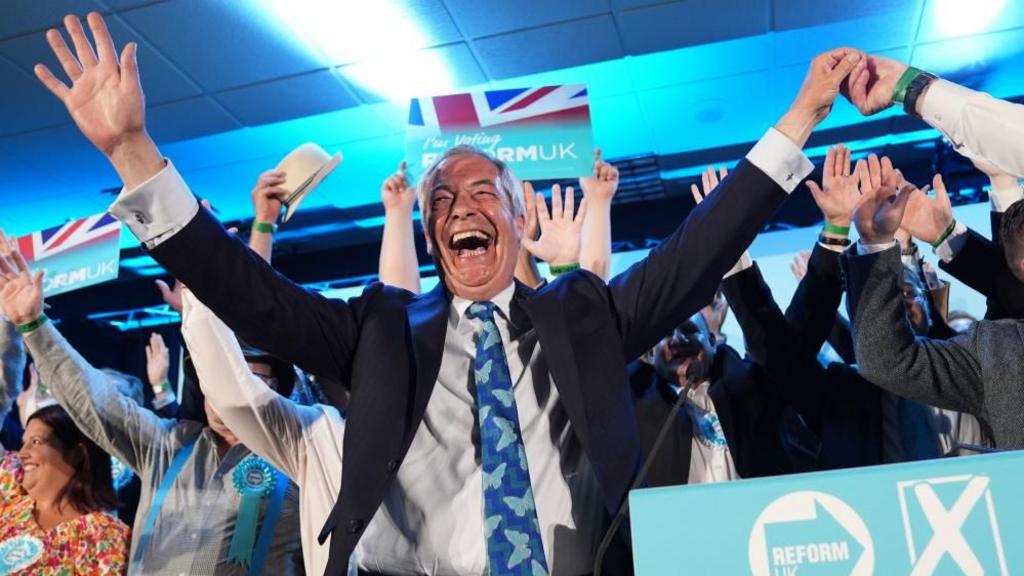
Reform Storms to Double By-Election Triumph as Labour Suffers Catastrophic Defeat
Reform UK has secured two further council by-election victories in September, including a direct gain from Labour in Derbyshire, giving Nigel Farage’s party another burst of momentum at a time when Britain’s political landscape remains highly competitive.
The two results came on 10 September in Eckington South and Rainshaw in North East Derbyshire and Hutton & Locking in North Somerset. Reform won both seats despite having not previously contested either ward at the relevant election. In Eckington, Labour’s share fell sharply as Reform moved into first place; in Hutton & Locking, Reform defeated the Conservatives.
For Reform, the results provide another opportunity to argue that its support is extending beyond its established strongholds. For Labour, the Eckington result provides a more direct warning because the party had previously held the seat with a substantial vote share.
But local by-elections have to be interpreted carefully. They involve relatively small electorates and turnout can be considerably lower than at a general election. A single ward result cannot by itself establish how Britain would vote in a national contest.
Reform takes Eckington South
The most significant of the two results for Labour came in Eckington South and Rainshaw.
Reform candidate Jamie Hodgson won 426 votes, equivalent to 40.2 per cent of the vote. Labour finished second with 298 votes, or 28.1 per cent, while the Conservatives received 229 votes, or 21.6 per cent.
The scale of the change becomes clearer when compared with the previous contest.
Labour had previously won the ward with 60 per cent of the vote. In the by-election, its share fell by almost 32 percentage points, according to the Association of Liberal Democrat Councillors’ compilation of the results.
Reform had not previously stood in the ward, meaning its 40.2 per cent represented a major entry into an area where Labour had previously been dominant.
Farage’s party immediately presented the result as evidence that its appeal was reaching voters who had traditionally supported the established parties.
The Reform leadership described the two victories as “brilliant Reform wins”, arguing that voters were increasingly willing to support the party at local level.
The political interpretation, however, is more complicated.
A by-election is fought under circumstances that are different from a general election. Turnout, candidate recognition, local issues and the absence or presence of particular parties can all have a significant effect.
The result nevertheless represents a clear change in the distribution of votes in Eckington South and Rainshaw.
A second victory in North Somerset
The same day produced another Reform gain in Hutton & Locking in North Somerset.
William Jones won the seat for Reform with 706 votes, representing 38.5 per cent. The Liberal Democrats finished second on 612 votes, or 33.3 per cent, while the Conservatives received 281 votes and Labour 133.
The result was particularly notable because the Conservatives had previously held the seat.
Their vote share fell from 37 per cent to 15.3 per cent, while Reform entered the contest with no previous vote share in the ward and immediately finished first.
The Liberal Democrats also performed strongly, finishing only 94 votes behind Reform.
That detail is important because the result was not simply a straightforward two-party contest between Reform and the Conservatives. More than one opposition party was competing for voters, and the final outcome was determined by a relatively narrow gap between the top two candidates.
Two different political stories
The two by-elections therefore tell slightly different stories.
In Eckington, Reform directly displaced Labour.
In Hutton & Locking, Reform displaced the Conservatives.
Taken together, the results demonstrate that Reform can win council seats from different established parties.
That is politically relevant for Farage because Reform’s national strategy depends partly on breaking the traditional two-party pattern in areas where Conservative and Labour support has historically been concentrated.
However, it would be too broad to conclude from these two contests that Reform has established nationwide dominance.
The results are local, and the electoral circumstances are specific.
The wider significance will depend on whether similar results occur repeatedly across different regions and at higher-turnout elections.
Labour’s difficult result
For Labour, the Eckington result is the more uncomfortable of the two.
The party’s vote share fell from 60 per cent at the previous election to 28.1 per cent. Reform took first place, while the Conservatives also remained competitive.
That does not necessarily mean that all of Labour’s lost votes moved directly to Reform.
The by-election results do not provide a way of identifying how individual voters switched their allegiance.
Several factors can contribute to changes in vote share, including turnout and the presence of new candidates and parties.
Nevertheless, the numerical change is substantial.
A ward that had previously delivered a large Labour majority instead produced a Reform victory.
For a governing party, such results can become important indicators of where local support is weakening, even if they cannot be directly translated into a forecast for a general election.
Reform’s wider run of local victories
The two September victories did not occur in isolation.
Reform has also won several other local by-elections during the month.
In East Markham on Bassetlaw District Council, Reform’s Matthew Evans won 436 votes, or 49.6 per cent, on 15 September. The Conservatives finished second with 28.4 per cent and Labour third with 17.2 per cent. The result represented a Reform gain from the Conservatives.
In Hutton & Locking, Reform won with 38.5 per cent, while in Eckington South and Rainshaw it won with 40.2 per cent.
The party has therefore demonstrated an ability to compete in areas where it previously had little or no electoral presence.
That pattern is one of the reasons Reform is receiving increasing attention from the established parties.
But Reform has also lost contests
A balanced assessment requires looking beyond Reform’s victories.
Local by-elections have produced results for several parties during September.
In Burnage, Manchester, Labour retained its council seat with 42.1 per cent, while the Greens finished second on 32 per cent and Reform third on 9.7 per cent.
In Haverhill West, the Conservatives retained their seat with 51.3 per cent, with Reform second on 25.8 per cent.
In Frome West, the Greens retained their seat, while Reform finished third.
These results illustrate why individual by-elections should not be treated as a single national trend.
Different constituencies produce different political outcomes.
The Farage factor
Nigel Farage has nevertheless made local election results an important part of Reform’s political message.
His return to Parliament in August gave the party a prominent national platform. Farage won the Clacton parliamentary by-election with 22,239 votes, according to the House of Commons record.
That followed Reform’s parliamentary by-election gain in Runcorn and Helsby in May 2025.
The party’s national representation therefore remains relatively new, while its local organisation is continuing to expand.
For Farage, the challenge is turning individual victories into a sustainable political organisation.
Winning a council by-election requires a successful local campaign. Building a national party capable of competing across hundreds of parliamentary constituencies is a much larger organisational task.
The importance of turnout
One of the biggest reasons for caution is turnout.
Local by-elections can attract a small proportion of the electorate. Voters who are highly motivated by a particular local issue can have a disproportionate influence on the result.
That does not make the victories unimportant.
It simply means that the percentages should not automatically be compared with the results of a nationwide general election.
A party winning 40 per cent in a local by-election has not necessarily demonstrated that it would receive 40 per cent in a parliamentary election.
The demographic composition of the electorate, campaign intensity and national political circumstances would all be different.
What the results mean for Labour and the Conservatives
The two Reform victories nevertheless create political pressure for both Labour and the Conservatives.
Labour must consider the extent to which Reform can attract voters who previously supported the party, particularly in areas where concerns about immigration, public services, taxation and economic conditions are prominent.
The Conservatives face a different problem.
Reform is directly competing for voters who have historically supported the Conservative Party, as demonstrated by the Hutton & Locking and East Markham results.
This creates a complicated electoral environment in which the Conservatives must compete not only with Labour but also with Reform.
The outcome of that competition could vary considerably from constituency to constituency.
A growing presence, but not a national verdict
The phrase “catastrophic defeat” is a political characterization rather than an objective description of the Eckington result.
The measurable facts are more straightforward.
Reform won two council by-elections on 10 September.
It gained one seat from Labour and one from the Conservatives. In Eckington, Labour’s vote share fell sharply from the previous contest. In Hutton & Locking, Reform narrowly finished ahead of the Liberal Democrats while the Conservatives fell to third place.
Those are meaningful local results.
What they do not establish is the likely result of a future general election.
The next test will be whether Reform can reproduce this level of support across larger numbers of constituencies and under general-election conditions.
The road ahead
Reform’s growing presence in local government is likely to remain an important part of British political debate.
The party is attempting to build an organisation that can compete with Labour and the Conservatives not only in parliamentary elections but also at council level.
Farage has presented recent victories as evidence that voters are rejecting the established political parties. That is his interpretation of the results, rather than a conclusion that can be established from the vote totals alone.
For Labour, the Eckington defeat demonstrates that previously strong local support can be vulnerable.
For the Conservatives, Hutton & Locking and East Markham show the continuing challenge posed by Reform in areas where the party has traditionally been competitive.
For Reform, the immediate task is to turn individual victories into sustained local organisation.
The September results have certainly added to the party’s list of recent electoral successes. But Britain’s political picture remains fragmented, with Labour, Conservatives, Reform, Greens and Liberal Democrats all capable of winning particular contests.
The two Reform victories are therefore significant pieces of the political puzzle — but they are not, on their own, a national verdict.