

Farage Sets Time Limit on When Small Boats Crossings Will End if Reform Wins Next Election
Nigel Farage has once again placed the English Channel at the heart of Britain’s immigration debate, setting out an unusually specific timetable for ending small-boat crossings if Reform UK wins the next general election.
The promise is deliberately bold: Farage has said Reform would stop the crossings within two weeks once the necessary legal powers were in place. The pledge has become one of the clearest examples of the party’s approach to immigration—identify a highly visible problem, establish a firm deadline and promise decisive action where successive governments have struggled to deliver a lasting solution.
The issue is politically significant because small boats remain one of the most visible symbols of Britain’s wider immigration crisis. According to the House of Commons Library, around 39,000 people arrived by small boat in the year ending March 2026, accounting for roughly 90% of detected unauthorised arrivals. The number has risen again after falling from its 2022 peak.
For Farage, therefore, the issue is about much more than individual crossings. It represents a test of whether the British state is capable of controlling its borders.
His argument is straightforward. If governments have the authority to determine who enters the country, then they should be able to enforce those rules. If people can continue arriving across the Channel despite years of government promises, Farage argues that the existing approach has failed.
That message has obvious political appeal.
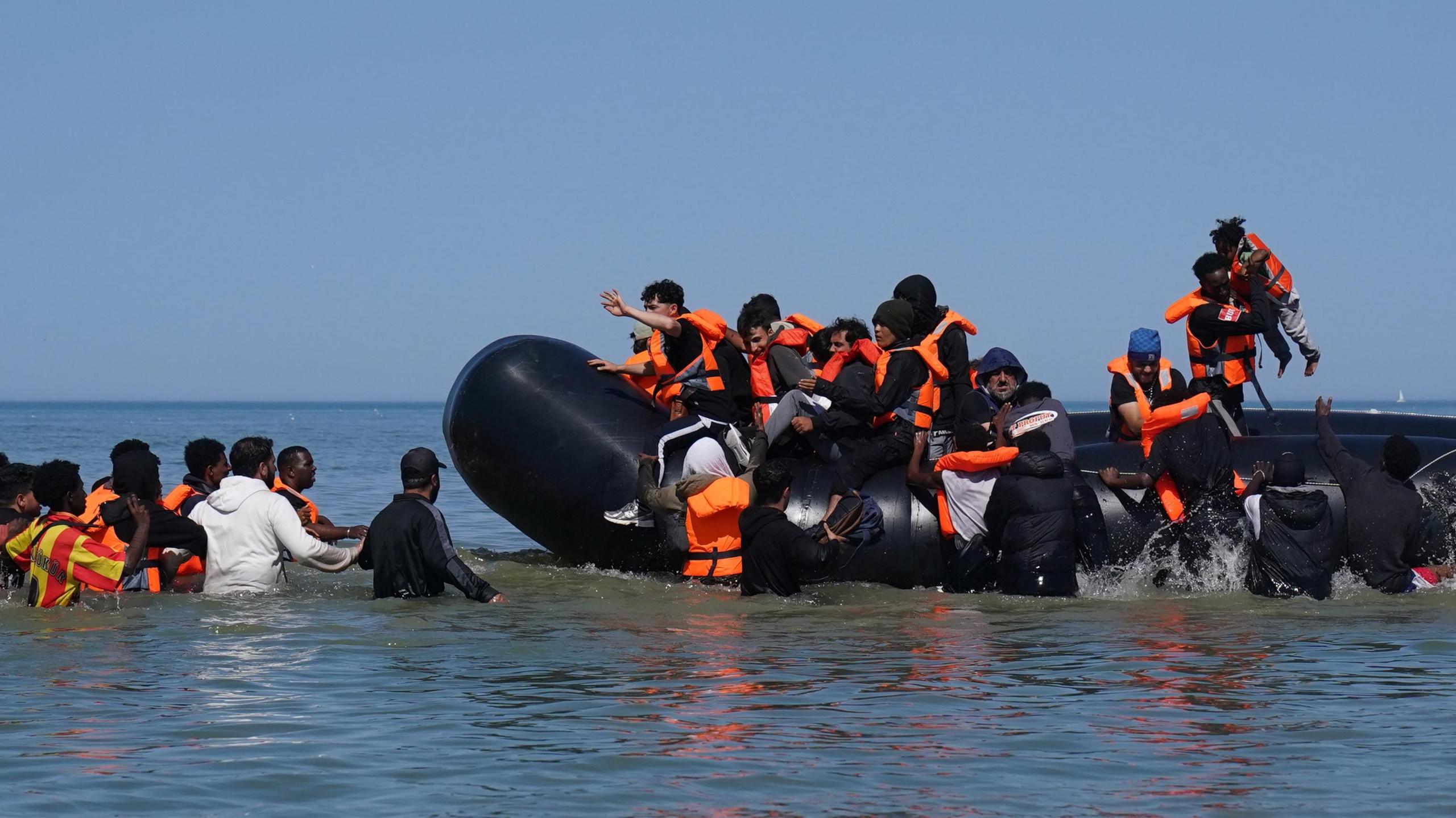
The small boats have become a recurring image in British political coverage. Every summer, photographs of overcrowded dinghies crossing the Channel can dominate the news. Behind those images are complicated questions about asylum law, international agreements, French cooperation, criminal smuggling networks, detention capacity and the processing of asylum claims.
But voters do not necessarily experience the issue as a legal seminar.
They see boats arriving.
They hear political promises.
And they want to know why the crossings continue.
This is where Farage’s two-week deadline becomes politically effective.
A precise deadline is much easier to understand than a general promise to “get tougher” on immigration. It gives voters a simple benchmark against which to judge Reform. If the party enters government, people can ask a very straightforward question: did the boats stop?
That clarity is one of Farage’s greatest political strengths.
However, the promise also creates an enormous political risk.
The details matter.
Farage’s original public claim suggested that Reform could stop the crossings within two weeks of winning office. When pressed on the practicalities, he qualified the pledge by saying the two-week period would follow the introduction of the necessary legislation and legal powers. That means the timetable depends on Parliament passing measures that could themselves take considerably longer.
This distinction could become crucial.
Winning an election does not instantly give a government unlimited powers. Ministers must operate within existing law, Parliament must legislate where necessary, courts can scrutinise government action and international agreements continue to matter.
Stopping boats is also not simply a matter of putting more vessels into the Channel.
The people attempting the crossing are often transported by organised smuggling networks. The boats themselves are frequently unsafe, overcrowded and poorly equipped. Any government attempting to intercept them must consider the safety of the people aboard, particularly where vessels are in distress.
There are also diplomatic complications.
Reform’s latest immigration strategy proposes a much more aggressive military response, including the use of the Royal Navy to intercept boats and return migrants to France or elsewhere. The party has described this as a major military operation in the Channel.
Critics argue that such a policy could face serious legal and diplomatic obstacles. Analysts have questioned whether Britain could simply return people to French territory without French agreement and whether military interception could be reconciled with maritime obligations to assist people in distress.
These are not minor technicalities.
They go directly to the question of whether Farage’s timetable is achievable.
Yet that is precisely why the promise is politically clever.
It shifts the argument away from the complicated question of what government is doing today and towards a much simpler future test.
Reform is effectively saying: give us the power to govern, and we will demonstrate that the problem can be solved.
For voters who believe successive Conservative and Labour governments have failed, this can be extremely attractive.
The Conservatives previously promised to stop the boats. Labour has also faced intense pressure to reduce crossings. The fact that the problem has persisted allows Farage to argue that the established parties have repeatedly offered promises without delivering a decisive solution.
The House of Commons Library figures reinforce the political difficulty. Small-boat arrivals peaked at approximately 46,000 in 2022, fell in 2023 and then increased again, reaching about 41,000 in 2025. By the year ending March 2026, approximately 197,000 people had been detected arriving by small boat since the significant increase in this route began in 2018.
Those figures explain why the issue remains politically explosive.
For Reform supporters, the argument is about sovereignty and enforcement. They believe a country cannot maintain public confidence in its immigration system if people can enter without prior authorisation and then remain while their asylum claims are processed.
For opponents, the situation is more complicated. They argue that people arriving by small boat frequently claim asylum and that international refugee and human-rights obligations constrain what any British government can legally do. They also warn that dramatic military solutions may create new risks without addressing the criminal organisations behind the crossings.
There is therefore a fundamental disagreement over what “stopping the boats” actually means.
Does it mean intercepting every vessel?
Does it mean returning people to France?
Does it mean dismantling smuggling networks?
Does it mean dramatically increasing deportations?
Or does it require a combination of all these measures alongside safe legal routes and faster asylum decisions?
Farage’s political language tends to emphasise the first part of the problem: control.
That is understandable because control is a powerful electoral concept.
People want to believe that governments are capable of enforcing the rules they create. When enforcement appears ineffective, confidence in government can decline rapidly.
This is where Starmer and the mainstream parties face their biggest challenge.
They cannot simply tell voters that the problem is complicated.
Voters already know that.
What they want is evidence that someone has a credible plan.
Farage understands this instinctively. His political style is based on turning complicated questions into clear choices. On immigration, the choice he offers is essentially between continued failure under established parties and decisive action under Reform.
Whether that choice is fair is another matter.
But it is easy to communicate.
And political communication matters enormously.
Reform’s recent plans demonstrate how seriously the party is treating the issue. In August 2026, the party unveiled “Operation Fortress”, a proposal involving the Royal Navy and Armed Forces to intercept migrant boats and return people to France. The plan has already attracted criticism over its feasibility and potential legal and diplomatic consequences.
The next election could therefore turn the Channel into one of its defining political battlegrounds.
The Conservatives will have to explain what they would do differently.
Labour will have to demonstrate that its existing strategy is producing results.
And Reform will have to prove that its ambitious promises are more than political slogans.
That final point may be the most important.
It is relatively easy for an opposition party to promise that a problem will disappear within two weeks. Governing is different. Once in office, Reform would inherit the legal, diplomatic and operational constraints that every previous government has faced.
The two-week promise could therefore become both Farage’s greatest political weapon and his greatest vulnerability.
If crossings fall dramatically, Reform could claim historic success and argue that the establishment simply lacked the political will to act.
If crossings continue, opponents will have a ready-made response: Farage promised two weeks, and reality proved more complicated.
Either way, the pledge has succeeded in doing something politically important.
It has created a clear deadline.
And deadlines create accountability.
Britain’s small-boat crisis is unlikely to be solved by rhetoric alone. It involves organised crime, international cooperation, asylum law, maritime safety and domestic politics. There is no guarantee that any government can eliminate crossings entirely, particularly in the short term.
But Farage is betting that voters are tired of hearing why something cannot be done.
His message is that government should simply do it.
That is the political power behind the two-week promise.
It is short.
It is dramatic.
It is measurable.
And if Reform wins the next election, it could become one of the most closely watched promises in modern British political history.
For Farage, the gamble is clear: promise a deadline, demand the powers to enforce it, and challenge the political establishment to explain why it failed for so long.
For his opponents, the response cannot simply be criticism.
They will need to provide something more convincing—a credible alternative capable of demonstrating that Britain can control its borders while remaining within the law and meeting its international responsibilities.
Until then, Farage has succeeded in setting the terms of the argument.
The boats are no longer merely an immigration problem.
They are a test of political authority.
And Farage has put a clock on it.