
MUSLIMS THOUGHT FLORIDA WOULD BOW DOWN TO ISLAM — THEN GOVERNOR DESANTIS SIGNED THIS BOMBSHELL LAW
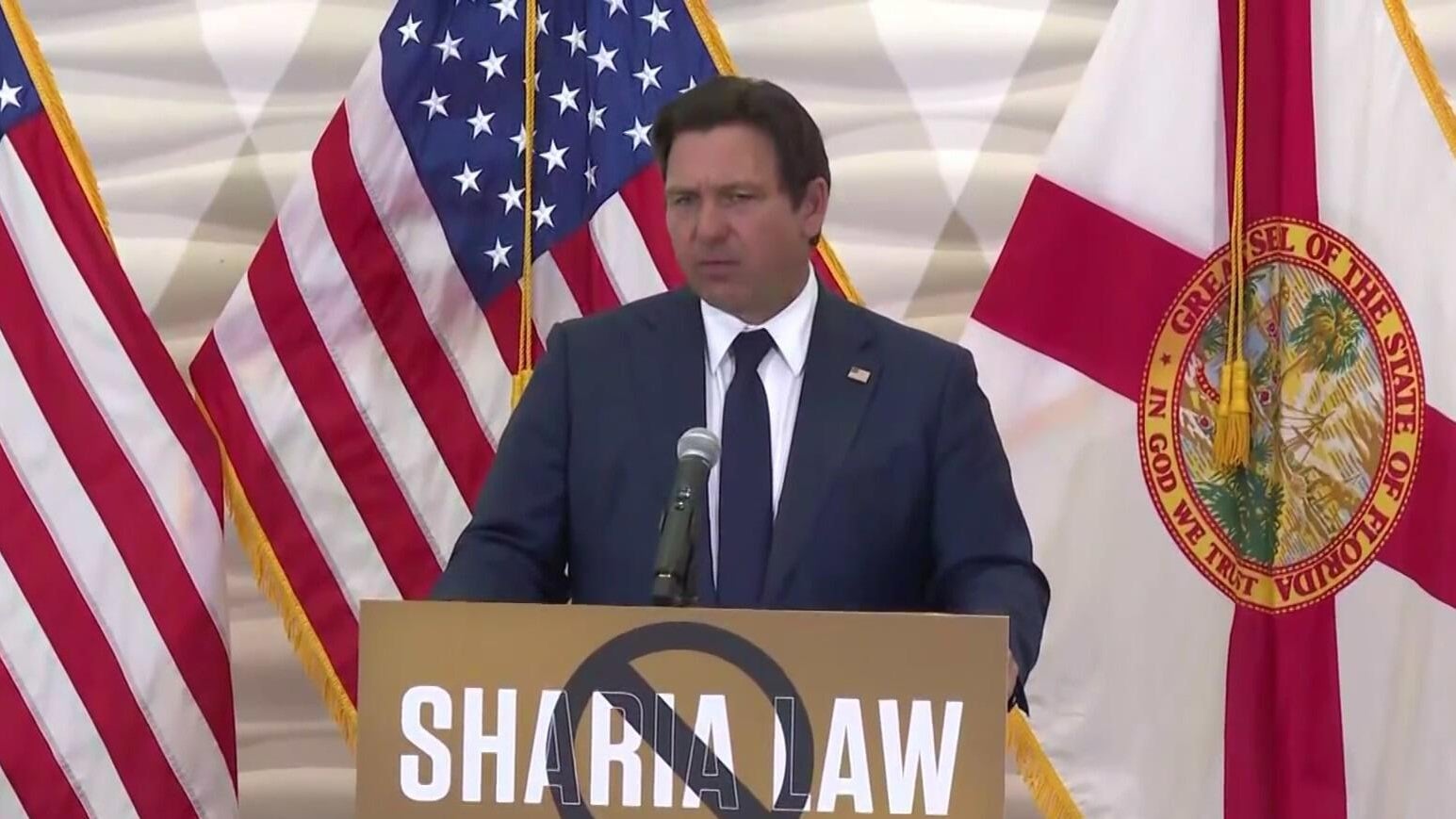
Florida has once again placed itself at the center of America’s fierce debate over religion, constitutional law and political extremism.
On April 6, 2026, Governor Ron DeSantis signed HB 1471, legislation that strengthens Florida’s restrictions on the use of foreign and religious laws when their application would violate constitutional rights. The law also establishes a new state framework for dealing with organizations designated as terrorist groups.
Supporters immediately presented the measure as a declaration that Florida would have one legal system, one Constitution and one ultimate source of public authority.
Critics, however, have argued that the political rhetoric surrounding the legislation risks portraying ordinary Muslims as though they are collectively attempting to replace American law with Islamic law.
Those are two very different claims.
The actual law is more specific than the dramatic headlines suggest.
HB 1471 says Florida courts may not apply or enforce foreign or religious law when doing so would violate constitutional rights. It also addresses foreign judgments, contracts and legal provisions that attempt to circumvent those protections.
In other words, the measure does not simply declare that Muslims cannot practice Islam.
It establishes that religious rules cannot override the U.S. Constitution or Florida law inside Florida’s courts.
That distinction is critical.
A Muslim living in Florida remains free to pray, fast during Ramadan, attend a mosque, follow religious dietary practices and observe other aspects of Islamic faith, subject to the same general laws that apply to everyone else.
The constitutional issue arises when someone attempts to give a private religious rule the authority of state law.
That is where Florida’s legislation draws its line.
ONE CONSTITUTION, ONE LEGAL SYSTEM
The central political message from DeSantis was unmistakable.
When he signed HB 1471, he said that Florida must operate under one legal system and that the Constitution must remain the law of the land.
For supporters, this is fundamentally a rule-of-law argument.
They believe American courts should never be placed in a position where a religious or foreign legal code overrides constitutional protections.
That principle is broader than Islam.
The legislation refers to foreign and religious laws, meaning the underlying concept is not supposed to depend on which religion is involved.
A Christian organization could not establish a private legal system that overrides Florida law.
A Jewish organization could not do so.
A Muslim organization could not do so.
A Buddhist organization could not do so.
Religious freedom allows people to follow their beliefs. It does not give private religious institutions governmental judicial authority.
That distinction is essential in understanding what Florida actually did.
THE “SHARIA BAN” HEADLINE
The political phrase “Florida bans Sharia law” is therefore catchy but incomplete.
Florida’s legislation specifically targets the application or enforcement of foreign or religious law when it conflicts with constitutional rights.
That is different from banning Muslims from following religious principles in their private lives.
Sharia itself is a broad Islamic religious tradition with different interpretations and applications. For many Muslims, religious principles concern personal morality, prayer, family responsibilities, charity, fasting and other aspects of everyday life.
The existence of religious rules does not automatically mean that believers want those rules imposed on everyone else.
This is where political rhetoric can become misleading.
There is a huge difference between saying:
“Florida courts will enforce the Constitution.”
and saying:
“Florida is fighting Muslims.”
The first statement describes the purpose of the law.
The second is a much broader political characterization that cannot simply be inferred from the legislation itself.
BUT DESANTIS WENT FURTHER
HB 1471 was not limited to religious and foreign legal codes.
The legislation also created a framework allowing Florida authorities to designate organizations as terrorist organizations under state law. The law gives the Chief of Domestic Security within the Florida Department of Law Enforcement a role in recommending designations.
That part of the legislation became even more consequential in July.
On July 1, 2026, the DeSantis administration announced the first implementation of the new statutory powers. Florida said it intended to designate the Council on American-Islamic Relations (CAIR), the Muslim Brotherhood and Antifa under Florida law, alongside more than 90 federally designated foreign terrorist organizations, including cartels.
This is an important development—but it also needs careful wording.
The announcement described an intent to designate these organizations, with confirmation by the Florida Cabinet required before the designations would carry the full force of state law.
That means headlines suggesting that every Muslim organization in Florida has suddenly become illegal would be inaccurate.
The policy targets organizations designated under the state’s statutory process.
It does not criminalize being Muslim.
That distinction should not be lost.
WHY THE LAW IS POLITICALLY EXPLOSIVE
The reason the legislation has attracted so much attention is obvious.
DeSantis has built a national political reputation around aggressive policies concerning education, immigration, foreign influence and cultural issues.
Florida has increasingly attempted to position itself as a state willing to challenge what its leaders describe as ideological or foreign influence.
HB 1471 fits directly into that broader strategy.
The governor’s office says the law protects Florida institutions from terrorist organizations and prevents foreign or extremist influence from gaining a foothold in the state.
Opponents see potential dangers.
Whenever government gains the power to designate organizations as terrorist groups, questions about due process, constitutional rights and the boundaries of political association inevitably arise.
What evidence is required?
Who makes the designation?
Can an organization challenge the decision?
What constitutes material support?
How are constitutional rights protected?
Those questions are not minor technicalities.
They are at the heart of American constitutional government.
THE MUSLIM QUESTION
One of the most important issues is whether laws directed partly at organizations associated with Islam will affect ordinary Muslims.
The answer is that the legislation, as described by Florida’s government, is aimed at organizations and conduct—not at Muslim identity itself.
That does not mean Muslims have no reason to scrutinize the law.
Religious minorities have a legitimate interest in ensuring that counterterrorism measures do not become a substitute for religious discrimination.
At the same time, the government has a legitimate responsibility to respond to organizations it believes pose genuine security threats.
The difficult part is establishing where that line should be drawn.
That is the debate Florida has now entered.
“FLORIDA WILL NOT BOW DOWN”
For DeSantis supporters, the message is much broader than Sharia.
It is about sovereignty.
They argue that Florida should not permit foreign governments, foreign organizations or religious institutions to influence the state’s legal and political institutions in ways that undermine constitutional rights.
The governor’s office has repeatedly emphasized this theme.
In May, DeSantis also signed HB 905, the Foreign Interference Restriction and Enforcement Act, which expanded restrictions involving hostile foreign influence and foreign adversaries.
Taken together, these measures represent a broader political philosophy.
Florida is attempting to place stronger legal barriers between state institutions and organizations that officials characterize as foreign, extremist or hostile.
That is why the new law has attracted attention beyond the question of Islam.
THE BIGGER AMERICAN DEBATE
The Florida controversy reflects a much larger question confronting the United States.
How should a constitutional democracy respond when religious freedom, political activism and national security appear to collide?
The answer cannot simply be “ban religion.”
That would violate the basic principle of religious freedom.
Nor can the answer be “religious organizations are above scrutiny.”
They are not.
Religious institutions, like other organizations, remain subject to generally applicable laws.
The difficult task is maintaining both principles simultaneously.
Americans should be free to practice their faith.
Government should remain secular in its legal authority.
Terrorist organizations should not receive government support.
Citizens should not lose their constitutional rights merely because of their religion.
Those principles can coexist—but only if the government applies them consistently.
WHAT HAPPENS NEXT?
Florida’s new legal framework is unlikely to end the controversy.
It may instead move the fight into courts, universities, political campaigns and public debate.
Organizations affected by state designations may challenge them.
Civil-liberties groups may scrutinize the law.
Supporters will argue that Florida is finally taking threats seriously.
Critics will ask whether the state has gone too far.
Those arguments are exactly what constitutional democracy is supposed to permit.
The important thing is to distinguish between Muslims as individuals and specific organizations accused or designated by the government.
Millions of American Muslims cannot reasonably be treated as a single political entity.
A law aimed at a particular organization is not automatically a law against everyone who shares its religion.
That distinction is essential.
THE REAL “BOMBSHELL”
So what was the bombshell law?
It was not a law declaring Islam illegal in Florida.
It was a much broader measure designed to ensure that foreign or religious legal systems cannot override constitutional rights and to give Florida a statutory framework for designating and penalizing organizations considered terrorist threats.
Whether that framework ultimately strengthens public safety or creates new constitutional conflicts will depend on how it is enforced.
And that may be the most important part of the story.
Florida has drawn a line.
DeSantis says the line is simple: religious freedom is protected, but the Constitution remains supreme.
His opponents will now test how that principle works in practice.
The coming legal battles may therefore be more consequential than the original signing ceremony.
Because the real question is not whether Florida “bows down” to Islam.
It is whether Florida can aggressively confront organizations it considers dangerous while simultaneously protecting the rights of millions of ordinary people—including Muslims—under the same Constitution.
That is the standard by which this law should ultimately be judged.
**Not by the loudest headline.
Not by the angriest political speech.
But by whether the rule of law is genuinely applied equally to everyone.**
Leave a Reply
You must be logged in to post a comment.