
Electron Expert Claims Labour Could Be Left With Just Nine MPs as Reform Storms Towards Victory
British politics is becoming increasingly difficult to predict, but few scenarios would be more dramatic than the prospect of Labour being reduced to just nine MPs at a future general election. Such a result would represent an extraordinary collapse for a party that won a huge parliamentary majority only a few years ago and would demonstrate just how dramatically the political landscape has changed.
The claim that Labour could be reduced to such a tiny parliamentary presence should not be treated as a prediction carved in stone. Electoral projections are inherently uncertain, particularly when Britain’s first-past-the-post system converts votes into seats in ways that can produce surprising outcomes.
Nevertheless, the possibility is politically significant because Reform UK has demonstrated that it can take support from Labour in areas where the party once appeared virtually unbeatable.
The transformation is remarkable.
When Labour won the 2024 general election, it secured 411 seats and returned to government with a large Commons majority. Yet that victory was achieved amid historically unusual voting patterns, including a very low Conservative vote and significant support for smaller parties. Since then, the political environment has changed substantially.
The 2026 local elections provided perhaps the clearest warning yet.
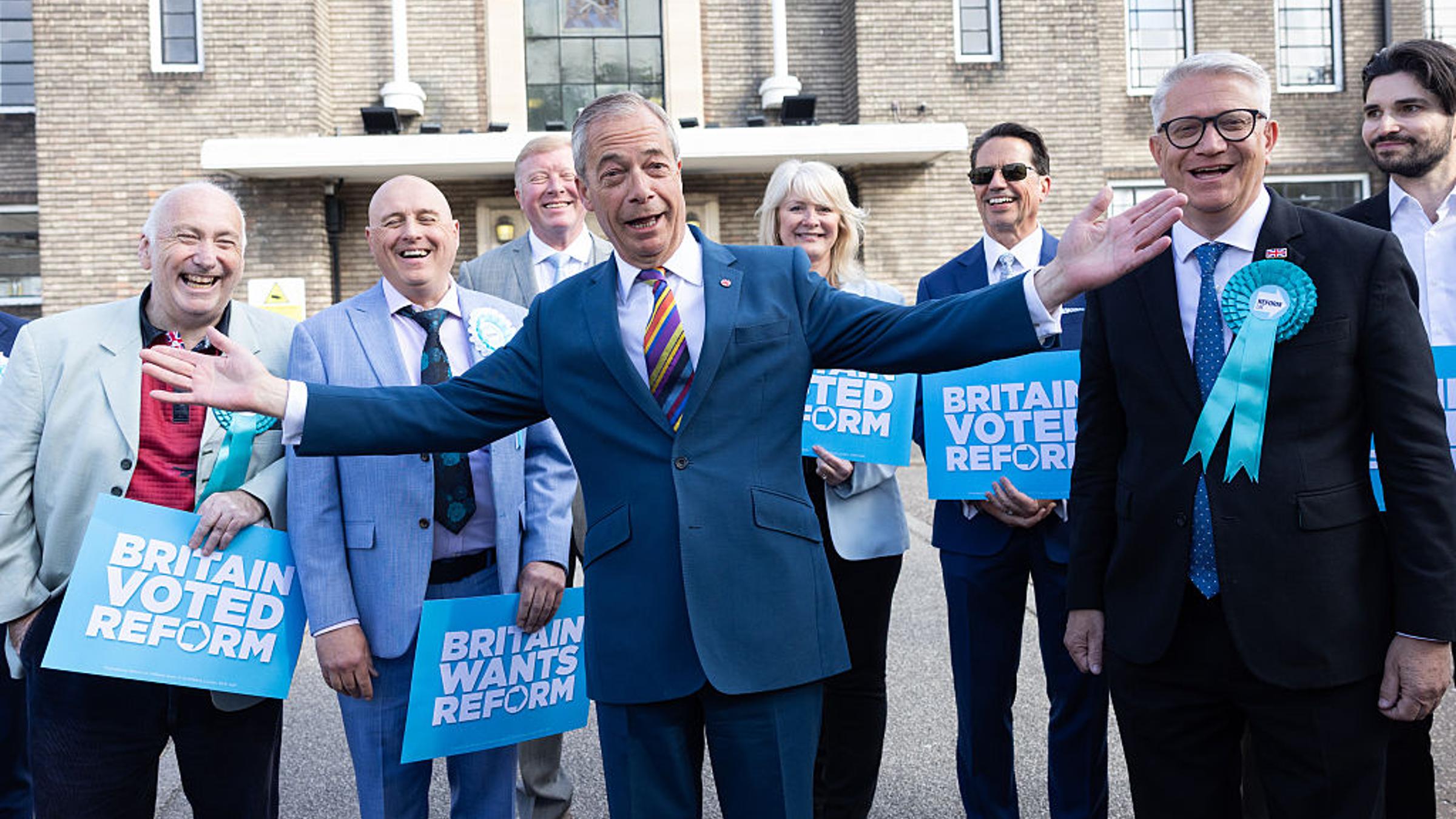
Reform made hundreds of gains across England and took control of several councils, while Labour suffered heavy losses, including in traditional northern strongholds. Nigel Farage described the results as a “truly historic shift in British politics”.
That shift is at the heart of the argument behind dramatic seat projections.
If Reform continues taking votes from Labour and the Conservatives simultaneously, the consequences under first-past-the-post could be enormous.
Britain’s electoral system rewards parties that can concentrate support efficiently. A party does not need to win a majority of the national vote to win a majority of parliamentary seats. Conversely, a party can receive millions of votes and still win relatively few constituencies if its support is spread too thinly.
This makes predictions of a Labour collapse both fascinating and extremely difficult.
A few percentage points of movement in dozens of constituencies could transform the Commons.
Labour’s problem is that it is potentially vulnerable in multiple directions.
In Scotland, the party faces the continuing strength of the SNP as well as competition from Reform. In Wales, Plaid Cymru and Reform can challenge Labour’s traditional support. In England, the Conservatives remain a potential threat in some constituencies, while Reform is increasingly targeting working-class communities that historically formed the core of Labour’s electoral coalition.
The result could be a political squeeze.
Labour does not necessarily need to lose millions of voters nationally to suffer a catastrophic loss of seats. It could lose relatively modest numbers of votes in strategically important constituencies and see its parliamentary representation collapse.
This is why the Reform phenomenon is so important.
Reform’s success is not simply about gaining its own seats.
It is about changing the relationship between the other parties.
Suppose Reform wins 25 per cent of the vote in a constituency that Labour previously won comfortably. If that Reform support comes disproportionately from former Labour voters, the Conservatives or another opposition party may suddenly become competitive.
The same process works in reverse in Conservative-held constituencies.
This creates the possibility of a political earthquake without Reform necessarily winning an outright majority of votes.
The traditional two-party system is already under enormous pressure.
Voters increasingly appear willing to switch between parties rather than maintain lifelong political loyalties. The rise of Reform is one expression of this wider fragmentation.
For Labour, this represents a profound strategic challenge.
The party cannot simply assume that voters who have become dissatisfied with the government will return at the next election. Once a voter has discovered an alternative party and become comfortable supporting it, the psychological barrier to switching again becomes much lower.
That is especially dangerous for Labour in working-class constituencies.
For generations, many communities regarded Labour support as part of their political identity. But that loyalty has weakened. Concerns about immigration, taxation, living standards, housing and public services can now push voters towards parties that their parents or grandparents would never have considered.
Reform has been highly effective at exploiting that change.
Its message is straightforward: the established parties have failed, and Britain needs a fundamental political alternative.
That argument does not need every voter to agree with every Reform policy.
It simply needs enough voters to believe that Labour and the Conservatives have failed them.
The 2026 local election results suggest that this message is having a significant impact. Labour’s losses were substantial, while Reform demonstrated that it could win in both former Labour and Conservative territory.
Yet there is an important reason to be cautious about predictions of Labour being reduced to nine MPs.
Local elections are not general elections.
Turnout differs considerably. Tactical voting can operate differently. Candidates matter. National campaigns can change voter perceptions. And smaller parties can experience sharp fluctuations in support.
Even the recent local election results contained signs that Reform’s advance may not be completely unstoppable. Analysis of the results suggested that Labour’s losses were not as catastrophic as some expectations and that Reform’s share of seats might indicate it had already reached a peak in some areas.
That does not mean Reform is declining.
It means that electoral politics is more complicated than a simple straight-line projection.
The same caution applies to opinion polls.
A poll showing Reform ahead of Labour can be politically significant, but it does not automatically translate into a particular number of parliamentary seats. Different pollsters use different methodologies, and national voting intention does not perfectly capture constituency-level dynamics.
An election expert projecting Labour down to nine MPs is therefore presenting a scenario rather than an inevitable future.
But even a scenario can reveal something important.
It demonstrates how far Labour’s political position has fallen from the security it enjoyed immediately after the 2024 election.
The psychological impact of such a projection could be considerable.
For Labour activists, the idea that the party could lose hundreds of seats would be deeply alarming. For Reform supporters, it would reinforce the belief that a political realignment is underway.
For the Conservatives, however, the picture is more complicated.
The Tories would welcome Labour’s losses, but they cannot assume that those losses would automatically benefit them. Reform has demonstrated that it can take Conservative votes as well.
The Conservatives could therefore find themselves in an extraordinary situation: Labour collapses, but Reform emerges as the principal beneficiary.
That is why Reform’s rise represents a threat to both traditional governing parties.
Kemi Badenoch’s Conservatives face the challenge of convincing voters who have moved towards Farage that the Conservative Party remains capable of delivering the changes they want.
That will not be easy.
Many Reform supporters are former Conservatives who believe the party failed to control immigration, failed to reduce taxes sufficiently or became too cautious on questions of national identity and sovereignty.
Winning those voters back will require more than attacking Farage.
It will require convincing them that the Conservatives can actually deliver.
Labour faces an equally difficult task, although from a different direction.
It must demonstrate that it understands why voters who once supported the party are now considering Reform.
That means addressing economic insecurity, public services and concerns about immigration without abandoning the values that distinguish Labour from Reform.
This is a difficult political balancing act.
Move too far towards Reform, and Labour risks losing progressive voters.
Ignore Reform’s appeal, and it risks losing traditional working-class supporters.
The party therefore faces a strategic dilemma that cannot be solved through slogans.
Meanwhile, Nigel Farage has every reason to encourage the most dramatic possible projections.
A prediction of Labour being reduced to nine MPs reinforces Reform’s central argument: that Britain’s old political order is collapsing.
It creates a sense of inevitability around Reform’s rise.
But Farage must also be careful.
Expectations can become a political trap.
If Reform predicts a historic victory and then performs only moderately well, opponents can portray the result as evidence that the party’s momentum has stalled.
The same applies to Labour.
A party expecting disaster can sometimes mobilise supporters precisely because they fear losing everything.
Political campaigns can change rapidly once voters realise that a particular constituency is genuinely competitive.
That is why the eventual general election campaign could look very different from today’s polling environment.
Nevertheless, the possibility of an extraordinary Labour collapse tells us something important about the state of British politics.
The old assumption that Labour and the Conservatives are the two unavoidable governing parties is weakening.
Reform has changed the conversation.
The SNP remains powerful in Scotland. Plaid Cymru remains important in Wales. The Liberal Democrats have demonstrated an ability to win constituencies through highly targeted campaigns. Greens and other smaller parties can influence the distribution of votes.
Britain is becoming increasingly multiparty.
That makes the next general election potentially one of the most unpredictable in modern political history.
Could Labour really be reduced to nine MPs?
It is far too early to say.
A projection that extreme should be viewed as a warning rather than a certainty.
But the fact that such a scenario can now be discussed seriously illustrates how dramatically Labour’s political position has changed.
The party that won a huge majority in 2024 is no longer operating in the same political environment.
Reform has emerged as a major electoral force.
Nigel Farage has transformed the political debate.
Traditional party loyalties are weakening.
And voters appear increasingly willing to punish established parties when they believe those parties have failed to deliver.
The biggest danger for Labour is therefore not one particular poll or projection.
It is complacency.
If the party assumes that its traditional voters will eventually return, it may discover too late that those voters have permanently changed their political allegiance.
Reform, meanwhile, must prove that it can turn momentum into durable support and eventually into effective government.
That is the real battle ahead.
A nine-MP Labour Party may sound extraordinary today.
But Britain’s political history is full of supposedly impossible electoral outcomes that eventually became reality.
The lesson for Labour, the Conservatives and Reform is simple: never assume that yesterday’s electoral map will still exist tomorrow.
The political earthquake is already underway.
The only question is how large it will become.