

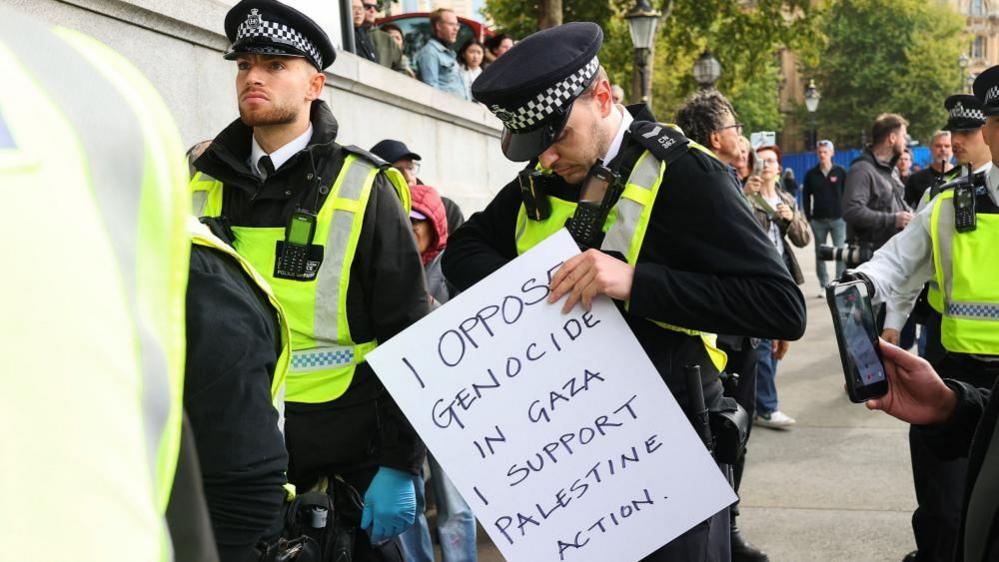
BRITAIN’S BIGGEST POLICE force will resume arresting protesters for holding signs in support of Palestine Action.
The Metropolitan Police paused doing so in February after the UK High Court ruled that the British Government’s ban of the group was unlawful.
But tonight, the Met announced that officers will resume arresting protesters because the appeal against the ruling is likely to take several months.
Deputy Assistant Commissioner James Harman said: “While the High Court has found the proscription of Palestine Action to be unlawful, it has confirmed the impact of that judgment will not take effect until the Government’s appeal has been considered which could take many months.
“That means it is still a criminal offence to support Palestine Action.
“We must enforce the law as it is at the time, not as it might be at a future date. We must do that consistently and without fear or favour.”
He went on: “The High Court decided on 25 February to grant the Home Secretary permission to appeal and to leave the proscription in place pending the outcome of that appeal.
“Having now considered our position in light of that decision, taking into account all the circumstances, we have determined that while Palestine Action remains proscribed and support for it remains unlawful under the Terrorism Act, we must continue to enforce the law and this is likely to involve the arrest of those committing offences.”
More than 2,700 people have been arrested so far for allegedly expressing support for Palestine Action since it was banned as a terrorist group last year.
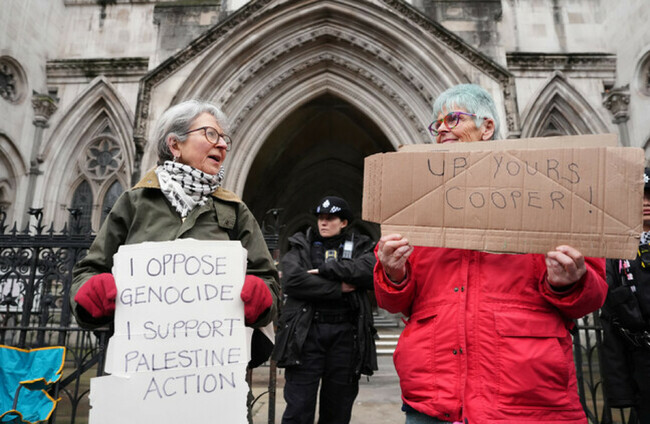
Protesters have arranged mass rallies where demonstrators hold up signs saying “I oppose genocide, I support Palestine Action”.
The trials of hundreds of people accused of holding up the placards have been put on hold while the legal battle over whether the group should have been banned rumbles on.
Earlier this month Chief Magistrate Paul Goldspring said the cases would be delayed until after the UK High Court Appeal over the ban is heard.
Proscription makes it a criminal offence to belong to or support Palestine Action, punishable by up to 14 years in prison.
The move to ban the organisation was announced after two Voyager aircraft were damaged at RAF base in Oxfordshire on 20 June, 2025, an incident claimed by Palestine Action, which police said caused around £7m (€8m) of damage.
Met Police to Resume Arresting Protesters for Holding Signs in Support of Palestine Action
The relationship between public protest, government authority, and individual freedom has always been one of the most sensitive issues in democratic societies. The headline “Met Police to Resume Arresting Protesters for Holding Signs in Support of Palestine Action” highlights a major controversy in Britain over the limits of free expression, the enforcement of terrorism laws, and the responsibility of police forces when dealing with politically sensitive demonstrations.
The decision by the Metropolitan Police to resume arrests of people displaying support for Palestine Action has intensified debate across the country. Supporters of the police position argue that officers are required to enforce the law as it currently stands, while critics argue that the move risks criminalising political expression and weakening the right to peaceful protest.
The controversy centres around the legal status of Palestine Action and the consequences of supporting an organisation that has been proscribed under UK terrorism legislation. Although a High Court ruling challenged the government’s decision to ban the group, the legal effect of that ruling was suspended while an appeal process continued. As a result, police maintained that expressions of support for the organisation remained subject to criminal law.
For the Metropolitan Police, the issue is primarily about enforcing existing legislation rather than making political judgments. Police leaders have argued that officers have a duty to apply the law regardless of the political opinions involved. From this perspective, the role of the police is not to decide whether a law is popular or controversial but to implement decisions made through the legal system.
However, critics argue that the situation raises serious questions about freedom of speech. They believe that holding a sign or expressing political support should not automatically lead to criminal punishment, particularly when the action itself is peaceful. Civil liberties groups have warned that using terrorism legislation in protest situations could create a wider impact on democratic freedoms.
The debate reflects a long-standing tension in democratic societies. Governments have a responsibility to protect public safety and prevent violence, but they must also protect the right of citizens to criticise government policy and express unpopular opinions.
The controversy surrounding Palestine Action has developed within a wider political debate about protest movements in Britain. In recent years, demonstrations on issues such as climate change, foreign policy, and international conflicts have become increasingly visible. These protests have often involved civil disobedience, creating difficult questions about where the boundary lies between lawful protest and criminal activity.
Supporters of stronger enforcement argue that some forms of direct action go beyond traditional protest. They point to previous activities associated with Palestine Action and argue that the government had legal reasons for taking action against the group. From this viewpoint, preventing support for the organisation is considered a matter of national security.
Opponents, however, argue that there must be a clear distinction between supporting a political cause and participating in illegal activity. They claim that individuals holding signs or expressing opinions should not automatically be treated in the same way as people accused of committing criminal acts.
The issue has attracted significant attention because many of those arrested or threatened with arrest have been involved in peaceful demonstrations. Previous protests have included participants sitting silently while holding signs expressing opposition to the ban and support for Palestine Action. Police have responded by making arrests under terrorism legislation.
These arrests have created a wider debate about proportionality. Critics ask whether counter-terrorism powers are appropriate for dealing with peaceful protesters. They argue that such laws were designed to address serious security threats and should be used carefully.
Supporters of the police approach respond that the law applies regardless of the form of protest. They argue that allowing people to openly support a banned organisation would undermine the purpose of the ban and create difficulties for authorities responsible for public safety.
The role of the courts is also central to the debate. In democratic systems, courts provide a mechanism for challenging government decisions and ensuring that laws are applied fairly. The legal dispute over Palestine Action demonstrates the importance of judicial review and the balance between government power and individual rights.
For the government, the issue creates a difficult political challenge. Leaders must demonstrate that they are protecting national security while avoiding accusations that they are restricting legitimate democratic activity. Any decision involving protest rights is likely to attract criticism from different sides.
For opposition parties, the controversy provides an opportunity to question government policy. Some may argue that the government has gone too far in restricting civil liberties, while others may argue that stronger action is necessary to maintain public order.
The Metropolitan Police also faces a difficult position. Police forces are expected to remain politically neutral while enforcing laws that may themselves be politically controversial. Officers on the streets must make decisions in complex situations where public emotions are high and legal questions may not always be simple.
The impact on public confidence is another important consideration. Trust in policing depends partly on the belief that laws are applied fairly and consistently. If sections of society believe police action is politically motivated, confidence in institutions can be damaged.
At the same time, police leaders argue that failing to enforce the law could also undermine public trust. They maintain that selective enforcement based on political pressure would create an inconsistent system where some groups are treated differently from others.
Social media has further intensified the debate. Videos of arrests, statements from campaign groups, and political reactions spread quickly online, often creating strong emotional responses. Supporters and opponents of the protests frequently present very different interpretations of the same events.
The controversy also raises questions about the future of protest in Britain. If people believe certain political expressions may result in arrest, some may become more cautious about participating in demonstrations. Civil liberties advocates warn that this could have a chilling effect on democratic participation.
Others argue that democratic rights must exist alongside responsibilities. They believe that freedom of expression does not include the right to support organisations that have been legally banned for security reasons.
Finding the right balance is one of the hardest challenges facing governments and legal systems. Too much restriction can damage democratic freedoms, while too little enforcement can create risks to public safety.
Ultimately, the debate is not only about Palestine Action but about broader questions regarding the relationship between citizens and the state. It concerns how democracies respond when political movements challenge government decisions and how authorities should react when protest crosses into disputed legal territory.
In conclusion, “Met Police to Resume Arresting Protesters for Holding Signs in Support of Palestine Action” represents a major debate over security, protest rights, and freedom of expression in modern Britain.
The Metropolitan Police argues that it is enforcing the law, while critics argue that the use of terrorism legislation against peaceful protesters raises serious concerns about civil liberties. The outcome of the legal and political debate will have implications far beyond one organisation or one set of demonstrations.
At the heart of the issue is a fundamental democratic question: how can a society protect itself from genuine threats while ensuring that citizens remain free to express political opinions? The answer will continue to shape discussions about democracy, policing, and individual rights in the United Kingdom.