

⚠️ NOTICE: SENSITIVE HISTORICAL CONTENT
This text addresses World War II–era atrocities, the aftermath of occupation, and postwar justice. It is presented for educational and commemorative purposes only. It does not promote violence, hatred, or extremist ideologies, and it avoids graphic detail.
The Kyiv Trial (1946) and Postwar Justice: How a City Confronted the Memory of Babyn Yar
In Kyiv’s World War II history, Babyn Yar (Babi Yar) remains a powerful symbol of the human cost of occupation and extremist ideology. At the end of September 1941, one of the most documented mass killings of the Holocaust by bullets took place there: 33,771 Jewish victims were recorded as murdered over two days. Over the wider period of occupation, the total number of people killed in the Babyn Yar area is often estimated at 100,000–150,000, including victims from multiple persecuted groups.
After Kyiv’s liberation in 1943, investigations began at different levels, ranging from local documentation and witness testimony to broader postwar prosecutions. Within this wider process of accountability, the Kyiv Trial in January 1946 became one of the most visible public proceedings connected to crimes committed during the occupation era.
The Kyiv Trial (17–28 January 1946): From Evidence to Verdicts
Historical overviews commonly describe the trial as involving 15 defendants accused of crimes against civilians and wartime atrocities committed in various locations under occupation. The verdicts reportedly resulted in 12 death sentences and 3 prison terms.
For many observers, the trial carried a clear message: even when a war ends, responsibility for mass crimes does not disappear. Documentation, testimony, and judicial proceedings were meant to show that these acts were not anonymous “events,” but the result of human decisions.
29 January 1946: Why a Public Sentencing Event?
On 29 January 1946, the death sentences for 12 convicted men were carried out publicly in Kalinin Square—today’s Independence Square (Maidan Nezalezhnosti) in central Kyiv.
Some contemporary accounts and later historical reconstructions report that a very large crowd—sometimes cited as around 200,000 people—filled the square and nearby streets. In the Soviet postwar context, such public punishments are often interpreted as both deterrence and a symbolic display of state justice: bringing perpetrators into public view to declare that the war had ended, but accountability would be enforced.
At the same time, public punishment raises difficult ethical questions. A responsible historical approach avoids sensationalism and focuses instead on what these events reveal about how dehumanization, propaganda, and extremist thinking can lead to catastrophic outcomes.
Babyn Yar: Numbers Are Not “Just Statistics”
Babyn Yar is often referenced because of the scale and the speed of the killing. The recorded figure of 33,771 victims over two days (29–30 September 1941) is especially striking for how concentrated it is in time.
Yet the tragedy did not end there. Killings continued throughout the occupation, which is why broader estimates frequently range from 100,000 to 150,000 victims in the area. When discussing the Kyiv Trial and its outcomes, the most responsible focus is not on punishment as spectacle, but on remembrance—of lives reduced to numbers, and of families and futures erased.
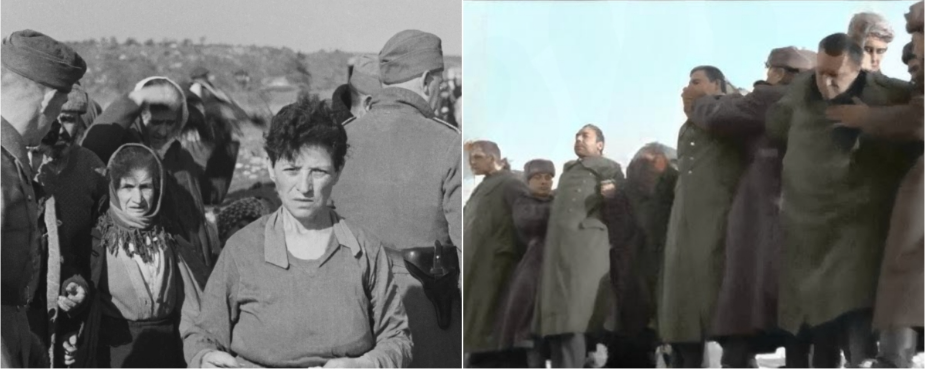
About Archival Images: A Fragment of Collective Memory
Photographs associated with postwar trials and crowded public squares often do more than document a single moment. They also reflect a wider reality: after the war, societies sought ways—imperfect and shaped by their political era—to confront a traumatic past through investigation and legal judgment.
The Lesson That Remains
Mass atrocities can begin when indifference becomes normal.
Propaganda can train people to see human beings as “targets” instead of persons.
And remembrance is not meant to perpetuate hatred, but to encourage learning—so that tragedies like Babyn Yar are not repeated.