
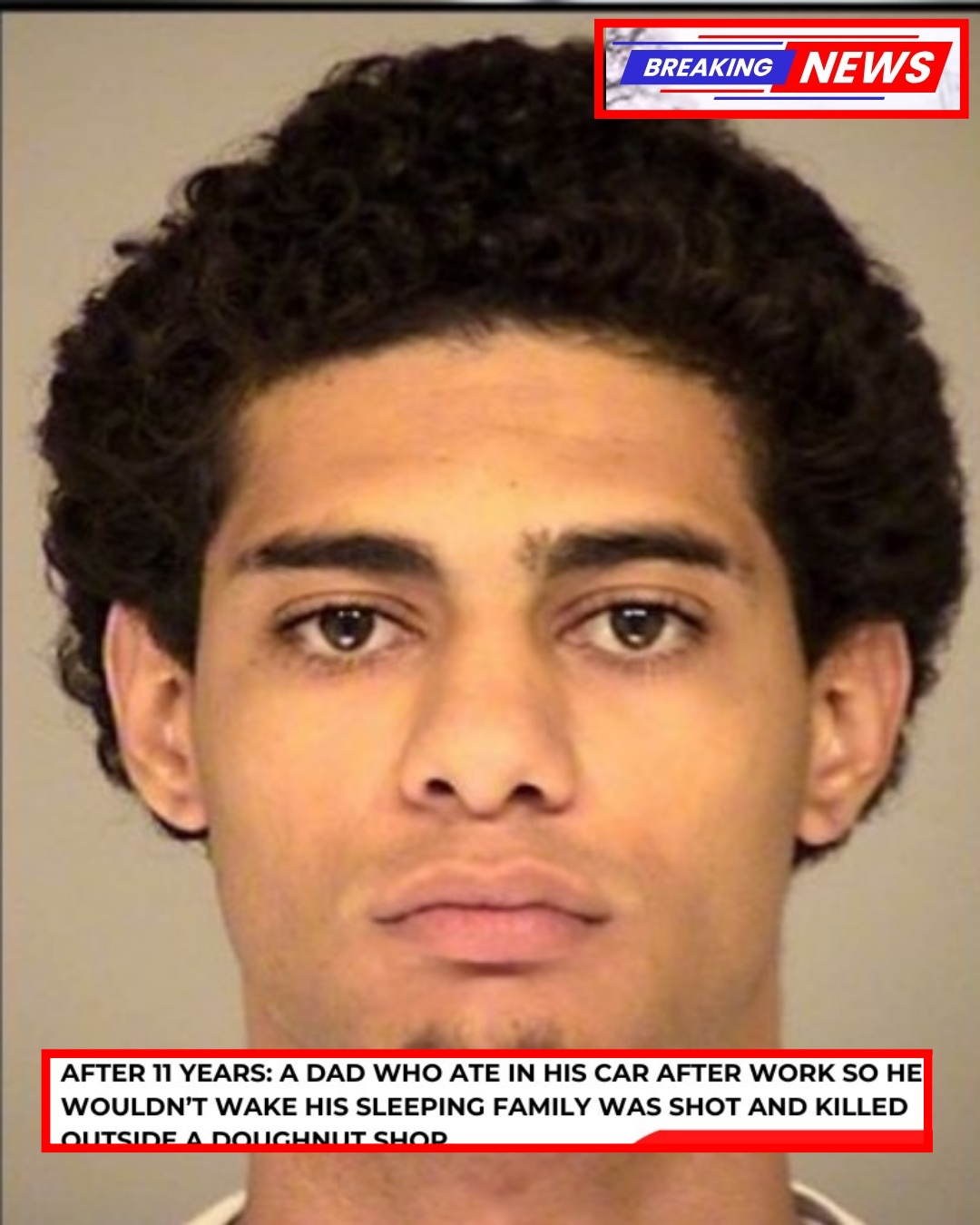
What should have been a quiet, forgettable moment at the end of a long workday instead became the final chapter in a young father’s life. On a warm spring night in California, Angel Diaz made a small, thoughtful decision—one rooted in love and responsibility—that would unknowingly place him in the path of unimaginable violence. He chose to sit alone in his pickup truck outside a doughnut shop, eating his dinner in silence, rather than go home and risk waking his sleeping family. It was an ordinary act of care, the kind performed by countless parents every night, and it would cost him everything.
Angel Diaz was only 25 years old, but he already carried the weight of adulthood with quiet determination. He was a husband, a father, and a provider who worked long, late shifts to ensure stability for the people he loved most. Those who knew him described him as gentle, hardworking, and deeply devoted to his family. He wasn’t reckless or careless. If anything, Angel was known for thinking ahead, for putting others before himself, and for making sacrifices without complaint. That night, like many before it, he was simply tired.
The doughnut shop where Angel parked was familiar, unremarkable, and well-lit—hardly the kind of place one would associate with danger. His truck idled quietly as he ate, the engine humming softly, the glow from nearby streetlights reflecting off the windshield. Inside the cab, there was no sense of urgency, no awareness that his life was about to be violently cut short. Angel had no enemies, no disputes, and no reason to believe he was in danger. He was just passing time, letting the night settle before heading home.
While Angel sat in his truck, another story was unfolding nearby—one driven by chaos, aggression, and a complete disregard for human life. Nineteen-year-old Aaron Jabezz Holmes was moving through the area with four other individuals, engaging in what prosecutors would later describe as a violent crime spree. The group had no clear target, no defined motive beyond destruction. Their actions that night were impulsive, reckless, and fueled by a mindset that treated human lives as disposable.
Earlier that same evening, Holmes had already fired his gun at random people. In one instance, he shot at a driver he labeled an “enemy,” a term that carried no meaningful justification beyond his own distorted perception. In another, he fired toward a group of teenagers who were practicing a dance routine in a parking lot—young people doing nothing more than enjoying their time together. These acts were not the result of self-defense or provocation. They were random, senseless, and terrifying.
Despite the severity of these earlier shootings, Holmes continued moving through the area, armed and emboldened. Each pull of the trigger seemed to reinforce his belief that he was untouchable. There was no pause for reflection, no moment of restraint. Violence had become casual, almost routine. It was in this state of reckless momentum that Holmes noticed Angel Diaz sitting alone in his truck.
From the outside, Angel’s truck appeared vulnerable—one person, alone, stationary. To Holmes, that was enough. He approached the driver’s side window with a loaded gun, tapping on the glass in a gesture that immediately shattered the calm of the night. Inside the truck, Angel was suddenly thrust into a moment of pure terror. He had no idea who this person was or what he wanted. He only knew that a stranger with a gun was standing inches away.
Instinct took over. Angel tried to escape. He reached to shift gears, hoping to drive away before the situation escalated. It was a natural, desperate response—a young father fighting for his life. But he never got the chance. Before Angel could pull away, Holmes fired a single shot through the driver’s side window.
The bullet struck Angel, causing catastrophic injuries. In those final moments, there was no opportunity for defense, no chance to plead, no time to understand why this was happening. The force of the shot caused Angel to lose control of the vehicle. His truck veered forward, crashing into the doughnut shop just feet away. The impact drew attention, but it was already too late.
First responders arrived to a scene of devastation. Inside the truck, Angel Diaz was dying. Efforts to save him were unsuccessful. At just 25 years old, his life ended not because of a mistake he made, but because he crossed paths with someone who chose violence without reason. The place where he had paused to eat—a symbol of normalcy and routine—became the site of a fatal crime.
News of Angel’s death sent shockwaves through his family and community. His wife was left to face the unthinkable: raising their children without the man who had promised to stand beside her. Those children would grow up with memories, photographs, and stories, but without their father’s presence. Birthdays, school events, and milestones would pass with an absence that could never be filled.
For investigators, the case was part of a broader pattern of violence that night. Holmes and his actions quickly became the focus of an intensive investigation. Prosecutors worked to piece together the sequence of events, gathering evidence that demonstrated not only what happened to Angel Diaz, but the broader danger Holmes posed to the public. Witness statements, forensic analysis, and ballistic evidence all pointed to a clear conclusion.
Yet justice did not come quickly. Years passed as the legal process unfolded. For Angel’s family, time moved differently. Grief did not fade with the calendar. Each delay, each court date, and each procedural step reopened wounds that never fully healed. Still, they waited—because accountability mattered, even if it could never undo the loss.
Nearly eleven years after that night, the case reached a turning point. Aaron Jabezz Holmes, now 30 years old, appeared in court and pleaded no contest to first-degree murder. The plea acknowledged the weight of the evidence against him and avoided a lengthy trial, but it did not lessen the gravity of his actions. Prosecutors confirmed that Holmes had personally and intentionally discharged the firearm that killed Angel Diaz.
The sentence was severe: 54 years to life in prison. It was a punishment that reflected not only the murder of Angel Diaz, but the broader pattern of violence Holmes had unleashed that night. For the family, the sentence brought a measure of closure—but not peace. No amount of prison time could restore what had been taken.
In the courtroom, Angel Diaz was remembered not as a victim in a case file, but as a human being. He was described as a devoted father, a loving husband, and a man who worked hard to provide for his family. Prosecutors emphasized that Angel was not involved in any criminal activity, was not armed, and posed no threat. He was simply in the wrong place at the wrong time.
The contrast between Angel’s intentions and Holmes’ actions could not have been more stark. One man was thinking about his sleeping children, choosing kindness and consideration. The other was moving through the night with a weapon, driven by impulse and indifference. Their paths crossed for mere seconds, but the consequences would last generations.
Angel’s death serves as a chilling reminder of how fragile life can be in the face of senseless violence. It underscores how ordinary moments—eating a meal, sitting in a car, waiting for the right time to go home—can be shattered without warning. There was no argument, no exchange of words, no reason at all.
For the community, the case became a symbol of the broader impact of gun violence. It highlighted how innocent people are often the ones who pay the highest price, and how quickly lives can be destroyed by a single decision. Angel Diaz did everything right that night. He tried to avoid trouble. He tried to protect his family. He tried to escape.
He never made it home.
Today, Angel’s story lives on through those who loved him and through the quiet power of his final act—a simple, loving choice that speaks volumes about who he was. He was not a target. He was not a threat. He was a young father trying to get through another workday for the people who mattered most.
And for that, his life was stolen.