
In the early 1980s, Gary Plauché was an ordinary father living in Baton Rouge, Louisiana. He worked hard, raised his family, and was deeply devoted to his son, Jody. Those who knew him described him as protective, involved, and proud of the young boy who was growing up under his care. Jody, at eleven years old, was trusting and gentle, a child who still believed the world was mostly safe.
That belief was shattered when Jeff Doucet entered their lives. Doucet was a man with a dark and dangerous history, though much of it was not fully understood at the time. He befriended Jody through shared interests and gradually gained his trust. Like many predators, Doucet did not act suddenly or violently at first. He positioned himself as safe, friendly, and reliable, carefully lowering the defenses of both the child and the adults around him.
In February 1984, Doucet abducted Jody from Louisiana. He took him across state lines to California, a journey that would later become a key legal detail. During the days that followed, Doucet held Jody captive in a motel room in Anaheim, where he repeatedly abused him. For Jody, the experience was terrifying and disorienting, marked by fear, confusion, and the sudden collapse of everything familiar.
Back in Louisiana, Gary Plauché was living every parent’s nightmare. His son was gone, taken without warning, and the days stretched into an agonizing wait filled with uncertainty. Law enforcement worked across jurisdictions, and eventually, Doucet was located and arrested in California. Jody was rescued alive, but the emotional damage had already been done.
When Gary learned what had happened to his son, the knowledge hit with devastating force. The abuse was not abstract; it was intimate, personal, and irreversible. Jody was physically alive, but deeply traumatized. Gary now had to face not only his child’s suffering, but the knowledge that another man had deliberately destroyed his son’s innocence.
Doucet was extradited back to Louisiana to face charges. On March 16, 1984, he was escorted through Baton Rouge Metropolitan Airport by police officers. He was handcuffed, surrounded by law enforcement, and under full custody. Television cameras were present, documenting the transfer as part of routine news coverage.
What no one present fully grasped was that Gary Plauché was also in the airport that day. He had positioned himself carefully, blending into the public space. Hidden inside his boot was a .38 caliber revolver. He had not announced his intentions to anyone. There was no manifesto, no warning, no dramatic declaration. Only silence and resolve.
As Doucet was led through the terminal, Plauché stepped forward. In one swift motion, he drew the weapon and fired a single shot into the back of Doucet’s head. The sound echoed through the airport. Doucet collapsed instantly, dying on the spot. The entire moment was captured on camera, freezing history into one chilling image that would be replayed and debated for decades.
Police immediately subdued Plauché. He did not resist. According to witnesses, he remained calm, almost eerily composed. When officers arrested him, he reportedly said, “If someone did this to your child, you’d understand.” Those words would later become central to the public’s reaction to the case.
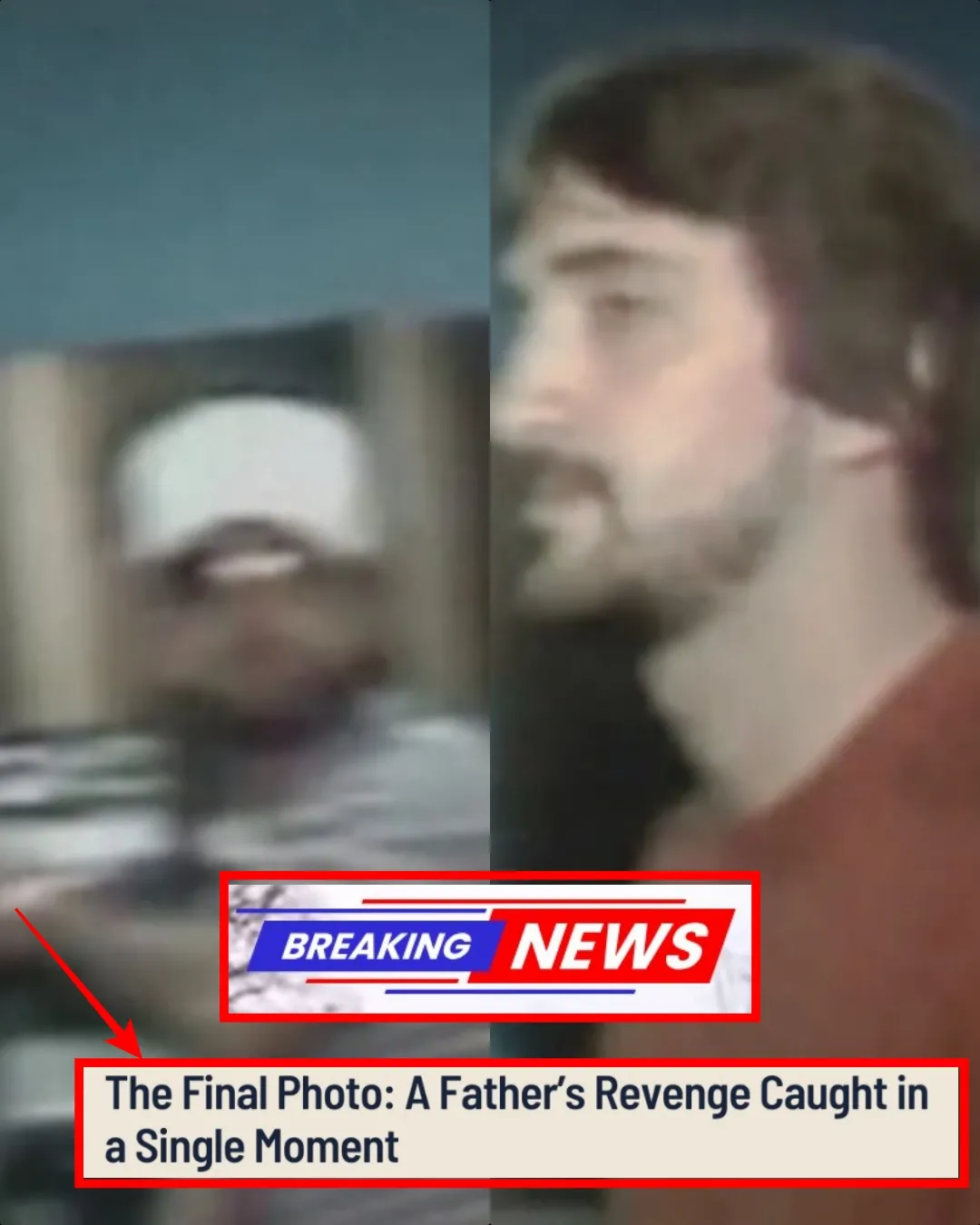
The photograph taken at the moment of the shooting became iconic. It showed Doucet walking forward, unaware of what was about to happen, and Plauché standing just behind him, gun raised, face set with grim determination. The image circulated widely, becoming a symbol of both horror and moral conflict.
Public reaction was immediate and intense. Many people expressed sympathy for Plauché, viewing his actions as an understandable response to an unforgivable crime. Others argued that what he did was murder, plain and simple, regardless of Doucet’s actions. The case divided public opinion in a way few criminal cases ever had.
Legally, the facts were clear. Plauché had intentionally killed an unarmed man in police custody. There was no dispute about what happened. The question was how the justice system should respond to a crime committed in such extraordinary emotional circumstances.
Plauché was charged with second-degree murder. However, his defense centered on temporary insanity, arguing that the emotional trauma of learning what had happened to his son overwhelmed his ability to control his actions. Mental health experts testified about the psychological impact of such trauma, particularly on parents.
The court ultimately showed remarkable leniency. Plauché accepted a plea to manslaughter and was sentenced to a suspended term with probation, community service, and mandatory counseling. He served no prison time. The decision reflected not only legal reasoning, but an acknowledgment of public sentiment and the unique nature of the case.
Jeff Doucet’s past further complicated public perception. During the investigation, it emerged that he had previously been suspected in other cases involving minors. To many, this reinforced the belief that Plauché had eliminated a future danger. To others, it raised troubling questions about vigilantism and the role of the state in administering justice.
For Jody Plauché, the aftermath was complex. While his father’s actions were widely discussed, Jody himself had to process both the trauma of abuse and the knowledge that his father had killed someone because of it. As he grew older, Jody spoke openly about the lasting psychological impact of both events, emphasizing that violence did not erase his pain.
In later years, Jody became an advocate for survivors of abuse, using his story to highlight the long-term effects of trauma and the importance of proper support. He has stated that while he understands his father’s actions, he does not glorify them. His perspective added another layer of nuance to a story often reduced to headlines.
Gary Plauché lived the rest of his life under the shadow of that moment. He was neither celebrated nor condemned in simple terms. He became a symbol of moral ambiguity, a man whose actions could not be easily categorized as heroic or villainous.
The case has since been studied in law schools, psychology courses, and ethics debates. It is frequently cited in discussions about emotional distress, criminal responsibility, and the limits of empathy in the justice system. It challenges the assumption that law and morality always align.
What makes the Plauché case endure is not the violence itself, but the questions it leaves behind. Can justice exist without mercy? Can mercy exist without consequence? And how should society respond when a crime is committed in response to another, even more horrifying crime?
The haunting photograph remains, a frozen fraction of a second that captures the collision of pain, rage, love, and law. It does not offer answers. Instead, it demands reflection.
Decades later, people still argue about whether Gary Plauché did what many secretly believe they would do, or whether his actions crossed a line that must never be crossed, no matter the circumstances. The truth may lie somewhere in between, uncomfortable and unresolved.
In the end, the story of Gary Plauché is not just about a killing in an airport. It is about a father’s breaking point, a system struggling to balance justice with humanity, and a society forced to look at its own instincts when confronted with unimaginable harm. It is a story that refuses to fade, because it asks a question that has no easy answer: when the law feels insufficient, what does justice really mean?