
The desert air was unusually still on the last day of 2025, a quiet calm that seemed almost to foreshadow the events about to unfold in the courtroom of Pinetop, Arizona. Outside, the sun glinted off the jagged peaks, painting the sparse landscape in gold and amber. Inside, a courtroom filled with the hushed tension of anticipation — reporters with notebooks poised, legal clerks shuffling papers, and a gallery of onlookers whose whispers barely disturbed the heavy air.
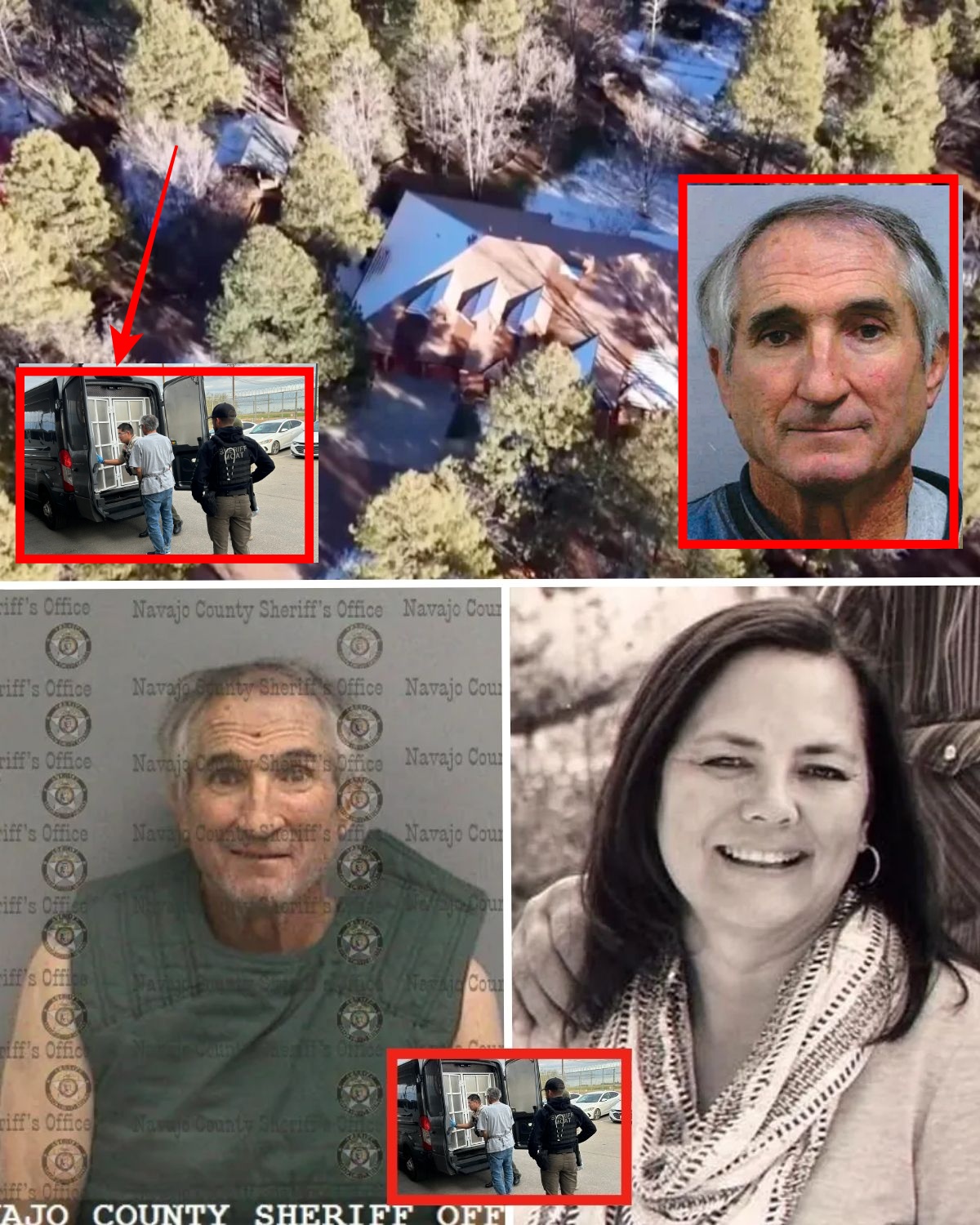
Michael Abatti, 63, stood at the defendant’s table, his tall frame almost rigid under the weight of the accusations he faced. His face was set, expression carefully neutral, as though he had rehearsed every line, every gesture for this moment. Behind him, a team of defense attorneys reviewed notes and whispered legal strategies. Across the room, the prosecution prepared exhibits, carefully organizing evidence that investigators had spent months gathering.

At the center of the case was Kerri Ann Abatti, a woman whose life had been cut violently short. Her reputation as a former beauty queen, philanthropist, and mother made the story all the more shocking. Neighbors and friends alike had described her as warm, engaging, and seemingly untouchable by the darker currents of life that swirled around her divorce proceedings. Yet, the same headlines that once celebrated her triumphs now detailed a tragedy that left the entire community reeling.
The divorce had been fraught from the beginning. Michael, a man known for his expansive water holdings across California, had appeared in court multiple times over disputes involving property, spousal support, and long-standing grievances that had simmered for decades. Kerri Ann had requested $30,000 a month in support, a sum that became a central point of contention and reportedly an element in the chain of events leading to her death.
In the days following the murder, law enforcement outlined a narrative that seemed ripped from the pages of a thriller. Kerri Ann had been shot through the window of her Pinetop home, a targeted attack carried out with precision. While authorities remained careful with details, it was clear that the incident had been planned, orchestrated, and executed with a cold-blooded clarity that sent ripples of fear through the small community. For those who knew her, the violence was inconceivable — for those who knew Michael, it was a jarring juxtaposition of public persona and private turmoil.

On December 31, the day of the hearing, the courtroom brimmed with the quiet intensity of a high-profile case. Reporters live-streamed proceedings, capturing each movement, each word, and each subtle expression. Cameras were fixed on Michael as he faced the judge, the weight of a first-degree murder charge pressing down with every breath. The bond, set at an astonishing $5.5 million, underscored the severity of the allegations and the gravity of the potential consequences.
Prosecutors recounted the evidence with meticulous care. The timeline of Michael’s alleged actions was laid bare: a seven-hour drive across the desert, coordinated movements, and interactions that investigators claimed tied him directly to the scene. Digital footprints, witness testimonies, and material evidence were all presented to paint a comprehensive picture of premeditation, control, and opportunity.
Defense attorneys, in contrast, portrayed a different narrative. Michael’s team argued that circumstantial evidence could not, in their view, establish guilt beyond a reasonable doubt. They highlighted inconsistencies in witness statements, questioned procedural handling of the digital evidence, and emphasized his long-standing ties to the community, seeking to humanize a man whose reputation had been swiftly reduced to headlines and speculation.
Throughout the proceedings, the tension between factual evidence and public perception became apparent. Outside the courthouse, news crews and curious onlookers gathered in clusters, sharing theories, offering commentary, and absorbing the spectacle of a case that combined wealth, power, and tragedy. The contrast between Michael’s image as a “pillar of the community” and the accusations against him created a palpable sense of dissonance.
Investigators had spent countless hours reconstructing the scene. Forensics teams documented the window, ballistic trajectories, and the positioning of objects inside Kerri Ann’s home. Even the minutiae — fingerprints, traces of fabric, and the angles of light through the window — were analyzed to provide a comprehensive understanding of the events. Each piece of evidence was carefully cross-referenced with Michael’s known activities, establishing connections that the prosecution believed would prove determinative.

The personal dimension of the tragedy was woven throughout the trial. Kerri Ann’s family, still mourning, provided statements that spoke to her character, her routines, and the fear that had escalated in the days before her death. Friends described confrontations over finances, arguments that had become increasingly heated, and moments that suggested a relationship spiraling beyond control. These testimonies added a human depth to the technical and procedural aspects of the trial, reminding all present that beyond legal points were lives irrevocably altered.
Legal scholars watched the case closely. The intertwining of wealth, legal maneuvering, and technology presented a cautionary tale about access to resources, influence over outcomes, and the ethical obligations of those with power. The use of digital evidence, including GPS tracking, communications data, and electronic records, highlighted how modern investigations rely not just on witness statements, but on an intricate lattice of technology that can either clarify or complicate the search for truth.
As the days of testimony progressed, the courtroom became a stage where competing narratives played out in meticulous detail. Experts explained forensic processes, reviewed the chain of custody for evidence, and provided hypothetical reconstructions. Legal arguments volleyed across the room, probing definitions of intent, premeditation, and culpability. Each statement, each question, each pause was a potential pivot in a case that could redefine reputations and lives.
Outside, the town of Pinetop grappled with the implications. Residents reflected on the stark contrast between the serene desert landscape and the shocking violence that had transpired within its bounds. Conversations shifted from casual exchanges to careful discussions of safety, legal boundaries, and the unpredictable intersections of personal conflict and extreme action. A community once defined by familiarity now navigated the uneasy terrain of suspicion and uncertainty.
Media coverage amplified the sense of intensity. Stories circulated not just locally, but nationally, as the elements of wealth, notoriety, and the starkness of the crime created a narrative that captivated audiences. The coverage highlighted not just the legal dimensions, but the broader societal implications: questions about how domestic disputes escalate, how wealth and influence intersect with law enforcement, and how communities reconcile public images with private actions.
In the courtroom, the judge maintained a measured presence, balancing the need for procedural fairness with the high stakes of public scrutiny. Decisions about bond, admissibility of evidence, and procedural challenges were made with deliberate care, mindful that any misstep could reverberate far beyond the case itself. Observers noted the careful rhythm of the proceedings, the way tension was acknowledged but never allowed to tip into chaos.
As the trial unfolded, investigators and legal professionals alike were confronted with difficult questions. Was this a crime of opportunity, or of long-term calculation? How could digital and physical evidence be reconciled to form a coherent narrative? What weight should be given to motive, previous behavior, and the emotional dynamics of the parties involved?
Throughout, Michael Abatti’s demeanor remained composed, almost stoic, as though insulated from the unfolding storm. Observers debated whether this was a display of confidence, detachment, or something else entirely. His responses to questioning were measured, careful, and deliberately neutral, leaving jurors, prosecutors, and the public to interpret intent and character through a prism of limited information.
Meanwhile, forensic and cyber experts continued to provide insights into the technological dimension of the case. Data reconstructed from devices, timestamped communications, and GPS logs all contributed to a picture that was simultaneously precise and tantalizingly incomplete. The combination of human testimony and machine analysis created a layered narrative, where certainty was elusive and interpretation critical.
As weeks turned into months, the courtroom proceedings revealed both clarity and ambiguity. Every piece of evidence seemed to answer some questions while raising others. The prosecution’s narrative emphasized premeditation, planning, and the cold calculus of execution. The defense highlighted gaps, uncertainties, and alternative explanations that cast doubt on direct culpability.
Community sentiment was divided. Some viewed the proceedings as a long-overdue reckoning, justice finally reaching a man of means who had allegedly overstepped legal and ethical boundaries. Others questioned whether the intensity of media coverage, combined with public fascination, might distort the perception of reality and influence the judicial process.
In parallel, analysts noted the wider implications of the case for domestic dispute management, wealth-related influence, and the role of technology in modern investigations. It became an example in professional circles of how multiple domains — legal, technological, social, and emotional — intersect in high-profile criminal investigations.
The trial ultimately became as much about narrative, perception, and societal reflection as it was about individual guilt or innocence. Each testimony, each cross-examination, each procedural decision contributed to an evolving story that stretched beyond the courtroom walls.
And yet, as the days of evidence, arguments, and deliberation continued, a central truth remained: one life had been taken, one community had been shaken, and one question loomed above all else, unrelenting and unresolved.
Who orchestrated this act?
Why was it carried out with such precision?
And what hidden realities about power, wealth, and modern crime remain unseen, even in the daylight?
For Pinetop, and for the public observing from afar, the answers had yet to be revealed. Each court session, each new piece of evidence, offered the promise of clarity — yet the mystery lingered like a shadow across the desert landscape, unseen, pervasive, and chilling in its persistence.
The story of Michael and Kerri Ann Abatti became more than a legal case; it became a symbol of the unpredictable intersection of wealth, relationships, and technology. It was a narrative that captivated, confounded, and unsettled, reminding all who followed it that even in communities that appear serene, danger can be methodical, invisible, and devastating.
And so the question endures: in a world where every movement can be traced, every action monitored, and every secret potentially exposed, what truly lies behind the lives we see — and what truths remain hidden, waiting for discovery?