
This is the story of Operation Blockbuster. Five brutal chapters. Chapter 1, the Siegfried Line’s northern gamble. Chapter 2, the plan that shocked the Wehrmacht. Chapter 3, when artillery rewrote the rule book. Chapter 4, the Hochwald gap, Germany’s costliest stand. Chapter 5, why this battle ended the Western Front. Let’s begin.
Chapter 1, the Siegfried Line’s northern gamble, the German fortress mentality, February 1945. While Soviet armies hammer toward Berlin from the east, something critical unfolds in the west that most histories overlook. The Siegfried Line, Germany’s massive fortification network. 600 km of concrete bunkers, dragon’s teeth obstacles, and interconnected defensive positions stretching from the Dutch border to Switzerland.
According to German military planning documents, the northern sector, particularly the region around the Hochwald and Baberger forests, represented what planners called the anchor position. General Obst Alfred Schlemm commands the first parachute army here. Not regular infantry, these are Fallschirmjäger, paratroopers converted to elite defensive troops after years of brutal combat.
Post-war interrogation records show Schlemm’s confidence in his position. His forces control the high ground. Dense forest provides natural concealment. The frozen terrain severely limits enemy mobility, and he’s positioned his troops brilliantly. >> [snorts] >> The 84th Infantry Division occupies the Hochwald forest itself. The 6th Parachute Division covers the critical flanks.
Artillery batteries are pre-registered on every conceivable approach route. The defensive engineering is sophisticated. Concrete bunkers positioned every 150 to 200 m, interlocking fields of fire, anti-tank guns covering all roads, minefields protecting the gaps. Behind everything lies the Rhine river, Germany’s final natural barrier before the industrial Ruhr.
According to German operational estimates documented in post-war archives, Schlemm calculated that attacking through this position in winter would require a 3:1 numerical advantage minimum. More likely 4:1. And even then, casualties would be catastrophic. His chief of staff, Obst Hermann Schulte, summarized the situation in a February briefing recorded in division war diaries.
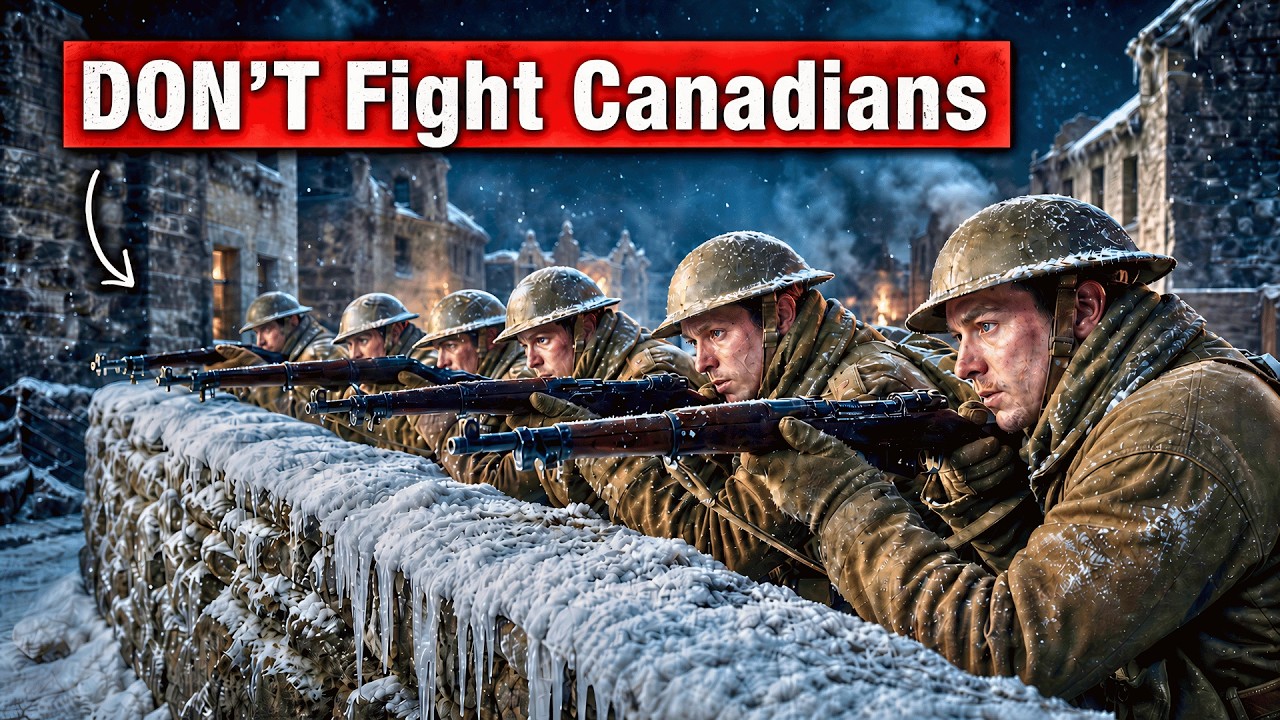
The weather is our greatest ally. No competent enemy commander would attempt a major offensive in these conditions. February in northwestern Germany means sub-zero temperatures, frozen ground harder than concrete, visibility reduced to nearly nothing during snow squalls. Tanks cannot maneuver off established roads.
Infantry movement becomes exhausting, dangerous. Equipment failures multiply. Frostbite hospitalizes as many men as combat. Historical records show Schlemm believed he could hold until spring, then negotiate, perhaps sue for separate peace with the Western Allies. But there’s a critical intelligence failure developing.
Schlemm doesn’t know who’s about to hit him, the Canadian factor, Lieutenant-General Guy Simonds. Commander, First Canadian Army, aged 32, the youngest army commander in the British Commonwealth, and according to Field Marshal Bernard Montgomery’s private correspondence, the most aggressive battlefield commander I have. Simonds sits in his headquarters at Tilburg, Netherlands, studying reconnaissance photographs and intelligence summaries.
His superior, Montgomery, has given him the mission, break the Siegfried Line’s northern sector, open the route to the Rhine, cut off German forces before they can establish new defensive lines. Montgomery’s operational directive, preserved in the Imperial War Museum archives, is blunt. This will be the hardest fighting since Normandy.
Perhaps harder. The Germans are desperate. They’ll fight for every meter. Simonds’ response, according to staff officers’ memoirs, was characteristically direct. Then we’ll need to hit them harder than they’ve ever been hit before. The First Canadian Army at this point isn’t purely Canadian. It’s a powerful multinational force.
The Second Canadian Corps forms the spearhead. British XXX Corps provides armored support. Polish armored divisions stand ready. Scottish infantry brigades integrate into the assault formations, but the breakthrough force, predominantly Canadian, the 4th Canadian Armoured Division under Major-General Chris Vokes, the 2nd Canadian Infantry Division under Major-General Bruce Matthews.
Elite units, the Black Watch of Canada, the Calgary Highlanders, the Régiment de Maisonneuve, the Essex Scottish. These aren’t novice troops. War diaries and unit confirm these formations fought from Juno Beach through Caen, Falaise, the Scheldt Estuary. They’ve seen everything, done everything. And now they’re about to do something the Germans think is impossible.
Simonds convenes his senior commanders. According to the official Canadian history by C.P. Stacey, the meeting on February 20th is sobering. Gentlemen, operational records quote Simonds saying, “Operation Blockbuster begins in 6 days. Our objective, punch through the Hochwald-Baberger position within 72 hours.

” The silence in the room speaks volumes. Every professional officer present understands the tactical reality. Frontal assault, winter conditions, against prepared positions in terrain that favors the defender. The German defensive doctrine manual, captured and studied by Allied Intelligence, specifically identifies this type of position as near impregnable under winter conditions.
But Simonds has been studying something else. Artillery coordination tables, ammunition expenditure rates, weather forecasts. He’s calculated something the Germans haven’t anticipated. What if you don’t try to be clever? What if you simply bring overwhelming coordinated violence? Not a clever flanking maneuver, not deception, just crushing, methodical, unstoppable force.
Major-General Vokes, according to divisional war diaries, asked the critical question, “What artillery support?” Simonds’ answer changes everything. Over a thousand guns. The room reacts. That’s more concentrated artillery than most operations in the entire Italian campaign, more than several D-Day sectors combined.
“Where?” someone begins. Already positioning, Simonds cuts him off. Every gun in Second Army, every available piece from First Canadian Army, American guns from Ninth Army on loan, even some captured German pieces. According to Terry Copp’s research in Cinderella Army, the final tally approaches 1,034 artillery pieces.
Field guns, medium artillery, heavy howitzers, self-propelled guns. The largest artillery concentration on the Western Front since the Normandy invasion. Brigadier Stanley Todd, commanding the artillery, later wrote in his memoirs, “We weren’t planning suppressive fire. We were planning to physically destroy the German defensive zone before our infantry arrived.
” The plan is methodical, scientific, brutal. Rolling barrage advancing at exactly 100 m every 3 minutes. Infantry following 50 m behind the explosions. Armor pushing through gaps the moment they appear. Continuous pressure. No pause, no respite. Attack through the night, attack through the day, attack until German resistance collapses.
It’s not elegant. It’s engineering applied to warfare, and the Germans have no idea it’s coming. The countdown, February 22nd through 25th, Canadian preparations intensify. Artillery pieces move into position under cover of darkness and weather. Forward observers infiltrate to within visual range of German positions, marking targets.
The Germans notice increased activity. Division war diaries record heightened enemy patrol activity and probable artillery registration. But German intelligence assessments preserved in OKW archives conclude this is routine harassment fire and defensive preparation for expected German counterattack. They’re seeing what they expect to see, not what’s actually happening.
One German officer doesn’t buy it. War diaries from the 84th Infantry Division reference a company commander commanding forward bunker positions who repeatedly warns division headquarters that enemy artillery activity appears coordinated and systematic. “This isn’t random,” he reportedly tells his staff.
“They’re preparing something major.” His warnings go up the chain. Division acknowledges, Corps notes it, Army headquarters files it. No action taken. The German command structure, according to post-war analysis, suffers from what modern military theorists call “mm bias.” They believe winter makes major offensive operations impossible.

Therefore, increased activity must be something else. Meanwhile, Canadian assembly areas become organized chaos. Tank crews perform final mechanical checks. Infantry companies conduct equipment inspections. Ammunition is distributed, each rifleman carrying 200 rounds minimum, every section issued extra grenades.
Medical units establish casualty collection points. Engineers prepare bridging equipment. Signals personnel string communications wire. Everything points to one moment, February 26th, 0415 hours. According to multiple war diaries, unit commanders synchronize watches at midnight.
Artillery crews stand by their guns. Infantry wait in frozen assembly areas. The temperature drops to minus 15° C. Perfect attacking weather if you’re Canadian. Dot Chapter 2, the plan that shocked the Wehrmacht, the science of overwhelming force, February 24th, 1945, 300 hours. Canadian forward observers complete their final preparations.
These aren’t random positions. Artillery planning documents show meticulous target analysis. Every German bunker identified, every known artillery position plotted, every likely reinforcement route mapped. Brigadier Todd’s artillery plan, preserved in the Canadian archives, is a masterpiece of coordination.
Over a thousand guns divided into specific fire missions, some targeting German artillery to achieve counter-battery suppression. Others creating the rolling barrage. Still others prepared for on-call fire support. The ammunition expenditure plan is staggering. Tens of thousands of shells pre-positioned. Supply columns already moving forward with resupply.
This isn’t just firepower, it’s orchestrated destruction. The rolling barrage concept requires precise execution. Artillery fire advances exactly 100 m every 3 minutes. Infantry must maintain that pace. Stay too close, risk friendly fire. Fall too far back, walk into recovered German positions.
Training records show Canadian infantry practice this extensively. Platoon commanders carry synchronized watches. Section leaders know their exact advance rates. It’s dangerous, difficult, demanding, but according to after-action reports from previous operations, it works. The artillery umbrella suppresses German defensive fire while infantry advances.
Explosions create smoke and debris that blocks German observation. The psychological impact is devastating. Simon’s plan adds another layer, night assault. Most armies avoid night attacks, too much confusion, too much risk of friendly fire, too difficult to coordinate. But Canadian training emphasizes night operations.
Unit war diaries document extensive night exercise programs throughout late 1944 and early 1945. The logic is sound. German defensive positions are optimized for daytime fields of fire. Night reduces that advantage. Artillery provides navigation reference, follow the barrage. And psychologically, being hit by overwhelming artillery in darkness is uniquely terrifying.
The German blind spot, February 25th, evening. In his headquarters, General Obleschlemm reviews the daily intelligence summary. German signals intelligence reports increased radio traffic in Canadian sectors. Aerial reconnaissance, limited by weather, notes some vehicle movement. The intelligence assessment concludes, “No indications of imminent major offensive operations.
” This failure isn’t stupidity, it’s sophisticated Canadian deception. Allied intelligence operations, documented in post-war British intelligence histories, implemented a comprehensive deception plan. Dummy radio traffic suggesting attacks in different sectors. Limited forward activity to avoid alerting German observation posts.
Artillery registration disguised as routine harassment fire. Even the weather helps. Cloud cover grounds German reconnaissance aircraft during critical preparation phases. Schlemm’s operational estimates, based on available intelligence, predict that if the Allies attack, it won’t come until late March or April when weather improves.
His defensive planning reflects this assumption. Troop rotation schedules, supply priorities, even leave policies. The entire German First Parachute Army is positioned for a long winter defense, not for what’s about to hit them in 18 hours. The final hours, February 26th, 200 hours. Canadian infantry move to assault positions.
According to war diaries, movement is silent, disciplined. No smoking, no talking. Radio silence except for essential command communications. Company commanders brief their platoon leaders one final time. The plan is straightforward. Artillery lifts at 0415. Infantry advances immediately. Objective, penetrate 3,000 m by nightfall.
Secure the Hochwald forest edge. Tank formations position behind the infantry start lines. Crews perform final checks. Engines are kept running in this cold. Stopping means risking failure to restart. Medics prepare casualty collection points. Chaplains move among the troops. Some men write final letters home. Others clean weapons for the fourth or fifth time. A few sleep.
Combat veterans can sleep anywhere. The silence is heavy. For 400 hours, 15 minutes, artillery crews stand by their guns. Shells loaded, aiming stakes confirmed, fire control orders distributed. Infantry companies fix bayonets. The metallic clicking sound ripples through the darkness. 0410 hours, 10 minutes. In German positions, sentries peer into darkness.
Some hear distant engine noises. Others report nothing unusual. One German observation post, according to captured logs, reports possible enemy activity, sector unclear at 0408 hours. The message reaches battalion headquarters at 0413, 2 minutes too late. 0414 hours. One minute. Canadian artillery officers watch their chronometers.
Hands on firing lanyards. Simon stands in his command post. Radio operators monitor frequencies. Staff officers plot positions on maps. He lights a cigarette. Checks his watch. 30 seconds. 20. 10. And then, the world transforms into sound and fury. Chapter 3, When Artillery Rewrote the Rulebook. The bombardment, 4:15 hours, February 26th, 1945. Over a thousand guns fire.
The sound is physical, not just heard but felt. A pressure wave that hits the chest, a vibration in the ground. According to veterans’ accounts collected in oral history archives, the noise is beyond description, continuous, overwhelming, all-consuming. The shells scream overhead, different calibers creating different pitches, a symphony of destruction.
3 seconds of flight time. Then the German positions erupt. High explosive shells detonate in the tree canopy. Shrapnel tears through branches. Secondary explosions as shells hit ammunition stores. Trees shatter into deadly splinters. The frozen ground convulses. Bunkers shake. Concrete cracks under repeated impacts. German soldiers in the forward zone experience something few armies have faced, total artillery saturation.
War diaries from surviving German units describe continuous earthquake and impossible to remain in bunkers due to structural collapse risk. Communication lines cut within the first 2 minutes. Radio antennas destroyed. Observation posts obliterated. The barrage continues for 40 minutes.
Artillery expenditure reports show over 20,000 shells in that opening bombardment. An average of one shell every 5 seconds falling on the German defensive zone. When the barrage shifts, transitioning from stationary targets to the rolling barrage, the Hochwald forest edge looks transformed. Craters overlap.
Trees reduced to jagged stumps. Bunkers collapsed. The earth itself churned and broken. And then the Canadians come forward. The infantry push, 0455 hours. The Calgary Highlanders advance. According to regimental war diaries, platoons move in disciplined rushes. Stay tight to the barrage. Maintain formation.
Watch for surviving German positions. The smoke hangs thick in the frozen air. Visibility may be 30 m. The smell of cordite mixed with shattered pine. They reach the first bunker line. Most positions are destroyed or abandoned. Concrete cracked. Firing slits blocked with rubble. German defenders either dead, wounded, or fled deeper into the forest, but not all.
A surviving German MG 42 position opens fire. The distinctive sound, incredibly high rate of fire, around 1,200 rounds per minute, rips through the smoke. Veterans’ accounts describe the effect. Like a buzzsaw, you don’t hear individual shots, just one continuous tearing sound. Three Canadians are hit in the first burst.
The platoon reacts with practiced efficiency. Covering fire pins the German position. Flanking element maneuvers. Grenades thrown. The MG 42 stops. They continue advancing. The pattern repeats across the entire assault front. Small firefights at surviving German positions. Quick, violent, professional. The Black Watch of Canada pushes into the forest proper. The terrain is nightmarish.
Fallen trees block roots. Shell craters create obstacles. Frozen mud makes footing treacherous. Visibility decreases further under the canopy. Maybe 20 m. This is where German defensive planning should shine. Prepared positions, interlocking fields of fire, fighting from cover. But the artillery has disrupted everything.
Bunkers damaged, communication severed, units scattered. German resistance is brave but fragmented. Individual positions fighting independently. No coordinated defensive plan. The Canadians maintain momentum. Platoons support each other. When one section hits resistance, another flanks. When positions prove too strong, artillery is called in.
By 0730 hours, the Calgary Highlanders have advanced 800 m. The Black Watch, 600 m. The Essex Scottish, 700 m. Faster than operational planning predicted, but casualties are mounting. The price combat medical records paint a stark picture. Rifle companies that started with 120 men are down to 9100 within the first 3 hours.
Not all killed, many wounded, evacuated, or separated in the forest chaos. The regimental aid posts operate continuously. Medics work in shell holes behind knocked-out tanks in captured German bunkers. Wounds from multiple sources, small arms, shrapnel, concussion injuries from artillery near misses. Frostbite from men lying immobilized in snow.
The evacuation chain functions despite the chaos. Stretcher bearers move forward. Jeep ambulances navigate cratered roads. Field surgical units prepare for the flood of casualties. German casualties are worse. Captured medical logs show overwhelming numbers. Artillery bombardment caused massive casualties before infantry even arrived. Then close quarters combat in bunkers and forest fighting.
German medical services, already stretched thin across multiple fronts, struggle to cope. Many wounded Germans are simply left in positions as units retreat. Canadian medics treat them when found. Geneva Convention requires it, and Canadian medical personnel honor that requirement.
One captured German medical officer later told interrogators, “We expected combat casualties. We didn’t expect our positions to be destroyed before the fighting even started.” The armor challenge of 7:30 hours. The Fourth Canadian Armoured Division attempts to exploit the infantry breakthrough. This is where tank formations should surge forward, break into open terrain, create chaos in German rear areas, but the terrain doesn’t cooperate.
The main road through the Hochwald is cratered by artillery, both Canadian bombardment and German defensive fire. Shell holes every 50 m, some large enough to swallow a Sherman tank. Engineers work frantically to fill craters. Bulldozers push debris. Gravel and rubble dumped into holes, but it’s slow, agonizingly slow.
Meanwhile, Sherman tanks that try to move off-road discover why the Germans felt confident. The frozen ground that seems solid actually conceals soft spots. Drainage ditches buried under snow. Fallen trees hidden beneath white cover. Tank after tank bogs down, throws tracks, or becomes stuck. Recovery vehicles labor to extract them.
Precious time lost, and German anti-tank guns are still operational. A Canadian tank squadron moving down a partially cleared road encounters a German Pak 40 in a concealed position. The 75-mm anti-tank gun fires. At close range, maybe 200 m, it can penetrate Sherman frontal armor. The lead Sherman takes a hit. The armor-piercing round punches through.
Inside, the result is catastrophic. The crew has second to evacuate. Some make it, others don’t, but Canadian infantry have learned combined arms coordination. British Columbia Regiment infantry spot the Pak position. A PIAT team, projector infantry anti-tank, moves into range. The PIAT fires its hollow-charge warhead from 60 m.
The explosion destroys the gun and kills the crew. This pattern repeats throughout the day. German anti-tank positions ambush Canadian armor. Canadian infantry suppress or destroy the positions. Armor continues advancing. It’s effective, but it’s slow, and it’s costly. The first night, 1800 hours, February 26th. Darkness falls.
Canadian forces have penetrated 2,500 to 3,000 m into the German defensive zone. Significant progress, faster than conservative estimates, but they haven’t broken through. The Germans have established a new defensive line deeper in the forest. Casualty reports arrive at division headquarters. Numbers that make staff officers wince.
Approximately 400 Canadian casualties on the first day. Killed, wounded, missing. About 15% of the assault force. Historical context. In modern military planning, 15% casualties in one day is considered extremely heavy. But Seeman’s operational plan anticipated this. The plan assumed high initial casualties in exchange for rapid penetration.
The wounded fill aid stations and field hospitals. Medical personnel work through the night. Surgery by lantern and flashlight. Morphine, plasma, bandages. Some men will be evacuated to England. Others patched up and returned to their units within days. In German positions, the situation is worse. Surviving units have pulled back to secondary defensive lines, but they’ve lost cohesion.
Companies reduced to platoon strength. Battalions combat ineffective. Communication with higher headquarters remains sporadic. Runners carry messages through artillery fire. Radio traffic when possible. One German regimental war diary captured later records, “Casualties estimated 40-50%. Position untenable. Request permission to withdraw to Rhine. Permission denied.
Hold at all costs.” Day two. Momentum builds, February 27th, 600 hours. The artillery begins again. This time, German troops know it’s coming. They’re deeper in bunkers, better prepared psychologically, but knowing doesn’t stop high explosive shells. The bombardment is shorter this morning, 20 minutes instead of 40, but focused on identified German strongpoints.
Then infantry advances again. The Régiment de Maisonneuve, French Canadian infantry with a ferocious reputation, pushes into the Bourbourg Wald, a forest position adjacent to the Hochwald. According to regimental histories, the fighting is intense. German paratroopers defend stubbornly. These are elite troops, experienced, well-trained, motivated, but the Canadians don’t stop. Bunker by bunker.
Grenade exchanges at close range. Rifle fire through trees. Brutal, exhausting combat. By 1400 hours, the Bourbourg Wald is under Canadian control. The cost, approximately 140 casualties in 8 hours, but strategically, it’s critical. The Bourbourg position flanked the main Hochwald defenses. With it gone, German positions in the Hochwald become untenable.
German forces begin pulling back toward their final defensive position, the Hochwald Gap. Chapter 4. The Hochwald Gap. Germany’s costliest. Stand the geography of death. The Hochwald Gap is a geographic choke point. A valley approximately 1,500 m wide running between the Hochwald Forest and the Bourbourg Wald.
Relatively open ground compared to the dense forest on either side. German defensive planning identified this as the critical position. If the gap falls, the entire Siegfried Line northern sector becomes indefensible. General Eugen Meindl, a highly decorated Fallschirmjäger commander with combat experience from Crete to the Eastern Front, takes personal command of the defense.
Meindl’s service record shows exactly why the Germans trust him with this mission. Knight’s Cross with Oak Leaves. Wounded multiple times. Veteran of nearly every major airborne operation. He surveys the gap on February 27th. According to staff officers’ post-war accounts, Meindl immediately grasped both the strategic importance and the defensive advantages.
“We can hold here,” he reportedly tells his staff. “Every meter of this valley can be covered by fire. They’ll have to cross open ground under our guns.” He’s not wrong. German forces establish a formidable defensive array. Anti-tank guns positioned on both flanks with overlapping fields of fire. Machine gun nests dug into the forest edge.
Artillery pre-registered on the entire valley floor. Every available German unit in the sector concentrates here. Remnants of the 84th Infantry Division. Elements of the 6th Parachute Division. Tank destroyers pulled from reserve. Post-war casualty analysis and unit strength reports suggest approximately 5,000 to 7,000 German troops defending the gap position by February 28th.
Against them, two full Canadian divisions preparing to attack. The Canadian assessment, Major General Vokes, studies the gap from a forward observation post. According to his later reports, he immediately recognizes the tactical challenge. The Germans hold the high ground. Open approaches.
Excellent fields of fire. A textbook defensive position. But Vokes doesn’t plan finesse. He plans overwhelming force. “We’re going straight through the center,” operational records quote him telling his commanders. “Maximum artillery. Maximum armor. Maximum speed. We break their line before they can react effectively.
” His staff raises concerns about casualties. Crossing open ground under fire historically produces heavy losses. Vokes’ response, according to divisional war diaries, “The casualties will be heavy, but they’ll be acceptable compared to a prolonged siege. We need the Rhine crossings. Every day we delay costs more lives across the entire front.
It’s brutal calculus, but it’s honest.” The artillery plan for the gap assault is even more intensive than the initial bombardment. Over 800 guns, nearly all available artillery in the sector, will concentrate fire on the gap defenses. Rolling barrage advancing at 100 m per 3 minutes. Infantry staying within 50 m of the explosions. The risks are obvious.
Short rounds will kill Canadian soldiers, but German defensive fire will kill more if infantry don’t stay close to the artillery umbrella. Vokes makes his decision. “We stay tight to the barrage. Accept the risk of friendly fire casualties.” February 28th, the assault at 8:30 hours. The artillery opens fire. But this time, the Germans fire back immediately.
Counter-battery fire trying to suppress Canadian guns. The result is a massive artillery duel. Shells crossing into the midair. Explosions across the entire sector. Canadian infantry advances regardless. The Governor General’s Foot Guards lead the mechanized assault. Half-tracks and Bren carriers racing across the valley floor at maximum speed.
German artillery begins falling immediately. Impact explosions throw frozen earth skyward. Vehicles hit directly disintegrate. Casualties mount within the first 5 minutes, but the Canadians stop. Those who survive the artillery barrage then face machine gun fire. MG 42s from both flanks create interlocking fields of fire across the valley.
Carriers hit by machine gun fire. The armor is thin, designed against small arms, not concentrated heavy machine gun fire. Men bail out. Seek whatever cover exists in a valley with precious little concealment. The advance slows. This is the critical moment. If momentum stops here, the attack fails. German artillery will devastate stationary Canadian forces.
But Canadian armor is already moving forward. The tank battle, 0915 hours. German armor and tank destroyers engage. Intelligence reports identified several Tigers, multiple Panthers, and numerous assault guns in the sector. They’ve been carefully positioned, camouflaged, waiting for this moment. The first German shots are devastating.
A tiger fires at extreme range, maybe 1,200 m. The 88-mm armor-piercing round crosses the distance in under 2 seconds. A Sherman explodes, catastrophic ammunition detonation. Another Sherman catches fire. Crew evacuates through machine gun fire. Within 2 minutes, Canadian forces lose multiple tanks.
But Sherman know they’re outgunned. Their doctrine emphasizes numbers, maneuver, and combined arms. Canadian tank commanders call for smoke. Mortar teams respond immediately. White phosphorus shells create obscuring clouds across the battlefield. In the confusion, Shermans maneuver. They can’t penetrate tiger frontal armor at range.
But German tanks have vulnerable side and rear armor. Multiple Shermans concentrate fire on one German tank. Even if individual shots don’t penetrate, the sheer volume creates opportunities. One German Panther takes hits to its tracks, immobilized. Canadian infantry with PIATs move forward under covering fire.
The PIAT effective range may be 100 m maximum, requires courage to employ. You have to get close to an enemy tank, very close. One PIAT team reaches 60 m from the immobilized Panther, fires. The hollow-charge warhead penetrates side armor. The Panther brews up. But German infantry spot the PIAT team. Machine gun fire kills them seconds after their successful shot.
This brutal exchange repeats across the battlefield. German armor superior in direct engagement. Canadian armor superior in maneuver and numbers. Infantry supporting armor, armor supporting infantry. The infantry held 10 3 hours. Canadian infantry is pinned in the valley center. Machine gun fire from multiple positions. Artillery falling.
Mortars adding to the chaos. According to war diaries, this is the moment when junior leaders make the difference. Company and platoon commanders realize staying pinned means death. They must break the stalemate. Small unit actions begin across the front. Section-sized assaults on German machine gun positions. Grenade attacks on bunkers.
Close-quarters fighting in the forest edge. These aren’t coordinated battalion assaults. These are desperate, courageous actions by small groups of men who refuse to accept defeat. One company sergeant major, referenced in multiple after-action reports, leads a section assault on a particularly deadly machine gun position.
They charge across open ground. Half the section is hit in the first seconds, but the survivors reach grenade range, throw, explosion, the machine gun stops. The sergeant major is killed by fire from a second position, but his action opens a gap in the German line. Other units exploit it. This pattern repeats. Individual acts of courage creating small tactical advantages.
Those advantages exploited by following units. By 1200 hours, Canadian forces have penetrated the German defensive line in multiple places. The breakthrough 1330 hours. The German defense begins fracturing, not breaking, not routing, but fracturing. Individual positions still fight effectively, but coordination breaks down. Communication is severed.
Units become isolated. General Meindl, according to German operational reports, orders a fighting withdrawal to secondary positions. That fighting withdrawal requires coordination, covering fire, disciplined movement. Under continuous Canadian pressure, the withdrawal becomes increasingly chaotic. Some German units retreat in good order.
Others scatter. Equipment is abandoned. Wounded are left behind when evacuation becomes impossible. Canadian armor pushes through the gaps. The Lake Superior Regiment, Fort Garry Horse, British Columbia Regiment. Sherman tanks overrun German infantry positions, scatter retreating units, create chaos in rear areas.
By 1600 hours, the Hochwald Gap is under Canadian control. The butcher’s bill, the casualty reports are sobering. Canadian losses for the gap assault, approximately 350 killed and wounded in one day of combat. About 12% of the assault force. By any measure, heavy casualties. But German losses are catastrophic.
Post-war analysis using German casualty records, prisoner interrogations, and unit strength reports estimates German losses at approximately 2,000 killed, 3,000 wounded, and 2,000 captured in the gap battle. Total, roughly 7,000 casualties from a defending force of similar size. The German 2 Parachute Corps effectively ceases to exist as a cohesive fighting formation.
General Meindl’s after-action report, captured in German archives, is stark. Core combat effectiveness, nil. Recommend immediate withdrawal to Rhine defensive positions. Higher command denies the request, but the reality is unavoidable. The Siegfried Line northern sector is broken. The pursuit, March 1-10. Canadian forces don’t pause to consolidate.
Operational doctrine emphasizes exploitation. When enemy forces break, pursue immediately. Don’t allow them time to establish new defensive lines. March 1st through 10th becomes a running battle. German forces try to establish defensive positions. Canadian forces attack before positions are fully prepared. Germans fall back. The cycle repeats.
By March 10th, the First Canadian Army reaches the Rhine River, the great natural barrier, Germany’s last defense of the industrial Ruhr. Behind them, over 100 km of liberated territory. The Siegfried Line smashed. German forces in the Rhineland cut off. The cost, over 1,600 Canadian casualties killed and wounded throughout Operation Blockbuster.
But strategically, the operation achieved everything Simonds intended. The Rhine crossings are now feasible. The path into Germany is open. The end of the war is visible. Chapter 5. Why this battle changed everything. The evolution of modern warfare, Operation Blockbuster represents a watershed in military history.
Not because of its size. Larger battles were fought on the Eastern Front weekly. Not because of casualties. Other operations cost more lives. But because it demonstrated the evolution of combined arms warfare to a level the German army could no longer match. Let’s examine why. First, artillery integration.
German artillery doctrine in 1945 remained rooted in World War I concepts. Preparatory bombardment, then infantry attack. Artillery shifts to suppressing enemy reserves. Canadian artillery doctrine had evolved beyond this. According to artillery planning documents, the Canadian approach used artillery as a dynamic, integrated component of the assault.
The rolling barrage wasn’t just covering fire. It was a moving wall behind which infantry could advance with relative safety. The coordination required was extraordinary. Gun crews adjusting ranges every 3 minutes. Infantry maintaining exact Forward observers embedded with assault companies calling corrections in real time.
One timing error and infantry walks into their own artillery or falls too far behind and faces recovered German defenses. Training records show Canadian units practice this coordination extensively. The result was near-seamless execution. German defenders reported in post-war interrogations that the combination of continuous artillery and immediately following infantry gave them no time to recover between bombardment and assault.
Traditional defensive tactics assume a gap between artillery preparation and infantry assault. That gap allows defenders to man positions, prepare weapons, coordinate fire. The Canadian rolling barrage eliminated that gap. Second, armor-infantry cooperation. German tank doctrine in 1945 emphasized armor as defensive weapons, static positions, ambush tactics.
Canadian doctrine emphasized armor as exploitation forces, breakthrough defenses, create chaos in rear areas. But crucially, Canadian doctrine integrated armor and infantry at the tactical level. After-action reports consistently note tank platoons working with specific infantry companies. Armor providing mobile fire support.
Infantry protecting armor from anti-tank teams. When Canadian tanks encountered superior German armor, they didn’t retreat. They called for smoke, maneuvered to flanks, and coordinated with infantry PIAT teams. This integration wasn’t improvised. Training exercises from late 1944 show deliberate practice of armor-infantry cooperation.
The result was tactical flexibility that German forces couldn’t match. Third, decentralized command as factor often gets overlooked in popular histories. But military professionals recognize it as crucial. German military doctrine, despite its reputation for Auftragstaktik mission-type orders, had become increasingly rigid by 1945.
Years of Hitler’s interference created a command culture where junior officers waited for orders from above. When communications broke down under Canadian artillery fire, German units often froze, waiting for direction that never came. Canadian doctrine emphasizes initiative at every level.
Platoon commanders had authority to make tactical decisions. Section leaders could adapt to changing situations without waiting for orders. Operational reports and war diaries show this repeatedly. When company commanders lost contact with battalion, companies continued attacking independently. When platoons got separated, platoon leaders found other units and integrated into ongoing assaults.
This created unpredictability that German defenders couldn’t counter. They couldn’t predict Canadian movements because Canadians weren’t following a rigid plan. They were reacting, adapting, exploiting opportunities. It’s the logical evolution of maneuver warfare. The strategic cascade, Operation Blockbuster’s strategic impact extended far beyond the immediate battlefield.
The operation broke the Siegfried Line’s northern sector. This achievement enabled Operation Plunder, Field Marshal Montgomery’s massive Rhine crossing on March 23-24. Without Blockbuster, Plunder would have been impossible. German forces would have controlled the western Rhine bank. Artillery could have devastated crossing attempts, but with the Hochwald Balberger position in Allied hands, the Rhine crossings became feasible, and Plunder led directly to the rapid Allied advance into Germany in April.
The encirclement of the Ruhr, the collapse of organized German resistance in the west. Military historians debate counterfactuals. What if Blockbuster had failed? The consensus, the war likely extends into summer 1945. Possibly longer. Every additional week meant thousands more deaths, concentration camps operating longer, cities continuing to burn under strategic bombing.
In this context, the 1,600 Canadian casualties, while individually tragic, shortened the war and ultimately saved lives. The human dimension, but statistics and strategic analysis obscure the human reality. Behind every casualty number is a person. Behind every killed in action notation is a family receiving devastating news.
Post-war records show the geographic distribution of Canadian casualties. Small towns across Canada, places with populations of a few thousand, losing multiple young men in a single week. Communities devastated, families destroyed, futures erased. The Governor General’s Foot Guards lost approximately 50 men during Blockbuster. The Calgary Highlanders, 60.
The Régiment de Maisonneuve, over 70. Each regiment came from specific communities. Each casualty was known personally by dozens or hundreds of people back home. The German casualties were even heavier in absolute terms. Thousands of young Germans killed or wounded defending a regime that was already defeated.
Many German survivors later expressed, in oral history interviews, profound bitterness about the futility. “We knew the war was lost,” one veteran said, “but we were ordered to hold, so we held, and we died.” The institutional learning the Canadian Army learned critical lessons from Blockbuster. Lessons about artillery infantry coordination, about night operations, about combined arms integration.
These lessons were systematically documented in after-action reports and training bulletins. By April 1945, Canadian units were executing operations with a professionalism that matched or exceeded any army in the world. The German Army also learned, but too late. Post-war German military analyses, conducted for American and British intelligence, identified Blockbuster as a turning point.
“We realized,” one German general wrote, “that the Allies had surpassed us in operational sophistication.” Their coordination, their integration of combat arms, their junior leadership, all superior to our capabilities at that stage of the war. This institutional learning gap mattered. By March 1945, the qualitative advantage Germany had possessed earlier in the war was gone.
Allied forces had not only caught up, but surpassed German capabilities in several areas. The long shadow today, nearly 80 years later, Operation Blockbuster is largely forgotten outside military history circles. The Normandy invasion gets movies, the Battle of the Bulge gets documentaries, Market Garden gets books. Blockbuster gets a few paragraphs in general histories, but for military professionals studying modern warfare, Blockbuster remains relevant.
The coordination it required, the integration it achieved, the adaptation it demonstrated. These are timeless military principles. Current military doctrine in western armies, particularly regarding combined arms operations, traces lineage directly to operations like Blockbuster. The idea that artillery, armor, and infantry must operate as a single integrated system.
That junior leaders must have authority to adapt. That overwhelming coordinated force can overcome even strong defensive positions. These concepts were proven in the Hochwald Forest in February 1945. The memorial there is a Canadian war cemetery at Groesbeek, Netherlands, close to the German border. 2,619 graves, white headstones in neat rows.
Many casualties from Operation Blockbuster rest there. Names, ranks, ages, regiments, known unto God for those who couldn’t be identified. Walking through that cemetery, the scale becomes personal. Row after row after row. Most headstones marking men in their early 20s, some teenagers, a few in their 30s.
Each one represents someone’s son, brother, husband, father. Each one had plans, dreams, a life they expected to live. The Hochwald Forest is quiet now. The bunkers overgrown, the craters filled. Nature has reclaimed the battlefield, but the cost remains. Carved in white stone, recorded in unit histories, remembered by families.
Operation Blockbuster achieved its military objectives. It broke the Siegfried Line. It opened the path to the Rhine. It shortened the war, but the price was paid in blood. Canadian blood. German blood. And that price should never be forgotten. February 26th through March 10th, 1945. 72 hours of initial assault, two weeks of total operation.
The Siegfried Line’s northern sector, declared impregnable by German planners, shattered. Over 5,000 German casualties in the initial breakthrough alone. Total German losses approaching 7,000 by operation’s end. 1,600 Canadian casualties, killed and wounded. Both sides paid heavily, but only one side achieved its objective. The lesson echoes through military history.
Defensive positions, no matter how strong, cannot withstand overwhelming, coordinated, sustained assault by determined forces. The Germans learned that lesson in the frozen forests of the Rhineland. The Canadians proved that winter isn’t an obstacle when you refuse to accept limitations. If this deep dive into Operation Blockbuster resonated with you, hit that subscribe button.
Ring the notification bell. This channel brings you the battles that changed history, told with the detail and respect they deserve. Drop a comment. What other Canadian operations deserve this treatment? The Scheldt? Ortana? Dieppe? Juno Beach? Share your thoughts. And if you want to dig deeper, I’ve pinned the comment with primary sources. C.P.
Stacey’s official histories, Terry Copp’s research, archive references. Because history this important deserves rigorous documentation. Thanks for watching. See you in the next one.