
The temperature at night dropped fast enough to kill a man who stopped moving for too long. And somewhere out there, dug into the hills and valleys of West Falkland, was an Argentine military force that had been preparing its defenses for weeks. Britain had sent a task force of over 100 ships and more than 25,000 men to take the islands back.
But before any of that could work, someone needed to know exactly where the Argentines had placed their artillery, their command posts, and their supply lines. Someone needed to go in first, on foot at night, deep behind enemy lines, and come back with answers. That someone was the SAS. Specifically, it was D Squadron, one of the most experienced special forces units in the world, and the same squadron that had already conducted a highly successful raid on Pebble Island just weeks earlier, destroying 11 Argentine
aircraft on the ground before disappearing back into the dark. D Squadron knew the islands. D Squadron knew how to move in that terrain, and D Squadron knew that the coming ground offensive could not afford to be blind. The plan was straightforward in concept, though almost nothing about its execution would be simple.
Three teams of six men each would be inserted into West Falkland on separate nights, each team dropped into a different sector of the island. They would operate independently, with no direct contact between teams unless the situation demanded it. Each team carried enough supplies for 72 hours. Each man carried a weapon, a radio, enough ammunition to fight his way out of a bad situation, and the understanding that there would be no reinforcements coming if things went wrong.
They were not carrying enough firepower to fight a conventional battle. No six-man team was. What they carried was more limited and more dangerous. Radios capable of reaching the fleet, prearranged fire support procedures, marker rounds, light anti-armor weapons, and enough demolition charges to damage what they could reach, but not enough to hold ground.
If the protocol was ever activated, Bravo and Charlie were not expected to win by volume of fire. They were expected to identify, mark, disrupt, and bring heavier fire onto targets that had already been ranged. Their mission was to map artillery positions, command structures, supply routes, troop concentrations.
Every piece of information they could gather and transmit back to the fleet was one more advantage the British ground forces would have when the real offensive began. In a war where the difference between winning and losing was often measured in hours and in information, what these 18 men brought back from the field could shape the decisions made far beyond their own sector.
West Falkland was not expected to decide the war by itself. The decisive ground fighting would happen elsewhere, closer to the approaches to Stanley. But the island still mattered. Argentine positions there could threaten movement, distort the wider intelligence picture, and force British planners to account for guns, radios, and reserves that had not yet been properly located.
The mission was not about winning the campaign in one stroke. It was about removing uncertainty before larger forces committed themselves. The three teams had their sectors assigned. Alpha team would move through the central valley, the most exposed route, but the one most likely to reveal the heaviest concentrations of Argentine forces.
Bravo and Charlie teams would take the flanking sectors to the north and south, working in parallel, feeding their own intelligence back to the fleet while staying out of each other’s way. Before the insertion, the team commanders gathered for a final briefing. What was discussed there went beyond maps and coordinates.
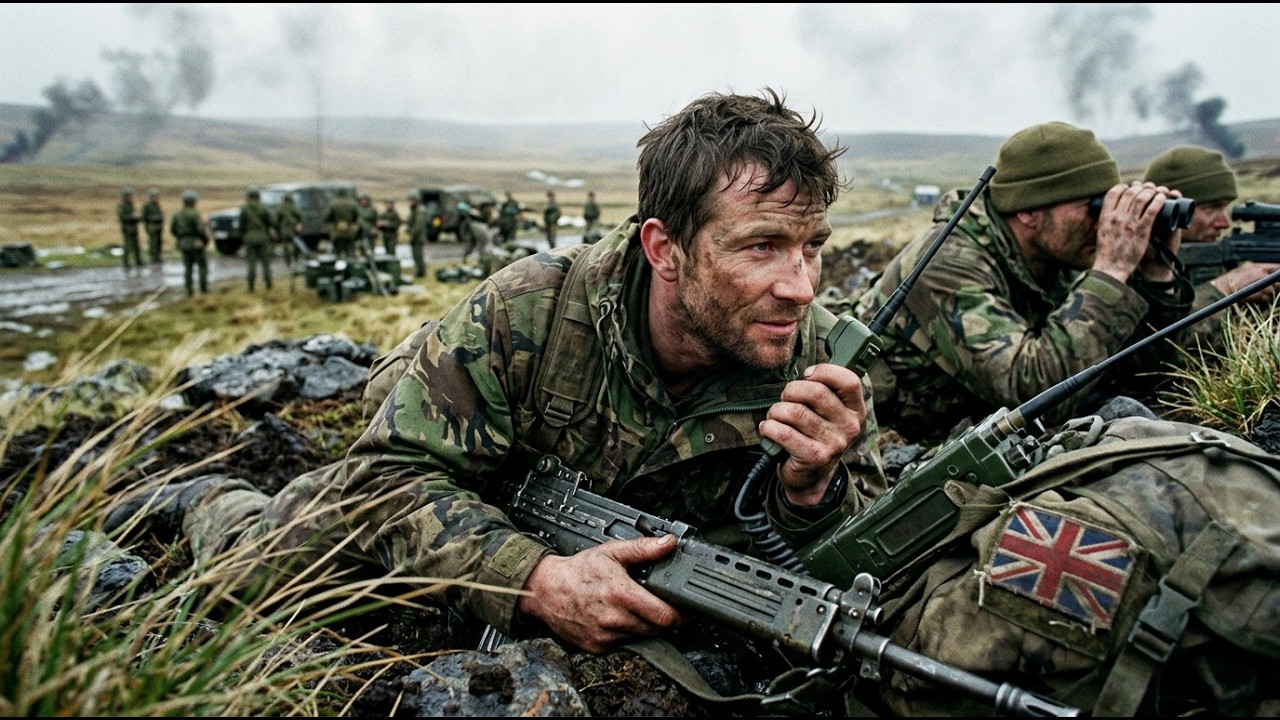
A specific operational protocol was established, one that would only become relevant if the mission went wrong in a very particular way. The protocol was simple. If any team was discovered and forced into radio silence, all further communication would cease immediately. No transmissions, no signals, nothing that could be used to triangulate their position.
But and this was the detail that made the protocol more than just a survival rule, if the commander of Alpha team ever broke that silence and transmitted anything on the operational frequency, it would not be a call for help. It would be a trigger. A single transmission from Alpha’s commander meant that Bravo and Charlie were to attack their designated targets immediately, without waiting for further orders, without asking for confirmation.
It did not matter whether the words came over the encrypted operational net or over an emergency channel the Argentines could hear. After radio silence had been imposed, Alpha’s voice itself was the trigger. Whatever was happening to Alpha at that moment, the other two teams would treat that transmission as the green light to unleash coordinated fire on the Argentine positions they had identified from their sectors.
This was not an improvised escape plan. It was a deliberate tactical decision, thought through before a single boot hit the ground. The three teams were not just a reconnaissance force. They were a weapon, and the protocol defined exactly how that weapon would be fired. On the night of the insertion, helicopters flew low and fast over the black water, dropping each team in sequence, sector by sector.
The pilots kept the runs short and the approach angles unpredictable. There was no radio chatter. Each team hit the ground, moved away from the drop point immediately, and disappeared into the dark. 18 men, three sectors, 72 hours. The clock had started. What none of them could know yet was that the next 3 days would test every layer of that protocol in ways the briefing room had only imagined.
The terrain, the cold, and the enemy were already waiting. And somewhere in the central valley, Alpha team was moving toward the position that would decide whether the mission became an intelligence success or a disaster. For the first 2 days, everything went exactly as planned, which in special forces operations is never something you take for granted.
Alpha team moved through the central valley in near total silence, covering ground at night and going to ground before first light, staying still through the daylight hours in shallow observation posts scraped into the peat. The cold was relentless. The wind rarely stopped, and the Argentine military presence in the valley was heavier than initial estimates had suggested.
What the team found over those first 48 hours was significant. Artillery batteries positioned on elevated ground to the east, their firing arcs covering the most likely British approach routes from the coast. A command post established in a cluster of farm buildings roughly 12 km inland, with vehicle traffic and radio antenna arrays that made its function unmistakable.
Supply convoys moving along a gravel track that connected the Argentine positions in a rough line from north to south, predictable in their timing, which made them easy to watch and easy to document. Every observation went into the radio in short, encrypted bursts during the designated transmission windows. Coordinates, grid references, estimated troop strength, equipment types.
Back on the fleet, intelligence officers were building a picture of the Argentine defensive structure in West Falkland that had simply not existed before these teams went in. The picture was not yet complete, but it was already more detailed than anything available through aerial reconnaissance or signals intercept alone.
Bravo and Charlie teams, working in their respective sectors to the north and south, were feeding the same process. Three separate streams of ground-level intelligence flowing back to the fleet simultaneously, cross-referenced, verified, and built into targeting packages that the naval fire support teams would use when the time came. The mission was working.
Then the third day arrived. Alpha team had moved to a new observation post in the early hours before dawn, shifting position as protocol required to avoid establishing a pattern. The move was careful. It always was. But the valley floor in that section held patches of soft ground between the rock outcroppings, and six men moving in the dark, however carefully, leave traces that daylight makes visible.
A four-man Argentine patrol working a sweep pattern along the valley’s eastern edge found the traces mid-morning. Boot prints in the peat. A compression mark where a pack had been set down. Small signs, but unmistakable to anyone trained to read them, and whoever was running that patrol knew what they were looking at.
Alpha team, watching from their position less than 400 m away, saw the patrol stop. Saw the men crouch over the ground. Saw one of them raise his hand to stop the others and point. The commander of Alpha team had seconds to make a decision. The standard response in that situation was to abort, to break contact, move to the extraction point, and call for evacuation before the Argentines could bring up enough force to cut off the route out.
It was the conservative choice. It was the choice that preserved the lives of six men at the cost of leaving the mission incomplete. But the commander did not call for extraction. What he understood in those seconds, what he calculated with the speed and clarity that come from years of training in exactly these kinds of moments, was that the abort option carried its own risks.
Moving six men in daylight across open ground, away from a patrol that was already suspicious, would be difficult at best and catastrophic at worst. And beyond the immediate tactical question, there was something else. The protocol. Bravo and Charlie teams were in position. They had been transmitting. They had identified their targets. The Argentine command post, the ammunition supply point in the southern sector.