


Larry Nassar’s name is one that will forever be associated with one of the most disturbing betrayals of trust in modern sports history. Once celebrated as a leading expert in sports medicine, lauded by elite gymnasts and Olympians, his rise to prominence was built on decades of access and acclaim. But that same access would reveal a long pattern of abuse that left deep scars on hundreds of survivors. When the legal system finally held him accountable, the consequences were beyond legal penalties; they carried him into another world entirely — one that tested him in ways few outside prison can imagine.
When Nassar received his federal and state sentences in 2017, the weight of public outrage was immense. Survivors had come forward in numbers that shook the nation. Their testimonies, filled with courage and heartbreak, led to one of the most significant reckonings in American sports and legal history. Yet as the emotional and symbolic dimensions of the trial dominated headlines, what lay ahead for Nassar — the years behind bars — was a reality few understood. His punishment did not end with a verdict; in many ways, it continued and transformed in confinement.
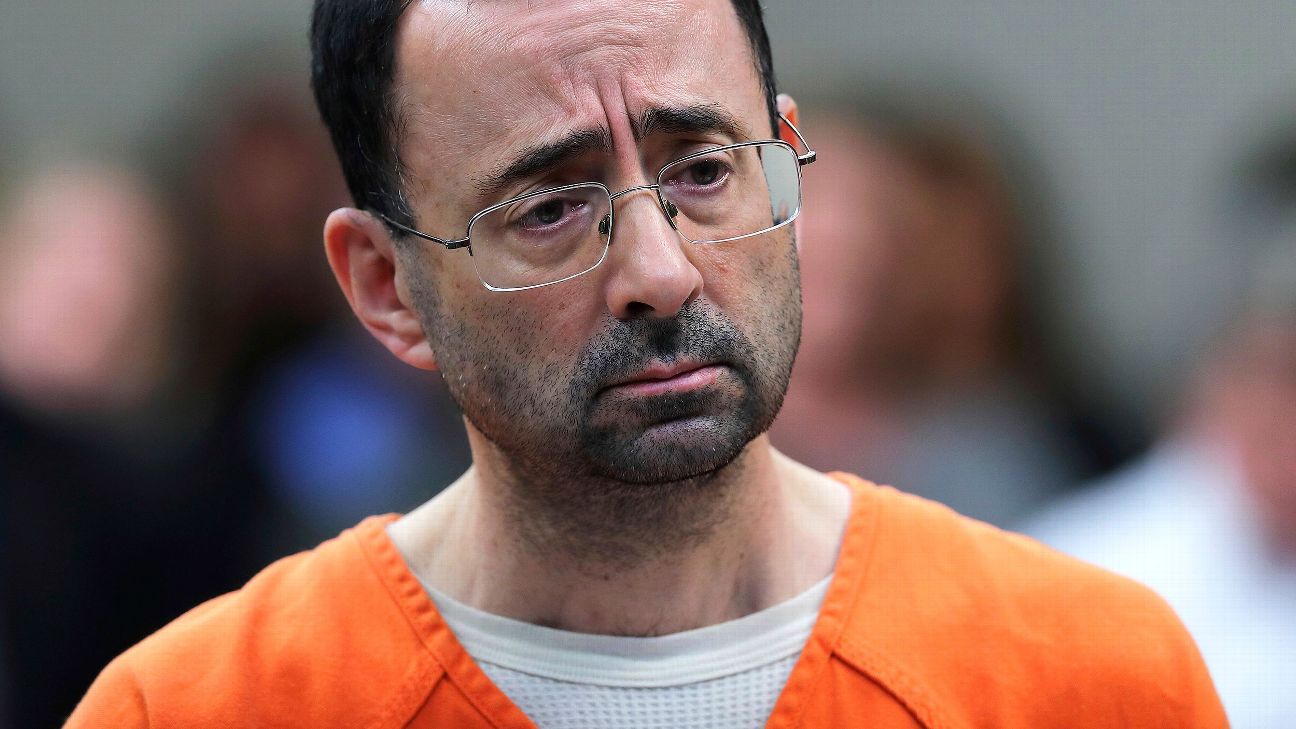
Upon his arrival at the federal facility where he would serve the first portion of his sentence, Nassar was confronted immediately with the starkness of prison life. There were no cheering crowds, no accolades, no certificates of achievement — only the heavy clang of metal doors and the austere geometry of cell blocks. The world he had known, where he was a respected figure with credentials and connections, receded instantly. In its place stood a different hierarchy, one governed by rules that operated without sportsmanship or fanfare.
His first moments inside were overwhelming. He was processed through intake, his personal belongings catalogued and removed, and given a standard‑issue jumpsuit that marked him as part of a system designed to erase individuality. For someone whose identity had long been bound up in professional success and personal autonomy, this loss of control was a jarring experience. Privacy, once taken for granted, was gone. Behind sealed doors and watched by cameras and guards, his life became a sequence of routines that left little room for reflection beyond the stark facts of incarceration.
In the early days, Nassar was acutely aware of how other inmates perceived him. Prison culture has its own set of unspoken codes about crimes and offenders, and those convicted of sexual abuse — especially against minors — are often regarded with contempt. This contempt manifests not only in quiet avoidance but in behaviors that signal a broader rejection, a refusal of association. Some inmates refused to share common spaces with him; others made it clear through unspoken gestures that he occupied a place far outside even the informal social norms of prison.

The physical architecture of the prison was imposing — long concrete corridors, steel railings, bleak lighting, and the constant echo of footsteps. Cells were small, functional spaces: a narrow bed bolted to the floor, a metal sink and toilet, and a small window that offered only a sliver of light. These rooms, designed for containment more than comfort, became both refuge and prison for Nassar. In these confined quarters, thoughts that might have been dismissed in the outside world crept into dominance. Days and nights blurred into one another, marked by the same routine motions and the same unyielding silence.
Sleep in prison is not restful. The walls transmit sound easily, and even the slightest disturbance — a distant shout, the clatter of metal, the crackle of a guard’s radio — can echo throughout the night. For Nassar, nights became a particular battleground of the mind. Without the distractions of daily life or the comforting presence of family and friends, his thoughts circled relentlessly. Memory merged with regret; the quiet of confinement amplified memories he could no longer suppress. The stillness that others might find peaceful only sharpened his sense of isolation.
Social interaction in prison is governed by necessity and caution. Inmates approach one another with guarded language and observant eyes, always calculating whether a new arrival is a threat, an ally, or simply someone to be ignored. For Nassar, conversations were rare and often strained. Many inmates kept their distance, not out of fear of physical confrontation, but because the stigma of his crimes created a chasm few were willing to cross. Silence became the default mode of communication around him — the absence of engagement as telling as any spoken rejection.
Meals, served in a communal dining area, were another test of presence among others. Rows of tables filled with men who weighed their own survival in subtle social calculations, it was here that Nassar felt the full intensity of avoidance. Empty seats around him were not random; they spoke of judgment, cultural codes, and a social desert no apology could cross. Even the mundane act of eating became an exercise in awareness — offering a constant reminder that he was seen differently and judged harshly by those around him.

Guards and correctional officers took on a distant neutrality. They were there to enforce rules and maintain order, but they were not sources of comfort or advocacy. They issued directives, conducted head counts, and enforced schedules. Meals at fixed times, recreation hours, mandatory counts several times a day — these rhythms gave structure to a life stripped of spontaneity. For some inmates, structure is a blessing; for others, it feels like the relentless ticking of a clock in a room with no windows.
Alongside daily routines came internal adjustments. Nassar had to adapt to a world where independence was limited and privacy was a luxury. Showering, dressing, sleeping — all were done in view of protocol and often under supervision. Even basic personal care followed the institution’s timetable, not his own. Old habits faded; new ones formed out of sheer necessity. Some inmates found solace in small rituals — reading, exercise, or simple stretches in a corner of the cell — moments that offered a semblance of control over an otherwise controlled existence.
As weeks turned into months, the psychological toll of confinement began to manifest more visibly. Prison officials observed shifts in his demeanor: increased reticence, a flattening of affect, or moments of introspection that went beyond normal adjustment. Some inmates simply withdrew, creating mental partitions between themselves and others. In Nassar’s case, solitude became both refuge and burden — protecting him from direct conflict but also exposing him to the full force of his own reflection.
Isolation exacts a subtle toll. Without meaningful connection, the mind seeks patterns in silence, and memories — both fragmented and vivid — begin to surface unfiltered. Nassar’s thoughts, once occupied with professional strategy and day‑to‑day engagements, now reverted to the deep, unresolved consequences of his actions. Each decision, each moment of his past that led him into conviction flickered in the quiet spaces between institutional routines. Regret, anger, mourning, and self‑reproach braided together in internal cycles that were difficult to break.
The psychology of punishment goes beyond bars and sentences — it enters the very architecture of thought. Prisoners carry the weight of identity in ways that go unnoticed by the casual observer. In Nassar’s case, the contrast between who he once was and who he became inside prison was stark. Once surrounded by resources, recognition, and professional respect, he now inhabited a world where every advantage was stripped away. No privileges remained, no deference given. Here, he was just another inmate — and in many ways, one the system was not designed to protect.
Amid the monotony and internal confrontation, vulnerabilities emerged. Sleep disturbances became persistent. Appetite fluctuated. Even exercise — a practice many inmates rely on for mental and physical release — took on a different quality. Instead of being a source of strength, it became another reminder of physical isolation: the sound of one person moving in an empty gym, the repetition of movements that once had purpose now serving only to fill time.

The prison yard offered limited respite. A fenced‑in space with a patch of cracked concrete and a distant view of sky, it became both a site of physical release and emotional exposure. Inmates wandered in small groups or alone, measured by their own needs for space and solitude. For Nassar, the yard was an arena of watchfulness; eyes were always aware of who was near, who was watching, who may silently judge. Even in open air, he carried the weight of his past with him, as though the sky above was too distant to bridge the gap between memory and presence.
While some inmates find ways to form bonds — conversations over shared stories, humor, or mutual interests — Nassar’s social landscape was different. Few were willing to offer genuine camaraderie, and attempts by others to engage were often met with caution or dismissal. It was not hostility in a physical sense that marked his prison experience; it was the emotional exclusion — the knowing silence of avoidance that made daily life feel like a series of walls within walls.
Mental health services in prison are limited and overstretched. Nassar had access to counseling, but the quality and depth of intervention were dictated by institutional constraints. Group therapy sessions offered space for risk management rather than emotional exploration. One‑on‑one appointments were brief and procedural. In a place where many inmates arrived with their own histories of trauma, addiction, or instability, the mental health system was inevitably overwhelmed, unable to fully address the layered psychological distress of individuals facing long‑term incarceration.
Letters from family offered intermittent solace. They arrived folded and stamped, words of encouragement mixed with updates from the outside world. These messages were beacons of connection, reminders that life beyond the walls continued. Yet every letter also carried a paradox: proof of love and care, but also evidence of separation, loss, and the distance he could no longer cross. Family pictures placed on the metal desk in his cell were small islands of warmth in a sea of gray.
Legal obligations continued alongside his prison routine. Appeals, notifications, and legal correspondence arrived in envelopes that punctuated the cadence of confinement. These reminders of ongoing processes drew him back into the world of legal realities — hearings, parole considerations, procedural updates. But for many inmates with long sentences, legal papers become a rhythm of anticipation and adjustment, a cycle of hope tempered by institutional inertia.
Time in prison bends differently. A day can feel like a week; a year can slip by unnoticed until an unexpected date on a calendar causes a sudden awareness of passage. Nassar moved through these years with an internal clock that counted routines rather than events, moments rather than milestones. Birthdays and holidays passed with muted acknowledgment, robbed of the rituals that once marked their significance.
When violence occurred in prison, as it inevitably does, it was rarely random. Confrontations, shoves, or fights often arose from tensions that had been simmering beneath the surface — disputes over space, noise, or perceived slights. Nassar observed these episodes from a distance, a silent participant in a world where alertness was survival and intervention was risky. Avoidance became his strategy: staying at the edge of conflicts, keeping clear of situations where social codes could misinterpret his presence.
And yet, in rare moments, small instances of normalcy emerged. A conversation about mundane topics — weather, food, a passing remark about outside news — could briefly lift the cloud of confinement. These moments were fragile; they dissolved as quickly as they arrived, reminding him that even fleeting normalcy was a gift in a world dominated by routine and survival.
Psychological strain did not ebb. Some days were battles for mental equilibrium, others exercises in endurance. Nassar grappled with his own conscience, memory, and sense of self. The person he had been — a confident, accomplished practitioner — was now submerged beneath years of consequence, reflection, and introspection. Shame and remorse were not neatly packaged emotions; they were landscapes he navigated daily, sometimes with clarity, often without.
When corrections officers conducted routine counts, it was a reminder of the hierarchy that governed prison life: authority figures who held the keys to movement, schedules, and access. There was no hostility in these interactions; it was simply the structural reality of incarceration. Yet every head count, every check, served as a reminder that freedom, as once known, was gone. His body moved but within boundaries, his presence was accounted for but always within institutional terms.
Years passed. The psychological cost of confinement accumulated like layers of sediment. What began as adjustment became deep introspection, an unending recollection of past choices and their irreversible consequences. Family members noticed the changes in his letters — shifts in tone, in focus, in the way he referred to himself and his situation. The external world continued to move forward, while his world remained largely unchanged, a cycle of days blending into one another with incremental variation.
As time unfolded, some inmates adapted better than others; some found strategies of survival that brought a semblance of inner calm. Others remained suspended in emotional drift. Nassar was neither entirely broken nor entirely whole. He occupied a precarious psychological terrain marked by awareness, regret, and the ongoing challenge of living with himself — in a place where forgetting was impossible and forgiveness was rarely spoken.
When he walked the corridors of the prison, heads turned with curiosity rather than malice. Some inmates whispered as he passed. Some looked away. Some treated him just like any other inmate. But the stigma of his crimes lingered — not as a rumor, but as an unmistakable context that shaped everything about how he was seen and how he moved through this world.
His life after sentencing was not marked by a single event that defined it. Instead, it was the accumulation of countless small moments — waking up, making his bed, walking to meals, receiving letters, sitting alone in his cell at night. And in those moments, layered with memory and consequence, the sentence became more than years counted on a calendar; it became a landscape of psychological and emotional confrontation that few get to witness from the inside.
Larry Nassar’s story after conviction was, in many ways, a continuation of public consequence in private confinement — a life lived under watchful eyes in a place where identity was no longer defined by accomplishment but by accountability and its long shadow. The world outside may debate whether prison is punishment enough or too much. What cannot be denied is that the reality within those walls is a crucible of mind and spirit, an unyielding environment where every day carries the weight of the past and the challenge of the present.
And as those years stretch and the pages of his life beyond the sentence continue to fill, a larger question remains — not just about justice and punishment, but about the hidden dimensions of confinement that few ever see. What does true accountability look like when every quiet moment is a reminder of loss? And in the silent corridors of a prison cell, will the deeper truths about consequence and redemption ever be fully understood — or will they remain part of a story still unfolding behind closed doors?