
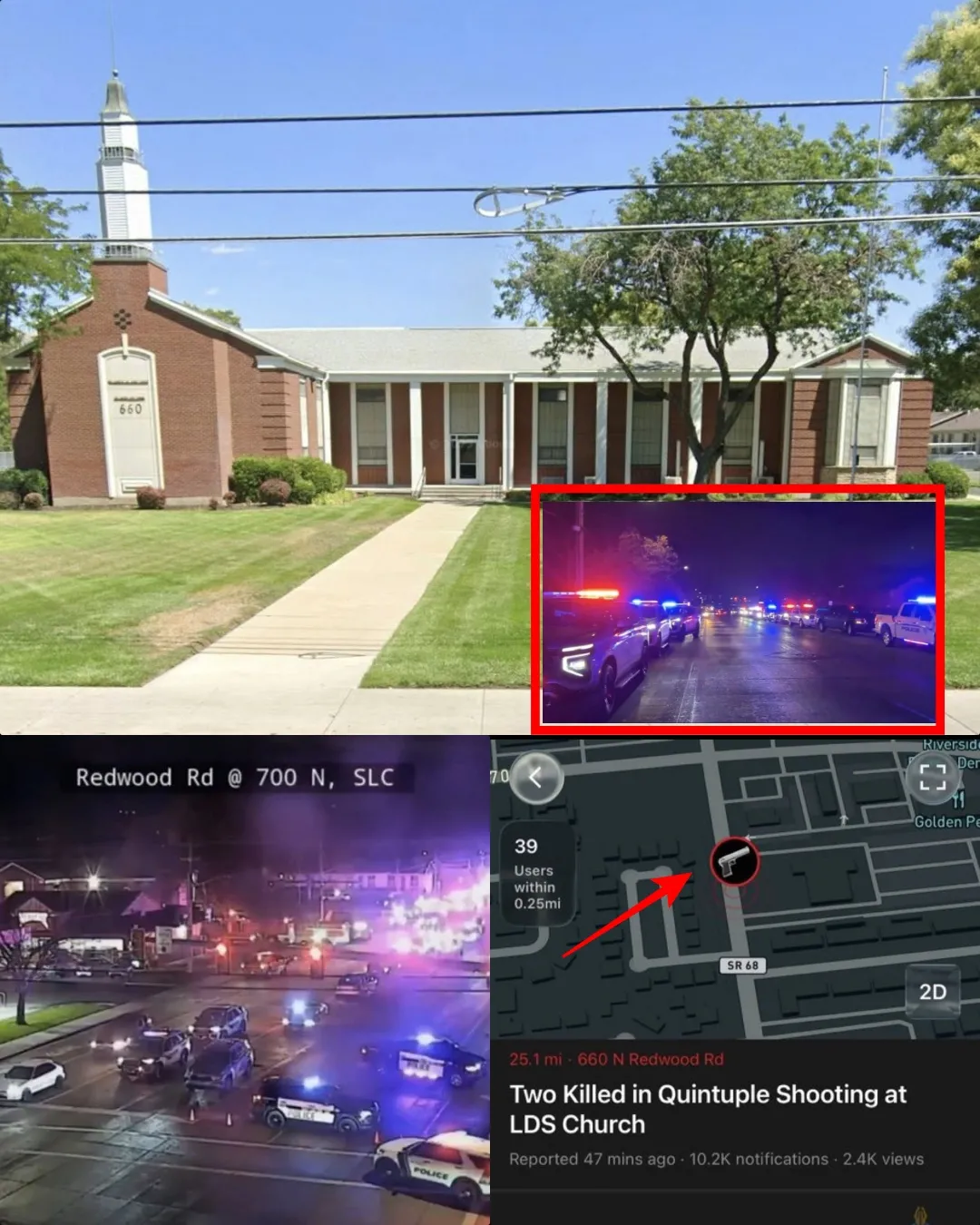
The quiet streets of Salt Lake City had settled into the typical rhythm of an early Wednesday evening. Residents went about their routines, some preparing dinners, others finishing up work, unaware that the night ahead would bring violence and grief into the heart of their community. Near 660 North Redwood Road, a church parking lot held a gathering of mourners attending a funeral service at a local Church of Jesus Christ of Latter-day Saints meetinghouse. It was meant to be a solemn evening of remembrance and reflection, a place where family and friends could honor a departed loved one.
The funeral had drawn a sizable crowd, with attendees spilling out into the parking area and adjacent streets. Cars lined the lot, and clusters of people exchanged quiet words, offering support and comfort. The atmosphere was subdued, but heavy with the emotion of loss. Some visitors carried flowers, others clutched tissues or held the hands of those nearest them, navigating the delicate balance between mourning and presence.
Around 7:36 p.m., what began as an argument among a few individuals in the parking lot suddenly escalated. Witnesses described the altercation as brief at first, with raised voices and sharp gestures. Conflicting accounts emerged almost immediately—some saying it was a dispute over parking, others suggesting personal tensions had boiled over. Regardless of the initial cause, the confrontation quickly intensified, culminating in the discharge of firearms.

Chaos erupted. The sound of gunshots shattered the evening calm, causing panic among the attendees. People screamed, ducked behind vehicles, and sought cover wherever possible. Mothers shielded children, friends pulled each other to the ground, and cars started to accelerate away from the scene in a desperate bid for safety. The sudden violence transformed the parking lot from a place of mourning into a scene of terror.
Police were notified almost immediately, though some victims were already transported to hospitals in private vehicles before first responders arrived. The initial reports were fragmented and harrowing: two confirmed fatalities, six others wounded, with three in critical condition and three others with injuries not immediately defined. Emergency medical teams converged on the scene, triaging victims, applying first aid, and coordinating rapid transport to local trauma centers.
Authorities quickly cordoned off the area, shutting down Redwood Road for several hours. Officers established a perimeter, ensuring that no one could enter or leave until the scene had been secured and evidence collected. Detectives, forensic teams, and crime scene analysts began methodically documenting the lot—photographing vehicles, shell casings, and any objects displaced by the chaos. Every detail, no matter how minor, was cataloged to piece together the sequence of events.

Witnesses were interviewed immediately, with officers taking detailed statements from those who had seen the altercation unfold. Many recounted moments of confusion, terror, and helplessness as the shooting began. Descriptions varied: some remembered a single suspect, others reported multiple individuals, while certain accounts highlighted vehicles leaving the scene at high speeds. These conflicting narratives would later become a critical part of the investigation.
Preliminary information suggested that the shooters fled north in a vehicle, but the type, make, and model had not yet been confirmed. Law enforcement canvassed nearby streets, seeking surveillance footage from businesses, homes, and traffic cameras. Analysts reviewed every frame, searching for clues that could identify the suspects or trace their movements before and after the shooting.
The potential involvement of gang connections emerged as a line of inquiry. Detectives noted that the level of organization and the timing could indicate ties to preexisting conflicts or rivalries. While investigators emphasized that no conclusions were drawn at the outset, the possibility influenced the collection of evidence and interviews with known associates in the area.
The large-scale response included patrol officers, SWAT units, detectives, and forensic specialists. Each team was assigned specific tasks: perimeter security, victim assistance, witness interviews, evidence collection, and intelligence gathering. Coordination between units was essential to manage both the physical safety of the public and the integrity of the investigation.
Victims were transported to nearby hospitals under careful supervision. Trauma teams worked around the clock to stabilize the critically injured, while medical staff coordinated with law enforcement to maintain accurate records of injuries and treatment. Hospital security was tightened to prevent unauthorized access and to preserve the chain of evidence related to gunshot wounds.

Meanwhile, community members gathered in nearby neighborhoods, some reporting sightings or suspicious activity to the authorities. Social media platforms quickly amplified the incident, with videos and photos from witnesses circulating widely. Law enforcement monitored these reports closely, verifying credible leads while warning the public against spreading unverified information that could compromise the investigation.
The fatalities prompted additional support for families affected by the tragedy. Victim assistance programs were mobilized to provide counseling, logistical support, and legal guidance. Officers liaised with family members to keep them informed without exposing them to unnecessary trauma. The dual focus on investigative rigor and human care reflected the complexity of responding to a mass casualty event.
Forensic teams began reconstructing the sequence of the shooting. Analysts examined bullet trajectories, positions of vehicles, and spatial arrangements of witnesses. Each shell casing was cataloged, ballistic tests were initiated, and investigators worked to match weapons with the evidence recovered. Early findings would later inform both the identification of suspects and the understanding of how the confrontation escalated into deadly violence.
The investigation also included interviews with church personnel and funeral organizers. Understanding the flow of attendees, access points, and security measures offered insight into how the shooters approached and left the scene. Patterns of movement within the parking lot, entry and exit behaviors, and the timing of the shooting were analyzed to reconstruct the sequence of events with precision.
Sheriff Javier Salazar emphasized the ongoing nature of the investigation, cautioning that details could change as new evidence emerged. Authorities made clear that arrests had not yet been made, and that anyone with information, no matter how minor, could assist in identifying the perpetrators. Public appeals encouraged vigilance and cooperation.
The incident had ripple effects across the community. Residents expressed shock and fear, grappling with the idea that violence could erupt at a place meant for reflection and mourning. Neighborhood meetings, counseling sessions, and public forums addressed both safety concerns and collective trauma. Mental health professionals worked alongside law enforcement to provide guidance on coping with the psychological impact.
Investigators reviewed prior reports of disputes or criminal activity in the area. Historical data on similar altercations, neighborhood gang activity, and regional conflicts were analyzed to contextualize the shooting. This holistic approach aimed to identify any connections that might explain the motive or anticipate further risks.
Digital forensics became an integral component of the investigation. Cellphone records, social media activity, and location tracking were analyzed to determine potential interactions between suspects, victims, and witnesses prior to the incident. Any evidence of coordination or planning would be critical to establishing premeditation.
The Bexar County Sheriff’s Office coordinated closely with federal partners, including the FBI, to pool resources, access broader databases, and apply advanced investigative techniques. The collaboration ensured that the pursuit of justice could proceed efficiently while covering all possible angles.
As the scene was processed, law enforcement noted the challenges of balancing public communication with operational security. Statements were carefully crafted to maintain transparency while avoiding the disclosure of sensitive tactical information that could compromise the investigation or public safety.
Community support efforts were extended to include local schools and youth programs. Counselors and law enforcement jointly offered sessions to help children and young adults process the event, addressing the sudden intrusion of violence into familiar environments.
Evidence collection also focused on vehicles involved in the incident. Tire tracks, paint residues, and traces of gunpowder were cataloged. Forensic analysis of these materials could link a vehicle to the shooting, helping to narrow down suspect identification and providing tangible proof for potential charges.
Witness statements were cross-referenced with physical evidence to reconcile differing accounts. Conflicting narratives were analyzed, and investigators used simulation and reconstruction methods to evaluate the most probable sequence of events. This methodology would inform both tactical understanding and legal strategy.
The shooting prompted broader discussions about public safety around places of worship and community gatherings. Authorities examined security protocols, lighting, and emergency response preparedness to mitigate risks in the future. Recommendations were planned to ensure that similar events could be prevented or more rapidly contained.
As the investigation unfolded, the community remained in a state of alert. Residents were encouraged to report suspicious activity and maintain situational awareness. Law enforcement emphasized cooperation and patience, recognizing that thorough investigation was essential to achieving justice.
The case remained open, with detectives and forensic teams continuing to analyze every detail—from ballistic evidence and witness accounts to digital records and vehicle tracking. Each lead was pursued diligently to identify the individuals responsible and to determine the motive behind the deadly confrontation.
The shooting outside the funeral in Salt Lake City marked a profound disruption to a community accustomed to calm and routine. Two lives were lost, six more were wounded, and a neighborhood that had gathered to honor life was left confronting death and uncertainty.
As authorities continue their work, one chilling question persists: Who exactly orchestrated the attack, and what hidden motives drove a moment of grief into chaos? The answers remain just out of reach, leaving a community anxious and a story still unfolding.