
Russia is attempting to flood Europe and the UK with illegal migrants in order to destabilise the EU and Britain, a Bulgarian minister has warned.
The country’s interior minister, Daniel Mitov, claimed Moscow was working with people smugglers to help them bring illegal migrants to the continent.
He also blamed “neo-Marxist groups” and warned British teenagers that they faced jail and fines if they try to help such organisations at the Bulgaria-Turkey border.
Illegal migrants now use this border to enter Europe more easily after it became the EU’s south-eastern external border when Bulgaria joined the EU’s Schengen area in January.
The nation will be among others from Europe attending a summit hosted in London by Sir Keir Starmer on Wednesday.
It is expected that a discussion will be held on the subject of closer co-operation on tackling illegal immigration through the western Balkans.
Mr Mitov said some charities and NGOs were “maybe unwittingly” assisting Russian and people smugglers through their actions.
He told The Times: “They are neo-Marxist groups which are trying to justify their actions through philosophical or ideological constructs.

Daniel Mitov blamed Russia for aiding people smugglers in getting illegal immigrants into Europe
“Basically, let’s get all the poor people from the world and let them establish themselves here, the absolute freedom of movement, the non-existence of borders and so on and so forth.
“So unfortunately, we do have challenges with such non-governmental organisations which, maybe unwittingly, take part in the operations of those hostile states and the criminal networks which smuggle people illegally into the territory of the EU and the UK.
“Illegal migration inflows are an instrument for hostile regimes to destabilise the European Union and the United Kingdom.
“They are aiming to destabilise the welfare systems. Plus, of course… through smuggling radicalised individuals, they create security issues for us.”
Russia is attempting to flood Europe and the UK with illegal migrants in order to destabilise the EU and Britain
REUTERS
Mr Mitov added that his nation needs strong borders as it had become “the gateway to Europe”, saying: “Not it is time to build a home and preserve our internal freedoms.
“Not a fortress but a home which needs walls. Every house needs walls.
“Those walls need to be solid and there are gates through which every guest can enter.”
Yvette Cooper, the Foreign Secretary, said: “It is clear that illegal migration into Europe and beyond is being driven not just by organised crime networks seeking to make a profit, but by hostile state actors seeking to destabilise Europe.”
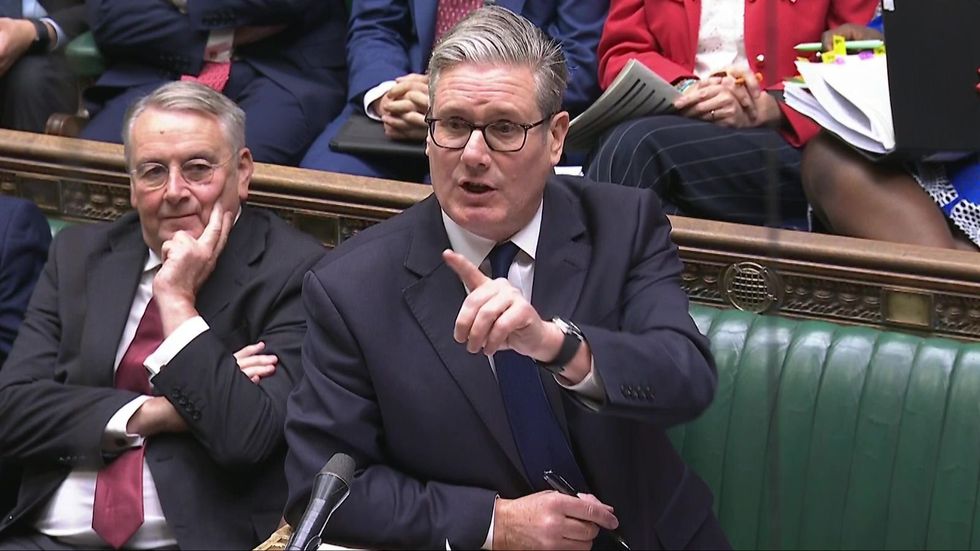
Sir Keir will try to further talks with several Balkan leaders on ‘return hubs’ during the summit on Wednesday
She added: “That threat is real, growing and very serious, and I have made clear that we need to expand and strengthen out international co-operation to tackle it together.
“We will therefore continue to support Bulgaria and our other Nato allies in securing Europe’s external frontiers, and tacking every different type of threat we face from the Putin regime, including providing the specialist equipment, intelligence and training that will help our Bulgarian counterparts to defend their borders and disrupt these criminal operations.”
It is also understood that Sir Keir will try to further talks with several Balkan leaders on “return hubs” during the summit on Wednesday.
The Prime Minister’s hope is for countries such as Kosovo, North Macedonia, Bosnia Herzegovina and several countries outside Europe to accept rejected asylum seekers in return for money and intelligence.
Russia ‘Flooding Europe and UK With Illegal Migrants’ in Attempt to ‘Destabilise the EU and Britain’
Russia has been accused of exploiting illegal migration as a political weapon in an attempt to destabilise Britain and other European countries. The explosive allegations, made by Bulgaria’s Interior Minister Daniel Mitov, have raised serious concerns about the growing threat posed by hostile foreign governments and organised criminal networks. According to Mitov, Russian intelligence services have established links with people-smuggling gangs to facilitate irregular migration into Europe, placing additional pressure on national borders, public services and political institutions.
The claims have reignited an already heated debate about immigration, national security and the ability of European governments to protect their borders. With Britain continuing to face challenges involving small boat crossings across the English Channel, the allegations could have significant implications for Keir Starmer’s immigration strategy and the country’s relationship with its European allies.
First of all, the accusations emerged ahead of an important international meeting in London, where European leaders were preparing to discuss ways of tackling irregular migration through the Western Balkans.
Daniel Mitov claimed that the Bulgarian government possessed evidence of direct connections between Russia’s foreign intelligence agency and criminal organisations involved in smuggling migrants across European borders.
He argued that illegal migration was being deliberately exploited by hostile governments to create instability within Western societies.
According to Mitov, the objective was not simply to encourage people to move between countries but to place additional pressure on public institutions, weaken confidence in governments and create political divisions.
He warned that uncontrolled migration could put considerable pressure on welfare systems while potentially creating additional security risks.
His comments were particularly significant because Bulgaria occupies an important geographical position along migration routes connecting Turkey, the Western Balkans and other European destinations.
The country has therefore become an important partner in European efforts to prevent people-smuggling networks from exploiting weaknesses along external borders.
Mitov’s allegations also reflect wider European concerns about Russia’s relationship with Belarus.
Belarusian President Alexander Lukashenko has previously been accused by Poland and other European governments of facilitating migrant movements towards the European Union’s external borders.
European authorities have alleged that Belarusian agencies encouraged people from countries in the Middle East and Africa to travel to Belarus by offering visas and transport arrangements.
Once migrants reached the border, Belarusian security personnel were accused of directing them towards Polish territory.
Poland described the situation as a deliberate attempt to weaponise migration and undermine European security.
The European Commission has also officially identified the actions of Russia and Belarus as part of a wider strategy to exploit migration flows and destabilise European societies. <Cite refs={[“turn375973search3″,”turn375973search12″,”turn375973news14”]}/>
These developments have increased fears that migration routes could be manipulated as part of a broader geopolitical strategy.
For Britain, the allegations are particularly concerning because the country continues to struggle with irregular crossings across the English Channel.
Thousands of migrants have attempted to reach the United Kingdom in small boats, often relying on dangerous journeys organised by criminal smuggling networks.
The British government has repeatedly promised to tackle these gangs, arguing that their activities undermine border security and put human lives at risk.
However, Mitov’s allegations suggest that the problem could extend beyond traditional criminal organisations.
If hostile foreign intelligence services are actively supporting people-smuggling networks, European governments may need to treat irregular migration as both an immigration challenge and a national security concern.
This would require closer intelligence cooperation, stronger border surveillance and more effective investigations into the financial networks supporting criminal operations.
The issue has also attracted attention from Britain’s political leadership.
Prime Minister Keir Starmer has repeatedly called for stronger international cooperation to combat people smuggling. His government has attempted to establish closer relationships with European countries to disrupt criminal networks operating across international borders.
The London summit was therefore an important opportunity to strengthen cooperation with countries along the Western Balkan migration routes.
Foreign Secretary Yvette Cooper also warned that irregular migration was being driven not only by criminal organisations seeking financial profit but also by hostile state actors attempting to destabilise Europe.
She described the threat as serious and growing, arguing that Britain needed to work more closely with international partners.
The UK has consequently offered support to Bulgaria and other NATO allies through specialist equipment, intelligence and training designed to strengthen border security.
British assistance has included cooperation involving drones, biometric technology and measures to identify fraudulent travel documents.
The objective is to improve the ability of authorities to identify suspicious movements and disrupt criminal organisations before migrants reach their intended destinations. <Cite refs={[“turn375973search0″,”turn375973search1”]}/>
Another important concern involves the possible involvement of humanitarian organisations.
Mitov suggested that certain non-governmental organisations could be unintentionally assisting people-smuggling operations through their activities.
He criticised groups that he believed were helping migrants cross borders illegally, arguing that their actions could indirectly benefit hostile governments and criminal networks.
However, these allegations are highly sensitive.
Humanitarian organisations have an important role in protecting vulnerable people, providing emergency assistance and preventing deaths along dangerous migration routes.
Several organisations named in reporting about the allegations strongly rejected suggestions that they were cooperating with smugglers. They maintained that their work was lawful and focused on protecting people in danger.
It is therefore essential to distinguish between humanitarian assistance and deliberate involvement in criminal smuggling operations. Any accusations of wrongdoing should be supported by evidence and investigated through appropriate legal procedures. <Cite refs={[“turn375973news11″,”turn375973search1”]}/>
Meanwhile, Russia has consistently denied Western accusations of deliberately destabilising European countries through covert operations.
Nevertheless, European governments have increasingly warned about a wider campaign of hybrid warfare involving cyberattacks, disinformation, sabotage and the exploitation of existing social divisions.
Migration could become another instrument within this strategy because it is already a politically sensitive issue across many European countries.
By exploiting disagreements about immigration, hostile governments could potentially deepen divisions between political parties and weaken public confidence in democratic institutions.
Britain has experienced intense disagreements over immigration policy in recent years. The arrival of small boat migrants has become one of the most controversial issues facing successive governments.
Conservative politicians and Reform UK leader Nigel Farage have repeatedly criticised Labour’s handling of border security, arguing that the government has failed to deliver effective control.
Farage has called for stronger deportation policies and more decisive action against criminal smuggling networks.
Meanwhile, Labour insists that international cooperation and intelligence-led enforcement are necessary to address the problem.
The Russian allegations could strengthen arguments for treating border security as an essential part of national defence rather than simply an administrative immigration issue.
However, governments must also avoid making assumptions that every person arriving through an irregular route is connected to hostile foreign activities.
Many migrants are fleeing conflict, persecution, poverty or dangerous conditions in their home countries. Their individual asylum claims must be assessed fairly under the law.
The responsibility for investigating suspected foreign interference lies with intelligence agencies, police forces and other relevant authorities.
Another major issue is the financial pressure associated with irregular migration.
European governments spend substantial amounts of public money on border enforcement, asylum accommodation, processing applications and immigration administration.
If hostile governments deliberately encourage irregular migration, these costs could become an additional burden on already stretched public finances.
Britain must therefore improve its ability to identify criminal networks, prevent dangerous crossings and process asylum applications efficiently.
At the same time, European countries need a coordinated approach because smuggling organisations operate across international borders and can quickly change their routes when enforcement becomes stronger.
No individual country can solve the problem entirely on its own.
The allegations also demonstrate why cooperation between NATO members and European governments is increasingly important.
Sharing intelligence, improving border surveillance and coordinating investigations could make it more difficult for criminal organisations and hostile states to exploit weaknesses in national security systems.
Ultimately, the challenge is to protect national borders without abandoning humanitarian responsibilities or allowing political tensions to undermine democratic values.
In conclusion, Bulgaria’s accusations that Russia is helping people-smuggling networks flood Europe and Britain with illegal migrants have raised serious questions about the relationship between immigration and national security. Interior Minister Daniel Mitov believes hostile governments are exploiting irregular migration to place pressure on welfare systems, create security concerns and destabilise democratic societies. Although the allegations require careful investigation, previous developments involving Belarus and the European Union demonstrate why governments are increasingly concerned about the weaponisation of migration. Keir Starmer’s government must strengthen cooperation with European allies, improve intelligence sharing and take effective action against criminal smuggling networks. At the same time, legitimate asylum claims and humanitarian responsibilities must continue to receive appropriate protection. As geopolitical tensions increase, Britain and its European partners must remain vigilant against attempts to exploit migration for political purposes while ensuring that their border policies remain fair, effective and lawful.