
The streets of Belfast and Derry/Londonderry descended into chaos this week as anti-immigration protests escalated into widespread violence, evoking memories of the region’s troubled past. Crowds numbering in the thousands clashed with riot police, leaving hospitals overwhelmed with injured officers and civilians, shops looted, vehicles set ablaze, and makeshift barricades burning through the night.
The unrest, which began in smaller towns like Ballymena last summer but has now spread to Northern Ireland’s two largest cities, reflects deep-seated frustrations over immigration policy, housing pressures, and rising crime that many residents attribute to unchecked arrivals. Protesters, many masked and hooded, chanted slogans demanding an end to what they call “hotel takeovers” — the use of local accommodations to house asylum seekers — and voiced fears for the safety of women and girls amid reports of knife attacks and street harassment.
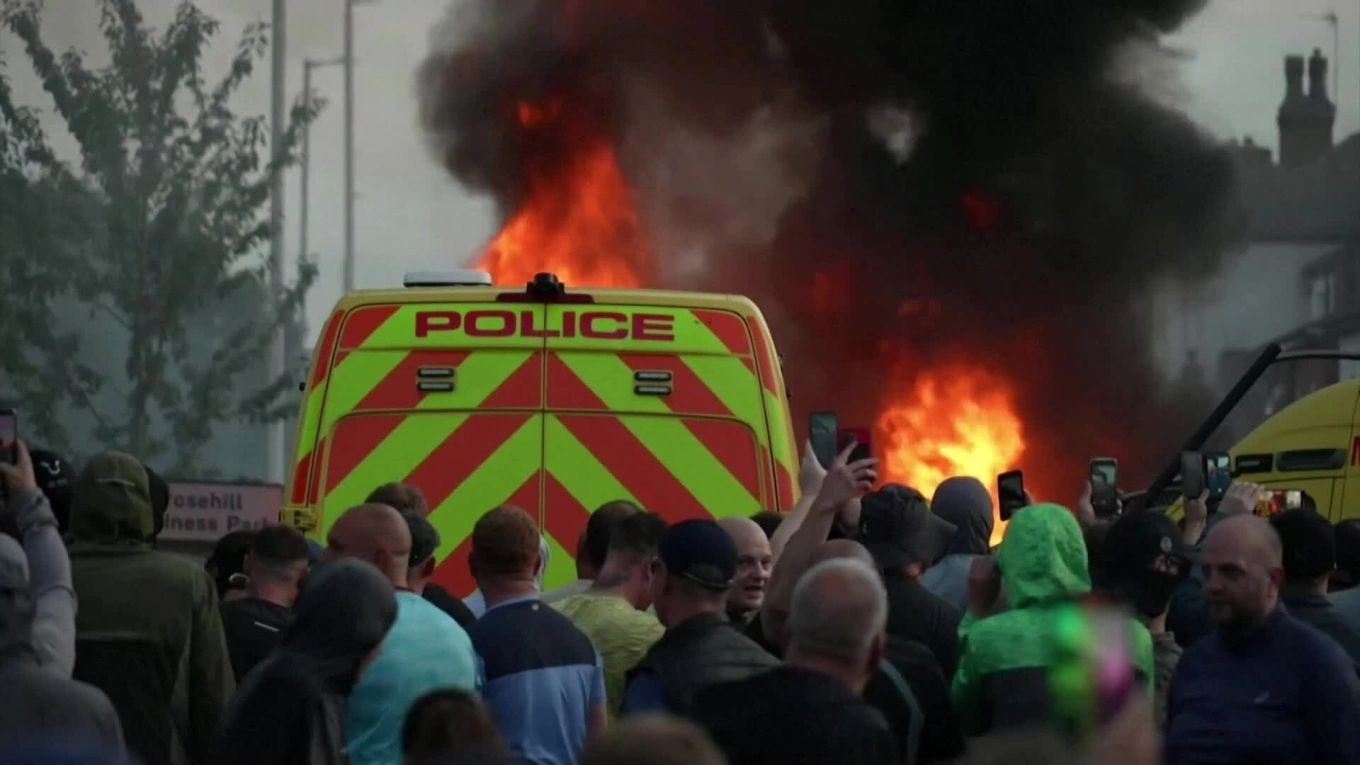
In Belfast, scenes unfolded near key thoroughfares and residential areas where armored police vehicles faced volleys of bricks, petrol bombs, and fireworks. Water cannons were deployed to disperse crowds as fires lit up the night sky. Witnesses described families barricading their homes while elderly residents expressed unprecedented levels of fear. “I’ve lived through the Troubles, but this feels different — more unpredictable,” said one longtime resident in the Shankill area, speaking on condition of anonymity.
Derry saw similar disorder, with reports of burning barricades blocking roads and confrontations spilling into neighborhoods. Police reported dozens of arrests, multiple injuries among officers, and significant property damage. Hospitals in both cities treated scores of casualties, including fractures, burns, and head injuries from thrown objects.
The spark for the current wave appears tied to months of accumulated grievances. Social media footage — now viral — shows young men in balaclavas confronting lines of riot police, while others loot stores amid the confusion. Authorities have pointed to a pattern of anti-immigrant sentiment that has simmered since earlier outbreaks in 2025, when riots in Ballymena forced many Roma families to flee after an alleged sexual assault case involving two Romanian teenagers (charges were later dropped). That incident, combined with ongoing use of hotels for asylum accommodation, fueled perceptions of government inaction.
Critics argue the violence taps into broader anxieties about small-boat crossings across the Irish Sea and perceived failures in border control, even as official statistics show asylum numbers in Northern Ireland remain relatively low compared to other UK regions. The Police Service of Northern Ireland (PSNI) condemned the disorder as “racist thuggery” and warned of potential paramilitary involvement, a concern echoed in recent government reports highlighting links between loyalist groups and anti-immigrant actions.
Northern Ireland Secretary has called for calm and promised a review of immigration housing policies, but protesters dismissed such statements as empty. “They’ve been promising control for years while boats keep coming and crime climbs,” one demonstrator told local media outside a Belfast hotel previously used for asylum seekers.
Community leaders expressed alarm at the intensity, drawing uneasy parallels to the sectarian violence of decades past. Pubs across affected areas stood empty as people stayed indoors, and some neighborhoods saw self-organized patrols — raising fears of vigilante justice.
Human rights groups condemned the targeting of migrants and minorities, noting that the vast majority of arrivals are fleeing persecution and pose no threat. “This is mob rule fueled by misinformation,” said a spokesperson for the Committee on the Administration of Justice. “It traumatizes entire communities and solves nothing.”
As dawn broke over smoldering streets, cleanup crews moved in amid heavy police presence. Yet many residents fear the rage is far from spent. With tensions high and social media amplifying calls for further action, Northern Ireland faces a precarious moment — one that tests not only law enforcement but the fragile peace the region has worked so hard to maintain
NORTHERN IRELAND EXPLODES – MIGRANT CRISIS TURNS STREETS INTO WARZONE!
Violent unrest, mounting public anger, and growing tensions over immigration have placed Northern Ireland under an intense spotlight, raising urgent questions about community safety, government accountability, and the increasingly fragile relationship between migration policy and social cohesion.
Northern Ireland is facing renewed scrutiny as tensions surrounding immigration, community relations, and public safety threaten to deepen existing divisions. What should be a serious national conversation about migration and integration has become an increasingly emotional debate, with concerns about street disorder, public confidence, and the ability of authorities to maintain peace dominating discussions.
The dramatic phrase “streets into warzones” captures the intensity of public anxiety, but it also raises an important question: is Northern Ireland approaching a dangerous turning point, or are political tensions and sensational reporting making an already complicated situation appear even more explosive?
Across the region, immigration has become a politically sensitive issue. Communities are debating housing pressures, access to public services, employment opportunities, cultural integration, and the responsibilities of government. These concerns have created an atmosphere in which individual incidents can quickly develop into much larger political confrontations.
However, it is essential to distinguish between verified incidents of violence, peaceful demonstrations, and inflammatory claims circulating online. Not every protest represents widespread disorder, and migrants as a group cannot be held responsible for the actions of individuals.
A REGION UNDER GROWING PRESSURE
Northern Ireland has a distinctive political and social history. Its communities have experienced decades of conflict, division, and difficult efforts to establish lasting peace. Consequently, any development that threatens public order can carry particularly serious consequences.
Immigration has added another dimension to conversations about identity, belonging, and the future of local communities.
For some residents, concerns focus on the availability of affordable housing, pressure on healthcare services, educational resources, and the capacity of local authorities to support a growing population. Others worry about whether integration programmes are sufficiently effective and whether government policies are keeping pace with demographic changes.
These issues deserve serious attention from political representatives.
When residents believe their concerns are being ignored, frustration can grow. If public institutions fail to communicate clearly or respond effectively, rumours and misinformation can fill the information vacuum.
The result can be a cycle of distrust in which communities become increasingly suspicious of one another.
PROTESTS, ANGER, AND THE RISK OF ESCALATION
Public demonstrations over immigration and local community concerns have the potential to attract significant attention, particularly when tensions are already high.
Peaceful protest is a democratic right. Residents must be able to express concerns about government decisions, immigration policy, and local services without being automatically labelled extremists.
At the same time, violence, intimidation, attacks on property, and threats against individuals cannot be justified as legitimate expressions of political frustration.
The distinction matters enormously.
When demonstrations descend into disorder, ordinary residents, shopkeepers, workers, and families are often among those who suffer the greatest consequences.
Businesses may be forced to close, public transport can be disrupted, and residents may feel unsafe travelling through areas where confrontations have occurred.
Migrants and minority communities can also become targets of hostility, even when they have no connection to the events that triggered public anger.
The authorities therefore face a difficult responsibility: protecting the right to peaceful demonstration while preventing violence and ensuring that everyone is treated equally under the law.
THE MIGRATION DEBATE: WHAT IS REALLY DRIVING PUBLIC FRUSTRATION?
The situation cannot be understood simply by blaming migration.
Northern Ireland, like other parts of the United Kingdom, faces complicated economic and social challenges. Housing shortages, pressure on public services, rising living costs, and regional inequalities have developed over many years.
Immigration can influence demand for housing, schools, and healthcare, but these pressures also depend on government investment, infrastructure planning, employment conditions, and the availability of public resources.
Blaming an entire migrant population risks distracting attention from the decisions and structural problems that require political solutions.
A credible immigration strategy must address several important questions.
How many people can public services realistically support? Are local councils receiving sufficient funding? Are housing developments keeping pace with population growth? Are language and integration programmes effective? Are immigration rules being enforced fairly and consistently?
These are legitimate questions that deserve transparent answers.
The public should not have to choose between supporting vulnerable migrants and demanding better services for established residents. A responsible government should be capable of addressing both.
FEARS OF COMMUNITY DIVISION
One of the greatest dangers facing Northern Ireland is the possibility that immigration becomes another source of entrenched community division.
The region’s history demonstrates how quickly political disagreements can become deeply rooted social conflicts. Although the circumstances surrounding contemporary immigration debates are different from the historical conflict, the importance of protecting community relations remains undeniable.
When people begin to view their neighbours through the lens of nationality, religion, or ethnicity, trust becomes increasingly difficult to maintain.
Migrant families who have settled in Northern Ireland may include healthcare workers, business owners, students, construction workers, and children attending local schools.
They are individuals with different experiences, beliefs, and aspirations.
Likewise, local residents who express concerns about immigration should not automatically be portrayed as hostile towards foreigners. Many simply want reassurance that public services are functioning, neighbourhoods are safe, and government policies are being implemented effectively.
The challenge is to create space for both concerns without allowing discrimination or intimidation to become acceptable.
POLITICAL LEADERS FACE DIFFICULT QUESTIONS
The controversy places considerable responsibility on Northern Ireland’s political leadership.
Residents need more than statements condemning violence after incidents occur. They need credible policies addressing the underlying causes of public frustration.
Political leaders must explain how immigration decisions are made, how public services are funded, and what support is available to communities experiencing rapid demographic change.
They must also demonstrate that law enforcement is impartial.
Anyone committing violence or threatening others should face appropriate legal consequences, regardless of nationality, religion, or political affiliation.
Equally, individuals must not become victims of harassment simply because they are migrants or belong to minority communities.
A failure to maintain this balance could undermine confidence in public institutions and create further opportunities for extremist voices to exploit social tensions.
SOCIAL MEDIA: FUEL ON AN ALREADY SENSITIVE FIRE
Another major concern is the influence of social media.
Videos of confrontations, photographs of damaged property, and emotionally charged commentary can spread rapidly online. Sometimes these materials provide valuable evidence of genuine incidents. In other cases, footage may be taken out of context, incorrectly dated, or accompanied by misleading descriptions.
False information can intensify fear and encourage retaliation.
A video showing violence in one location may be presented as evidence of a nationwide crisis. An isolated incident may be portrayed as proof that an entire community is dangerous.
This environment makes responsible reporting especially important.
Before sharing dramatic claims, members of the public should establish when and where an incident occurred and whether reliable sources have independently confirmed it.
Journalists and political commentators also have a responsibility to avoid presenting speculation as fact.
Sensational headlines may attract attention, but inaccurate reporting can have real consequences for people living in already tense communities.
WHAT HAPPENS NEXT?
The future of community relations in Northern Ireland will depend heavily on how authorities and political representatives respond to public concerns.
First, public safety must remain the immediate priority. Police and local authorities must respond proportionately to disorder, protect vulnerable residents, and prevent further escalation.
Second, government representatives must engage directly with communities. Residents need opportunities to discuss housing, healthcare, immigration, integration, and local infrastructure without intimidation or political manipulation.
Third, immigration policy must be transparent and consistent. The public deserves clear explanations of legal processes, asylum responsibilities, enforcement decisions, and the resources available to local authorities.
Finally, community leaders must work to prevent hostility from becoming normalised. Peaceful disagreement is part of democracy, but collective blame and violence undermine the very communities that political debate is supposed to serve.
A WARNING NORTHERN IRELAND CANNOT IGNORE
Northern Ireland’s current immigration debate represents a serious test of political leadership, social responsibility, and public confidence.
The region cannot afford to allow frustration over public services or disagreements about immigration to develop into widespread hostility between neighbours.
Residents deserve safe streets, functioning public services, affordable housing, and confidence that their concerns are being taken seriously. Migrants and minority communities deserve protection from discrimination, threats, and violence.
These principles are not contradictory. They are essential foundations of a stable society.
The real question is whether political leaders can move beyond inflammatory headlines and deliver practical solutions before distrust becomes even more deeply embedded.
Northern Ireland has already experienced the devastating consequences of prolonged division. Its future depends on protecting the peace, strengthening community relationships, and ensuring that disagreements are resolved through democratic institutions rather than intimidation.
The streets should never become battlegrounds between communities. The priority must be restoring public confidence, establishing the facts, enforcing the law fairly, and addressing the genuine problems facing residents.
Because the greatest danger is not simply a crisis of immigration policy. It is the possibility that fear, misinformation, and political division could destroy the trust that communities need to live together peacefully.