
What unfolded on live television was framed by many viewers not as a debate, but as an irreversible rupture between media power and individual reputation.
In this fictionalized media storm, the words “You defamed me on live TV” became more than anger, transforming into a rallying cry echoing across British social platforms.
The broadcast, watched by millions, was later described by supporters as an ambush rather than an exchange of ideas.


To critics, however, it was simply journalism doing what it does best: challenging controversial figures in public view.
That divide is where the fire ignited.
According to the viral narrative, a £50 million lawsuit was prepared, aimed directly at one of Britain’s most respected broadcasters.
The allegation was severe: calculated defamation disguised as civic discourse.
In this fictional account, legal representatives argued that reputations can be destroyed in minutes when power and narrative align on live television.
They claimed the damage was not accidental, but systemic, amplified by silence from those who could have intervened.
The phrase “character assassination” dominated headlines, not because of its legal precision, but because of its emotional weight.
Supporters argued that live broadcasting creates an uneven battlefield where accusation travels faster than rebuttal.
Once spoken, words cannot be edited out of public memory.
In this scenario, the host became a symbol rather than an individual, representing institutional authority and editorial responsibility.
That symbolism intensified the reaction.

Calls for accountability spread rapidly, with online voices demanding to know where journalism ends and reputational harm begins.
Others pushed back, warning that lawsuits against broadcasters risk chilling free speech and robust debate.
This tension lies at the heart of modern media democracy.
Can public figures demand protection from reputational harm while engaging in controversial discourse.
Or does visibility come with unavoidable exposure.
The fictional lawsuit narrative suggested an aggressive legal strategy, extending beyond presenters to producers and executives.
This broadened the story from personal grievance to institutional reckoning.
Media insiders whispered that such a case, if real, could reshape how live political programs manage confrontation.
The fear was not about losing money, but about losing editorial courage.
Supporters of the fictional plaintiff framed the move as resistance against what they view as elite narrative enforcement.
They argued that broadcasters wield disproportionate influence over public perception.
Influence, when unchecked, becomes power.
Power, when abused, invites backlash.

Critics countered that controversial figures often weaponize victimhood to silence scrutiny.
From this perspective, the lawsuit narrative appeared less about justice and more about intimidation.
Both interpretations thrived simultaneously online.
Social media rewarded certainty over nuance, pushing the most dramatic framing into trending feeds.
Memes reduced complex legal concepts into punchlines.
Comment sections became courts of public opinion, delivering verdicts long before any judge could.
This fictional case exposed how trust in media has eroded across ideological lines.
Many viewers no longer believe broadcasters act as neutral moderators.
Instead, they see agendas, omissions, and selective outrage.
Whether true or not, perception now shapes legitimacy.
The BBC, in this imagined storm, stood as a proxy for institutional credibility itself.
Every defense was scrutinized.
Every silence interpreted.
Meanwhile, supporters framed the legal threat as long-overdue resistance against reputational monopoly.
They argued that live television offers no meaningful right of reply once the moment passes.
Opponents warned that punishing broadcasters for tough questioning risks sanitizing public discourse.
Democracy, they argued, is not comfortable.
The fictional narrative thrived because it mirrored broader cultural anxiety.
Anxiety about who controls truth.
About who gets to define legitimacy.
About whether media still serves the public or shapes it.
The £50 million figure mattered less than what it symbolized.
It represented defiance.
Escalation.

A refusal to absorb reputational damage quietly.
Legal experts in the narrative cautioned that defamation law is complex, especially involving public figures.
Intent, context, and public interest all collide in unpredictable ways.
But complexity rarely goes viral.
What goes viral is conflict framed as war.
“This wasn’t journalism, it was execution” became a slogan, not a legal argument.
Slogans travel faster than statutes.
As the story spread, Westminster insiders speculated about political fallout.
Not because of the case itself, but because of what it revealed about public trust.
Trust once broken does not return easily.
The fictional confrontation reignited debate over the ethics of live broadcasting.
Should producers intervene when exchanges turn destructive.
Or does intervention itself distort authenticity.
There are no easy answers.
The imagined lawsuit became a vessel for unresolved questions about media responsibility in an age of polarization.
It forced audiences to confront their own role as consumers of outrage.
Every share amplified pressure.
Every comment hardened positions.
In the end, the fictional storm mattered less for its legal outcome than for its cultural impact.
It reminded Britain that television is no longer just information.
It is power.
Performance.
And sometimes, a battleground.
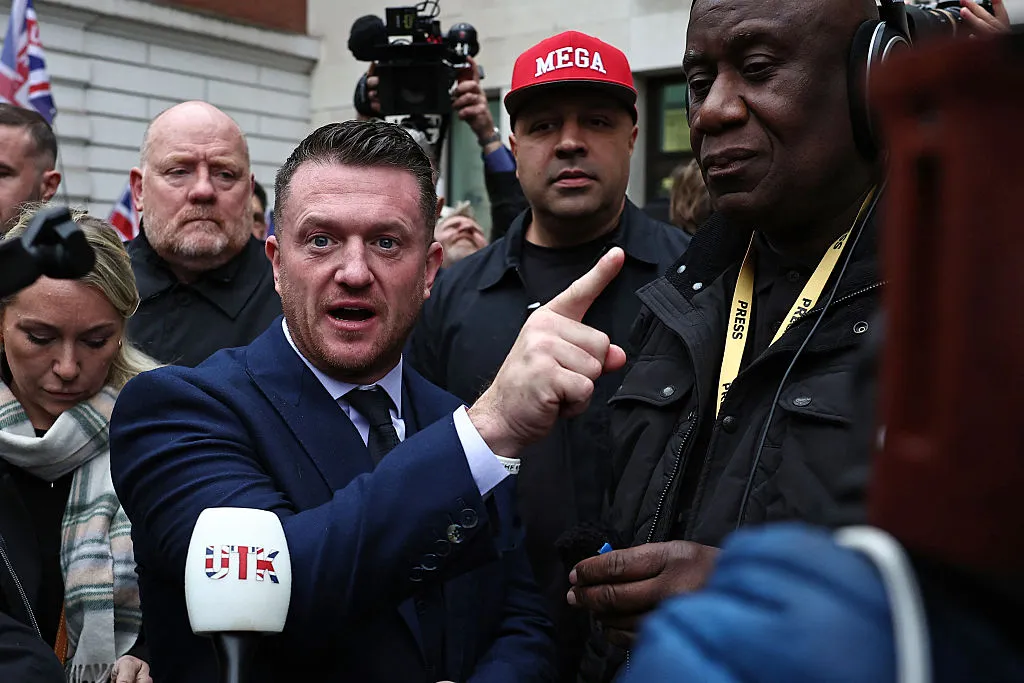
Whether one sees the plaintiff as victim or provocateur depends entirely on prior belief.
That dependence reveals the deeper fracture beneath the spectacle.
A fracture not between left and right, but between trust and suspicion.
As the narrative continues to circulate, one thing remains clear.
In the digital age, reputation can be challenged in seconds.
And defending it can shake institutions to their core.
The story may be fictional.
But the tension it reflects is painfully real.
TOMMY ROBINSON LAUNCHES £50 MILLION LEGAL ATTACK ON BBC’S QUESTION TIME AND FIONA BRUCE AFTER ALLEGED ON-AIR CLASH
Claims that controversial activist Tommy Robinson is preparing a £50 million legal attack against the BBC and Question Time presenter Fiona Bruce have circulated widely online, sparking debate about media accountability, freedom of speech and the treatment of controversial political figures.
The alleged dispute is being presented as a dramatic confrontation between Robinson and one of Britain’s most recognisable broadcasters. However, there is an important detail: there is currently no verified evidence that a £50 million lawsuit has actually been filed or that the alleged on-air confrontation happened as described.
THE ALLEGED BBC SHOWDOWN
According to viral online reports, Robinson believes his reputation was unfairly damaged through an alleged exchange connected with BBC’s Question Time.
Some versions of the story claim that the activist is seeking substantial compensation, accusing the broadcaster of damaging his reputation in front of a national television audience.
Fiona Bruce has also been named in the circulating allegations.
However, the websites promoting the story have not provided a verified broadcast recording, court documents or an independently confirmed legal statement establishing these claims.
WHY IS THE BBC FACING SCRUTINY?
The controversy touches on a much wider debate about the BBC’s responsibility when presenting controversial political discussions.
Question Time regularly features heated exchanges involving politicians, commentators and members of the public.
Its presenters must balance challenging questions with accuracy, fairness and the opportunity for participants to respond.
Critics of the BBC have repeatedly questioned its impartiality, while supporters argue that robust questioning is an essential part of democratic broadcasting.
These are legitimate issues for public discussion, regardless of whether the alleged Robinson lawsuit exists.
COULD TOMMY ROBINSON REALLY WIN £50 MILLION?
Under English defamation law, a claimant must establish serious harm to their reputation, alongside the other relevant legal requirements.
The Defamation Act 2013 also provides important protections, including defences involving truth, honest opinion and publication on matters of public interest.
A demand for £50 million would not automatically mean that a court would award that amount.
More importantly, there is currently no verified court filing establishing that Robinson has brought the reported case against the BBC and Fiona Bruce.
ROBINSON’S OWN HISTORY WITH DEFAMATION LAW
The controversy is particularly notable given Robinson’s previous involvement in defamation proceedings.
In 2021, Syrian schoolboy Jamal Hijazi successfully sued Robinson over false allegations published about him.
The High Court ruled against Robinson, and subsequent proceedings resulted in his imprisonment for contempt of court after breaches of the injunction.
That history does not prevent Robinson from bringing a legitimate legal claim in another matter, but it demonstrates why evidence and accurate reporting are essential when discussing defamation.
CONCLUSION: FACTS MATTER MORE THAN VIRAL HEADLINES
The alleged £50 million legal battle involving Tommy Robinson, the BBC and Fiona Bruce has generated considerable online attention.
However, the central claims remain unverified. No reliable evidence currently establishes that the reported lawsuit has been formally filed or that the alleged television confrontation occurred.
The broader debate about BBC impartiality, freedom of expression and media accountability remains important.
But a dramatic headline should never be confused with an established legal case.
Until court documents or reliable confirmation emerge, the reported £50 million lawsuit should be treated as an unverified online claim rather than confirmed breaking news.