
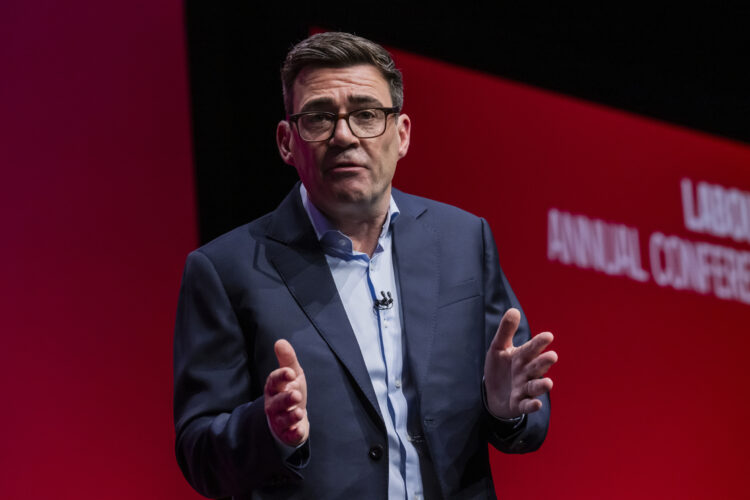
A snap poll has found that the public seem to generally be in favour of Andy Burnham’s major announcement about the triple lock on pensions.
One of the headline announcements from Burnham’s conference speech on Tuesday was his plans to scrap the triple lock, which currently means that the state pension increases each year by either 2.5%, inflation or average earnings growth, whichever is higher.
Whilst Labour will stick by their manifesto pledge to protect the triple lock in this parliament, Burnham’s proposals would see it reformed from April 2030, should Labour be in power after the next general election.
This would see the state pension rise every year by either the rate of inflation or 2.5%, whichever is higher. This ‘double lock’ would mean the state pension rises at a slower rate, saving the treasury billions.
Burnham said this money would then be put towards funding a National Care Service which would make social care free at the point of use.
Following the announcement, that has sparked criticism from both left and right wing voices, YouGov carried out a snap poll to see if people were in favour of the policy.
They found that almost half of the public (48%) supported the proposal, with 28% opposed.
Meanwhile, a quarter of Brits didn’t know what they thought about the policy yet.
In his speech on Tuesday, Burnham said that from 2030 the state pension will “continue to rise every year at least by prices or 2.5%.
He continued: “And it will hold its value relative to earnings over time so that pensioners will always share in the rising prosperity of the nation.
“This change will generate significant savings, which we will use to build up our own National Care Service.”
He added that he “may pay a political price” for the change, but “someone has to go through the pain barrier and rip the plaster off”.
Almost Half of Brits Support Burnham’s Proposal to Scrap Triple Lock to Fund National Care Service
Almost half of the British public support Prime Minister Andy Burnham’s proposal to reform the state pension triple lock in order to help fund a new National Care Service, according to a YouGov opinion poll published in September 2026. The proposal has sparked an important debate about pensioners’ financial security, the future of Britain’s social care system and how the government should pay for public services as the population continues to age.
The survey found that 48 per cent of respondents supported Burnham’s proposal, compared with 28 per cent who opposed it. The remaining respondents were either undecided or did not express a clear opinion. The findings suggest that many Britons are willing to consider changes to pension arrangements if the money saved is used to provide better care for older people and vulnerable adults.

What Is the Pension Triple Lock?
The triple lock is a government guarantee designed to protect the value of the UK state pension against inflation and rising living costs. Introduced in 2011, it ensures that the state pension increases annually by whichever is highest among three measures: inflation, average earnings growth or 2.5 per cent.
The policy has been particularly important for pensioners because it helps prevent their income from losing purchasing power over time. Many older people depend heavily on the state pension to pay for essential expenses, including food, housing, heating and healthcare.
However, maintaining the triple lock has become increasingly expensive for the government. As Britain’s population ages, the number of people receiving state pensions continues to increase, placing additional pressure on public finances.
Burnham argues that the current system needs to be adjusted to ensure that Britain can afford both adequate pensions and a comprehensive social care system.
Under his proposal, the existing triple lock would remain in place until April 2030. After that, pension increases would be linked to whichever is higher between inflation and 2.5 per cent, removing the separate earnings-growth element. The government has also said that pensioners should continue sharing in the country’s rising prosperity through a new mechanism that maintains pension values relative to earnings over time.
This means that the proposal is not simply about freezing pensions or eliminating annual increases. Instead, it would change the way pension increases are calculated, potentially reducing the government’s long-term expenditure.
The savings would then contribute towards establishing a National Care Service. <Cite refs={[“turn216710search2″,”turn216710news7”]}/>
A National Care Service for an Ageing Population
<AsyncImage query=”UK elderly care home professional caregiver helping older person” aspectRatio=”16:9″ width=”100%”/>
One of the central objectives of Burnham’s proposal is to transform Britain’s social care system.
For many years, social care has been one of the most difficult challenges facing successive British governments. Thousands of older people require assistance with everyday activities, including washing, dressing, eating and moving around their homes. However, access to professional care can depend heavily on personal financial circumstances and local authority resources.
Unlike NHS healthcare, which is generally free at the point of use, adult social care in England is often subject to financial assessments. Individuals with savings or income above certain thresholds may have to contribute substantially towards their care costs.
This creates considerable anxiety for older people and their families. Some individuals worry that they will have to use their lifetime savings or sell their homes to pay for residential care.
Burnham wants to introduce a National Care Service that would provide personal care free at the point of use for people who need it, regardless of their ability to pay.
The proposed system would be introduced gradually, allowing the government to develop the necessary workforce, infrastructure and financial resources.
The government has appointed Baroness Louise Casey to lead an independent commission examining how the service should operate and how it could be funded. Her recommendations are expected in summer 2027.
Burnham has argued that reforming social care is essential not only for older people but also for the future of the NHS. When patients cannot receive adequate support at home, they may remain in hospital longer than medically necessary, placing additional pressure on hospital beds and emergency departments.
A properly funded National Care Service could therefore improve the coordination between healthcare and social care while helping people maintain greater independence.
What Does Public Opinion Tell Us?
The YouGov survey provides an interesting insight into how British voters view the proposed changes.
When respondents were asked about establishing a National Care Service that would provide free personal care at the point of use, 74 per cent supported the idea, while only 11 per cent opposed it.
Support was relatively strong across political groups. Between 82 and 85 per cent of Labour, Liberal Democrat and Green voters supported the creation of the service. Support also reached 68 per cent among Conservative voters and 65 per cent among Reform UK voters.
When the pension reform was considered separately, 43 per cent supported changing the triple lock to a double lock, compared with 30 per cent who opposed the change.
However, when respondents were told that the savings would help fund the National Care Service, support increased to 48 per cent, while opposition remained at 28 per cent.
The differences between political groups were also revealing. Approximately 66 per cent of Labour voters supported the combined proposal, compared with 67 per cent of Liberal Democrat voters and 58 per cent of Green voters. Support was lower among Conservative voters, at 37 per cent, and Reform UK voters, at 27 per cent. <Cite refs={[“turn216710search0”]}/>
These findings suggest that the public’s attitude towards pension reform depends partly on what the government intends to do with the money saved.
Why Some People Oppose the Proposal
Despite the relatively positive polling results, Burnham’s announcement has generated criticism from pensioners’ organisations, trade unions and political opponents.
The main concern is that changing the triple lock could weaken the financial protection enjoyed by older people.
For many pensioners, the state pension represents their principal source of income. Even relatively small changes to annual increases could have significant consequences over time, particularly for individuals who have limited savings or no occupational pension.
Critics also argue that the government should explore alternative sources of funding before reducing the generosity of pension arrangements.
Some have suggested increasing taxes on wealth, closing tax loopholes or reforming other areas of public expenditure. They believe that older people should not bear the financial burden of addressing weaknesses in Britain’s social care system.
Sharon Graham, general secretary of the Unite union, has also criticised the proposal, warning that changing the triple lock could create serious political difficulties for Labour.
There is also uncertainty about whether the proposed savings will be sufficient to establish a comprehensive National Care Service. Building a nationwide system would require significant investment in facilities, staff training, wages and long-term care provision.
Consequently, the government will need to provide convincing financial evidence showing how the proposed changes would translate into sustainable improvements in social care.
The Financial Challenge Facing Britain
The debate takes place against the background of Britain’s ageing population and growing pressure on public finances.
As life expectancy increases, more people require support during retirement. At the same time, the proportion of working-age people contributing taxes relative to the number of pensioners is changing.
This creates a difficult challenge for governments attempting to maintain generous pension arrangements while financing healthcare, education, housing and other public services.
According to the financial analysis discussed by Reuters, the government’s proposed reform could generate substantial long-term savings. Labour estimates that the changes could save approximately £15 billion annually by the late 2030s and potentially £50 billion by 2050. However, these are projections rather than guaranteed savings, and independent analysts have questioned how quickly the benefits would materialise. <Cite refs={[“turn216710news7”]}/>
Burnham’s approach therefore reflects a broader debate about intergenerational fairness.
Younger workers face high housing costs, insecure employment and concerns about whether they will receive adequate pensions when they retire. Meanwhile, older generations need protection against poverty and rising living costs.
The government must find a balance between these competing responsibilities rather than allowing one generation to carry an unfair share of the financial burden.
Labour’s Political Challenge
The proposal also represents a significant political challenge for Burnham and the Labour Party.
The triple lock is a popular policy among pensioners, an important voting group in British elections. Any attempt to modify it could create dissatisfaction, particularly among people who believe that they have contributed throughout their working lives and deserve secure retirement incomes.
Burnham has acknowledged that the decision could carry a political cost. Nevertheless, he argues that politicians must sometimes make difficult long-term decisions rather than postpone necessary reforms.
His proposal also provides Labour with an opportunity to demonstrate that it is addressing a longstanding weakness in Britain’s social care system.
However, the government must be transparent about how much money will be saved, how the National Care Service will operate and whether the proposed funding will be sufficient.
Without clear guarantees, voters may question whether changing pension arrangements is a reasonable price to pay for a service whose precise structure and long-term costs have not yet been established.
Conclusion
Andy Burnham’s proposal to adjust the pension triple lock in order to help fund a National Care Service has opened an important debate about Britain’s economic priorities and social responsibilities.
The YouGov findings show that 48 per cent of Britons support the combined proposal, compared with 28 per cent who oppose it. Support for a National Care Service itself is considerably higher, reaching 74 per cent.
These figures indicate that many people recognise the importance of improving social care and are prepared to consider changes to existing pension arrangements to help achieve that objective.
Nevertheless, the concerns of pensioners must not be overlooked. The state pension provides essential financial security for millions of people, and any reform must protect those who are most vulnerable to poverty.
Ultimately, the success of Burnham’s proposal will depend on whether the government can deliver a genuinely accessible and financially sustainable National Care Service without undermining the living standards of older people.
The challenge is not simply to decide whether Britain should spend more on pensions or social care. It is to create a system in which older citizens can enjoy financial security, dignity and access to high-quality care when they need it most.