
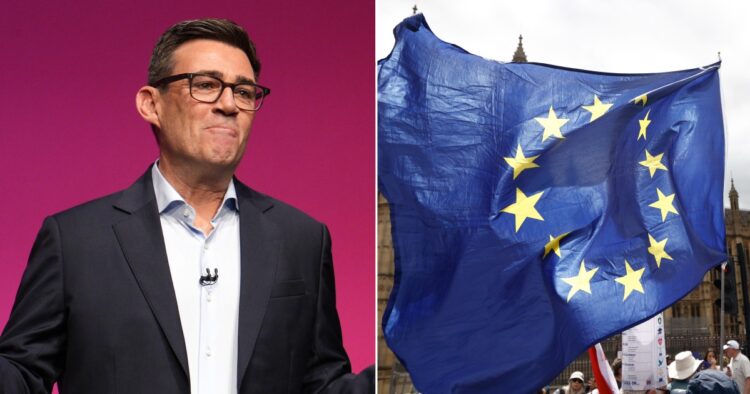
The leaders of France and Spain have said they would be more than happy to welcome the UK back to the European Union.
This week, Andy Burnham gave the strongest hint of any prime minister since Brexit that the UK could rejoin the EU.
In his Labour conference speech on Tuesday, Burnham said Brexit had caused “more harm than good” and he would look for a new consensus on what Britain’s relationship with the EU should be.
He told the conference: “We will not give Britain the clear path we need into the rest of this century until we decide on a long term relationship with what is still our largest market.”
Burnham went on to say that at a UK-EU summit later this year he would “lay out to the country what I believe the different options are for Britain’s long term relationship with our European partners.”
This seemed to hint at the possibility that Brexit could be reversed in some form or another.
The following day, Burnham confirmed that all options were on the table in terms of Britain’s future relationship with the EU, including ‘going all the way’ and reversing Brexit.
The comments are the latest evidence that Burnham and Labour are edging their way towards putting a pledge to rejoin the EU in the party’s next manifesto.
The idea has been welcome by French president Emmanuel Macron and Spanish prime minister Pedro Sanchez, who both seemed more than happy about the UK potentially returning to the trading bloc.
In a joint press conference this week, Macron said “welcome back” when he was asked about a potential ‘Breturn’, adding: “If the British want to come back and if the prime minister is moving in that direction, I think that is very good news both for his country and for Europeans.”
He then said: “Come back!”
Macron said Burnham was right to have the “boldness” to suggest a Brexit reversal.
The French president said the UK had “always been useful in helping us simplify things” when part of the EU.
Sanchez said Spain would ”open its arms to a brotherly people.”
He described Brexit has a “huge loss, both for the British population and for the whole European project”, adding that he would “applaud” if the UK chose to rejoin.
France and Spain Say They’d Welcome UK Back to EU With ‘Open Arms’ as Brexit Debate Intensifies
France and Spain have indicated that Britain would be welcomed back into the European Union with open arms, adding fresh momentum to the growing debate about whether the UK could eventually reverse its decision to leave the bloc.
The comments are likely to attract considerable attention in Westminster, particularly as support for closer relations with Europe appears to be increasing among sections of the British public.
Almost a decade after the 2016 Brexit referendum, Britain’s relationship with the European Union remains a controversial political issue. While supporters of Brexit continue to defend the decision as an important restoration of national sovereignty, critics argue that leaving has damaged the economy, weakened Britain’s international influence and created unnecessary barriers for businesses.
Now, with senior Labour figures increasingly willing to discuss the possibility of rejoining, positive signals from France and Spain could strengthen the argument that Britain’s return to Europe is not an unrealistic prospect.
For Nigel Farage and Reform UK, however, the prospect of Britain returning to the EU would represent a major political challenge.
France and Spain Open the Door to Britain’s Return
The suggestion that Britain could eventually return to the European Union has received a positive response from political figures in France and Spain.
Both countries recognise the importance of maintaining strong relations with Britain, which remains one of Europe’s most significant economic, military and diplomatic powers.
France has long maintained that Britain remains an important European partner, despite the political consequences of Brexit.
Spain has also expressed support for strengthening relations between London and European capitals, particularly in areas involving trade, security and economic cooperation.
The suggestion that Britain could be welcomed back with open arms represents a significant change in the political atmosphere surrounding Brexit.
For years, the discussion focused largely on how Britain and the EU could manage their relationship following the referendum.
Now, attention is increasingly turning towards whether Britain might eventually seek to restore full membership.
However, a warm political welcome should not be confused with a guarantee of automatic membership. Any British application would still require a formal negotiation and unanimous approval from all 27 existing member states.
Brexit Continues to Create Economic Challenges
One of the biggest reasons behind the renewed discussion about rejoining is the continuing economic debate surrounding Brexit.
When Britain voted to leave the European Union in June 2016, supporters promised that the country would regain control over its laws, borders and trade policy.
They also argued that Britain would be able to negotiate independent trade agreements and develop a more flexible economic model.
However, businesses have faced additional administrative requirements when trading with European countries.
Exporters have had to deal with customs declarations, regulatory changes and additional paperwork.
Smaller businesses have often struggled to absorb these costs, while some industries have raised concerns about recruitment difficulties and reduced access to European workers.
Critics of Brexit argue that these problems demonstrate why Britain should reconsider its decision.
They believe returning to the European Union could improve access to European markets, encourage investment and restore closer economic cooperation.
Supporters of Brexit, however, maintain that Britain should concentrate on improving its domestic economy rather than reversing the referendum result.
Andy Burnham Adds Pressure for a Fresh Brexit Debate
The comments from France and Spain come at a time when Andy Burnham has reopened the question of whether Britain should eventually rejoin the European Union.
Burnham has argued that the possibility of returning to the EU should not be dismissed and that Britain needs an honest discussion about the long-term consequences of Brexit.
His intervention is significant because Labour politicians have traditionally been cautious about reopening the membership question.
Following the 2019 general election, Labour leadership recognised that Brexit remained a sensitive issue among voters in many traditionally Labour-supporting communities.
The party subsequently attempted to move beyond the referendum argument and focus on improving Britain’s relationship with Europe without immediately pursuing membership.
However, changing public attitudes and continuing economic concerns have encouraged some politicians to adopt a more open approach.
Burnham’s comments suggest that the debate may be entering a new phase.
Rather than treating Brexit as a settled question, politicians are increasingly being asked whether the current arrangement is delivering the economic and political benefits promised to voters.
Nigel Farage Would Strongly Oppose a Return to Europe
Few politicians would be more concerned about the prospect of Britain rejoining the European Union than Nigel Farage.
The Reform UK leader spent decades campaigning against European integration and was one of the most recognisable figures behind the Brexit movement.
He repeatedly argued that Britain should regain control over its laws, borders and political decisions.
For Farage, Brexit was not simply an economic decision. It represented a fundamental question about national sovereignty and democratic accountability.
Consequently, any serious proposal to return to the EU would directly challenge one of the central achievements of his political career.
Farage would likely argue that rejoining would mean surrendering powers that Britain had fought to recover.
He could also point to the financial obligations and regulatory requirements associated with membership as reasons to remain outside the bloc.
Reform UK would almost certainly use the issue to mobilise Brexit supporters and portray Labour politicians as attempting to reverse the democratic decision made in 2016.
However, the changing political climate could make that argument more difficult if public dissatisfaction with Brexit continues to increase.
Could Britain Rejoin Before 2035?
The possibility of Britain returning to the European Union within the next decade has attracted growing attention from bookmakers and political commentators.
Recent betting markets have suggested that rejoining before 2035 is a realistic, although far from certain, possibility.
However, there are substantial obstacles.
Under Article 49 of the Treaty on European Union, a country seeking membership must submit a formal application and negotiate with existing member states.
Britain would need to demonstrate that it met the necessary membership requirements.
The European Commission would assess the application, while the European Parliament and all 27 existing member states would have important roles in approving the process.
The terms of Britain’s membership would also need to be negotiated.
It cannot be assumed that the UK would automatically recover all the special arrangements it enjoyed before Brexit.
Questions involving the euro, financial contributions, freedom of movement and regulatory obligations would need to be addressed.
The process could therefore take several years, particularly if disagreements emerged between Britain and individual European governments.
Nevertheless, the positive comments from France and Spain suggest that Britain would not necessarily face a hostile reception.
Why Britain Still Matters to Europe
There are also strong reasons why European countries might welcome Britain’s return.
The UK remains one of Europe’s largest economies and possesses significant military, diplomatic and intelligence capabilities.
Its financial services industry, universities, technology sector and international trade networks remain important to the wider European economy.
Britain also plays a major role in European security, particularly through its military cooperation with France and other NATO members.
Although Brexit changed the institutional relationship between Britain and the EU, it did not eliminate the need for cooperation.
European governments continue to recognise that Britain is an important partner when dealing with international security threats, economic instability and geopolitical tensions.
A return to membership could potentially strengthen Europe’s international influence.
It would also bring another major economy into the EU’s decision-making structures.
For France and Spain, therefore, a future British return could offer significant political and economic advantages.
Would British Voters Actually Support Rejoining?
Although the comments from France and Spain are encouraging for supporters of European integration, the most important question remains whether British voters would support returning.
The 2016 referendum produced a narrow majority for leaving, but public attitudes have changed considerably since then.
Many voters who supported Brexit have become dissatisfied with the economic consequences.
Others believe the country should remain outside the EU but develop a closer trading relationship.
There is also a younger generation of voters who were either too young to participate in the referendum or have entered the electorate since Britain left.
For these voters, the political arguments surrounding Brexit may look very different.
However, dissatisfaction with the current arrangement does not automatically translate into support for full EU membership.
Questions about immigration, national sovereignty and financial contributions could still divide public opinion.
Any government considering rejoining would therefore need a clear democratic mandate.
Labour Faces a Difficult Political Decision
For Labour, the debate presents both an opportunity and a potential political risk.
Supporters of closer European integration may welcome the prospect of Britain eventually returning to the EU.
They believe Labour should be more ambitious about rebuilding relations with European partners.
However, there are also Labour voters who supported Brexit and remain strongly opposed to reversing the referendum result.
The party cannot afford to ignore those voters.
If Labour moves too quickly towards full membership, it could create political divisions and provide Reform with an opportunity to attack the government.
On the other hand, refusing to discuss the possibility of rejoining could alienate voters who believe Brexit has damaged Britain’s economy.
The government must therefore balance the benefits of closer European relations against the political consequences of reopening one of the country’s most divisive debates.
Conclusion: France and Spain’s Welcome Could Reignite Britain’s European Future
The suggestion that France and Spain would welcome Britain back into the European Union with open arms represents an important development in the continuing Brexit debate.
Their positive attitude suggests that the possibility of British membership has not disappeared from European political thinking.
For supporters of rejoining, the comments provide encouragement that Britain could eventually rebuild its relationship with the EU and restore its position within the European project.
For Nigel Farage and Reform UK, however, the prospect presents a significant challenge to the political arguments that helped drive Brexit.
Andy Burnham’s willingness to discuss rejoining has also demonstrated that the issue is returning to mainstream political debate.
Nevertheless, a warm welcome from France and Spain does not mean that Britain’s return is guaranteed. Any application would require lengthy negotiations, unanimous approval from all member states and a clear democratic mandate from the British public.
Almost ten years after the referendum, Britain is still dealing with the consequences of its decision to leave.
Whether the country eventually returns to the European Union remains uncertain, but the latest comments suggest that Europe’s door may not be as firmly closed as some Brexit supporters once believed.